Sea Days on the Azamara Journey AKA Boris and the Showgirl

sunrise on the Azamara Journey. ©Jean Janssen

sunrise on the Azamara Journey.
©Jean Janssen

Ah, sea days.  Some cruisers don’t like them.  But in my opinion, sea days are what put the vacation in a cruise.  Otherwise, you will just go home more tired and sunburned than when you left.  We have quite a few sea days (6) on the Spice Route on the Azamara Journey.

I learn a lot of things on sea days.  (On ships that have them) the self-service laundry rooms are the place to get the most gossip-per one of the ship’s officers.  We like the enrichment series lectures that usually take place on these days.  Sometimes they are educational dealing with the history, economy, and culture of the places we are visiting or purely fun like discussing the investigation around Marilyn Monroe’s death.  You can learn how to play bridge, built a ship, play darts, surf, or ice skate (among other things).
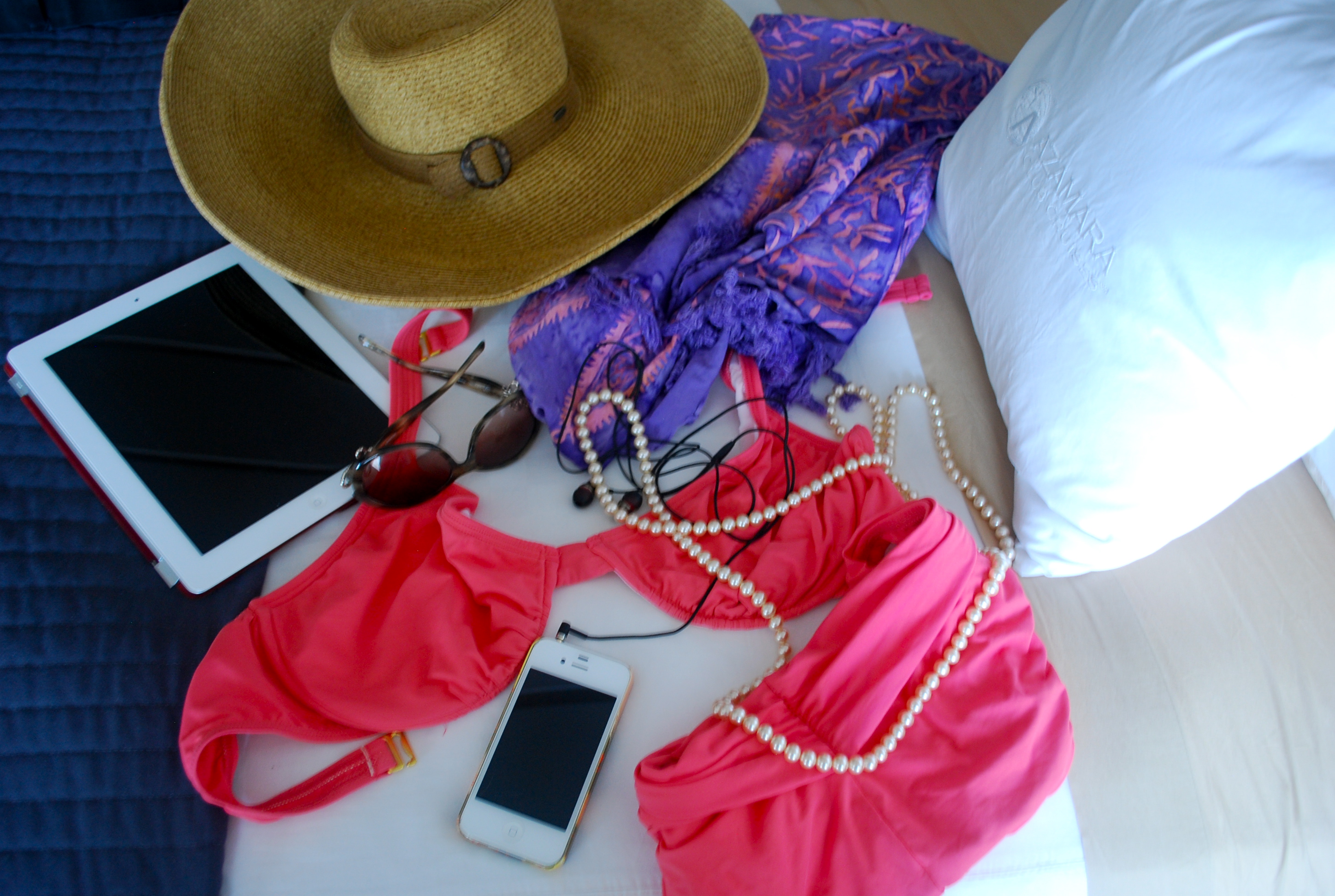
Considered adding pearls to my pool bag but decided against it. ©Jean Janssen

Considered adding pearls to my pool bag but decided against it.
©Jean Janssen

I am usually a pool princess on sea days, but with temperatures in the 90s F (30s C) my sun exposure has been limited.  The breeze just isn’t enough to compensate for the high temps.  It’s a pity too because the Azamara Journey has wonderful cushions on their lounge chairs, so it would be a perfect place to spend an afternoon or take a nap.  It is casual of course, although I did see one woman go into the pool wearing her pearls.  (I saw her at the pool three times and she was always wearing her pearls.

Charisa is one of the singers on the Azamara Journey.  She used to perform at Hollywood Studios and The Magic Kingdom at Walt Disney World.  She ran many of the trivia games that Boris attended.  He liked to refer to her as the showgirl. ©Jean Janssen

Charisa is one of the singers on the Azamara Journey. She used to perform at Hollywood Studios and The Magic Kingdom at Walt Disney World. She ran many of the trivia games that Boris attended. He liked to refer to her as the showgirl.
©Jean Janssen

Boris, of course is playing trivia.  He keeps comparing himself to Tiger Woods.  He is doing well again and has found a soul mate in Angela from Birmingham, England.  Between the two of them, they usually get a perfect score.  I am really not sure what the rest of the team does; no one actually asks them their opinion.  Charisa, a young blonde who is also one of the singers/dancers on the ship, runs some of the games.  When she told Boris that she would like to be on his team and that he needed to come to the show (which she probably tells many of the guests), he came running to tell me that we had to go or Charisa (who he refers to as a showgirl) would be upset.  He had the decency to blush when I told the Barnes that story.

Of course it wouldn’t be a sea day without the extra special food options like Tea Time and Gala Brunches.  We also signed up for a Chef’s Table Experience on one of the early sea days.  It is a seven-course dinner with wine pairing organized by one of the sommeliniers and it limited to 10 guests.  A senior officer hosts this specialty dinner.  The head chef visits your table at the beginning of the evening and the specialty restaurant chef comes to introduce each course.  Our dinner had an Italian theme for the food and wine pairings (although we began with a champagne).  We had a fabulous time and made some new friends, Frank and Janet, at the dinner.

Frank and Janet are from just north of London; they are fun and funny.  They hunt for sun or a pool in each of our ports.  They always find the spot with the best spa deals.  Frank, who is a judge, told us a wonderful story of going to get a new pet.  When he picked out his new kittens, the 40ish attractive woman owner thought she knew him, and he her.  By the time he went back to pick up the kittens a few days later after the kittens had gotten their shots, he had remembered where he knew her from.  Apparently she had too.  The money/kitten exchange was very quick.  No one mentioned the first meeting when she had been in from of him for solicitation.

Theo, on the left, was one of the senior officers on the Amazara Journey who served gelato on the pool deck to guests.  There is a lot of interaction between the officers and guests, the most I have ever seen on a cruise ship. ©Jean Janssen

Theo, on the left, was one of the senior officers on the Amazara Journey who served gelato on the pool deck to guests. There is a lot of interaction between the officers and guests, the most I have ever seen on a cruise ship.
©Jean Janssen

You could also add lots of toppings to your ice cream and have it on a cone or on top of a waffle. ©Jean Janssen

You could also add lots of toppings to your ice cream and have it on a cone or on top of a waffle.
©Jean Janssen

At the dinner we also met the ship’s Chief Financial Officer, Theo from Greece.  He was a wonderful dinner companion and it has been fun running into him around the ship since the meeting.  I have never seen another cruise line where there is so much interaction with the senior officers.  If you are in the line’s past guests program, the senior officers hosted and served you at a champagne brunch and you see them milling with the quests at the frequent cocktail parties.  All the guests see them when they host an Officers’ Gelateria, serving ice cream and toppings out on the pool deck.  Today, they are hosting a lunchtime bar-b-que.  I had to give Theo a hard time; I questioned whether he was actually in the food service department after he served me food both the second and third times I ran into him.

In addition to the senior officer interaction, another way Azamara distinguishes itself is with the bonuses given to their past passengers. Besides the usual cocktail parties, there was a Champagne Brunch, coffee tasting, and wine and cheese party.  I love the coupons-two bags of free laundry-cleaned and pressed-and almost 8 hours of free internet time between the two of us.
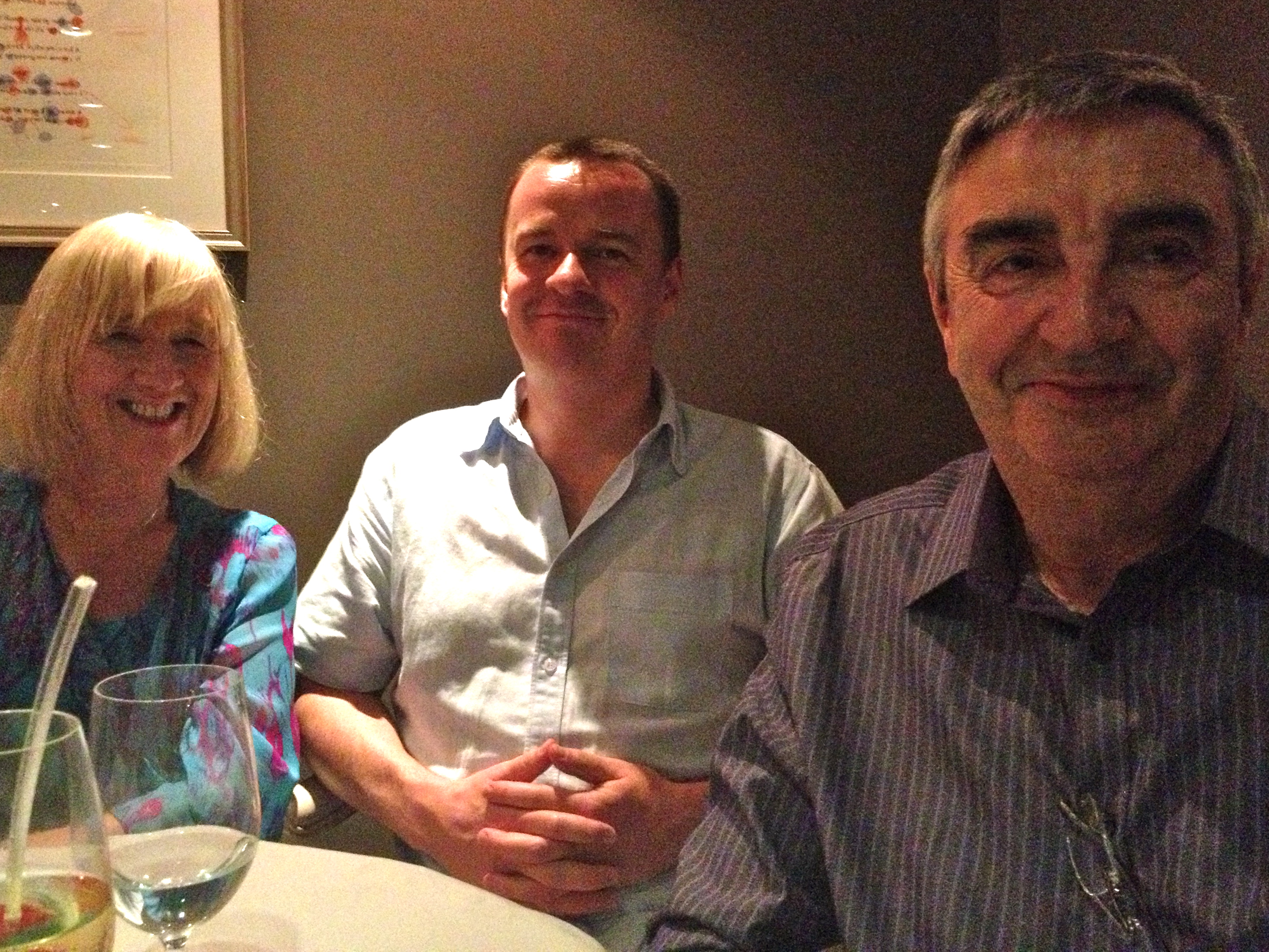
Our friends from Birmingham (Mosley), England, the Barnes Family.  Mom Angela instructs and grades exams, the equivalent of of SATs or ACTs in the US.  Son Barnaby is  a detective sergeant (soon to be Inspector) in the Birmingham Police Force; Dad Joseph is a retired University Dean.  They all helped Boris to victory in trivia and were wonderful lunch and dinner companions for us throughout the cruise.  This was taken at one of the special Chef's Table nights we attended with them. ©Jean Janssen

Our friends from Birmingham (Mosley), England, the Barnes Family. Mom Angela instructs and grades exams, the equivalent of of SATs or ACTs in the US. Son Barnaby is a detective sergeant (soon to be Inspector) in the Birmingham Police Force; Dad Joseph is a retired University Dean. They all helped Boris to victory in trivia and were wonderful lunch and dinner companions for us throughout the cruise. This was taken at one of the special Chef’s Table nights we attended with them.
©Jean Janssen

One of the things I have come to enjoy about these smaller ships and a longer cruise, is that you get to make friends and run into them on the ship throughout the voyage.  We have frequently asked and been asked to join others for dinner.  The passengers on this ship are very friendly, down to earth, and overwhelmingly English-speakers- although not necessarily from the USA.  In fact I think the Aussies are the largest group (followed by the Brits).  Today when the captain came on to make the noon announcement, he apologized to the Australian guests he was waking up with the PA.  Apparently, the Aussies had kept the disco/bar open for a record number of hours last night/this morning. (It doesn’t close until the last guest leaves.)

We have made friends from all over the world and got heard some wonderful stories.  There can of course be disadvantages to the small ship as well.  One couple told us of being propositioned by a swinger couple one of the first nights on the cruise and the great lengths they now go to avoid the couple on the ship.  It would be hard to beat that story.

Ah well, the pool calls.  I am going to squeak in some time before the next cocktail party.  Natasha does have a rough life…
Posted in cruises, international | Tagged , | Leave a comment

India Finally!! Kochi, the “Queen of the Arabian Sea”

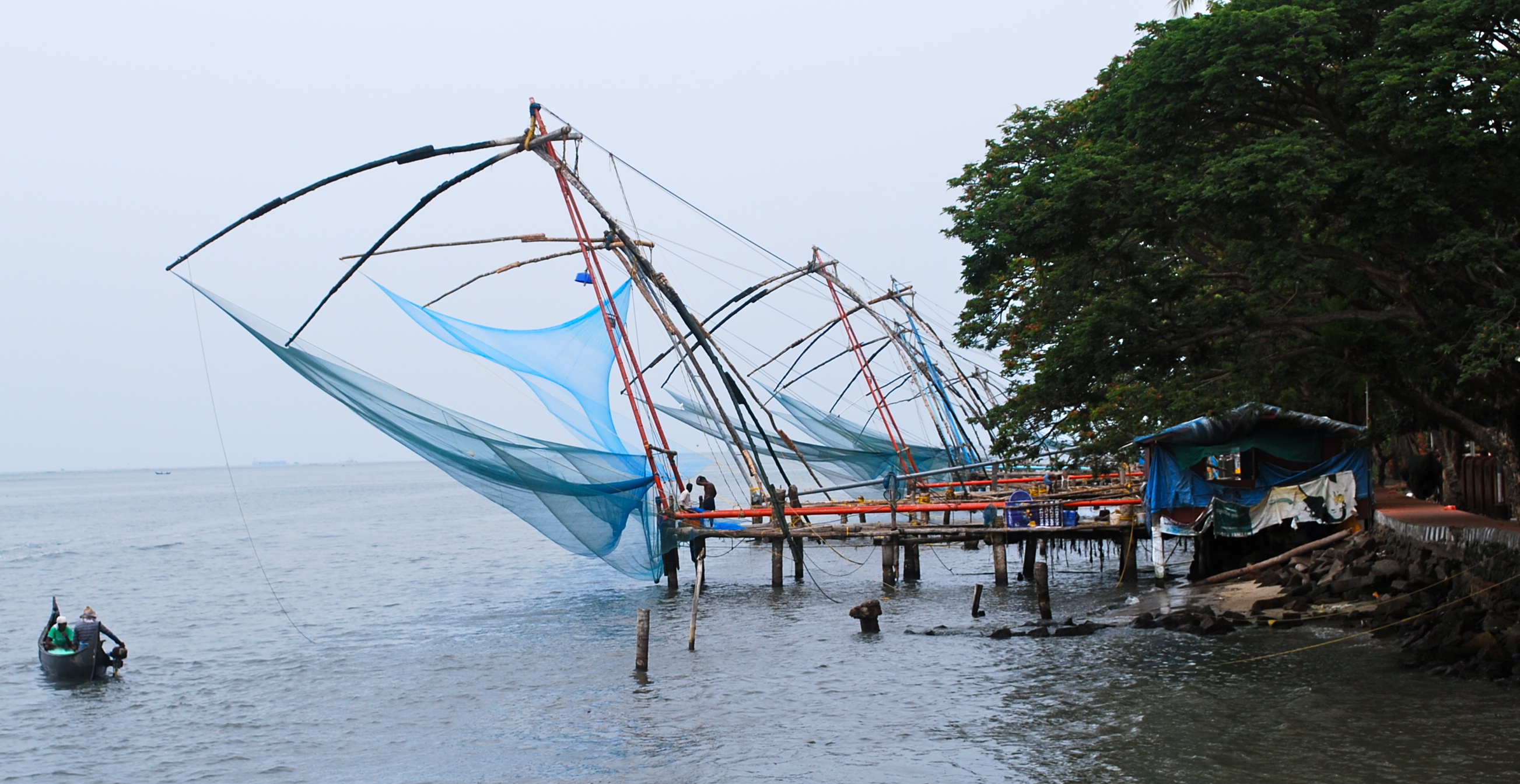
Chinese Fishing Nets, Fort Kochi, India ©Jean Janssen

Chinese Fishing Nets, Fort Kochi, India
©Jean Janssen

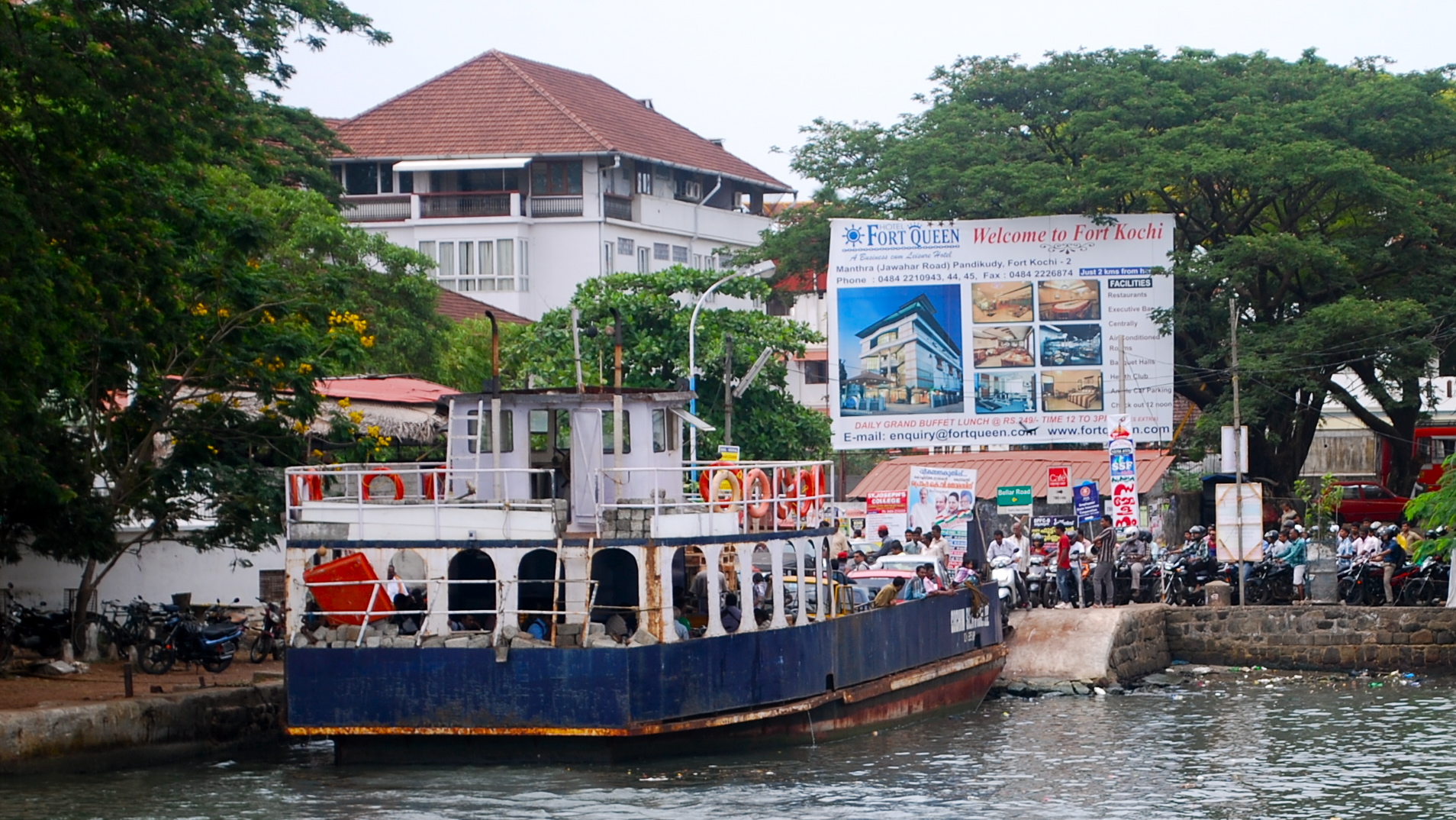
Car ferry at Fort Kochi, India.  Note all the cycles on the right waiting to get on. ©Jean Janssen

Car ferry at Fort Kochi, India. Note all the cycles on the right waiting to get on.
©Jean Janssen

Boy what a hassle it is to get into India for American, Brits, and Australians.  First we had to get a visa before we left home; then, we had to personally present ourselves to pick up our passport on the ship and obtain a landing card and a secondary card.  Then the form was messed up and everyone on the ship had to redo it last night.  Then we once again had to present ourselves this morning, turn in the revised form, and leave with the landing card.  Then they checked the landing card three times before we got on the bus.  Ridiculous.

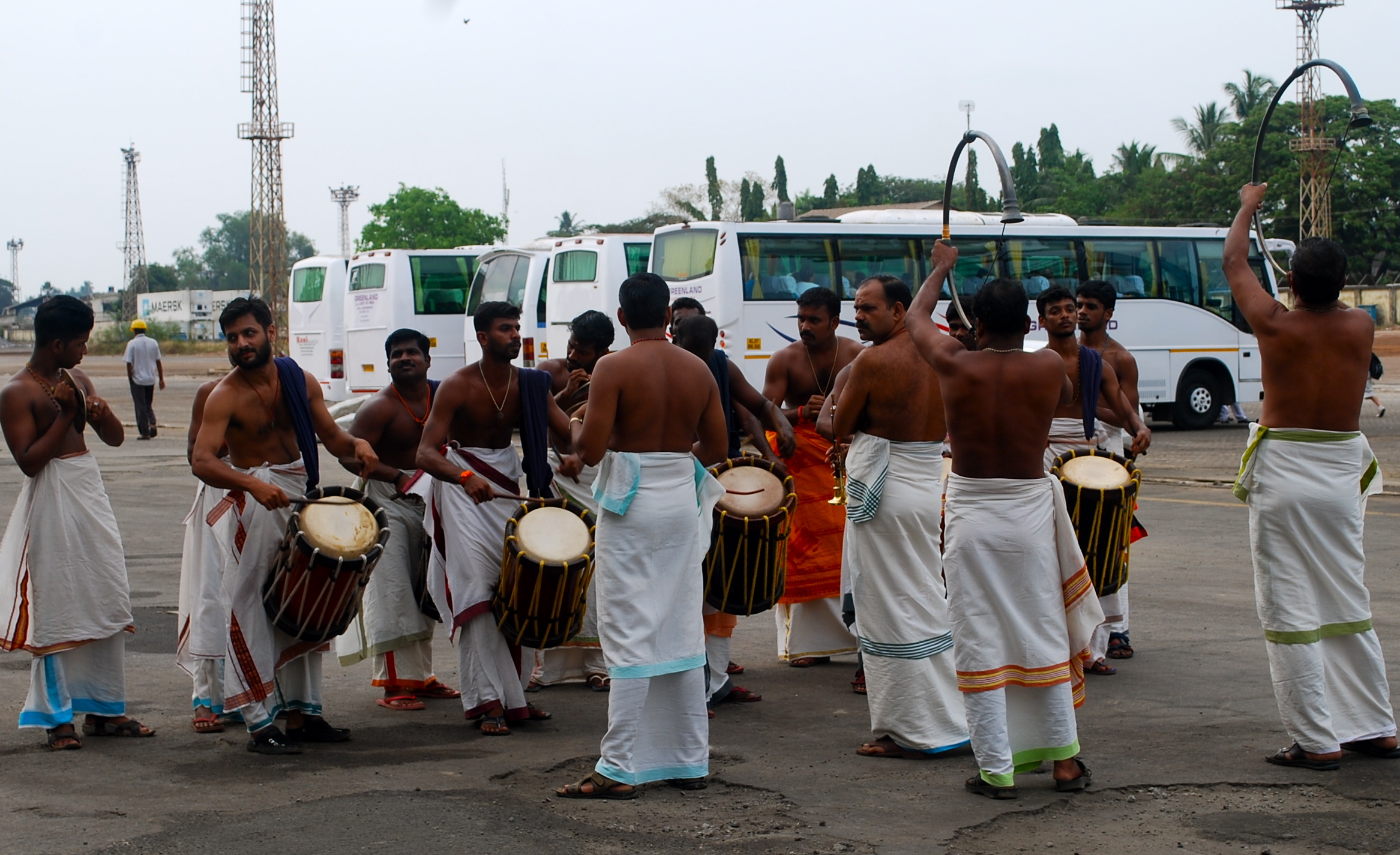
A performance at the dock to welcome us to India, Kerala, and Fort Kochi. ©Jean Janssen

A performance at the dock to welcome us to India, Kerala, and Fort Kochi.
©Jean Janssen

The ride in was under rough skies.  I woke to the sound of thunder.  Fortunately, the rain had cleared by the time we got to the pier and stayed clear for our tour.  Musicians using traditional instruments greeted us on the dock.  They took us by bus to the tourist dock on this man-made island for the harbor boat ride.  This land mass was created during the British era when a deeper seaport was needed.  There is a toll to enter the island.

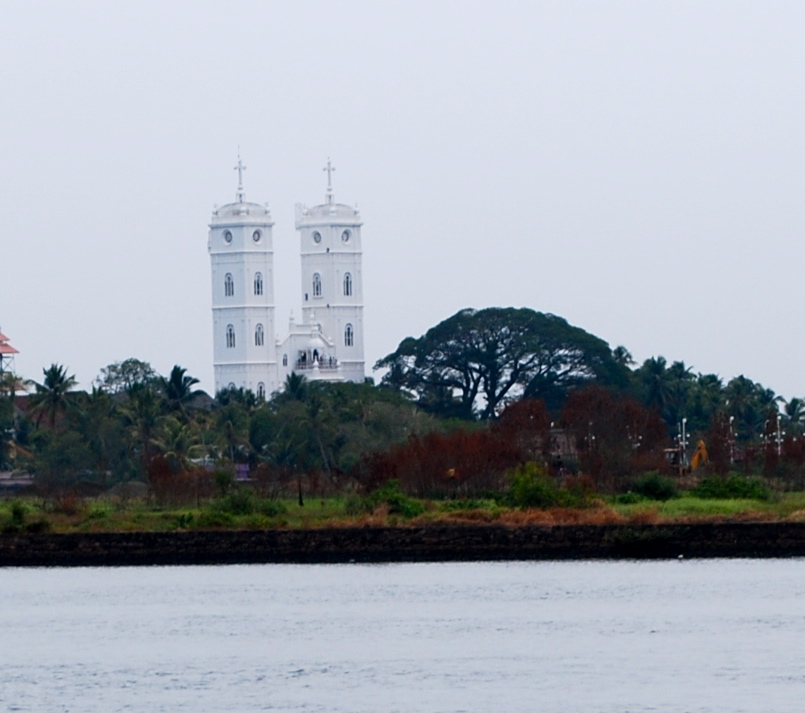
A Catholic Basilica seen from our tourist boat in the Kochi Harbor. ©Jean Janssen

A Catholic Basilica seen from our tourist boat in the Kochi Harbor.
©Jean Janssen

We are in the Indian state of Kerala (meaning coconut tree), one of 28 states in the country of India.  Kerala is on the southwestern coast and is one of India’s smallest states.  There is a higher percentage of Christians (21%), mostly Catholics, than in other parts of India.  Kerala is a melting pot, with peoples of various faiths living in harmony.  It is one of the more prosperous states in India and has the highest percentage of middle class families in India.  Wages are higher in Kerala than in other parts of India.  Kerala has a literacy rate of 97%.  Education is free up to age 15.  From age 3, children are taught Hindi, English, and the official state language.

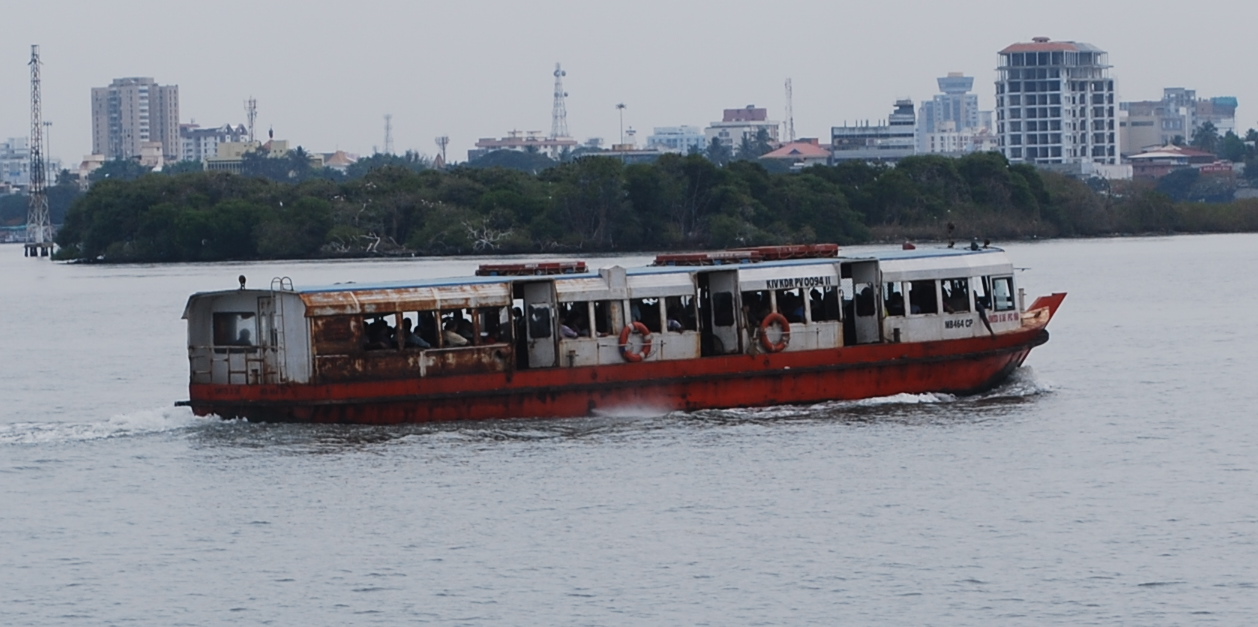
Public ferry, Kochi, India ©Jean Janssen

Public ferry, Kochi, India
©Jean Janssen

Significantly, its population has more women than men, unique in India due to the selective death of females among some segments of the Indian population.  The communist party is very strong is Kerala.  A communist was elected to office in 1957 and communists have been in and out of office in the state since that time.

Our tourist ferry boat.  Kochi, India ©Jean Janssen

Our tourist ferry boat. Kochi, India
©Jean Janssen

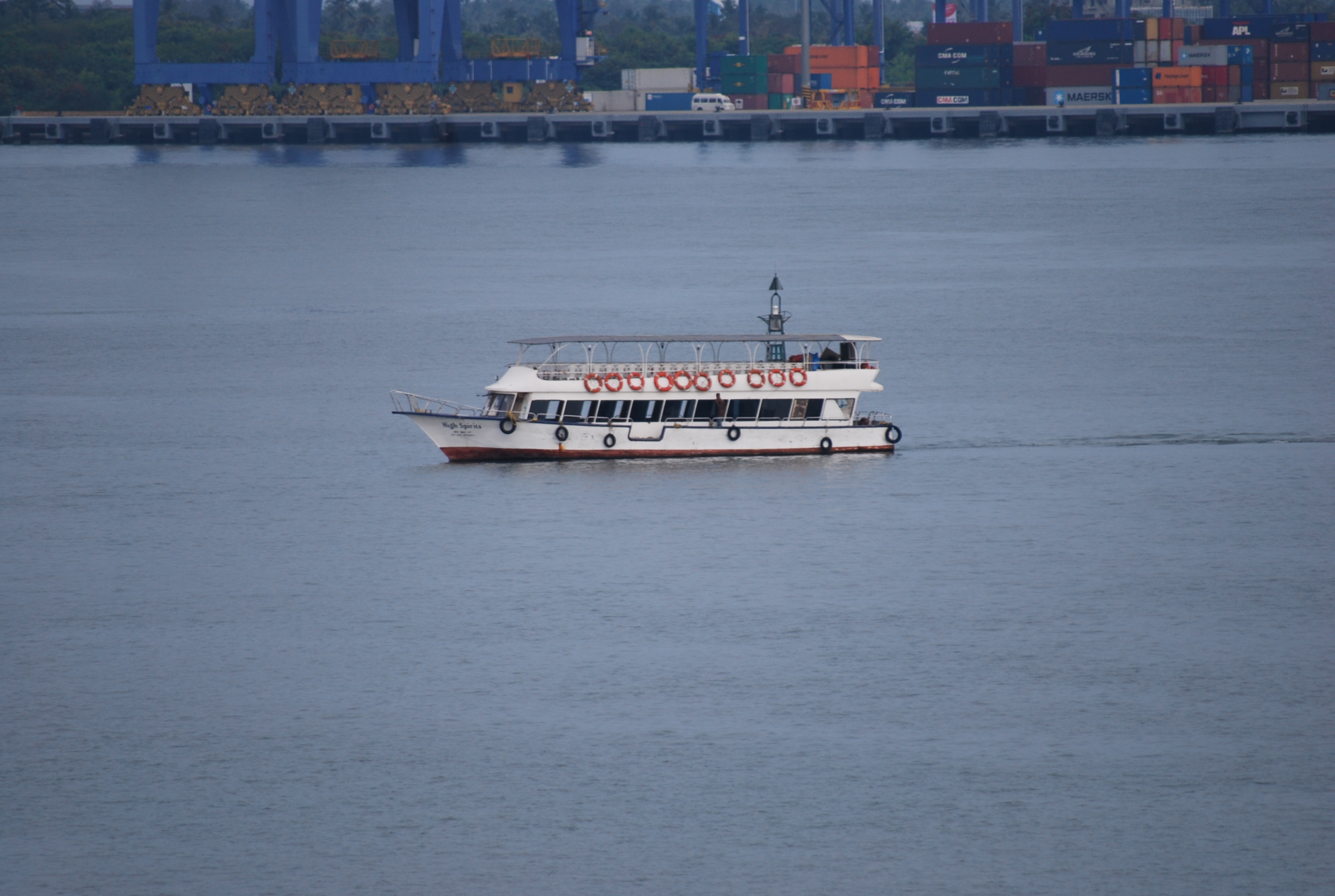
In the morning after we docked I had seen several boats I assumed were ferries headed in the direction we came.  These were actually our touring boats.  They were all a little different with “handmade” touches; all were rustic and worn.  I felt bugs biting my legs.  However, our tourist boat was certainly a step up from the public ferries I saw leaving from the dock over.  Kochi, or Cochin to use the colonial name, has a natural harbor.  There are 18 islands in this area.  You look out to the Arabian Sea and the Western Ghats.  As we rode around the harbor, we saw dolphins.  Cochin has the distinction of having had the first container cranes in India.  (We see them in all the major ports now.  In Colombo, Sri Lanka they were right next to our balcony.)

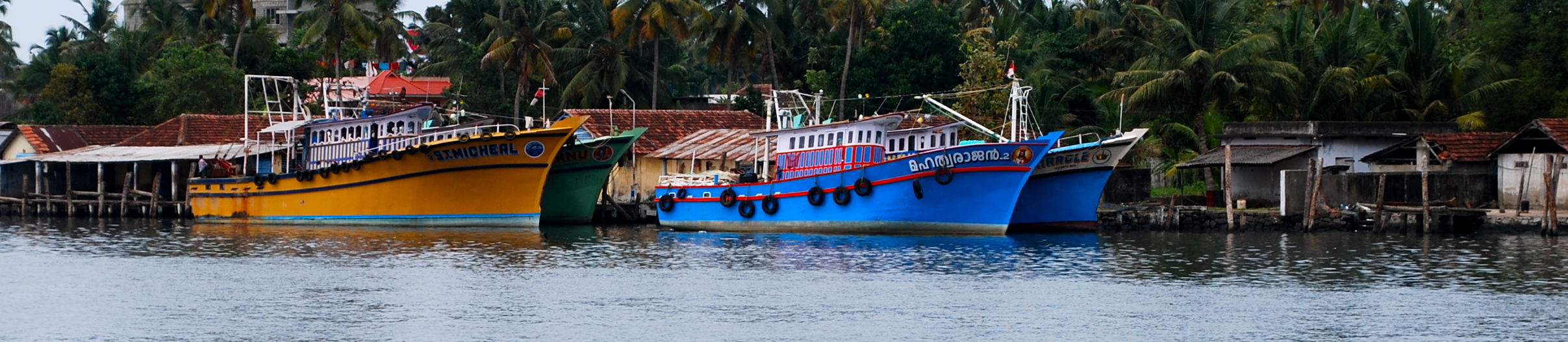
Named fishing boats at Kochi, India.  Note one is St. Michael.  The other has a picture of Jesus.  Names are reflective of the owner's religion. ©Jean Janssen

Named fishing boats at Kochi, India. Note one is St. Michael. The other has a picture of Jesus. Names are reflective of the owner’s religion.
©Jean Janssen

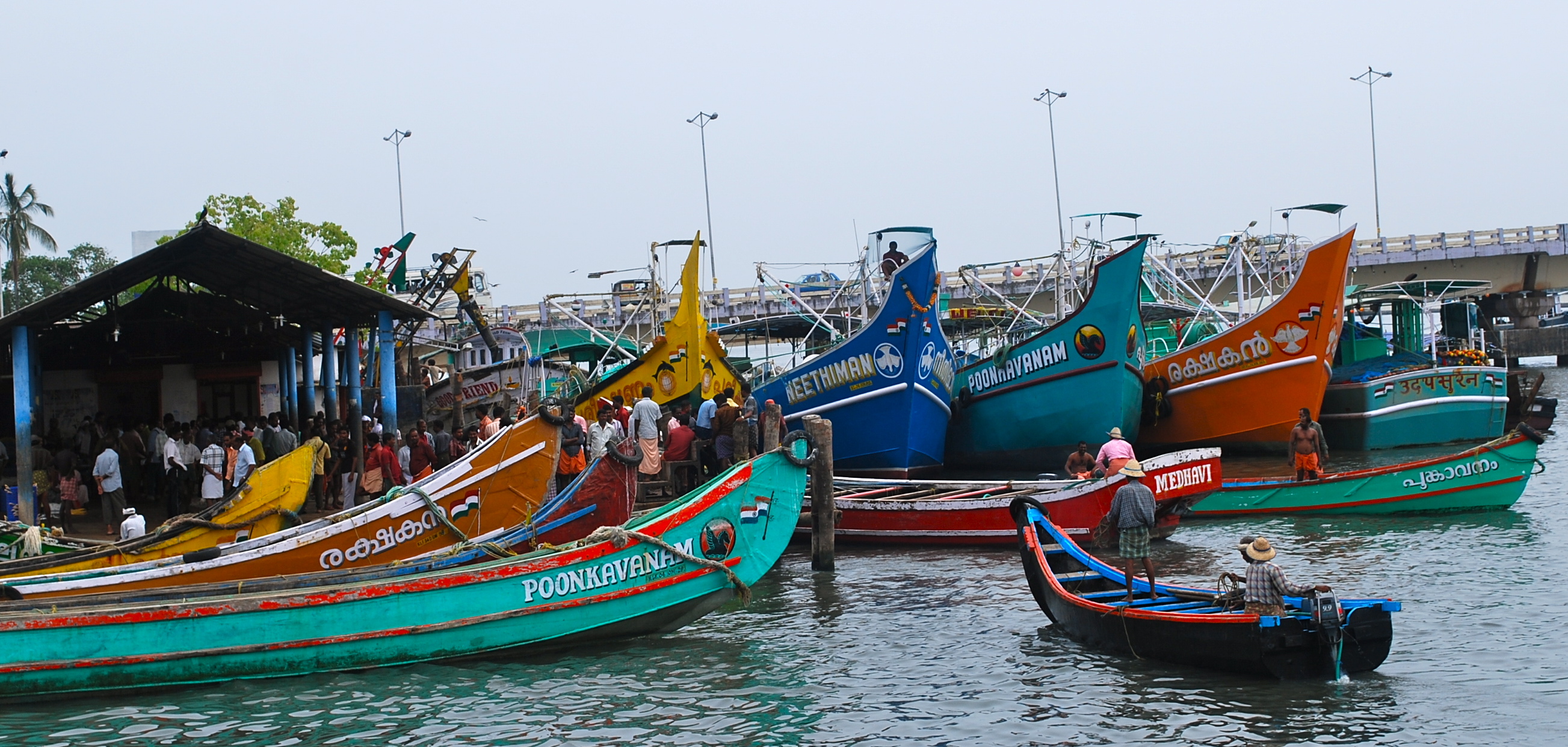
Colorful fishing boats, Kochi (Cochin), India. ©Jean Janssen

Colorful fishing boats, Kochi (Cochin), India.
©Jean Janssen

We passed several spots where the fishing boats were anchored, icehouses, conveyor belt loading stations, and a market area.  Each of the fishing boats has a name that indicates the religion of the owner.  All are colorfully decorated.  The highlight was the view of the Chinese fishing nests.  It is outdated technology, but requires no mechanization or fuel (only manpower).  They only work at high tide.  It takes 5-6 men to raise and lower the nets.  The large net is placed in the water for 3-5 minutes, raised, and the fish removed.  They catch mullet, shrimp, and crab in the nets.

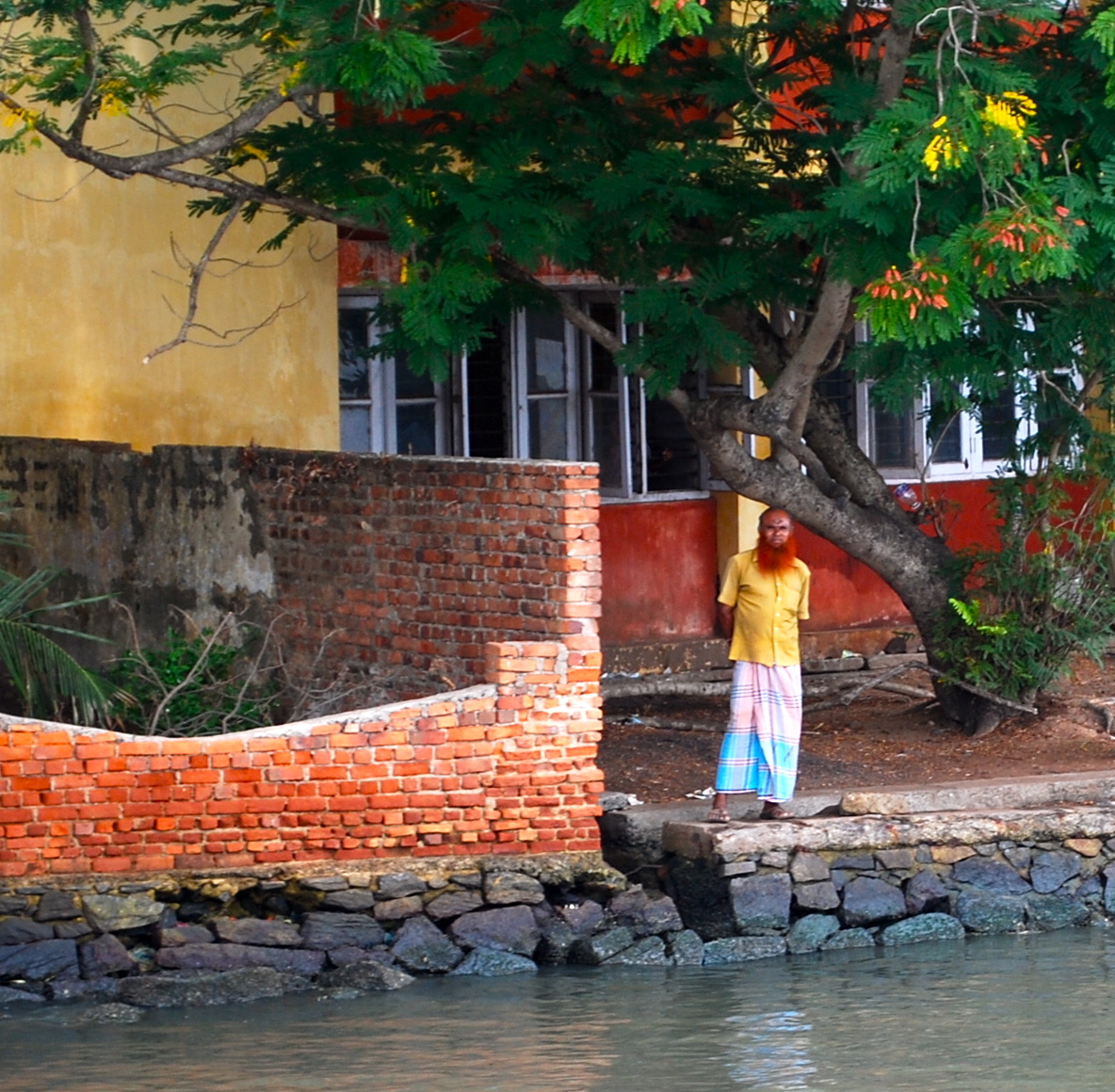
This Indian man near one of the public ferry piers had the reddest beard I have ever seen. ©Jean Janssen

This Indian man near one of the public ferry piers had the reddest beard I have ever seen.
©Jean Janssen

While we toured the harbor, our guide shared lots of information about India, particularly Kerala.  One of his best stories concerned his own arranged marriage.  Most marriages are still arranged; marriage is concerned more than the union of two people.  It is the union of two families.  Dowries are illegal in India, but still practiced.  There are three methods of going about the arranged marriage.  One, you give your CV to a marriage bureau and astrologist are consulted.  Two, you can hire a professional marriage broker.  Three, you can put an ad in the newspaper.  On Sundays, there are 6 or 7 pages of ads.  Our guide said some are quite funny.  “Woman looking for a husband with clean habits.”

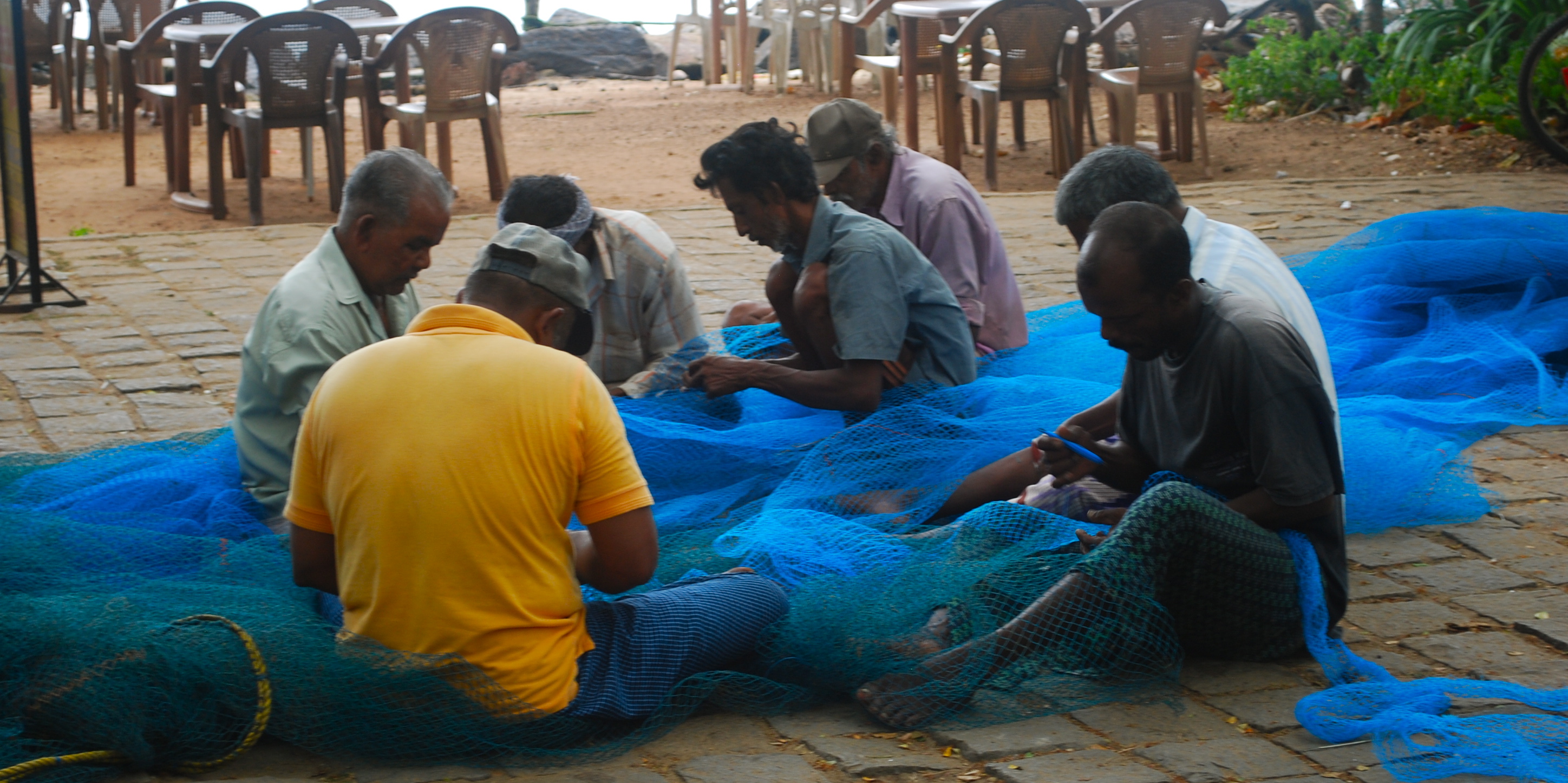
Repairing fishing nets.  Fort Kochi, India. ©Jean Janssen

Repairing fishing nets. Fort Kochi, India.
©Jean Janssen

Our guide married at 32, quite late by Indian standards; the average age of marriage is 18 for girls and 21 for men.  When he hit 30, his parents spent the next 2 years taking him to appointments every Sunday.  If the family was generous, you have a 5-minute chat alone with the “candidate”.

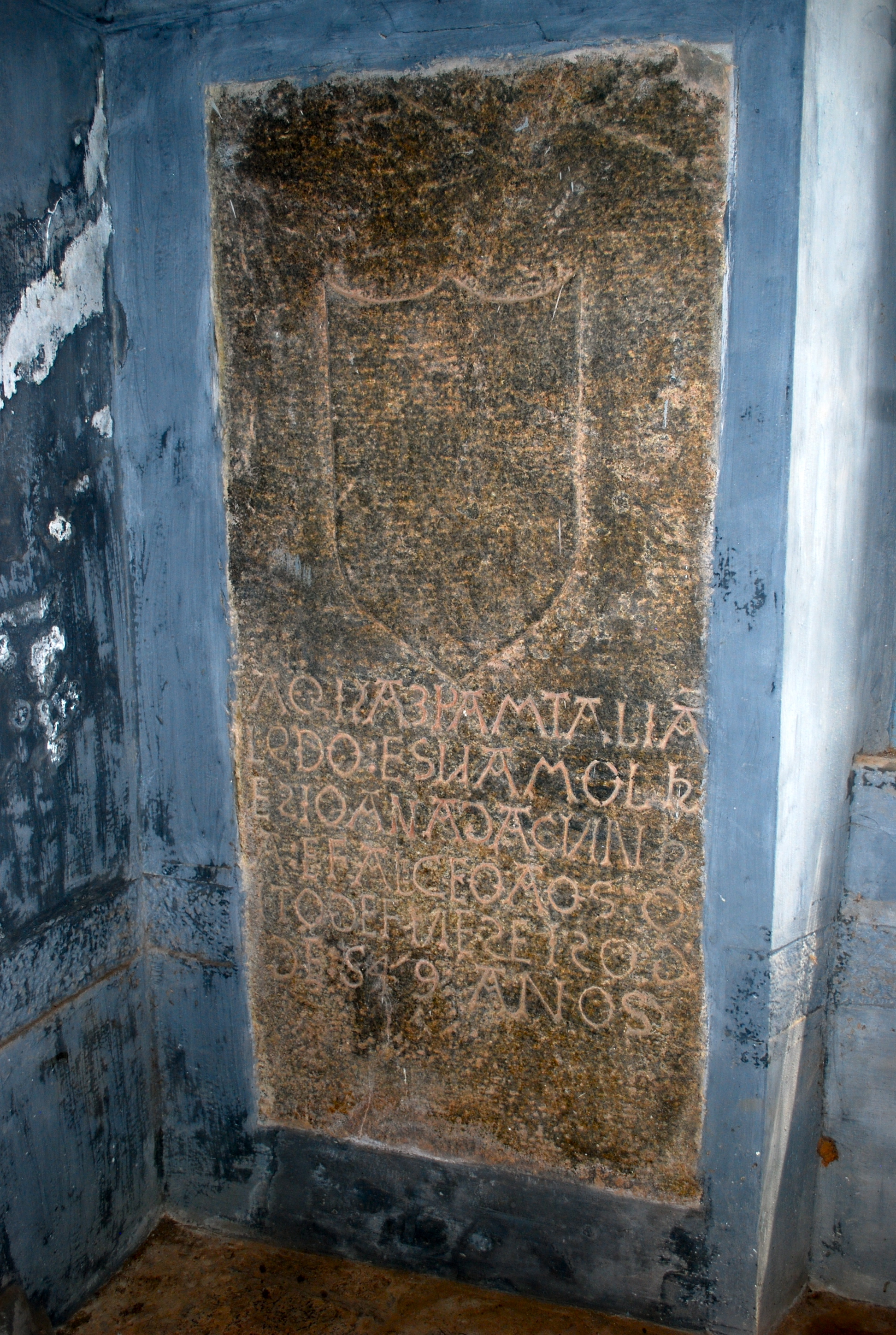
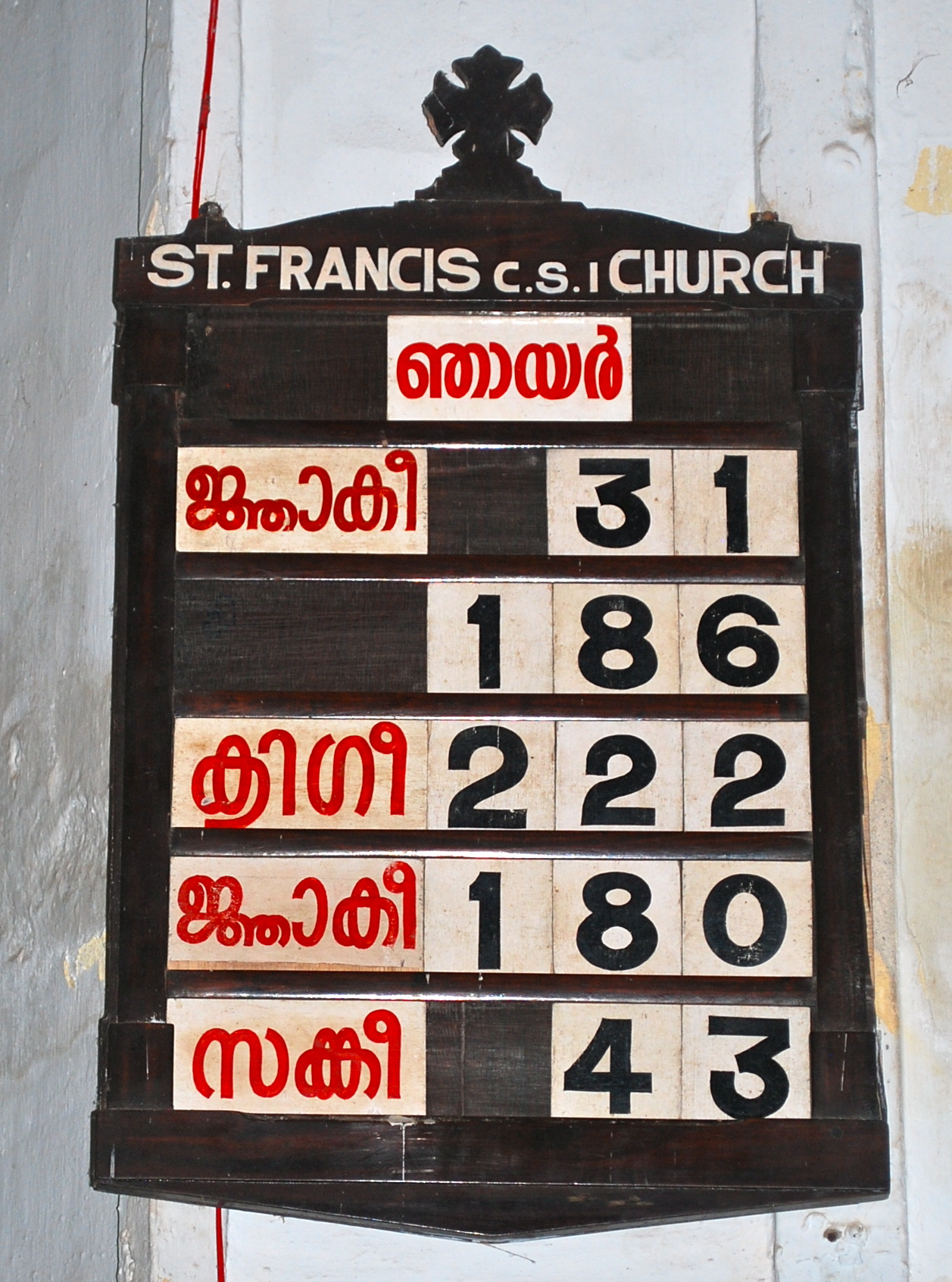
In St. Francis Church, Fort Kochi, India.  There are ancient Portuguese and Dutch tombs in the church. ©Jean Janssen

In St. Francis Church, Fort Kochi, India. There are ancient Portuguese and Dutch tombs in the church.
©Jean Janssen

He said sometimes you liked the girl and she liked you, but the astrology was not right so the match fell through.  He said there are some love marriages, Valentines’ Day is celebrating, and dating does exist (you go to another city and hope your parents don’t find out).  However, even in a love match, astrologers are still consulted.

Divorce rates are low in India because there is nowhere for the woman to go if she divorces.  The divorce rate in Kerala is higher than in other parts for India because the women are educated, have jobs, and feel they have options.

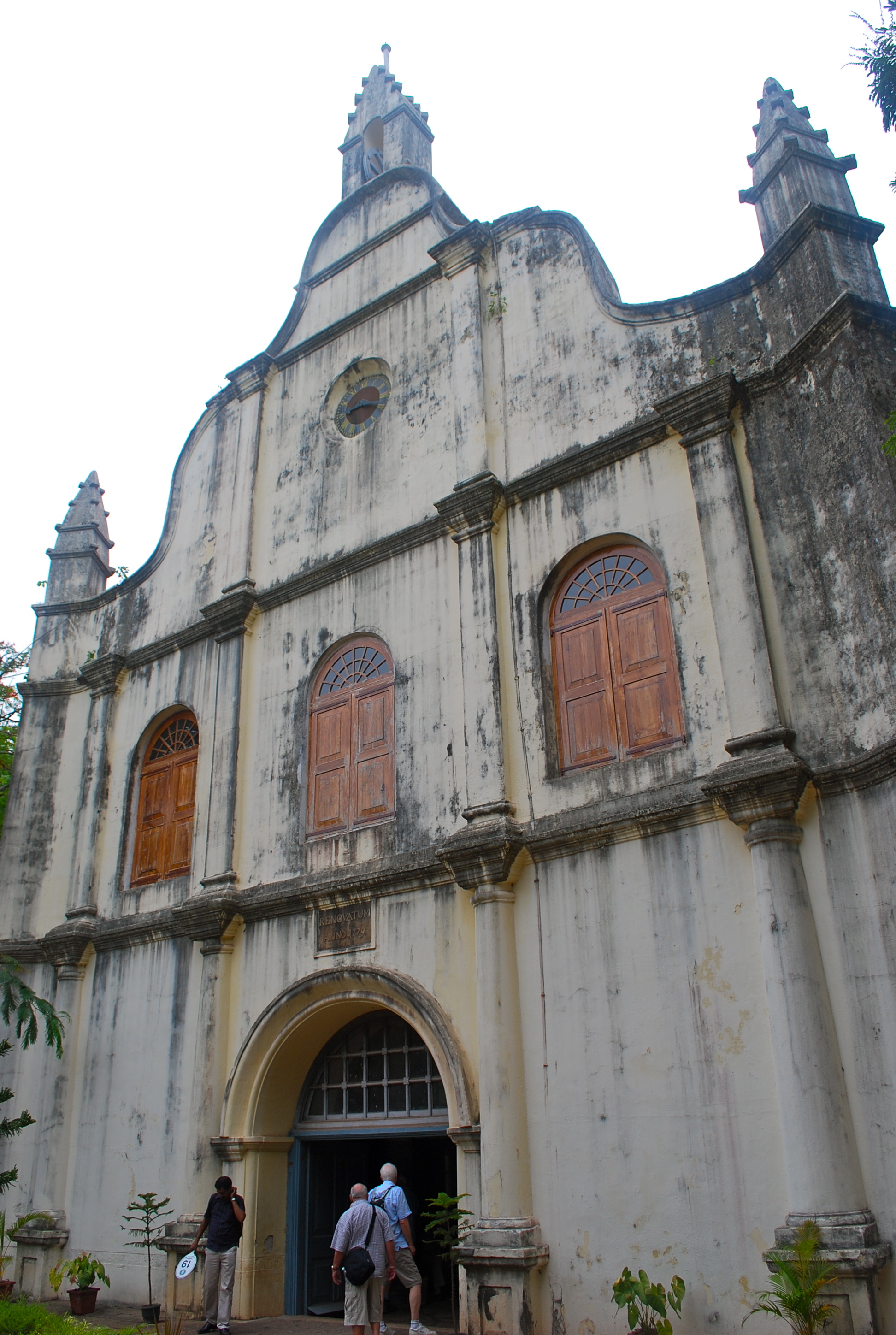
St. Francis Church, Fort Kochi, India ©Jean Janssen

St. Francis Church, Fort Kochi, India
©Jean Janssen

After our touring boat ride, we docked at Fort Kochi (Cochin) to see this historical seaport, the first European colonial settlement in India.  The Portuguese remained a stronghold here from 1503 to 1663.  It was later occupied by the Dutch and still later the British.  St. Frances Church was Catholic under the Portuguese, then Dutch Reformed, and later Anglican during the British occupancy.

Upon leaving the dock, we were immediately set upon by vendors.  (We had actually seen a few at the tourist dock where we boarded.)  They followed us down.  We got a land view of the Chinese fishing nets and walked through the gauntlet of stalls to St. Francis Church.  Fortunately, the vendors couldn’t follow us into the churchyard.

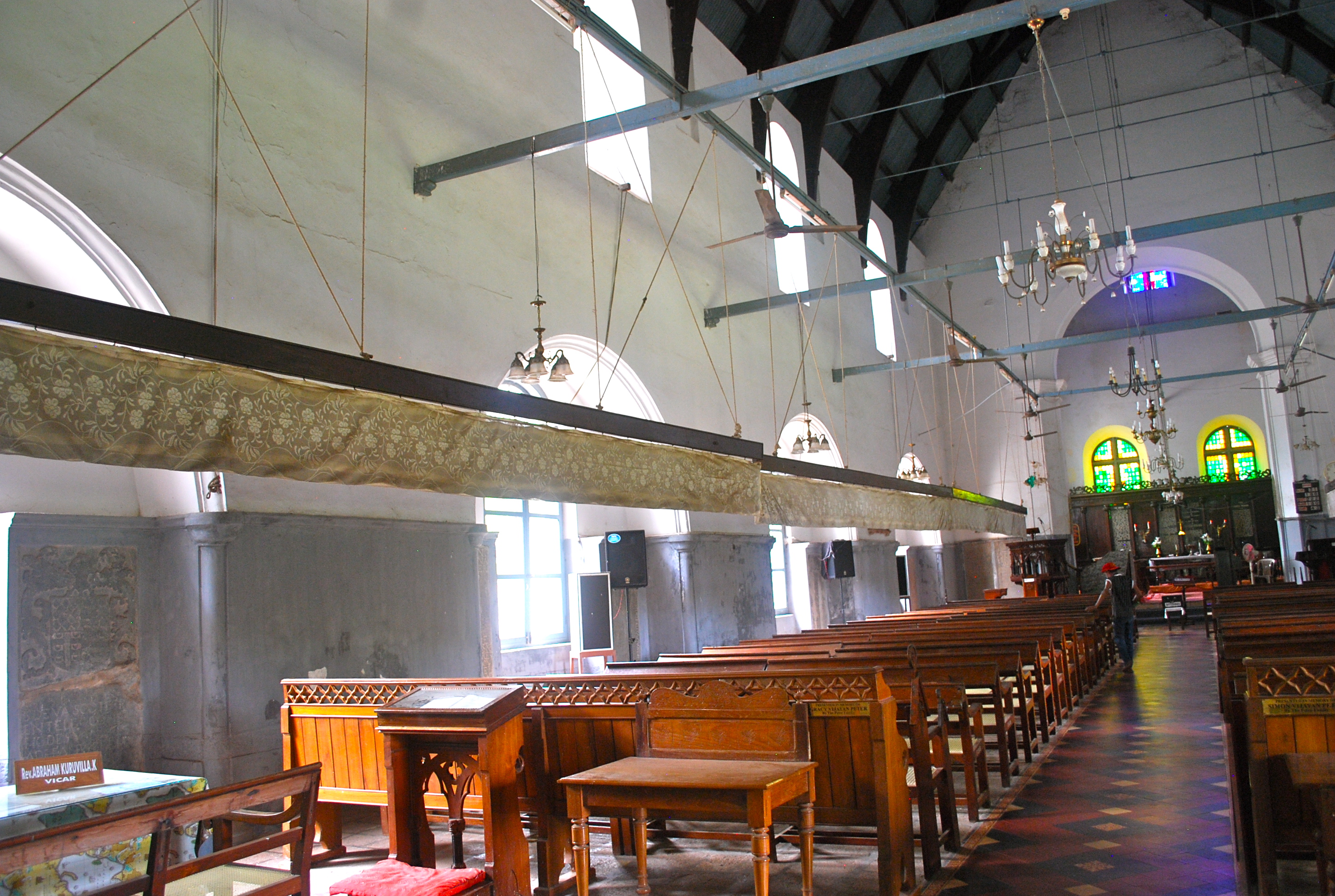
fans in St. Francis Church, Fort Kochi, India. ©Jean Janssen

fans in St. Francis Church, Fort Kochi, India.
©Jean Janssen

St. Francis Church has these wonderful cloth fans operated by manpower from outside.  Inside were Portuguese and Dutch tombs (on different sides of the church) and even a plaque commemorating Queen Elizabeth II visit in 1997.  It is also the site of the original tomb of Vasco da Gama.

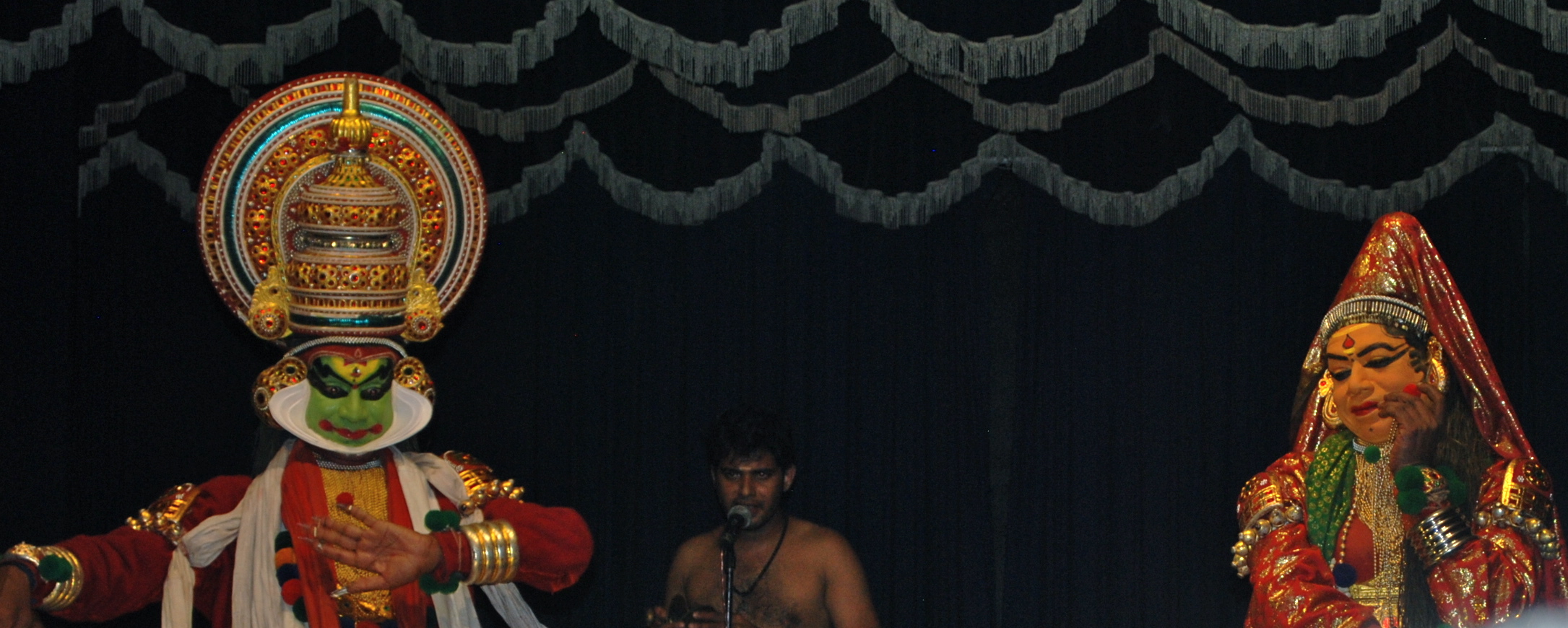
Kathakali performance, traditional Buddhist ritual, Kochi, India.  The chanter appears in the middle of the two "actors". ©Jean Janssen

Kathakali performance, traditional Buddhist ritual,
Kochi, India. The chanter appears in the middle of the two “actors”.
©Jean Janssen

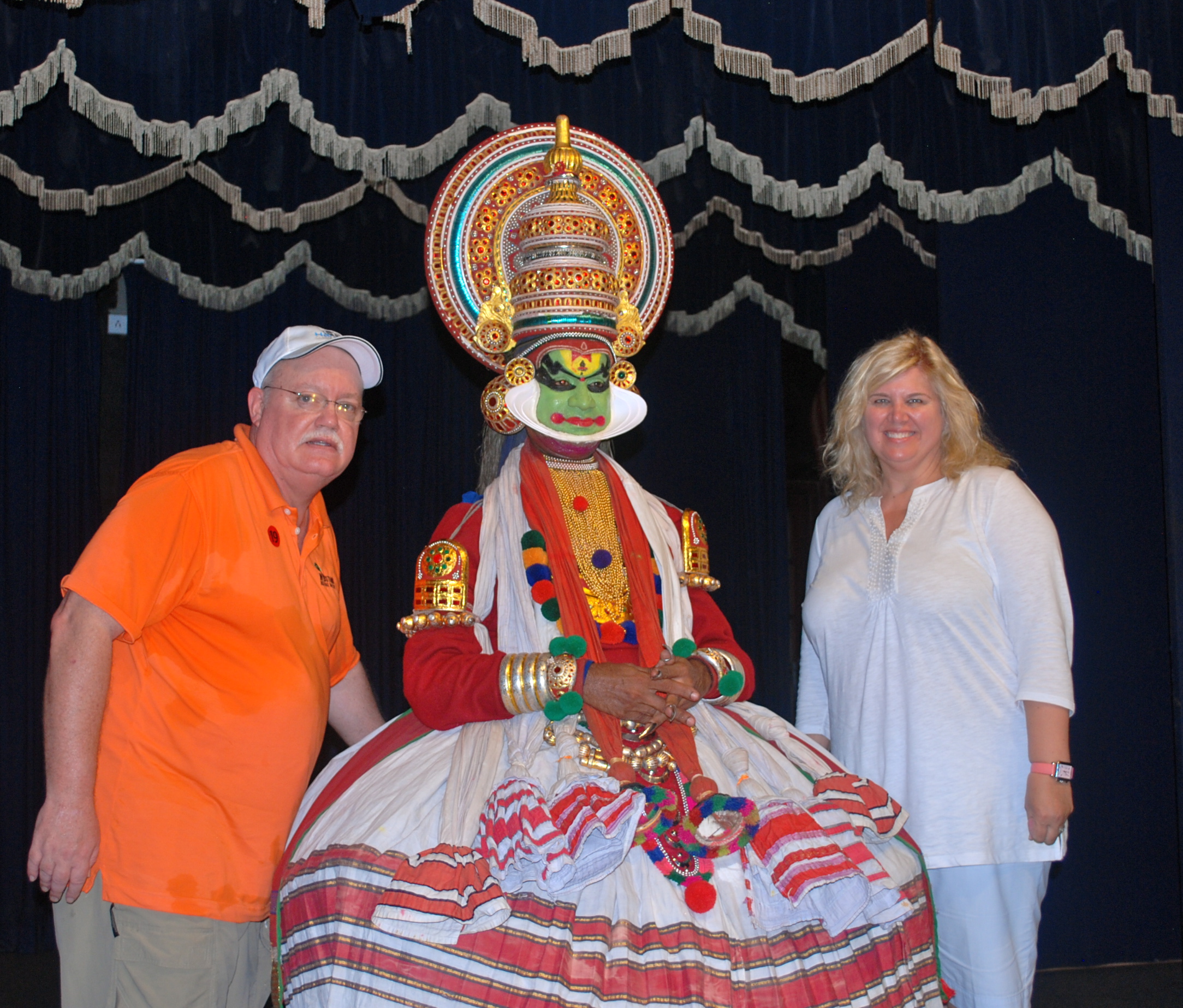
Our last tour stop was at Greenix Village dedicated to preserving Kerala’s art and culture.  Our tour groups saw a private performance of Kathakali theater, a Buddhist ritual.  A full performance may begin at 6 pm and continue until 2 or 3 the following morning.  We were given a demonstration on the various facial and eye expressions and also the language (done as sign language).  The heavily made-up performers presented a segment of a full play.  We saw two actors (in a full play there are 7-10 characters), two musicians, and a chanter.  The muscle coordination of the face was extraordinary and the eye movements equally challenging.  Students begin the study at age 8-10.  It normally takes 15 years to learn the complex performance techniques.  It is a traditional art form from the 18th century.  Kathakali Theater reminded Boris and I of the Chinese Opera Performance we saw with Rocky in Beijing.

Boris and I with one of the actors after the Kathakali performance.

Boris and I with one of the actors after the Kathakali performance.

In St. Francis Church, Fort Kochi, India ©Jean Janssen

In St. Francis Church, Fort Kochi, India
©Jean Janssen

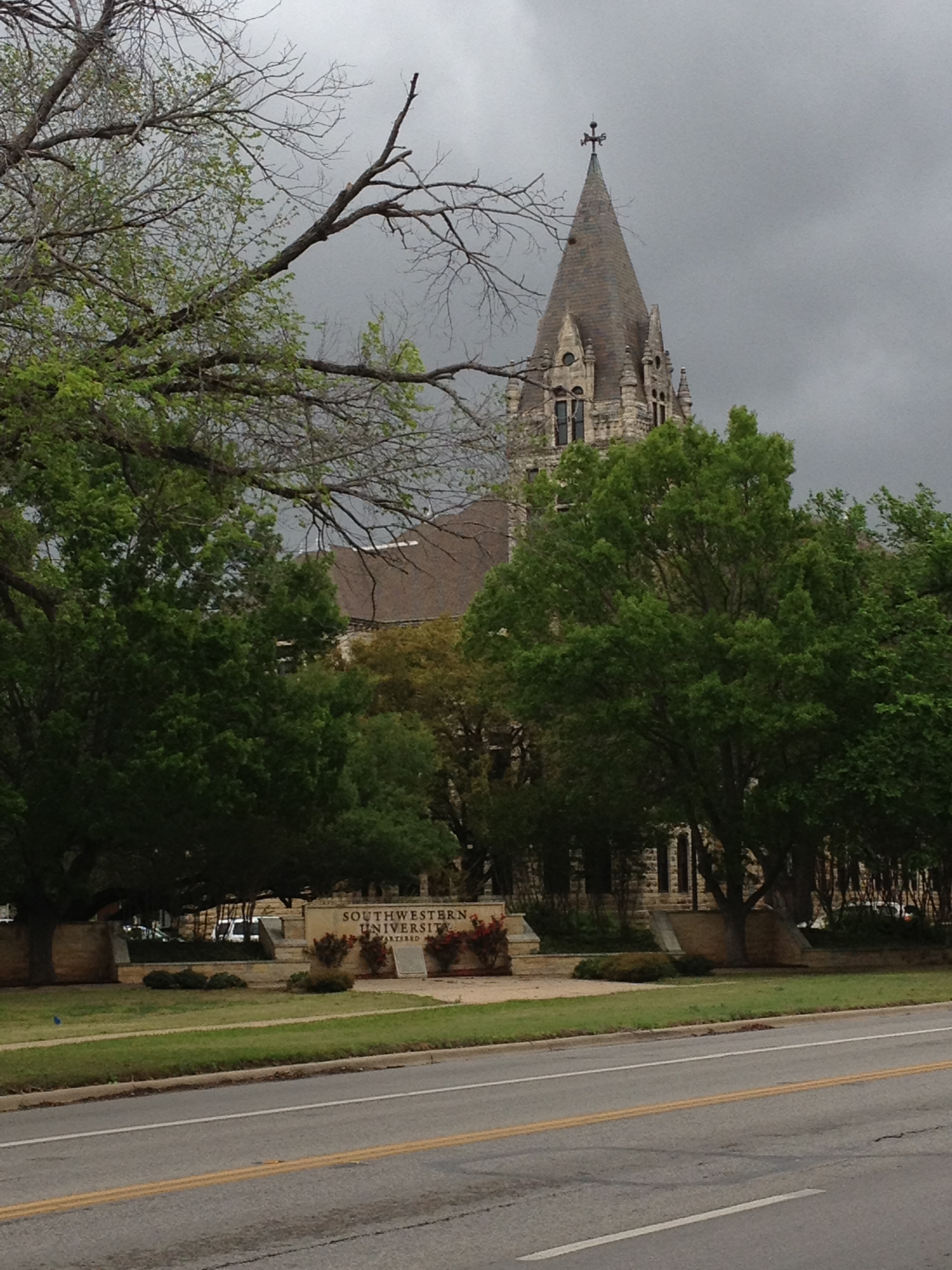
On the way back, I asked our guide about the local tok-toks.  I had noted that all the tok-toks-or “poor man’s taxi” as he called it-are the same color.  He told me that commercial vehicles had to have gold and black license plates.  Licenses for private vehicles are black and white.  The tok-toks had adopted the license color for the entire vehicle.  This color combination is unique to the state of Kerala in India.  (Black and gold are also the school colors of that famous Texas institution, Southwestern University.)  Public buses are red with 25% of the seats reserved for ladies and 10% of the seats reserved for the elderly.

Our bus was stopped at the harbor entrance and a policeman entered to check everyone’s landing card.  It was checked again when we boarded the ship.  Come on…really?

Chinese Fishing Nets, Kochi, India. ©Jean Janssen

Chinese Fishing Nets, Kochi, India.
©Jean Janssen

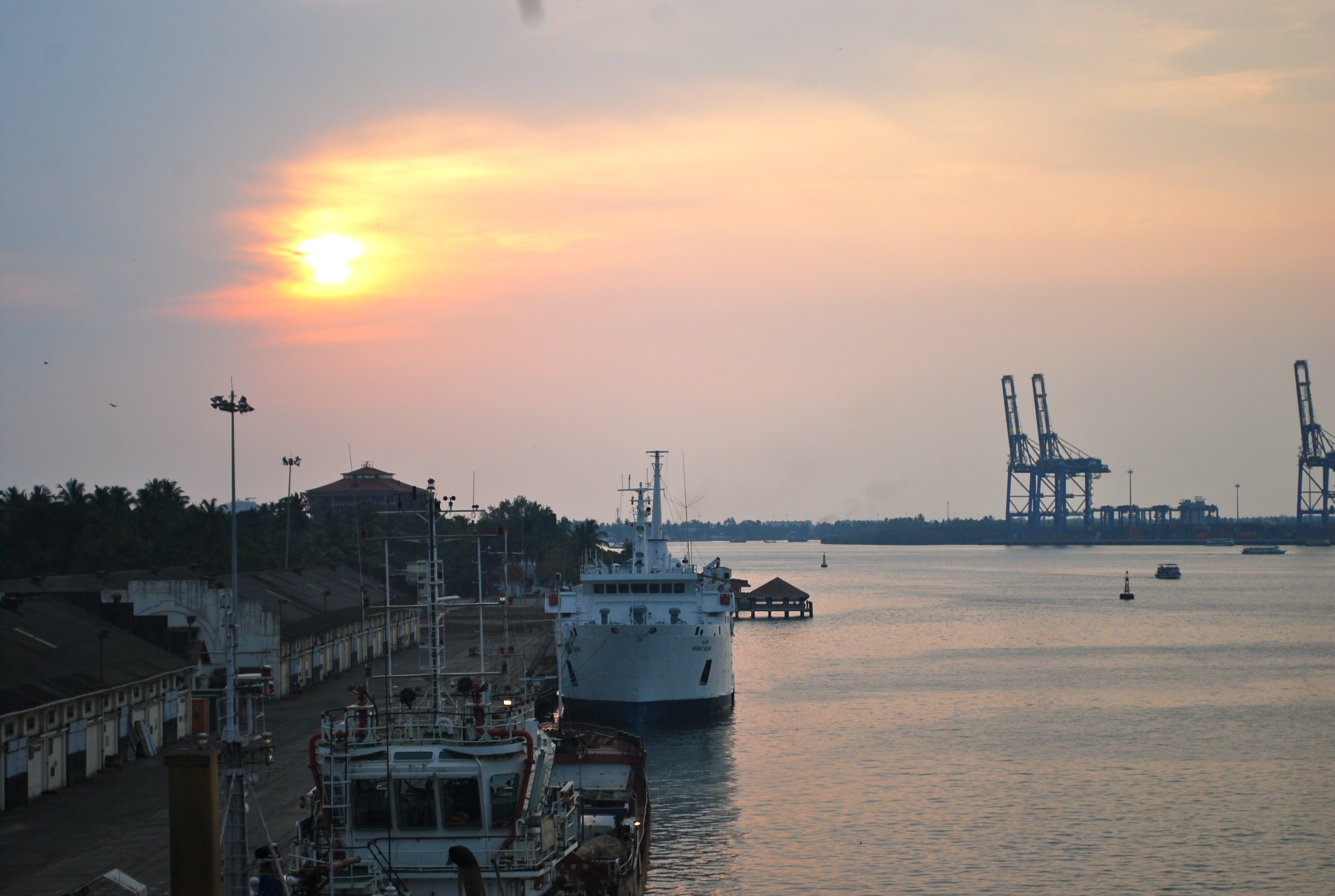
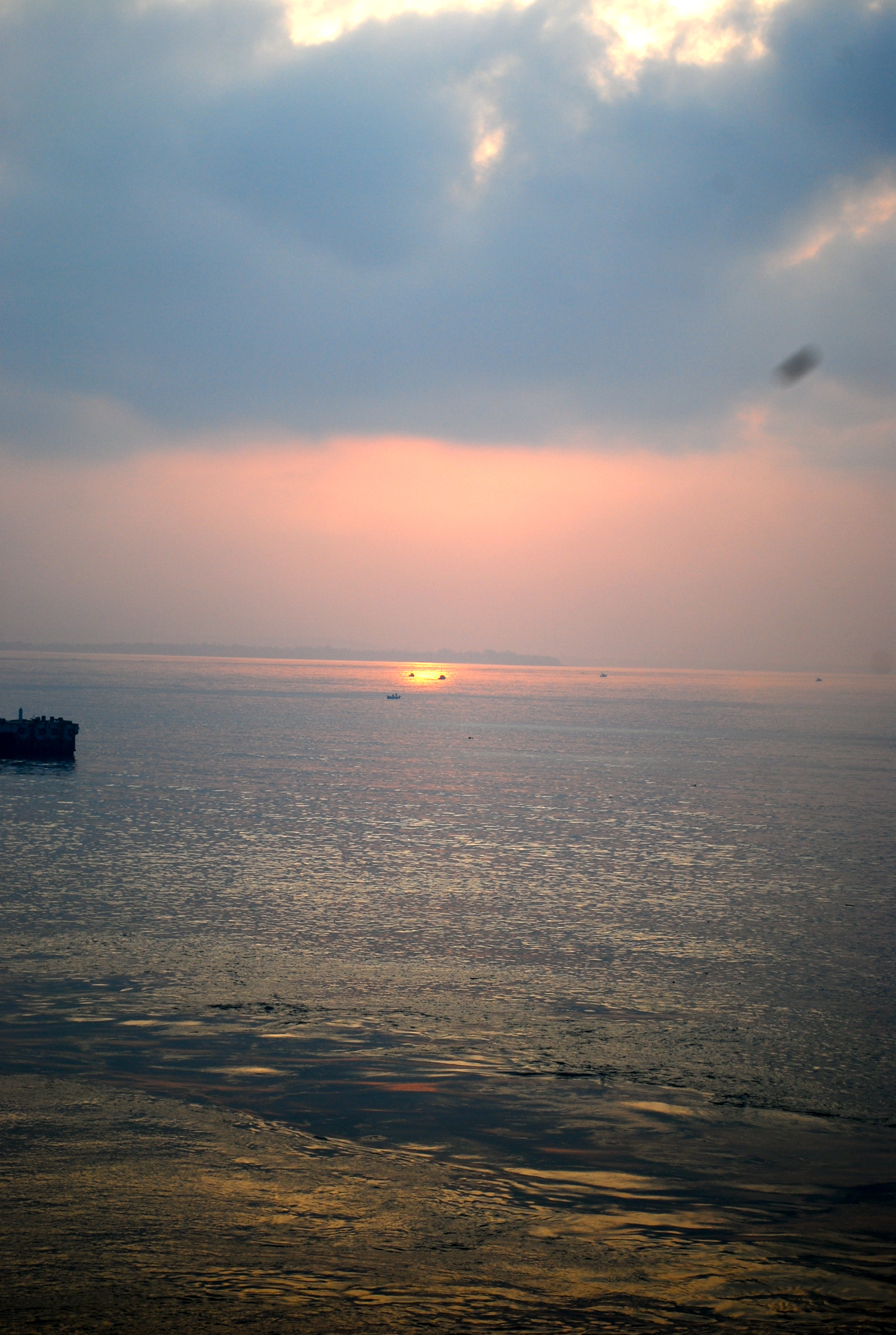
Back on board, we have champagne chilling in an ice bucket in our room.  The sun is setting just behind our ship so we will be able to enjoy the sunset from our terrace.  Welcome to India, Natasha.

sunset at Kochi, India. ©Jean Janssen

sunset at Kochi, India.
©Jean Janssen

Posted in cruises, international | Tagged , , , , , , , | 3 Comments

Galle, Sri Lanka

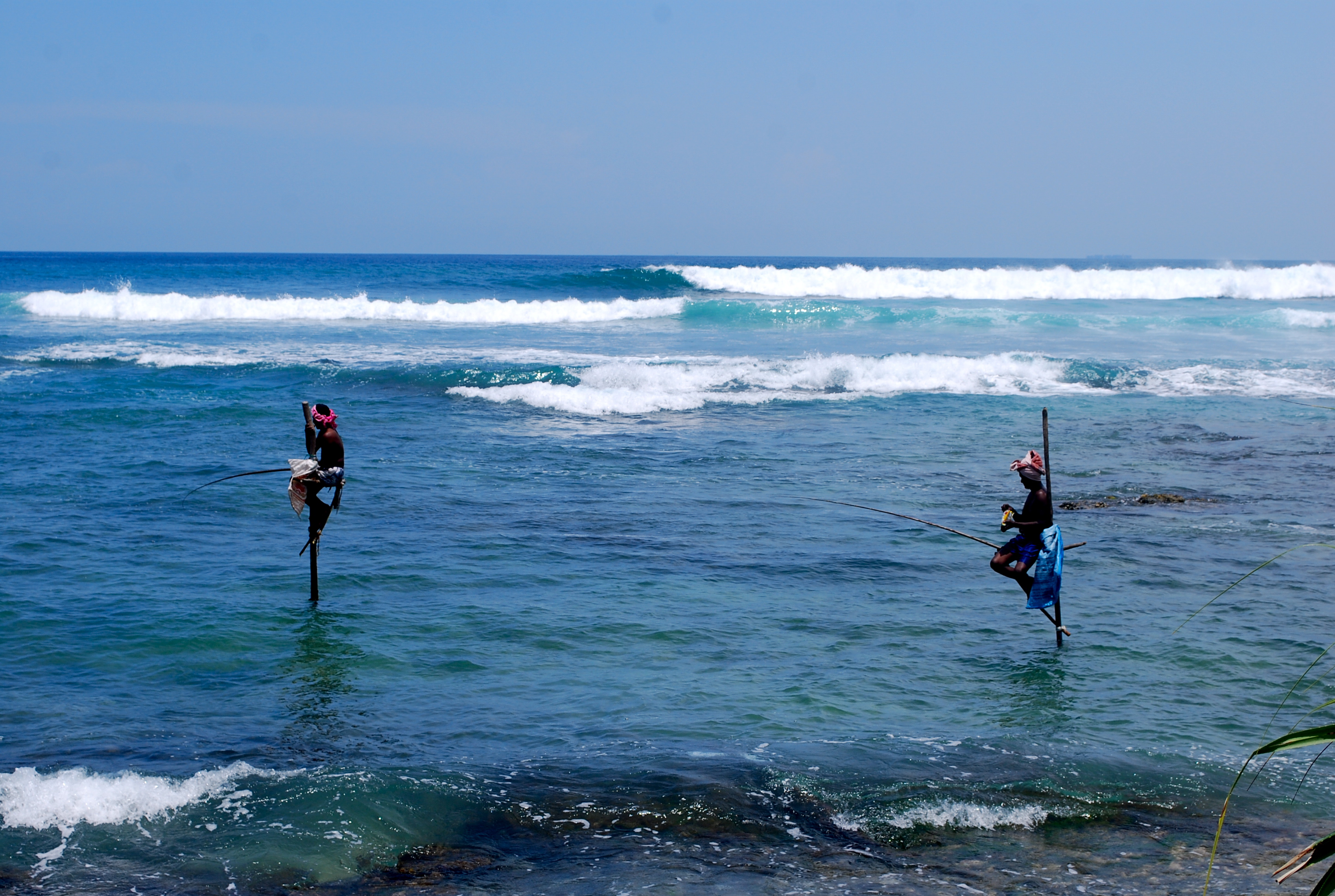
Stilt fisherman in the Indian Ocean at Galle, Sri Lanka. ©Jean Janssen

Stilt fisherman in the Indian Ocean at Galle, Sri Lanka.
©Jean Janssen

Sri Lanka's new Parliament building from 1985.  The old one is a British colonial building across from Galle Face Green. ©Jean Janssen

Sri Lanka’s new Parliament building from 1985. The old one is a British colonial building across from Galle Face Green.
©Jean Janssen

Today is our second day in Sri Lanka and we are going south to Galle by bus.  A new toll road has been completed in the last year that significantly shortens the trip.  (Toll road time 1 hour, 11 minutes; getting to the toll road 45 minutes).  While Colombo is the commercial capital of the country, the political capital is 14 km outside in a suburb that has grown so much since the capital was installed here in 1985 that you can’t tell where one ends and the other begins.  As it developed, they did allow for 4 lanes of traffic, rather than the usual one each way.  There are lane markers, but they are totally ignored.

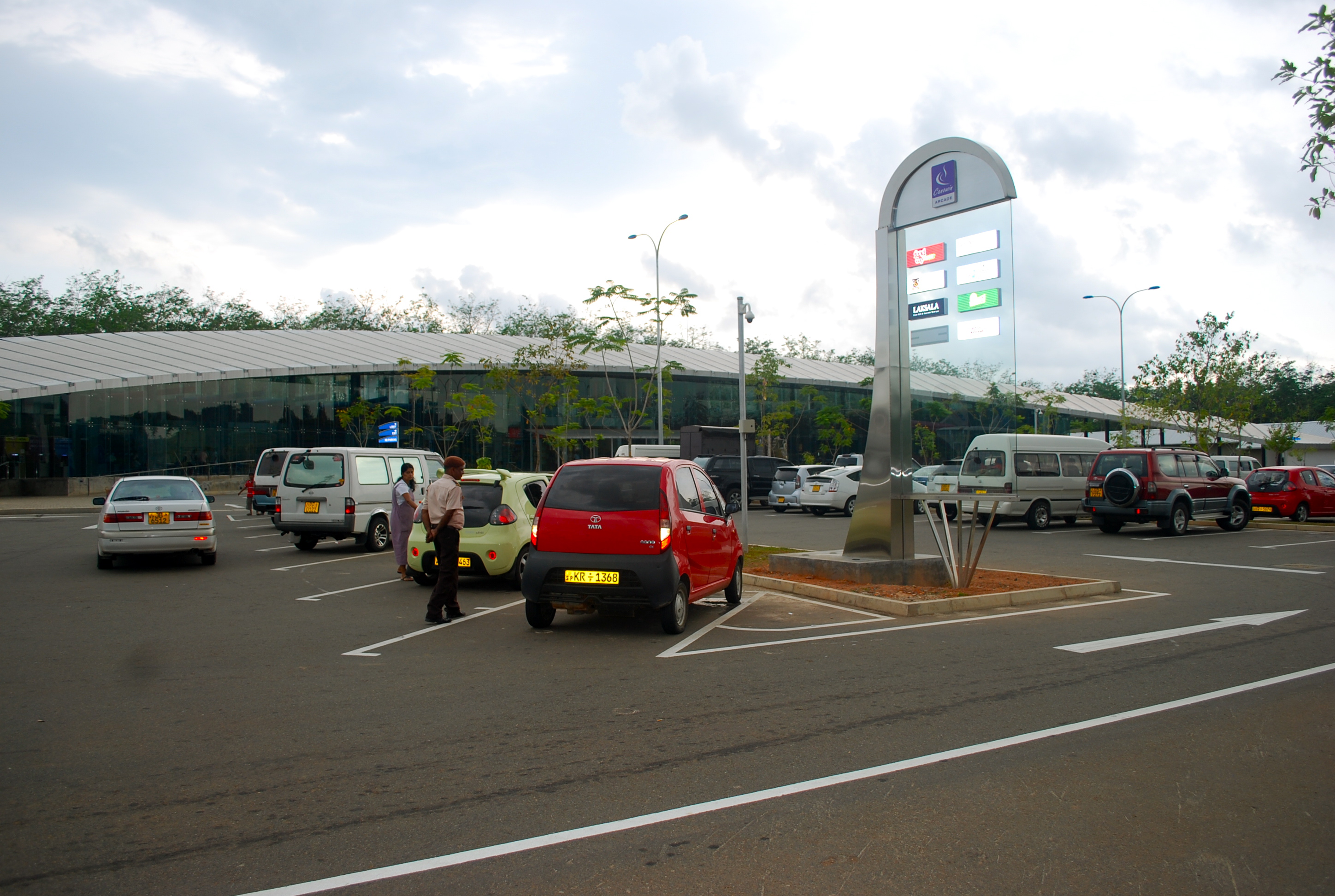
The ultra modern service center on the new tollway between Colombo and Galle, Sri Lanka completed within the last year. ©Jean Janssen

The ultra modern service center on the new tollway between Colombo and Galle, Sri Lanka completed within the last year.
©Jean Janssen

The maximum speed on the toll way is 110 km.  If you are caught speeding, you are not chased down, but the policeman calls the tollbooth.  When you exit the toll way you must pay the ticket.  We saw several policemen with speed guns and giving tickets.  Motorists also flashed their lights at oncoming motorists to let them know there was a speed check ahead.  (My daddy taught me this and when I was younger it was quite common for Texas motorists to flash their lights when a highway patrol car was up ahead.)

Lotus flower, Galle, Sri Lanka. ©Jean Janssen

Lotus flower, Galle, Sri Lanka.
©Jean Janssen

We had a terrific guide who used the trip out to provide some interesting information about Sri Lanka.  I’ll share the highlights.  The National Sport is volleyball, but cricket is the most popular.  The blue water lily is the national flower.  Smoking in public is totally outlawed and you will be given if seen; no ads for cigarettes are permitted; and the cigarette package must display a picture of a cancer patient.  Children receive a free education from ages 5-14; the country’s literacy rate is 92%.  From age 5, children are taught either Sinhalese or Tamil and English.  In the 6th grade, you begin learning the 3rd language-Sinhalese or Tamil.

I was just able to catch these water buffalo (right corner) from the bus window.  They are headed into a rubber tree forest. ©Jean Janssen

I was just able to catch these water buffalo (right corner) from the bus window. They are headed into a rubber tree forest.
©Jean Janssen

On the drive to Galle we saw all the major cash crops growing near the highway-tea, rubber, oil palm, rice, cinnamon, bananas, and coconuts.  Water buffalos are still used in cultivation, but the industry is becoming more mechanized.  We saw many water buffalos along the highway, mostly grazing, and one in town pulling a trash cart.  There are 10,000 man-made lakes in Sri Lanka to supply water for rice cultivation.  Rice and curry are the food staples.  There are no canned or frozen fruits or vegetables; all are fresh.  There are no enough cows to keep up with the demand for milk in Sri Lanka; powdered milk is imported from New Zealand, Australia, and Denmark.

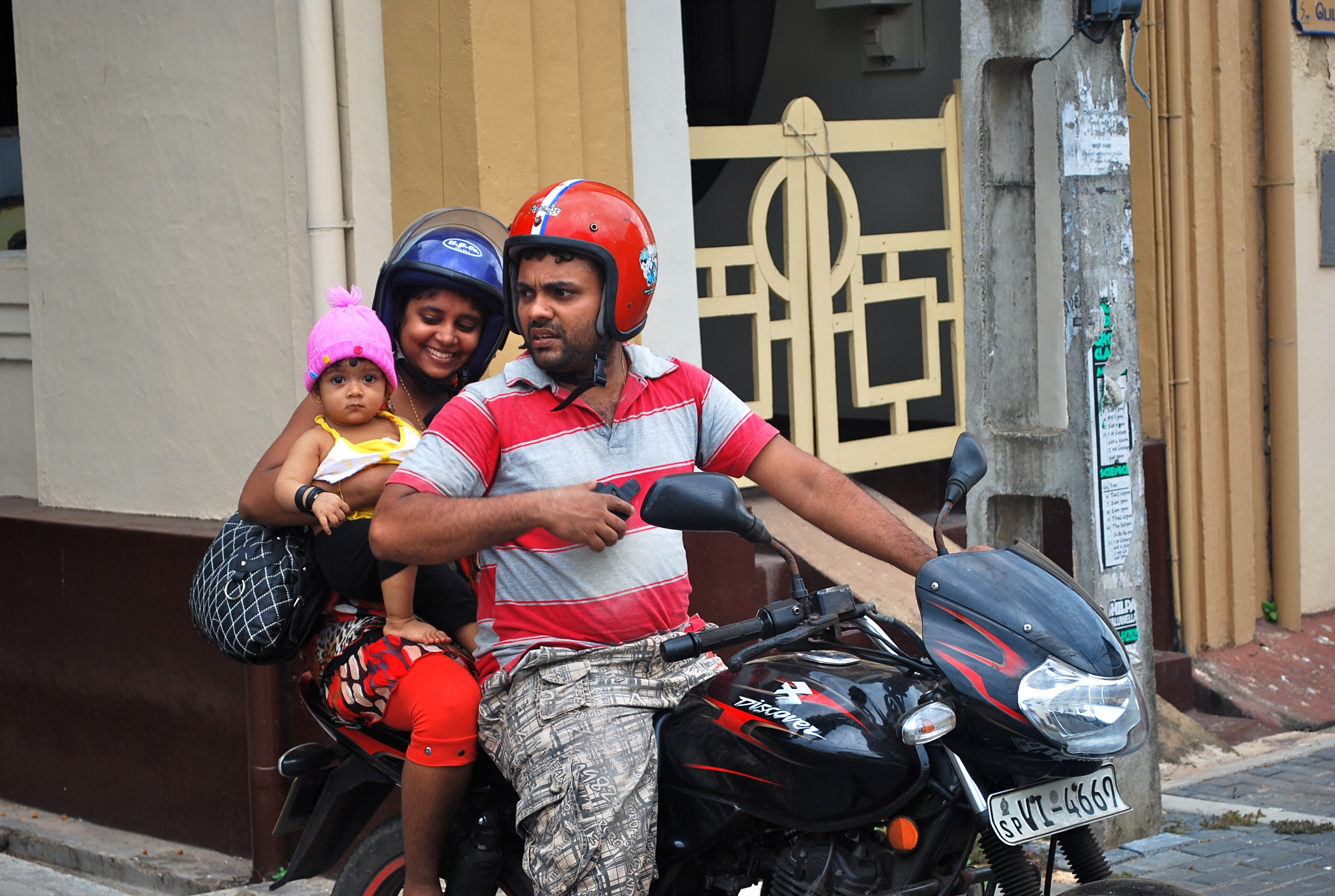
Family out for the holiday in the Dutch Fort, Galle, Sri Lanka. ©Jean Janssen

Family out for the holiday in the Dutch Fort, Galle, Sri Lanka.
©Jean Janssen

The government has promoted population control and the number of children couples are having has been reduced from 6-12 to 1-3 in a single generation.   While the cities are crowded, the country homes we saw were relatively large, widely spaced, and quite colorful.  The average age for marriage is 28 for men and 26 for women.  The divorce rate is 10-15 % and 50% of marriages are arranged.  Dowries are no longer common and the caste system is no longer part of Sri Lankan life (except in the Tamil communities). The use of all white uniforms in school was instituted to remove caste distinctions.  An astrologer is consulted for the timing of all major life events.  When a child is born the date and time of birth dictates the child’s name (as determined by the astrologer).

Former village life home in Sri Lanka.  The mother and children stayed inside while father slept on porch.  Note that porch is 3/4 of the home.  At the Martin Wickramasinghe Museum of Folk Culture in Koggala, Sri Lanka. ©Jean Janssen

Former village life home in Sri Lanka. The mother and children stayed inside while father slept on porch. Note that porch is 3/4 of the home. At the Martin Wickramasinghe Museum of Folk Culture in Koggala, Sri Lanka.
©Jean Janssen

Just before reaching Galle, we stopped in Koggala Sri Lanka at the Martin Wickramasinghe Museum of Folk Culture.  Having written 95 books (7 or those in English), Martin is considered the “Shakespeare of Sri Lanka”.  He was completely self-taught.  The museum is found in the village where he grew up and his birth home is open for touring.  In separate buildings, the interior exhibits included artifacts used by a Sri Lankan family in everyday life.  My favorites were the entertainment pieces like the masks; some were the “supernatural figures” used for rituals.  Others were the “natural” ones, like the red-faced man that the guide told us represented a sunburned European. There is also a wonderful puppet collection.

Stilt fisherman in the Indian Ocean, Galle, Sri Lanka. ©Jean Janssen

Stilt fisherman in the Indian Ocean, Galle, Sri Lanka.
©Jean Janssen

Our next stop was to see the stilt fisherman along the beach.  This is the only place in the world they can be seen.  Usually they have finished by this point in the day, but they stayed for us (and probably a significant donation from the cruise line).  It was very unique.  They would proudly show their catch, probably made several hours before our arrival.  I noted that most of what they showed us was very small and looked like aquarium fish or the ones I see while scuba diving on a coral reef.

Beach at Galle with the old Dutch Fort in the Background at the Lighthouse Hotel, Galle, Sri Lanka. ©Jean Janssen

Beach at Galle with the old Dutch Fort in the Background at the Lighthouse Hotel, Galle, Sri Lanka.
©Jean Janssen

After the fisherman, we continued our drive along the beautiful beaches along the Indian Ocean where there is (what our guide described as) unplanned tourism.  We saw lots of surfers out and people enjoying a holiday by the beach.  The southeast portion of Sri Lanka is where the tsunami hit in 2004 and we saw evidence of some places were reconstruction has not taken place.  In one hour, 50,000 people were killed.  There is now an alarm system in the Indian Ocean to provide warnings.  Formerly schools were placed near the beaches to catch the cool breeze.  Luckily the tsunami hit on Boxing Day (December 26), a holiday and the children were not in school.  The school buildings are now all at inland locations.  Ironically, the fishermen out that day were not hurt; they rode the wave.

Staircase at the Lighthouse Hotel designed by Jeffery Bower in Galle, Sri Lanka. ©Jean Janssen

Staircase at the Lighthouse Hotel designed by Jeffery Bower in Galle, Sri Lanka.
©Jean Janssen

We passed the Dutch Fort and went to the Lighthouse Hotel designed by Jeffery Bower for our fabulous buffet lunch.  The stir-fried (and freshly caught) seafood was my favorite.  I also tried several different curries.  The hotel has a lovely setting right on the beach with the waves crashing up against the rocks.  We had a wonderful seat by the window.  One of the design highlights was the intricate metalwork staircase railing that caught your eye the moment you walked into the hotel.  It is part of the Small Luxury Hotels of the World collection.  After I finished, I had time to wander around to take photographs and talk to one of the friendly tok-tok drivers in the car park.

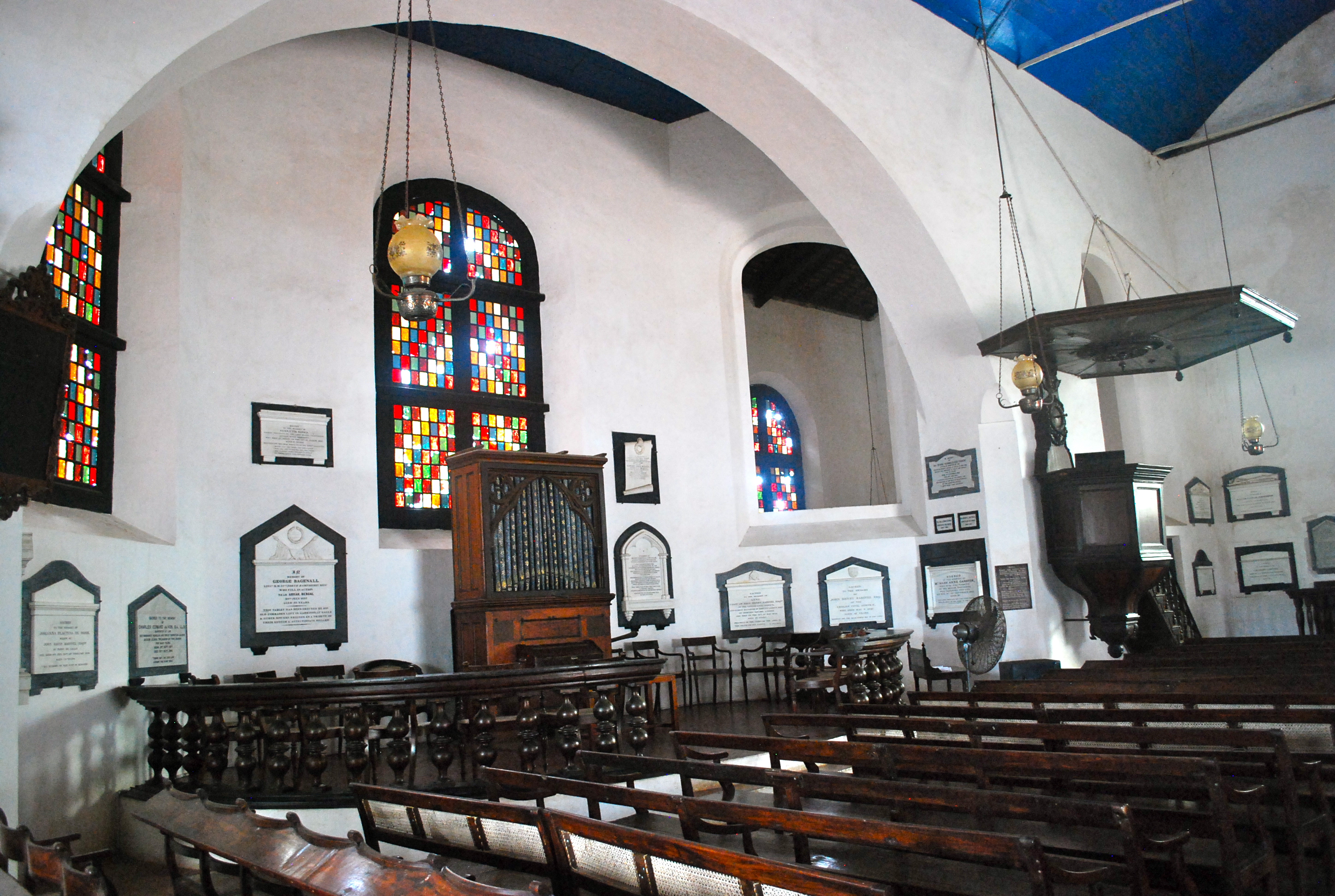
The Dutch Reformed Church built in 1755 at the  Dutch Fort in Galle, Sri Lanka.  The pulpit and organ are original. ©Jean Janssen

The Dutch Reformed Church built in 1755 at the Dutch Fort in Galle, Sri Lanka. The pulpit and organ are original.
©Jean Janssen

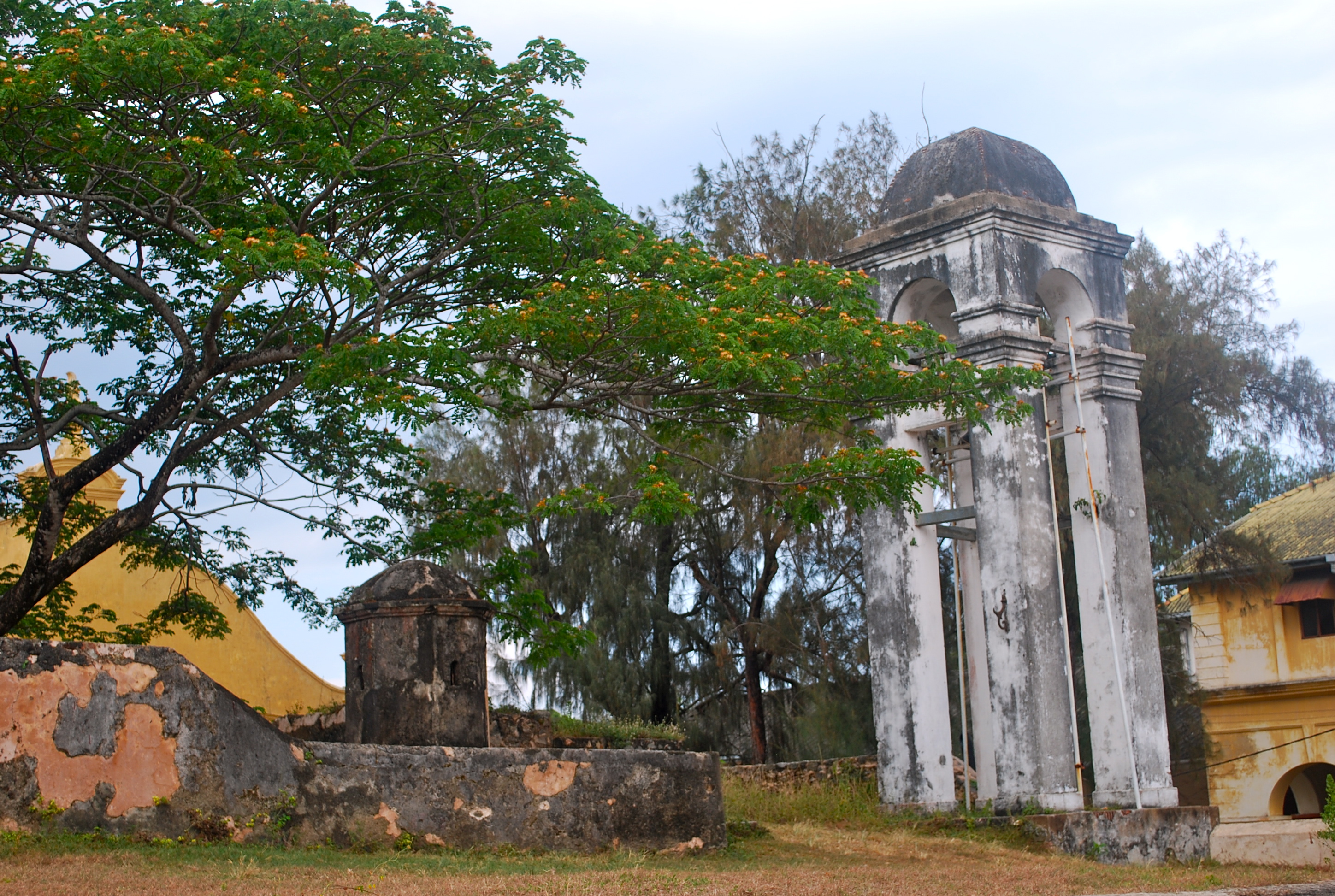
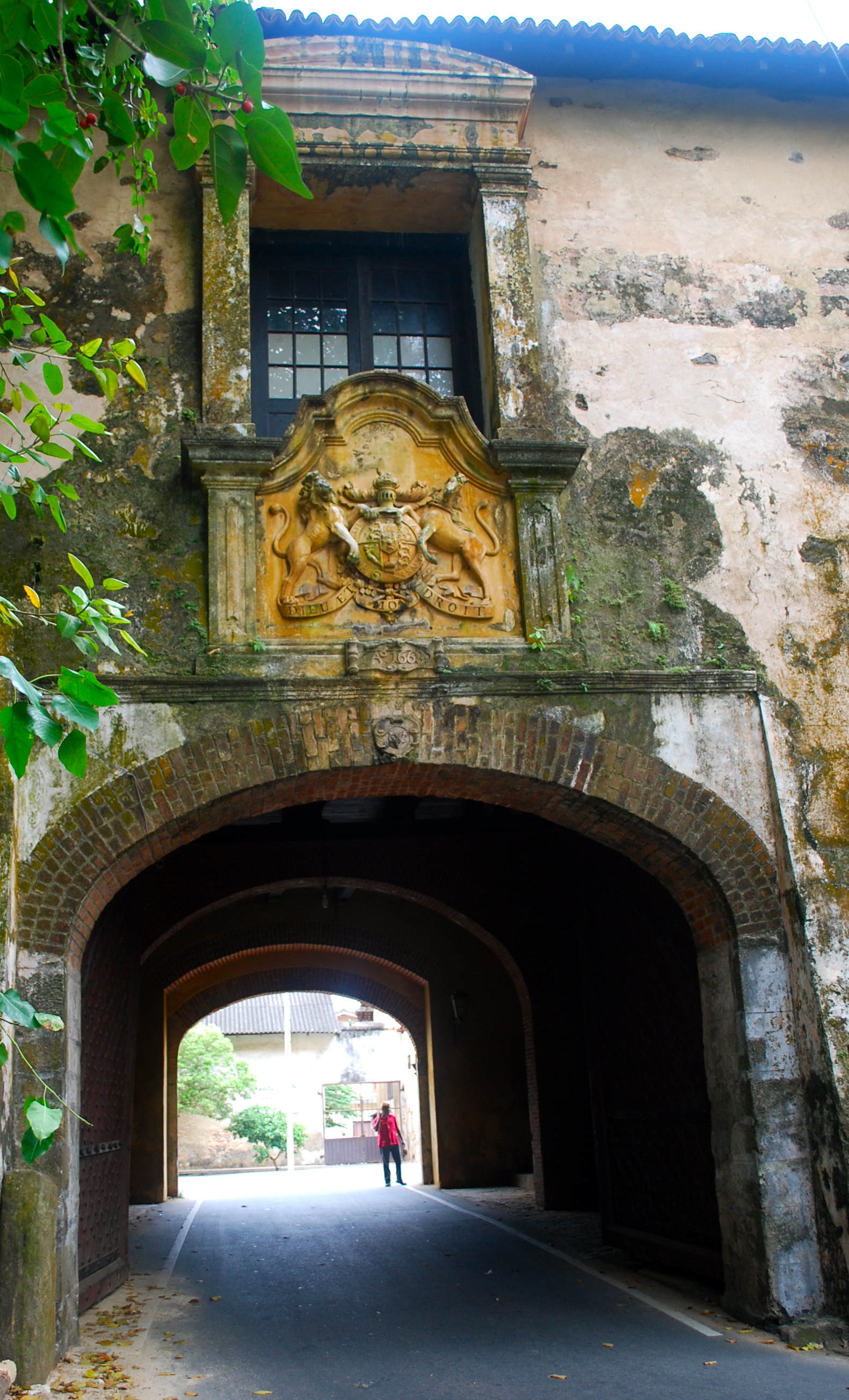
After lunch we toured the Dutch Fort (actually visible from the hotel), beginning with the Old Dutch Church with the original pulpit and organ from the 1755.  The ramparts and many of the buildings survived the 2004 tsunami.  The stones in the graveyard the tall mature trees were evidence that the ramparts had provided protection.  From the church we walked around to see the ancient Dutch Warehouse and the city gate with a British coat of arms on one side and a Dutch coat of arms on the other.  We saw the section of the fort walls originally built by the Portuguese in 1510.  The Dutch added the rest of the coral and granite ramparts.

The old Dutch Fort, Galle, Sri Lanka. ©Jean Janssen

The old Dutch Fort, Galle, Sri Lanka.
©Jean Janssen

Coat of arms at a city gate in the Old Dutch Fort, Galle, Sri Lanka.  The Dutch coat of arms is one side and the British is on the other. ©Jean Janssen

Coat of arms at a city gate in the Old Dutch Fort, Galle, Sri Lanka. The Dutch coat of arms is one side and the British is on the other.
©Jean Janssen

We walked down past more beautiful trees and the district court to where the rampart access opened up again.  As it is a holiday, there were many families picnicking along the walls.  It was not until I climbed up to the lighthouse and looked down that I saw the many Sri Lankan families on the beach enjoying the holiday.  It was hot and I would have loved to join them.  I continued walking down the fort walls to a lookout point just above the rocks.  Below, boys on holiday had made their way out to the rocks and were enjoying the attention and their triumph.  The ethnic and religious mix of the people was obvious from their dress, but all seemed to enjoy the day in harmony.

Sri Lankan families celebrate a Poya (full moon) Holiday at the beach on the Indian Ocean.  Galle, Sri Lanka. ©Jean Janssen

Sri Lankan families celebrate a Poya (full moon) Holiday at the beach on the Indian Ocean. Galle, Sri Lanka.
©Jean Janssen

Gypsy snake charmer at the clocktower at the Dutch Fort at Galle, Sri Lanka.  He has a cobra, python, or dressed monkey for you to have a picture with. ©Jean Janssen

Gypsy snake charmer at the clocktower at the Dutch Fort at Galle, Sri Lanka. He has a cobra, python, or dressed monkey for you to have a picture with.
©Jean Janssen

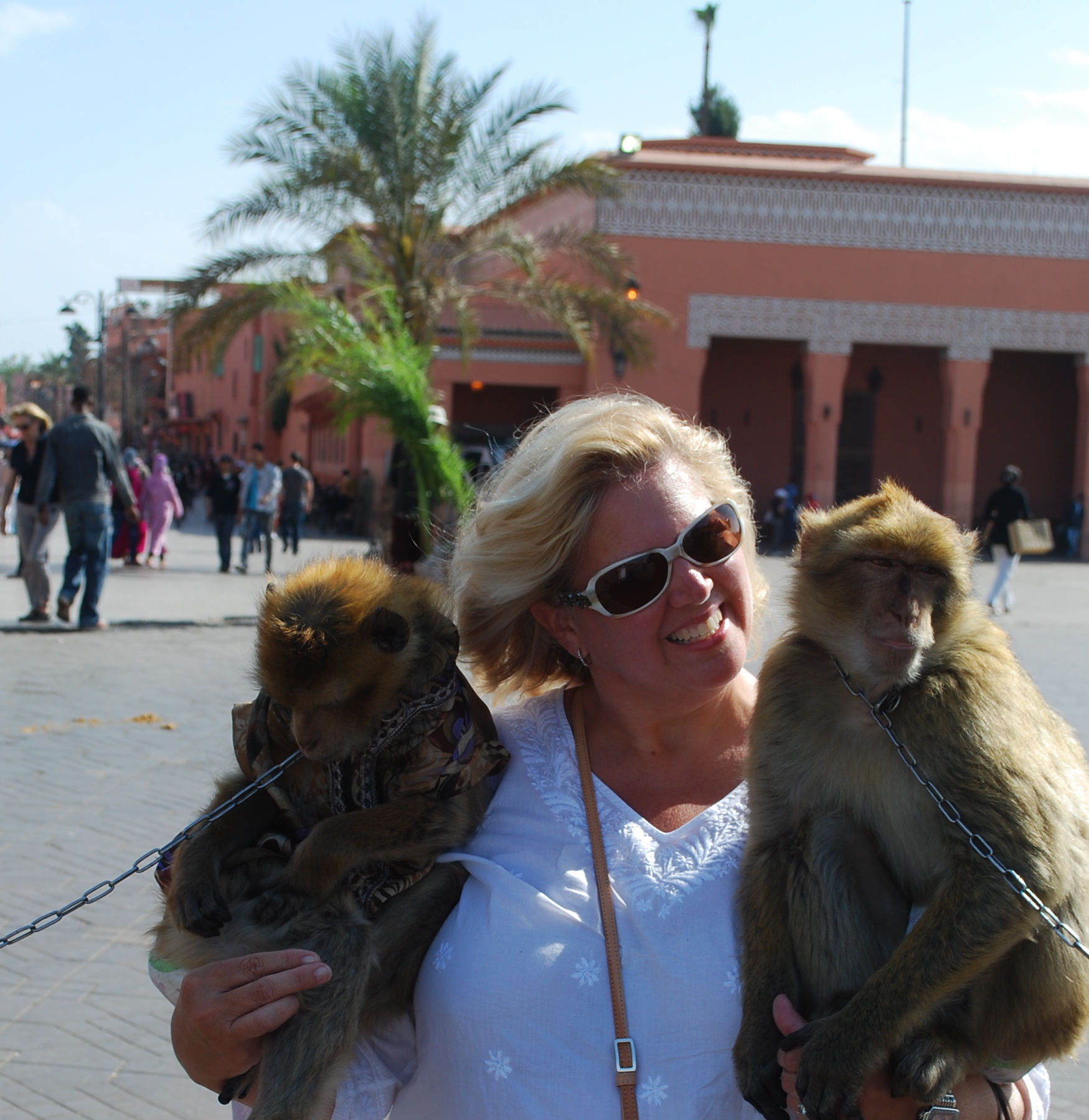
The bus took us to the final stop in the Dutch fort with a view of the clock tower and other sections of the ramparts.  At the bottom a gypsy played his horn for a cobra in a basket.  If that was not to your taste, he also had a python he would wrap around your neck for a picture or a small, dressed monkey that was happy to climb up on you for a photo.  His partner passed around the basket.  I reminded me of our trip to Marrakesh, Morocco of just a year ago this month.

From this vantage point, we could see the newly constructed International Cricket Field and look out of the rooftops of the centuries-old buildings inside the fort walls.  We could also see the storm that was coming in and boarded our bus for the return ride back to the ship just before the rains came.  Boris wasn’t up to climbing this section of the rampart after a full day of walking, but it wasn’t like he didn’t see anything.  Two gypsies were arrested and the third came up to the bus to get on and sell her palm-reading services.

Rooftops and flowers as seen from the clock tower at the Dutch Fort in Galle, Sri Lanka. ©Jean Janssen

Rooftops and flowers as seen from the clock tower at the Dutch Fort in Galle, Sri Lanka.
©Jean Janssen


Along the rampart, Dutch Fort, Galle, Sri Lanka. ©Jean Janssen

Along the rampart, Dutch Fort, Galle, Sri Lanka.
©Jean Janssen

We had a nice ride back with only one stop at the newly constructed rest area with a food court, tea shop, and souvenirs.  The clean, western-style restrooms were appreciated.  Everyone was back on the bus on time except for one person we waited 15 minutes for who was shopping-Boris.  He hates people being late, so this was most unlike him.  I was on the bus so I got to hear what everyone had to say about it.

Natasha along the ramparts at the Dutch Fort in Galle, Sri Lanka.

Natasha along the ramparts at the Dutch Fort in Galle, Sri Lanka.

We caught up with our friends from Birmingham, the Barnes, who had been to the elephant orphanage and rode out on one of the old British-style trains.  They had a good day.  They enjoyed tea on the train and got to see the elephants’ bath.  We met them at the bar and joined them for dinner.  Then we all went back to our rooms to watch the ship leave the harbor as we departed Sri Lanka.  (Like us they have a fantail room on the back of the ship.  They are one floor up, just above us.)  Just as the pilot left the boat, it started to drizzle.  For the second time today, we just beat the rain.  Another country to add to my list; I think that is 94.

Dutch Fort, Galle, Sri Lanka. ©Jean Janssen

Dutch Fort, Galle, Sri Lanka.
©Jean Janssen


This is where you get those fresh fruits and vegetables.  Love the twist with the bus in the background. ©Jean Janssen

This is where you get those fresh fruits and vegetables. Love the twist with the bus in the background.
©Jean Janssen

Dutch Warehouse from 1700's in Galle, Sri Lanka.  Everyone knows that Natasha likes taking pictures of windows and doors. ©Jean Janssen

Dutch Warehouse from 1700’s in Galle, Sri Lanka. Everyone knows that Natasha likes taking pictures of windows and doors.
©Jean Janssen


Posted in cruises, international | Tagged , , , , | 3 Comments