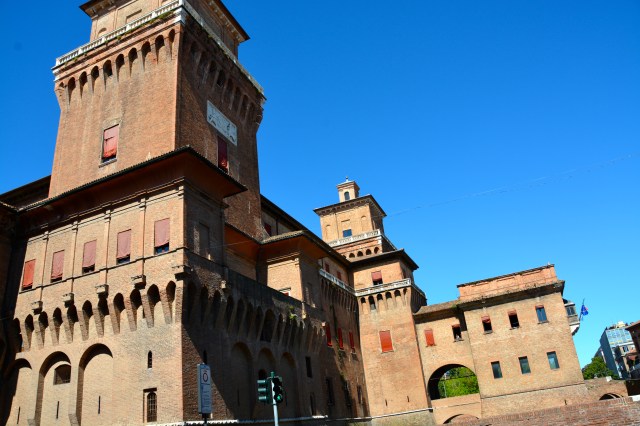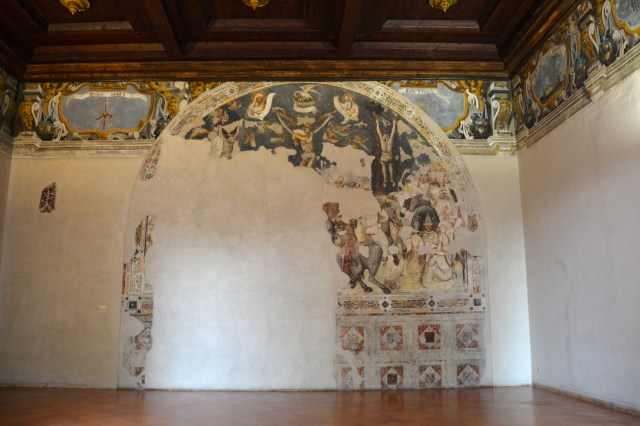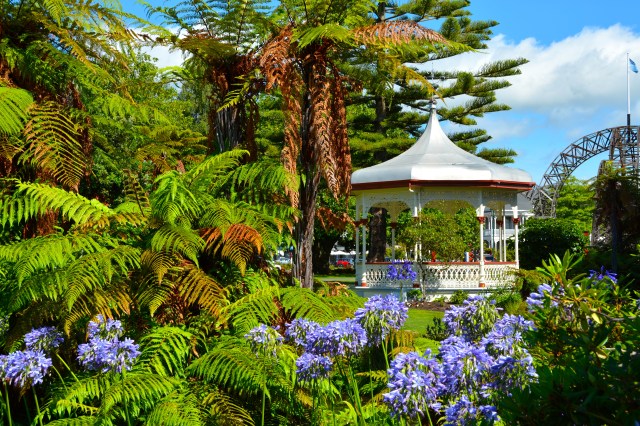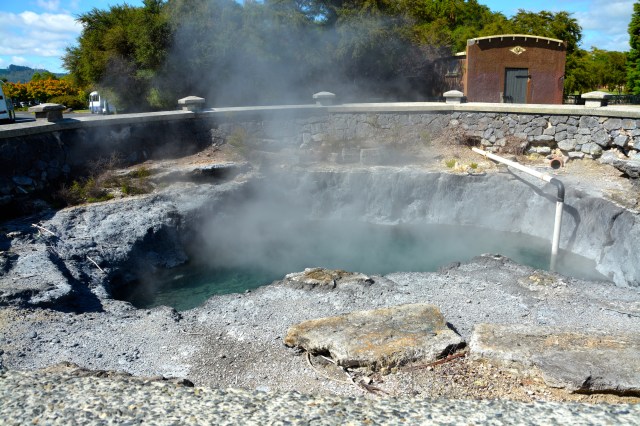
Mantua, Italy

DSC_7779 - Version 2

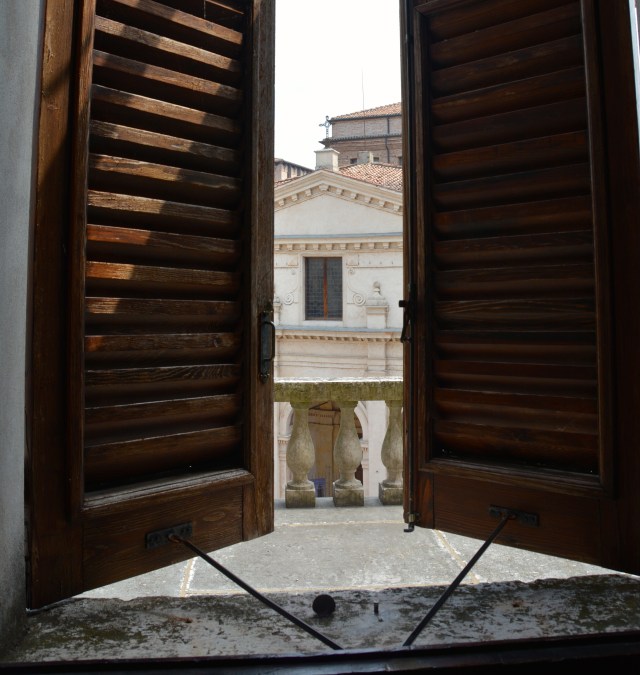
A view from the Ducal Palace in Mantua, Italy ©Jean Janssen

About now you are saying, “where have I heard of Mantua?  It sounds familiar.”  In Act III of Shakespeare’s Romeo and Juliet, Romeo is banned from Verona for slaying Tybalt.  He flees to Mantua.  Ah, a city of romance.  Locals call the Mantua, La Bella Addormentata, a sleeping beauty.  That is because the city hasn’t changed since the middle ages. Surrounded on three sides by artificial lakes created almost 1,000 years ago, the city was effectively cut off from the outside world.
IMG_4912

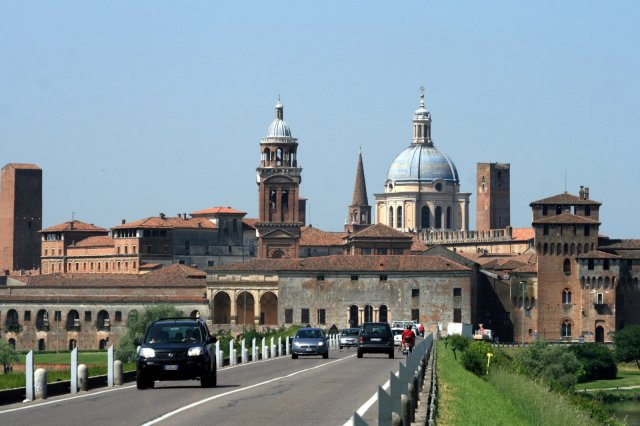
Approaching Mantua, Italy

The approach to Mantua is striking as you cross the narrow bridge heading straight to the castle.  There is an outer road with parking, although with our early arrival we took a chance that there was parking closer in.  Vehicular traffic within the city walls is very limited.  We were fortunate to find a spot just past the cobble-stoned Piazzo Sordello.
DSC_7602

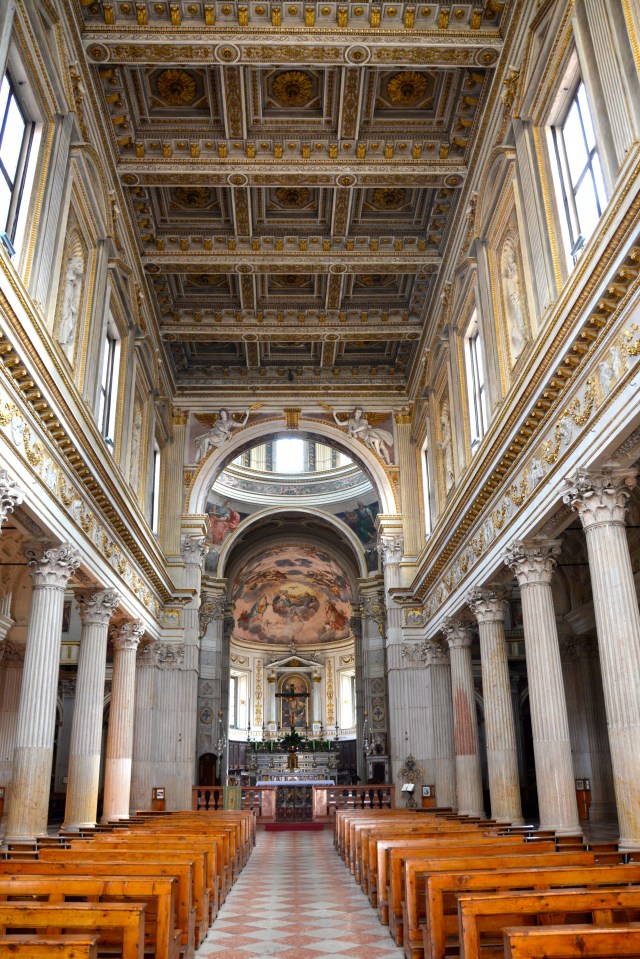
Duomo of San Pietro, Mantua, Italy. ©Jean Janssen
DSC_7613

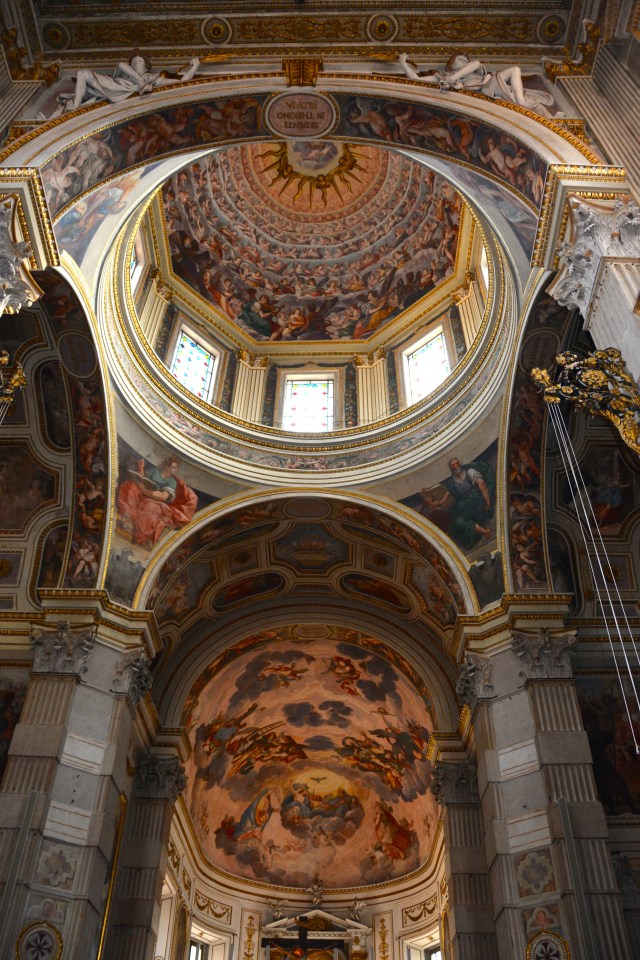
The beautiful paintings which adorn the ceiling of the Cathedral of Saint Peter on Piazza Sordello, Mantua, Italy. ©Jean Janssen

The Ducal Palace and the Cathedral form two sides of the huge Piazzo Sordello.  Always a sucker for churches, I wandered inside the Cathedral, the Duomo San Pietro, and found a beautiful painted ceiling.  Amazing ceilings would be the theme of the day.  (Never did I see so many fabulous ceilings as I did on my morning touring in Mantua.)

DSC_7874

The Carrara marble facade of the Cathedral, the Duomo of San Pietro, built between 1756 and 1761 as seen across the Piazza Soldello in Mantua, Italy. ©Jean Janssen

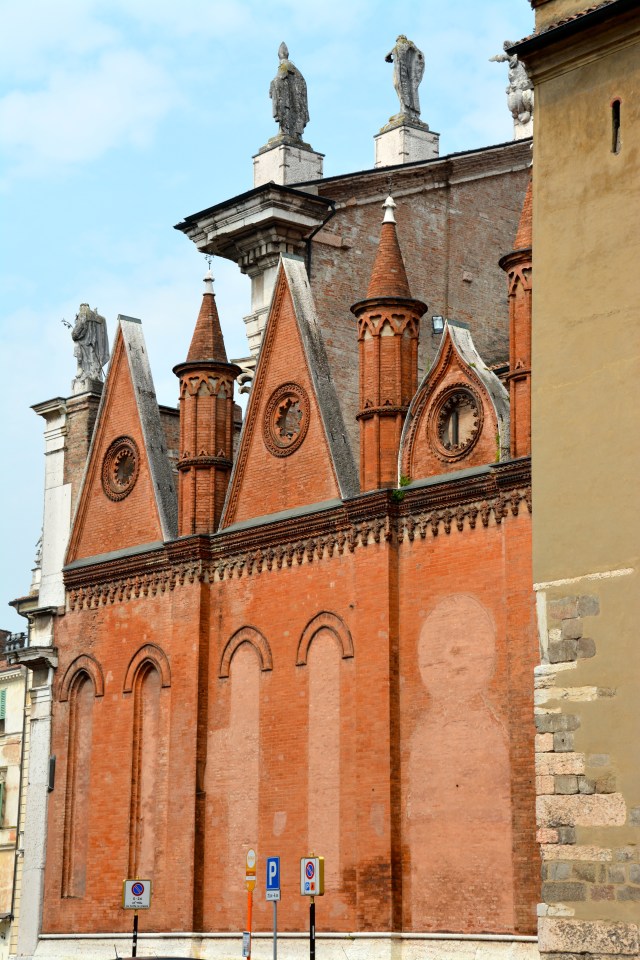
Just as beautiful as the interior was the exterior facades, both the entrance facing the Plaza and the side wall facing the Palace.
DSC_7689

The Cathedral was already in existence in the 11th Century and has been rebuilt several times.  The right side facade of the Cathedral shows the walls of the Gothic Chapels facing the Ducal Palace.  Duomo of San Pietro, Mantua, Italy.   ©Jean Janssen

We got our tickets for the Palace and Castle just off the Piazza and the agent directed us to the Castle for our first stop.  We also purchased the audio guides in English.  If you want more background on the art in these two locations, the audio guide might be a wise addition at 5 euros.  There was signage in both Italian and English throughout the castle and palace, so you can also get by without the audio guide.  Boris got more information from his guidebook and tended to not use his audio guide.
DSC_7630

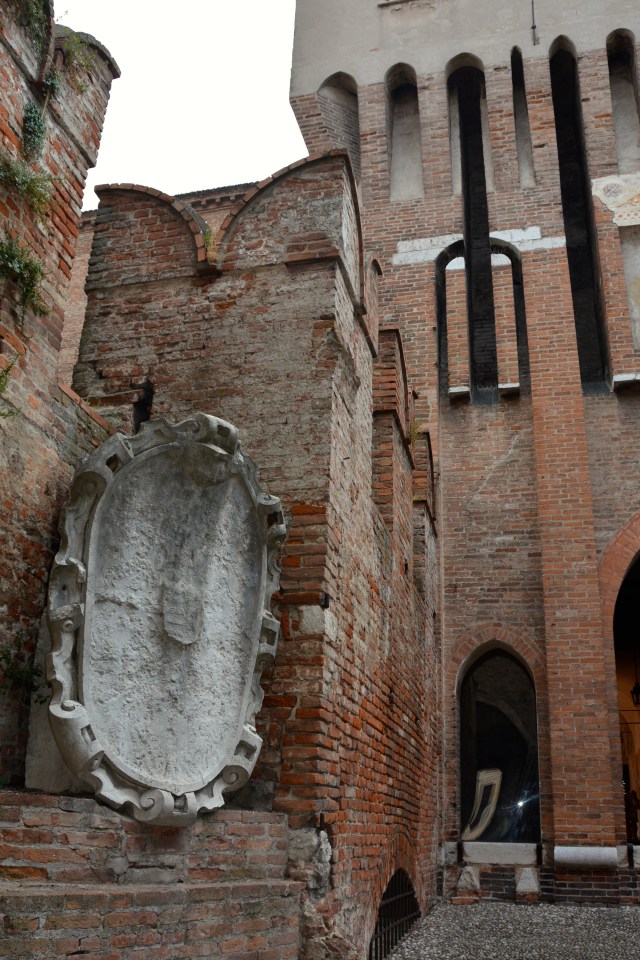
Entrance to the Castle of San Giorgio, Mantua, Italy. ©Jean Janssen
DSC_7679

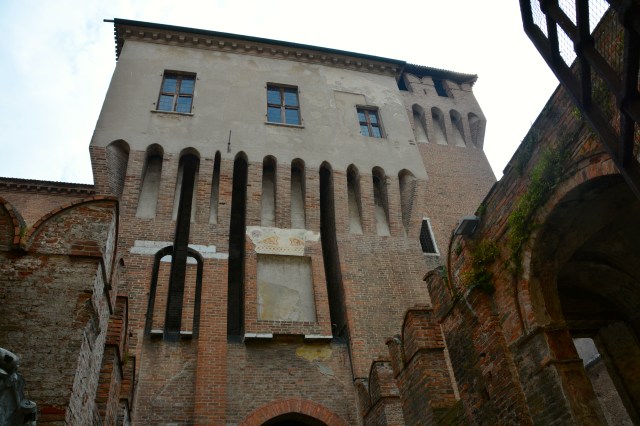
Towering entrance to the Castle of San Giorgio, Mantua, Italy. ©Jean Janssen

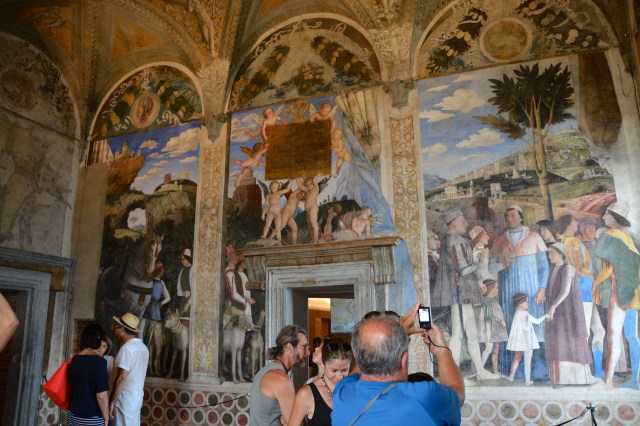
Crossing over the moat, you enter the Castle San Giorgio and are directed to the rooms open on exhibit.  The castle was built between 1390 and 1406.  When we visited there was also a special art collection, on loan until 2025, so the exhibit area is enclosed with glass doors.  The most celebrated frescos are found in the bride’s room or wedding chamber know as the Camera degli Sposi (Painted Room).  This small square chamber was originally a bedroom.  You are limited as to the amount of time you can spend in this room for purposes of crowd control.
DSC_7645

One wall of the Camera degli Sposi in Castle San Giogio, Mantua, Italy. ©Jean Janssen

The Renaissance painting of the room was done between 1465 and 1474 by Andrea Mantegna for Ludovico and his wife Barbara of Brandenburg depicting events in the history of the Gonzaga family.  It is the only work of its kind by Mantegna still in place.

DSC_7637

The ceiling of the Camera degli Sposi. The use of the oculus and the blue painted “sky” and clouds is intended to trick the eye into the feeling of height and openness.        ©Jean Janssen
DSC_7655

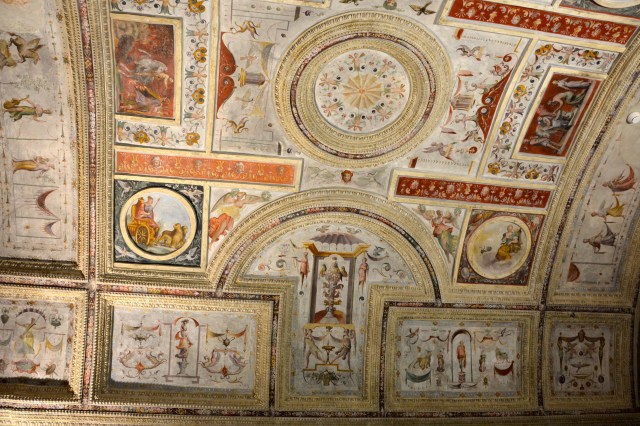
A completely different type of painted ceiling in the Castle of San Giorgio, Mantua, Italy. ©Jean Janssen

We toured more rooms full of paintings and ceramics on loan, each featuring wonderful painted ceilings.  These spaces were originally the apartments for Ludovico II and his wife Barbara of Brandenburg.  After a major renovation of the castle beginning in 1459, the apartments were used by Isabella d’Este, wife of Francesco II.

DSC_7660

Fabulous ceramic on display in the Castle San Giorgio, Mantua, Italy. ©Jean Janssen

DSC_7666

Photo by Boris. Natasha in the courtyard of Castle San Giorgio, Mantua, Italy.

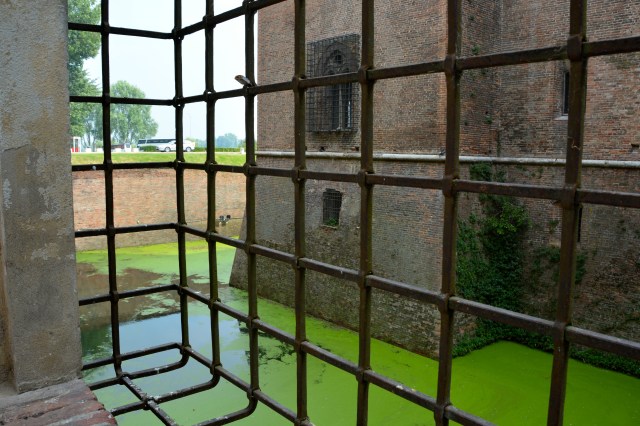
After finishing our tour of the castle interior, we stopped to look at the very green moat.  Not the most attractive sight, but a lot of castle moats have been filled in or are dry, so it was nice to have one still sporting questionable water.  The idea was to keep people from going in/crossing it.  This green water works for me.
DSC_7683

The green water of the moat at Castle San Giorgio, Mantua, Italy. ©Jean Janssen

Passing through the Piazzo Castello (currently under major construction), we returned to Piazza Sordello to tour the Ducal Palace.  The Palazzo Ducale is a complex of buildings with more than 500 rooms. Not all are on the tour, but there are more than enough to have your head spinning.  Even if you are not up for buying a ticket to view the Palace itself (a shame), you can walk into the lovely gardens free of charge.

DSC_7712

Boris viewing the gardens of Palazzo Ducale, Mantua, Italy. ©Jean Janssen

DSC_7869

Palazzo Ducale as viewed from Piazza Sordello in Mantua, Italy. ©Jean Janssen

This is “the largest residence in Italy after the Vatican”and was home to the Gonzaga family for over 300 years.  The Gonzagas held the duchy of Mantua until 1708 and ruled much like the Medicis did in Florence.
DSC_7700

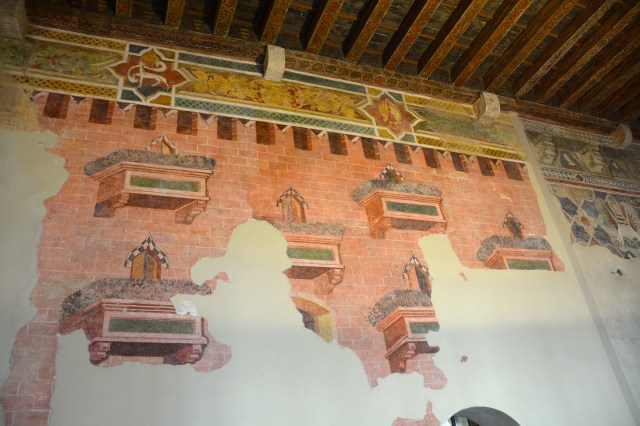
An enclosed courtyard featured a series of painted facades as each of these areas were originally separate entrances that were later enclosed. Palazzo Ducale, Mantua, Italy      ©Jean Janssen

We spent much of the morning touring the series of rooms which make up this complex of a “city within a city”.  The buildings and the decoration were added and joined over time between the thirteenth and seventeenth centuries.
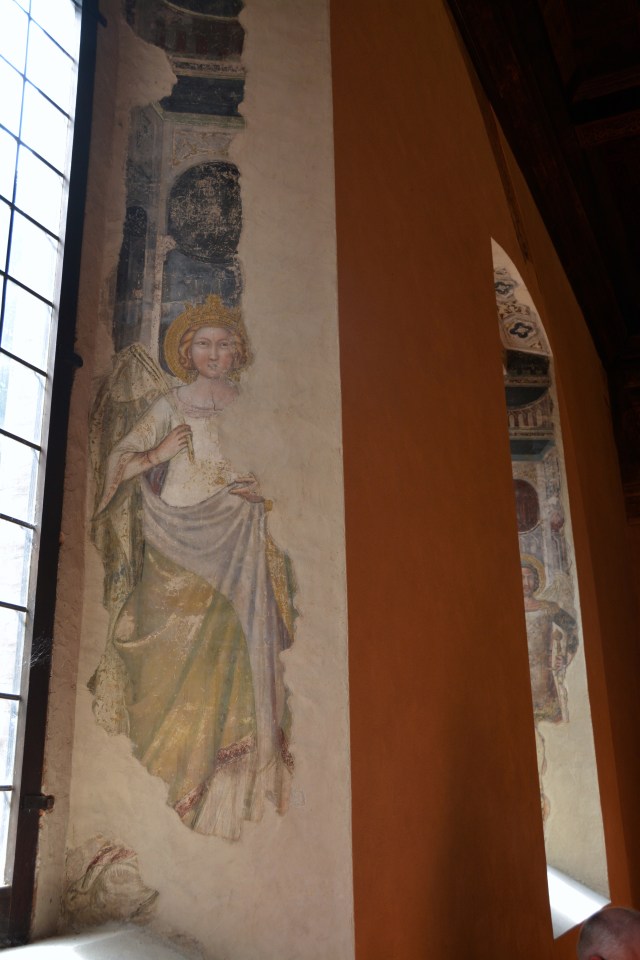
DSC_7729

Frescos can be found even in the areas framing the windows in Palazzo Ducale, Mantua, Italy. ©Jean Janssen

DSC_7752

The frescos on the walls of the Sala del Pisanello were never completed. This one details the Tournament of Louverzep. The uncompleted works by Pisanello depict Arthurian legend. ©Jean Janssen

The buildings were almost abandoned during the early 1900s.  Today, there are still areas under restoration.  The art on the buildings was most impressive, although I admit to a preference for the ceilings rather than the walls.  Below I give you a sampling of what you can see.  It is incredible.
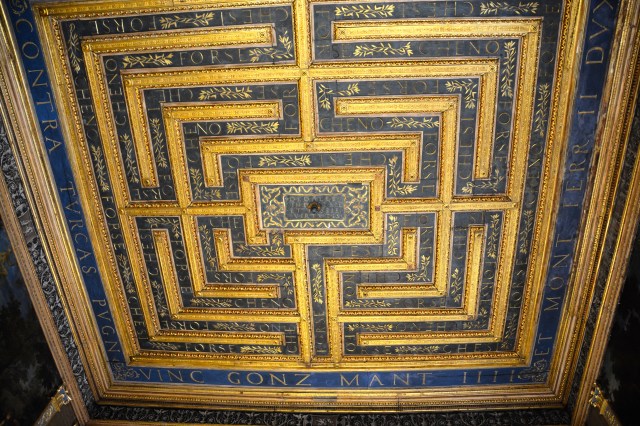
DSC_7768

The labyrinth depicted on the ceiling gives this room in the Ducal Palace its name, Sala del Labirinto. The ceiling was originally in the palazzo of San Sebastiano. Mantua, Italy        ©Jean Janssen
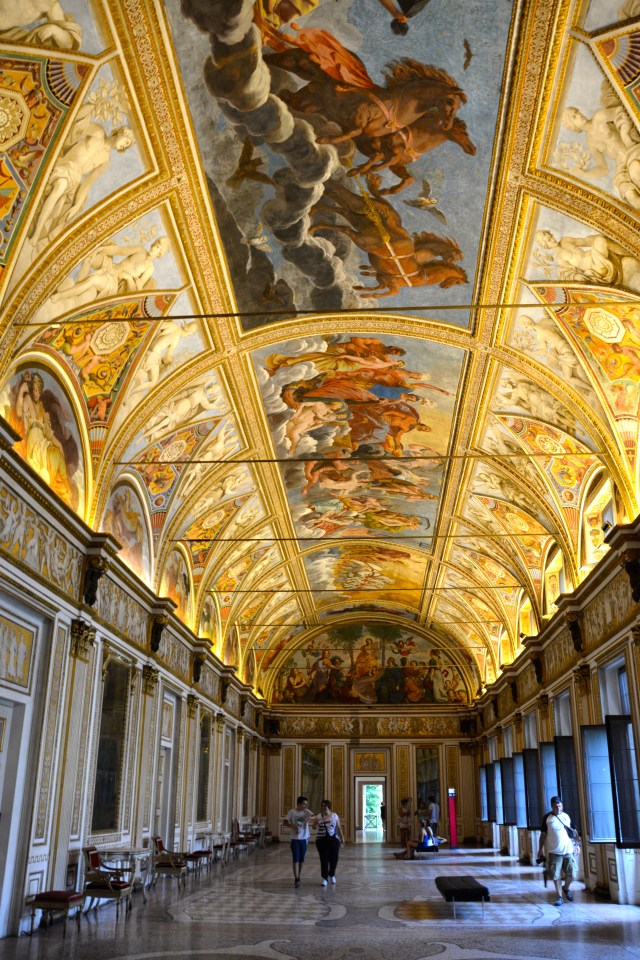
DSC_7790

In the Palazzo Ducale, Mantua, Italy ©Jean Janssen

DSC_7819

Boris walks the Salone dei Fiumi (Hall of Rivers), built as a loggia in 1575. ©Jean Janssen

DSC_7822

The grottos at each end of the Hall of Rivers in the Palazzo Ducale in Mantua, Italy were added in the late seventeenth century. ©Jean Janssen
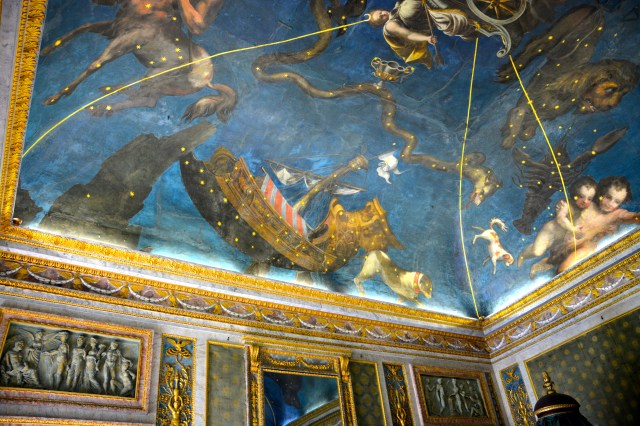
DSC_7814

Sala dello Zodiaco in the Palazzo Ducale in Mantua, Italy. Walls were done by Pozzo, the ceiling by Lorenzo Costa the Younger. ©Jean Janssen

After completing the Palazzo, we walked through the archway at the end of Piazza Sordello coming to the shopping area with its famous eateries under the porticos.  We got our first view of the clock tower, Torre dell’Orologio, built in 1473.  The adjacent Palazzo (to the left of the tower) was under renovation.  To the right of the tower was the Rotonda of San Lorenzo, a circular Romanesque church; it is also the oldest church in Mantua (1082).  Guglielmo Gonzaga closed and partially demolished it in 1579.  Between 1908 and 1926 the missing parts were rebuilt.  Inside there is a two-story ring aisle. It was beautiful in its simplicity.

DSC_7856

The Torre dell’Orologio and the Rotonda of San Lorenzo, Mantua, Italy. ©Jean Janssen

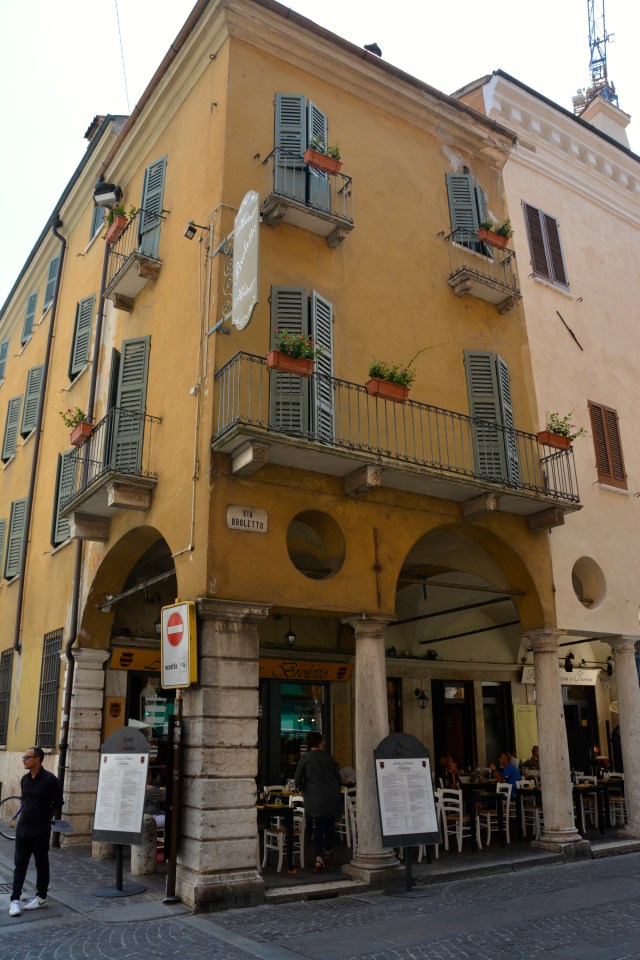
Just across the piazza from the Rotonda is the Basilica of Saint Andrea.  While I had the opportunity to admire the facade, the residents were taking their midday break and many things were closed to visitors at that time.  If you can’t beat them, join them.  Boris and I took our lunch break at Antica Osteria Broletto.  Boris had eaten there before and enjoyed their refreshing chilled house red wine.

DSC_7844

Interior of the Rotonda of San Lorenzo, Mantua, Italy. ©Jean Janssen

One of the regional specialities is donkey, but I just couldn’t go there.  So instead I ordered the pumpkin ravioli popular in this area.  Boris ordered our starter, an antipasti platter of sliced meats with a freshly-made warm orange jelly.  He had a regional favorite, risotto with sausage.  My ravioli was fabulous, but it was a little strange having something so sweet as a main course.  We also had a carafe of the chilled Lambrusco (which I would never order at home, but the Mantua version was wonderful) and downed three large bottles of sparking water (acqua frizzante).
DSC_7857

Antica Osteria Broletto, our lunch stop in Mantua, Italy. ©Jean Janssen

It was an extremely hot day with midday temperature in the mid 90s (35 C).  The porch offered a little breeze and it was actually cooler outside than inside.  Afterwards, things were still closed but we walked over to see the exterior of the Accademia Virgiliana which was built for Hapsburg Empress Maria Theresa.  Afterwards, Boris was on the hunt for bottle of Mantua Lambrosco to take with us.  (He found some; we bought two.)
DSC_7782

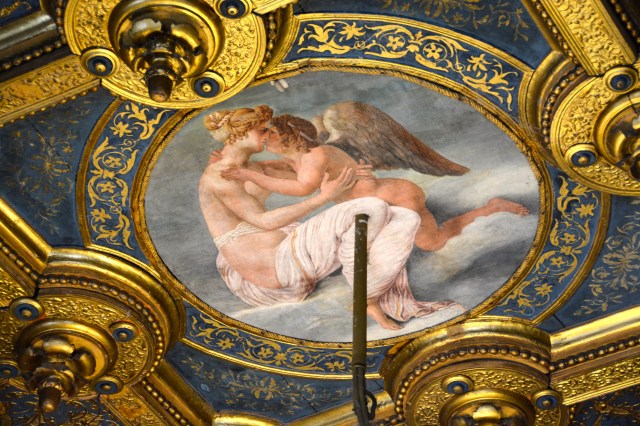
One of my favorite ceiling paintings in the Palazzo Ducale, Mantua, Italy. ©Jean Janssen

I had hopes of seeing the Teatro Scientifico where a young Mozart performed and the Palazzo Te, a lovely villa built by Fredorico Gonzaga II as a countryside residence to house his mistress.  It is one of Mantua “not to be missed sites” that I missed.  A boat ride on the lake would have been fun too.  Boris was hot, tired, and not excited about waiting to see when things would open up again.  Having been to Palazzo Te, he said I was not missing much.  When we got back to the house, our hosts told it differently.  He confessed he was just ready to come back.  Go see it for me; our hosts said the frescos are amazing.

DSC_7859

Viewing Piazza Sordello through the archway, Mantua, Italy.  ©Jean Janssen

We walked back through the covered opening into Piazza Sordello and to the car.  It was a little tricky finding a way out of the walled city, but we made it and headed back to Comcamarise.  I am doing the driving these days.  There is so much more to see and do in Mantua, I’ll need a return trip.

DSC_7794

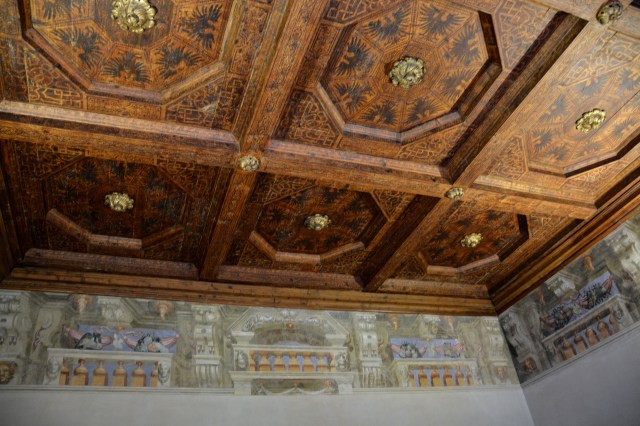
One end of a longer hallway in the Palazzo connecting two sections. The windows open to courtyards on either side. This was my favorite passageway in the Palazzo Ducale. ©Jean Janssen



Posted in international, Uncategorized | Tagged , , , , , , | 2 Comments

A Rough Start to Natasha’s Latest Visit to her Favorite Foreign Country-Italy

DSC_7887

Fields of sunflowers in the Italian countryside. ©Jean Janssen

I was going to start blogging on the day I arrived in my favorite foreign country, Italy, but we had such a rough start I wanted things to settle a little first.  When you have been to 110 foreign countries, it is a little tough to pick a favorite, but I don’t hesitate to tell people Italy when they ask.  I have been here between 15 and 20 times.  The love affair started on my honeymoon when Boris brought me to Italy for two weeks and I saw Rome, Assisi, Florence, San Gimignano, Siena, Venice, and a few other villages in between.  When Boris asked me to marry him, he thought to sweeten the deal.  He asked and before I could get a word out, he announced that he was converting to my religion and he thought we should go to Italy for our honeymoon.  Little did he know…

DSC_7720

A taste of what’s to come-perhaps the most fabulous collection of ceilings in the world          ©Jean Janssen

It is easy to get around the major tourists cities here even if you only know English.  However, a couple of years ago Boris started taking Italian lessons for fun.  “We are going to Italy so Boris can practice his Italian!”  Its a great excuse.  His command of the language has allowed us to go places a little farther flung-renting a farmhouse in rural Sicily for example-where English is not widely spoke if at all.

DSC_8172

From our villa, we can see the bell tower of the village church. Concamarise, Italy. ©Jean Janssen

This trip we are renting a villa in a village about a half hour south of Verona in northeastern Italy.  The original structure was a medieval tower that has been added on to.  The house sits prominently in the older section of Concamarise, its main gate next to the oldest church in the village.  You can see our front door as you look down the long drive.

We have been to Verona, but hope to explore some of the other specials cities and village nearby less frequented by tourists.  We also enjoy “going local” and getting a feel for what it would be like to live in this country (assuming I could own a villa).  Ok, so I couldn’t afford this as my home, but I can try driving, parking, shopping, drinking, and eating like an Italian.

DSC_8042

A taste of what’s to come…fabulous ceilings ©Jean Janssen

The short version of the travel saga is that we left Houston for a connection in Newark to Venice where we will pick up the car.  We ended up on that plane for over 9 hours for a flight that takes less than 4.  Air traffic control shut down Newark, so after circling we ended up getting diverted to Dulles for fuel and sat on the ground there until Newark opened again.  We landed in Newark two minutes after our plane to Venice took off.  Then we stood in line to get rerouted.  No more flights that night; no access to our luggage; and no compensation since it was a weather delay.

DSC_7979

A taste of what’s to come-fabulous castles with drawbridges and moats. ©Jean Janssen

Boris got us a hotel room and when we finally headed out of the airport two hours after landing, there were still people from our flight in line to find out what was going to happen to them.  Most couldn’t get hotel rooms (or couldn’t afford one).  We were rerouted through Brussels, not leaving until almost 24 hours after our flight to Venice was scheduled to depart.  We had a set time to pick up the rental car and to meet the Villa owner and so Boris (speaking Italian helps) had to spend much of his time changing all those arrangements.

We got to Venice eventually (about 27 hours after we were supposed to get there), but our luggage did not.  We then stood in line at the baggage counter forever to file our claim.  They could not locate our bags in the system.  Again, Boris speaking Italian helped.  We even called the Villa owner so they could help us complete the form.  Finally we made it to the rental car counter and got underway.

DSC_7897

Our beautiful villa in Concamarise, Italy. ©Jean Janssen

The villa is about 1.5-2 hours from the Venice airport.  However, after we left the autostrada, there were 15 different directional notes to follow to find the villa.  At one point we were stopped by a train and Boris needed a “convenience break”; he headed off into the corn field-have I told you yet this is farming country.  I got into the drivers seat, crossed the tracks, and pulled over to let the two-way traffic pass.  Boris eventually joined me.  I have been doing the driving ever since.  Best way to learn your way around is to be the driver.  We made it to the Villa.

That was four days ago.  As of today, the location of our luggage is unknown.  It hasn’t been scanned since the day we left Newark.  We have learned that because of the weather shutdown, over 700 travelers were stranded and almost 1000 bags were missing.  We have made due with the toiletries the two of us had in our possession.  I didn’t want to wear make-up on vacation right?

DSC_8169

The sunsets viewed from our pool house are fabulous. Concamarise, Italy ©Jean Janssen

Clothing is another story.  Which brings me to our first full day in Italy.  Arrival day we just checked in, slept, and ate as soon as a restaurant opened for the evening-usually 8 pm here.  I took a evening swim too-had to wait until it was getting dark because I had nothing to wear while swimming.  So, there are up sides to having no luggage.

The next morning we headed out to find a open air market where they sell cheap (new) clothing items.  I mean really cheap and you can get anything there-including underwear.  For less than 100 euros (less than $112), I got a pair of shoes, two pair of pants, 4 shirts, 2 dresses, and three pair of panties-and I was picky.  Ok, so I look like an old Italian lady-it was that or a sleazy look-but hey I might need clothes for the whole week.  You could have done it for less too.  (The strangest part was buying the panties from the old Italian guy.  I wanted a bra too, but I just didn’t want to have that conversation with him, with or without the translation issues.)

DSC_7724

A taste of what’s to come-frescoed chapels ©Jean Janssen

After the market, we went into the grocery store.  Another interesting experience.  I remember when shopping in Italy meant going one place for bread, another for meat, a third for fruits and vegetables; you get the idea.  Now they have “supermarkets” like in the states, but the products are different.  Besides drinking water, most liquids come in paper cartons.  I see some of this at home, but not to this extent.  I got in trouble at check-out because I hadn’t weighed the bread.  I’m supposed to weigh the bread?  Fortunately, Boris figured out what the checker was telling me to do.  You also have to rent your grocery shopping cart or realize that the plastic ones (like our hand-helds) have wheels.  You must also bring your own bags or buy them.  I’m learning.

And I thought figuring out how to drive here was the problem…

So this is the start of our adventure. Tomorrow I’ll put on my old lady clothes and head off to an Italian city I have never visited before.  Its still my favorite foreign country.

DSC_7896

Malaspina’s Tower, Concamarise, Italy ©Jean Janssen

Posted in international, Uncategorized | Tagged , , | Leave a comment

Auckland, New Zealand

DSC_7156

©Jean Janssen “The City of Sails” Auckland, New Zealand

We are disembarking the ship today in Auckland, the country’s largest city with a population of a half million.  Housing is scarce in this growing city with an unemployment rate of 0%.  We are fortunate to have a direct flight back to Houston this evening, so we are taking a ship’s excursion before going to the airport.

DSC_7053

©Jean Janssen  Sea plane in the Auckland harbor

Auckland is the size (land wise) of Los Angeles or London.  The largest money earner for the city is tourism.  1 in 5 members of the population is Asian, many of whom are Chinese students.  Auckland is a “supercity” which means it as some autonomy.  It operates as a “state” rather than a city.

DSC_7105

©Jean Janssen King penguins at Sea Life in Auckland, New Zealand

The massive growth has created some problems with infrastructure.  One in three residents has a car.  The ratio of boats to people is 1 to 5.  Immigration is strictly regulated.  Success depends on the type of work you do.  Those that fit the needs are let in.  Napier even guarantees a job and housing for certain tradesmen.

DSC_7178

©Jean Janssen At the Winter Garden, Auckland, New Zealand

We are to meet at the pier with our luggage at 8:30 am. So after showers and an early breakfast we went down at 8:10 to leave the ship.  Unfortuantely, they hadn’t yet cleared the ship and we were told an announcement would be made when they were ready.  Later an announcement was made that there was a delay getting luggage off the ship but nothing was said about disembarking.  The announcement wasn’t made in the lounge we were in, but we could hear it from a distance.  We went ahead and gave it a shot and were able to leave the ship.

DSC_7149

©Jean Janssen At Sea Life, Auckland, New Zealand
We went through passport control and customs and retrieved our luggage.  We were pretty close to the departure time for our excursion.  About half the people for the excursion were on the bus.  Then we waited, and waited, and waited.  There was a steady stream to get on the bus for a while and then we appeared to be waiting for 6 people and the Land Discoveries representative said they were trying to find them.

DSC_6994

©Jean Janssen Replica Maori craft being ready for sail in the Auckland, Harbor
Two passengers got on the bus shortly after that.  When  numbers 3 &4 arrived they were very rude to the other guests who had now been waiting over a hour for the tour to begin.  I understand that they were frustrated, but if almost everyone else made it off the ship, they could have too.  If things are running that late you would think you would have asked someone.  Finally the last couple was found; they were very apologetic.  Like us they were told that there would be an announcement, which there never was.
DSC_6998

©Jean Janssen   Poster encouraging immigration to New Zealand at the maritime museum in Auckland
Our tour left a hour and 20 minutes late.  Our drive through the city was maybe 5 minutes.  We went straight to the Maritime Musuem where we should have had over an hour; we had 15 minutes.  I really wished we would have had the time to visit it fully.  As we walked along the pier, we saw one of the replica Maori craft being readied for sail.  We next went inside the far end of the museum and saw its wonderful displays regarding the European immigration into New Zealand.  This was followed by a spectacular room with boats from the last 100 years with full sails out.  Included was an America’s cup winner.  Racing speed boats lined the exterior corridor.

DSC_7025

©Jean Janssen Polynesian craft that brought early settlers to New Zealand. Note that one side of the hull is long that the other.
In the front exhibition halls were traditional vessels like the ones used by the Polynesian settlers who came to New Zealand 700-800 years ago from various islands in the South Pacific.  I could have spent several hours in the museum although it actually wasn’t a stop on the tour that I had been very excited about when I read our tour description.  The Maritime Museum is definitely worth dropping in on if your are in the city.

DSC_7042

©Jean Janssen    The sail boat similar to ours carrying the other half of our bus passengers along with the Azamara Quest, our cruise ship, in the Auckland Harbor.

We were hustled across to the marina where a racing boat was waiting to take us out to the bay for a sail.  The passengers from the other bus (which left closer to the scheduled time) were getting off the sailboats.  They will get the full museum tour.  They split our bus group into two boats.  The ride out was interesting.  Before passing under the marina gate, we passed the one remaining house of an America’s Cup crew which is being renovated to another purpose.  Our crew seemed disappointed that they would no longer we housed in the same area.

DSC_7058

©Jean Janssen A view of Auckland from our sailboat in the bay.
We enjoyed a lovely sail out in the harbor.  The day was very hot, but it was a comfortable ride in the cool breeze on the bay.  There was a wonderful view of the city during our sail.    Eventually we saw the same Maori craft we saw being readied out at sail in the bay.  Everyone had been so frustrated by the wait and rush through the museum, that the timing of the sail was perfect.  This was the point where people started to relax and enjoy themselves.  It was over too soon.

DSC_7048

©Jean Janssen The same Maori craft we saw being readied joined us for a sail in the bay. Auckland, New Zealand
Next we were back on the buses to go around the bay to Kelly Tarlton’s SEA LIFE Aquarium.  Opened in 1985 as Kelly Tarlton’s Undersea World, this marine park is housed in old sewage storage tanks along the Auckland waterfront.  The original concept, by diver and marine archeologist Kelly Tarlton, was to give children the opportunity to see marine life the way a diver would see it.  (Natasha, as a scuba diver, loves this concept.)

DSC_7139

©Jean Janssen Ray above me and against the tank wall at Kelly Tarlton’s Sea Life Aquarium in Auckland, New Zealand

Tarlton pioneered the curved acrylic sheets of the aquarium that allow visitors to pass under the fish tanks; you might look up to see a shark or a stingray above you.  The concept has been adapted by many aquariums around the world.

DSC_7093

Gentoo penguins at Kelly Tarlton’s Sea Life Aquarium in Auckland, New Zealand

With it being a holiday weekend, this attraction was packed.  Sea Life offers various exhibits; the park has been renovated and expanded over the years.  You walk first through an exhibition showing the living conditions of expeditions to Antarctica before arriving at the Penguin Exhibit where I could have stayed all day.  There were two spieces on display, the Gentoo and the King penguins.  8 of the King penguins were sitting on eggs.

DSC_7109

©Jean Janssen King penguins at Kelly Talton’s in Auckland. Some are sitting on their eggs.
The Stingray Bay exhibit is an open-topped tank and you pass lots of interactive exhibits for children before coming to the original acrylic tank.  This is followed by several smaller aquariums and sea horse world before you reach the gift shop and the exit.  The park was rebranded Kelly Tarlton’s SEA LIFE Aquarium after being purchased in 2012 by Merlin Entertainments who utilizes the SEA LIFE Centres branding.  The park is very family friendly; I enjoyed my visit.

DSC_7154

©Jean Janssen Sea Life has a parking lot along the roadway and is also a stop on the Hop On/Hop Off bus, but who wouldn’t want to ride in this free shuttle from Downtown Auckland.

Next we drove through Parnell on our way to the Winter Gardens, our last stop before the airport.  Parnell is Auckland’s oldest suburb and went through a revitalization in the 1970s with the introduction of sidewalk cafe and boutique shopping.

DSC_7174

©Jean Janssen At the Winter Garden, Auckland Domain, New Zealand
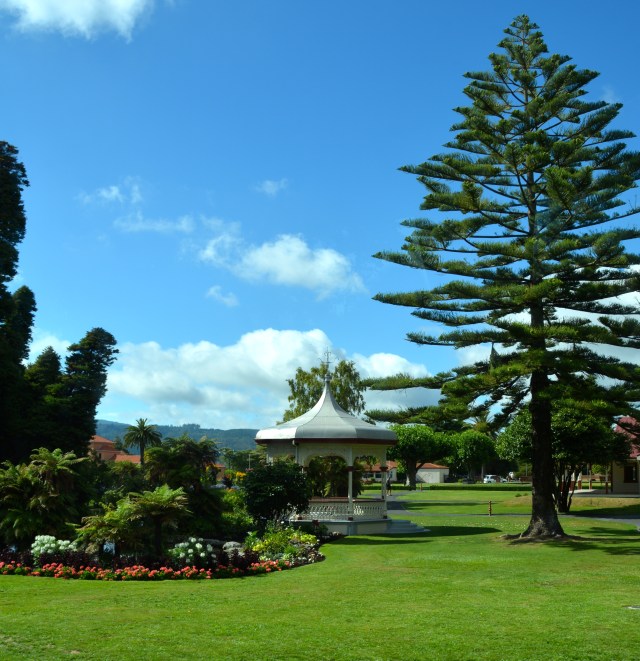
The Winter Garden is in the Auckland Domain, a wonderful park with expansive grassy areas.  Lots of locals were picnicking on this holiday weekend.  We also saw a game of soccer being played where all the participants were inside bubble balls.  The Auckland Domain is the city’s oldest park and it actually located in the suburb of Grafton.  The high point is the War Memorial Museum and the park’s dock pond is the site of the city’s first piped water supply (1866).  The “park has been developed around the cone of an extinct volcano.”

DSC_7160

©Jean Janssen The courtyard and sunken pool at the Winter Garden in the Auckland Domain, New Zealand
Our stop in the park was at the brick step entrance to the Winter Garden.  You could go across the road for tea, but I decided to wait on the airport for food and used our short time there to take photographs.  Up the stairs you come to a covered brick loggia; going through, you find yourself in the courtyard with a sunken pool with fountains.

DSC_7189

©Jean Janssen One of the glass-domed Victorian houses at the Winter Garden, Grafton, New Zealand
The Winter Garden was opened in 1913 and features two barrel-vaulted Victorian style glass houses with rotating exhibits.  The statuary was added in the 1920s and 30s.  I had a wonderful time taking pictures both in and outside the houses.   If we had had more time, it would have been a wonderful place to just sit and relax.

DSC_7225

©Jean Janssen At the Winter Garden in the Auckland Domain, New Zealand
Next we were back on the bus for our trip to the airport.  It was hands on once were got there with most of the check-in counters being self-service.  Since we had several hours to kill and we hadn’t eaten in about 8 hours, we grabbed some fast food and filled out our departure forms before clearing security which again is self-service if you are a citizen of the several countries which are associated with their electronic visa program.  You are photographed going through so they can confirm your identity.

DSC_7125

©Jean Janssen Sand shark at Kellly Talton’s Sea Life Aquarium in Auckland, New Zealand

Once we cleared security we did some shopping to use up our New Zealand dollars and then headed to the very nice lounge where all the drinks were free and you could eat a full meal.  They offer free wifi and all types of seating, including long lounges that could serve as a bed.  Some of our fellow excursion participants took advantage of the showers before their long plane ride home.

DSC_7065

©Jean Janssen Maori craft in the Auckland marina, New Zealand

I downloaded pictures and checked emails in the lounge before departure.  When Boris found some more local currency among his things, I kindly volunteered to spend it on the way to our gate.  Our flight back is direct and just over 13 hours.  Awesome really, when you consider how far away we are from our home in Houston, Texas.  Plus, we get a day back; we’ll cross the date line and actually “get home before we leave”.

DSC_7204

©Jean Janssen Sunken pool at the Winter Garden, Auckland Domain, New Zealand

I enjoyed my day in Auckland, although rushed and starting with a frustrating delay.  There are actually luggage storage facilities within an easy walking distance to the disembarkation terminal.  If I had to do it again, I would probably have stored the bags and done the hop on/hop off bus around town, had lunch in the marina, and enjoyed the wonderful duty free shopping mall downtown before going to the airport.

DSC_7150

©Jean Janssen Puffer fish at Kelly Tarlton’s Sea Life Aquarium, Auckland, New Zealand

The ship excursion did make it easy since our luggage traveled with us.  Given that it was a holiday in town, the excursion also eliminated any concern about grabbing a taxi downtown and making it to the airport on time.  We also by-passed the lines at the places we visited.

DSC_5136 - Version 2

©Jean Janssen “Cruz” at You Yangs State Park, near Melbourne, Australia

Loved our trip.  We probably saw a lot more of New Zealand than Australia.  If Australia was about the animals, then New Zealand was about the scenery, at least the way we saw the two countries.  I think I’ll be back.–Natasha

DSC_5698

©jean Janssen Milford Sound, New Zealand

Posted in cruises, international | Tagged , , , , , , , , , , | 2 Comments

Update on Azamara Quest

My loyal readers will recall that there were problems with our approach into Picton, New Zealand caused by the local pilot who hit the rocks. The cruise company is required to have a local pilot on board when they are close to land and dock in these unique ports. The error was not the fault of the ship’s crew, although they stepped in to correct the problem when it occurred. On the night we left Picton it was thought there was no damage to the ship. The investigation of the ship took place while we were docked in Napier and was also conducted by divers outside Picton. The local pilot has been suspended.

For more reading on the incident, I refer you to this article.

Posted in Uncategorized | Leave a comment

The Bay of Plenty, New Zealand

DSC_6976

©Jean Janssen This area of New Zealand is one of geothermal activity.

Today is a full day in Tauranga, New Zealand, a favorite holiday spot for those from Auckland and Wellington.  Monday is a local holiday in Auckland, so people have come in early for a long holiday weekend.  In the Bay of Plenty, people were already out early staking their claim on the beach, while others breakfasted at the cafes across the street.  The Bay boasts a beach over 12 miles long and this morning there are both volleyball and kayak tournaments taking place at Mount Maungaui Beach Park.  The Bay is also popular with surfers.

DSC_6866

©Jean Janssen   For obvious reasons, these beautiful trees are called the New Zealand Christmas Tree.

The biggest impact on population growth for Tauranga came in the 1950s when the city was chosen as the primary port for the Bay of Plenty.  It is now one of the country’s fastest growing  metropolitan areas.   Our tour takes us outside the city on new multi-lane roads and tollways.  They have installed new cycleways along side these roads to keep bicycles off the highways.

DSC_6877

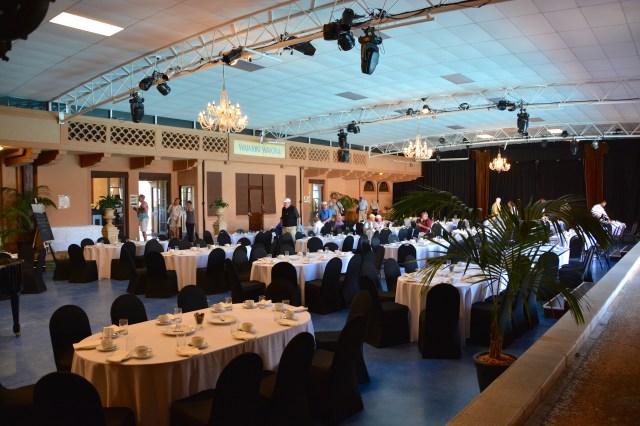
©Jean Janssen Interior of the Blue Baths, Rotorua, New Zealand.

We are headed to Lake Rotorua and the city of the same name.  Rotorua is filled with private thermal bath resorts and a single public thermal bath.  Our first stop is the Blue Baths in the Government Gardens.  The gardens were originally known at Paepaekumana and were gifted to the public by the Maori people.  The Blue Baths Building was constructed in 1933 in the Spanish Mission style.  We are having tea in what was originally the indoor pool.  There is a slight step down, but the bottom has been raised and the facility now hosts corporate events, weddings, and theater and concert series.  It was closed from 1982 to 1999.

DSC_6879

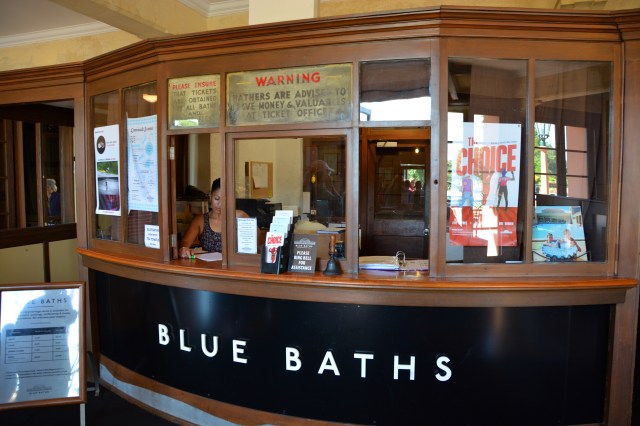
©Jean Janssen Entrance to the Blue Baths, Rotorua, New Zealand

When originally opened the purpose of the blue baths was recreational rather than medicinal.  They offered instruction in “fancy and scientific swimming” to both men and women in the same facility.  Built during the depression, the baths  represented movie star glamour.  Their construction has been called “the last gasp of New Zealand’s large scale spa development[.]”  You are still able to swim in the heated outdoor pool, but this is fresh rather than mineral water.

DSC_6884

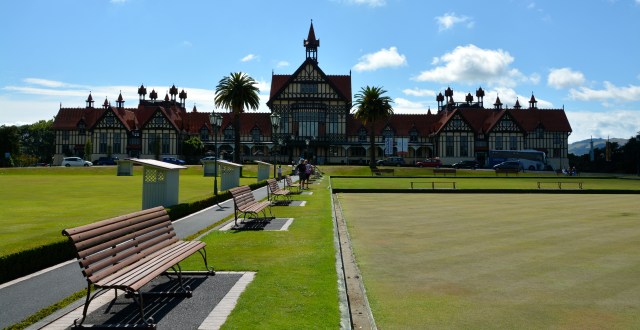
©Jean Janssen The Rotorua Museum with sport fields in front, Rotorua, New Zealand

After our English Tea of water, coffee, hot tea, scones, butter, jam, cream, and finger sandwiches, we had the opportunity to briefly walk in the Government Gardens, the beautiful park where the Blue Baths are located.  The large wood frame bath house, now the Rotorua Art Gallery and Museum, dominates one end of the quad with bowling lawns running in front of it.  The Blue Baths are to the side of the lawns.

DSC_6900

©Jean Janssen A closer look at the Bath House in Rotorua, once a famous therapeutic spa, that now houses a museum and art gallery.

The Bath House was built at the height of the New Zealand government’s first tourism push attempting to draw visitors from all over the world to a Great South Seas Spa which offered therapeutic treatments.  “Water from nearby thermal springs was piped to private bathrooms and larger Aix-douche massage rooms. There were also a number of deep pools where chronic disorders were treated. The north wing accommodated male patients, while women were treated in the south wing.”

DSC_6894

©Jean Janssen   Government Gardens, Rotorua, New Zealand

In the time we had, I wandered around taking pictures of the gardens and the strange birds that inhabit it.  I also spotted my first mineral springs of the day.  There were lots of tour buses in the park.

DSC_6903

©Jean Janssen Thermal Spring in the Government Gardens, Rotorua, New Zealand

The oldest Maori settlement in New Zealand is found in Rotorua and we passed by the tribe buildings still used today.  Leaving Rotorua, we passed their golf course, probably the only one in the world to have active thermal activity on the course.  We are headed to the Maori Thermal Reserve at Te Puia in the Whakarewarewa Geothermal Valley.

DSC_6932

©Jean Janssen Traditional Maori costume for a male made at the weaving school at Te Puia, Rotorua, New Zealand

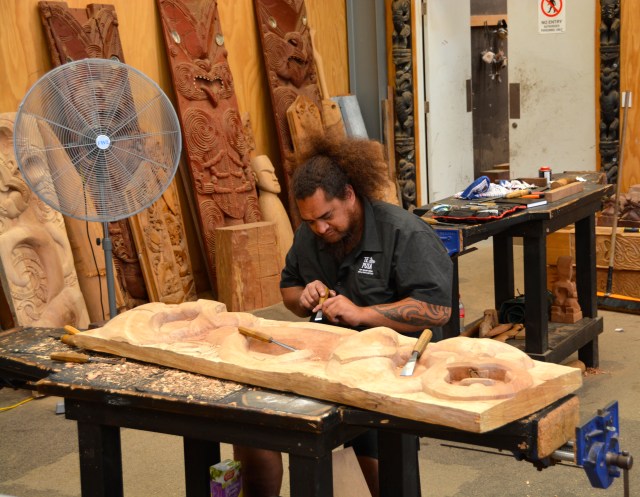
Te Puia continues to add to its offerings, beyond the natural geothermal activity that originally drew the Maori people to this area.  The front of the park is devoted to exhibits and demonstrations related to Maori culture.  To participate in the weaving or carving schools you must be able to document your Maori ancestry.  We were met at the gate by one of tour guides who took us first to the weaving demonstration and then to see the carving.

DSC_6939

©Jean Janssen Maori carver at work at the school at Te Puia, Rotorua, New Zealand

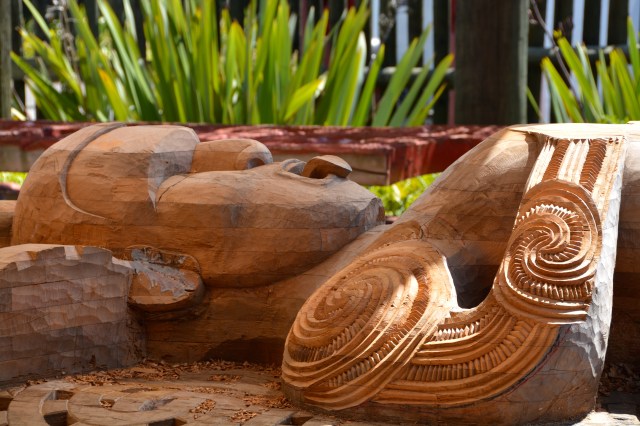
Against the wall were totem poles and tall plaques.  These are created by the students and are going to particular tribes.  They often depict ancestors or are a trophy.  Some sports teams also request them.

DSC_6945

©Jean Janssen Detail on a commissioned ceremonial piece being carved by students at Te Puia in Rotorua, New Zealand.  This memorial carving honors Maori who fought in World War I.

We had a nice guide, but not one good at time management, so we missed the geyser’s eruption.  We moved next to the kiwi house.  The kiwi is New Zealand’s national, although flightless, bird.  There were so many people in the park, especially at the kiwi house that it felt like a holiday at Walt Disney World.  We skipped the kiwi house and headed off to see the mud pools.

DSC_6954

©Jean Janssen Mud pools at Te Puia, Rotorua, New Zealand

The mud pools may have been my favorite thing in Te Puia, although it is impossible to capture their charm on a still frame.  The pools boiled and spit and made the most wonderful sounds.  Some mud pools are cool enough to experience.  These are so hot they reach 203 decrees Fahrenheit would be fatal if you fell in.

DSC_6957

©Jean Janssen One of the viewing platforms for Pohutu, the geyser at Te Puia, the largest geyser in the southern hemisphere.

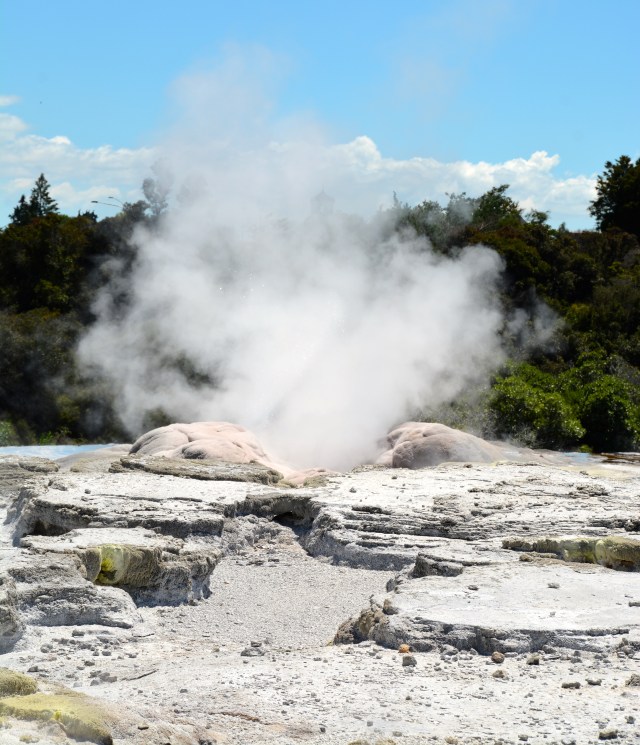
Next we stopped by the various viewing platforms for the geyser. It erupts regularly, giving a warming of 12-15 minutes with a release from a nearby opening.  When our guide realized that it was not going to erupt anytime soon she took the group back to the kiwi house.  It was about a 20 minute walk back to the bus and I knew what time we were leaving, so I left the tour group and stuck it out to see the geyser.

DSC_6973

©Jean Janssen The geyser flats of Pohutu, Rotorua, New Zealand

The geyser flats are quite thin.  The Maori chief Wahiao, in his attempt to intimidate neighboring tribes, would lead his warriors in a haka, a fierce war dance, on the flats.  The stomping on the thin surface made 300 warriors sound like three thousand and could be heard on the other side of the near mountain range.

DSC_6971

©Jean Janssen The relief hole near the geyser gives a 12-15 minute warning as to when the Pohutu Geyser will go off

I was able to stay in the area long enough to see the “alert” geyser begin its eruption.  I headed back to make the bus.  I did the route in 10 minutes instead of 20, I stuck my head in the kiwi house (there were only 3 people there now) and saw the bird in the darkness in a box.  Boris told me later he was able to see both the kiwi birds in the enclosure which is kept dark as these are nocturnal animals.  I also made a “necessary”stop.  I came out with 5 minutes to spare and the crowd’s reaction.  I knew that the geyser was going off.  I found a spot where I could see it near the entrance, snapped some pictures, and made it to the bus on time.

DSC_6977

©Jean Janssen The largest geyser in the southern hemisphere, Pohutu in Rotorua, New Zealand

We drove back to the ship and saw a little bit of the other side of Tauranga.  With temperatures over 100 degrees farenheit outside, neither Boris or I were too keen on walking around or sitting on the beach.  I almost gave in when the driver mentioned a good fish and chips shop, but it was too far to walk back to the ship.  We decided to go back and maybe get a little packing done.  We disembark the ship in the morning in Auckland.

DSC_6931

©Jean Janssen Traditional female costume of the Maori displayed in the weaving school at Te Puia, Rotorua, New Zealand

DSC_6984

©Jean Janssen Fully carved Maori meeting house at Te Puia, Rotorua, New Zealand

DSC_6960 - Version 2

©Jean Janssen Geyser flats and mineral pool at Te Puia, Rotorua, New Zealand

Posted in cruises, international | Tagged , , , , , , , , | Leave a comment

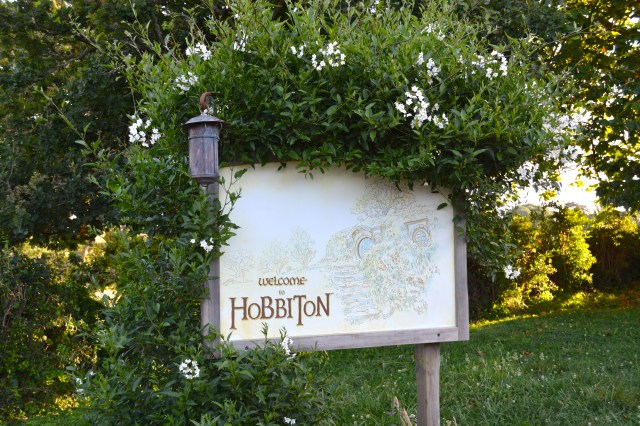
Hobbiton, New Zealand

DSC_6631

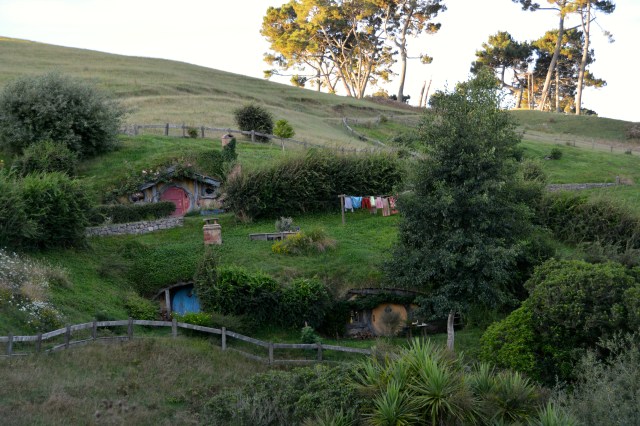
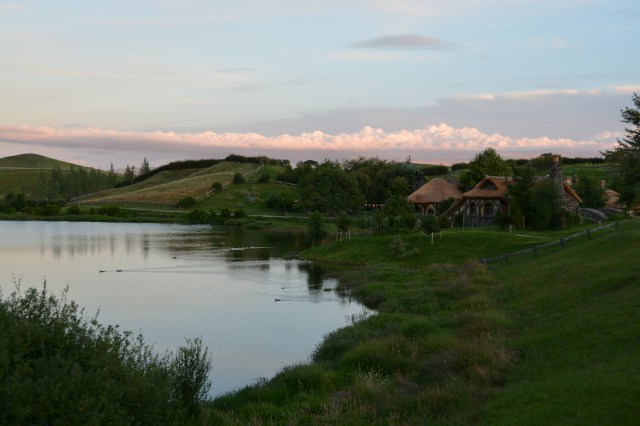
©Jean Janssen   Hobbiton, the reconstructed movie set is now a tourist attraction in Matamata, Waikato Valley, New Zealand

After a day at sea, we are scheduled to arrive in Tauranga, New Zealand at 5 pm.  Most guests will be staying on the ship tonight for the evening’s entertainment; we have chosen an evening excursion to Hobbiton.  Hobbiton is the recreated set where segments of the Lord of the Rings and The Hobbit movies were filmed.  Azamara has begun offering evening-dubbed Nights and Cool Places-and even overnight excursions when the boat stays in port overnight.  The evening excursions and overnights were added as the result of guest input.

DSC_6615

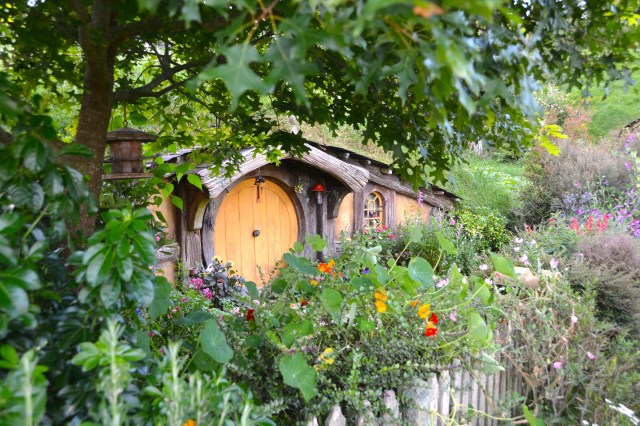
©Jean Janssen Window of a Hobbit hole, Hobbiton, New Zealand

A day trip to Hobbiton will be offered tomorrow, but by going tonight we can also tour the geothermal pools in the area tomorrow.  Additionally, the twilight excursion has some unique elements to it.  I knew I couldn’t return home to Rocky without seeing at least some of the movie connections to New Zealand based on the Tolkien books.

DSC_6643

©Jean Janssen Hobbiton

Peter Jackson, the movies’ director, did a fly over the area and selected the Alexander farm  as the setting for the shire for its untamed beauty.  It is one of the few remaining sheep farms in the area.  The story goes that when Jackson went to meet the farmer and ask about the use of the farm, he went on a day the national team had a rugby game.  This country is mad for their rugby.  Not knowing of Jackson’s fame, the farmer said he was too busy watching the game and suggested Jackson come back on a day when the All Blacks, New Zealand’s famous and highly successful rugby team, were not playing.  Later the farmer was informed of Jackson’s stature in the movie industry and the meeting eventually took place.

DSC_6612

©Jean Janssen   You ride on a bus through the farm to the small parking area at the entrance to the set which is marked with this sign.

The agreement reached was that when filming was complete, the film crew would put the land back exactly as they found it.  When filming concluded, initial demolition took place but there was a delay and some of the set was left for removal at a later time.  Many fans approached the farmer about seeing the remaining set and Alexander realized he had something special on his hands.  Alexander reached a new deal with Jackson whereby Jackson’s team would rebuild the set using more durable materials (these should last 50 years).  Most of the original set was foam board.  After reconstruction, Hobbiton opened as a tourist attraction in 2002.

DSC_6691

©Jean Janssen Additional section of Hobbiton added for the Hobbit series in 2011.

Original construction for the Lord of the Rings Trilogy was begun in March of 1999 and everyone was sworn to secrecy.  The set was again reconstructed in 2011 for the Hobbit movies and small additional section was also added at that time.  By 2013, Hobbiton had welcomed half a million visitors.  In 2014, the night-time events were added; this is the one we are taking advantage of.  Tonight, the park is opened exclusively for our group of 40 guests.  Crowd avoidance is a major advantage of this excursion.

DSC_6638

©Jean Janssen Hobbiton

The plan was to meet at 5:15 and exit the ship as soon as it was cleared.  Unfortunately, about 3 pm we were informed that due to low tide the ship would be in a hold pattern until 5 pm and that we should anticipate docking a hour late.  We were worried that our tour would be cancelled, but since the set was rented exclusively for us the evening was simply delayed an hour.  We are now scheduled to return to the ship at 12:30 am.

DSC_6646

©Jean Janssen The shire at Hobbiton

We ended up getting off the ship and leaving about 45 late.  Hobbiton is located in Matamata in the Waikato Valley about an hour from our berth in Tauranga, New Zealand.  It was a beautiful ride and our guide told us about the area, but everyone was just anxious that we would get to see the set before the sun went down I am not sure we took in much of what he said.  Fortunately, the sun does set late, about 9 pm, during the summer.

DSC_6659

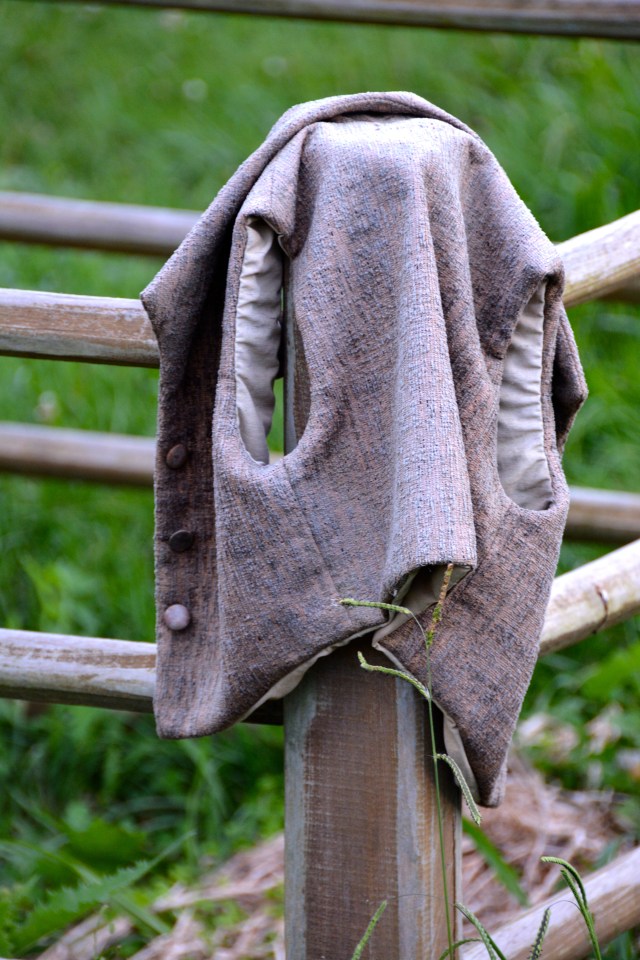
©Jean Janssen Clothing as a prop, Hobbiton, New Zealand

When we arrived, our guide jumped right on board and we skipped the welcome center and gift shop (which I am guessing will not be open when we conclude here about 11:30 pm).  The Hobbiton guide was young, cocky, and clearly having fun with the tour.  He was great about taking pictures of us, telling stories, and giving us time to take photographs while still keeping us on schedule.

DSC_6677

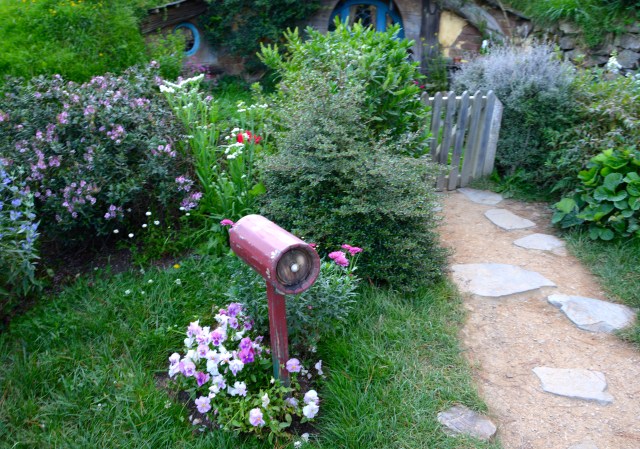
©Jean Janssen Prop details in Hobbiton

The tour company has a bus, but we just stayed aboard our own coach and he talked us down to the set entrance.  We drove through the Alexander farm as the set came into view.  The farm is once again a sheep station.  While on the bus and during our walk around the set, our guide pointed out particular locations where specific scenes from the film were shot.  There are a total of 44 hobbit holes built at 60, 90, and 100% scale to accommodate the various species that the hobbits come in contact with.

DSC_6664

©Jean Janssen Hobbiton

Our guide also pointed out the detail in the set.  When fruit or greenery needed to have a  consistent look through shooting, it was pulled out and reproduced artificially.  In some cases the natural element has come back; in others it is still fake.  Actually it was hard to tell which was which.

DSC_6712

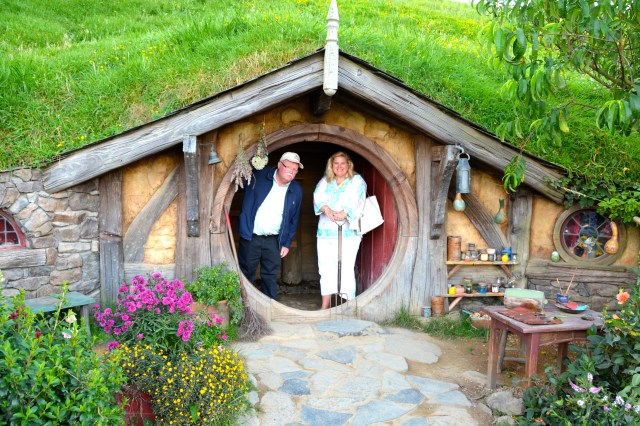
Boris and Natasha in the one hobbit hole in Hobbiton that you can step inside.

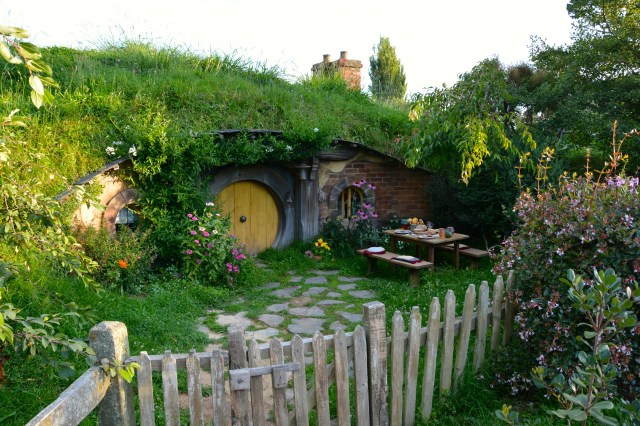
You can not go into the hobbit holes, they are only facades.  Bag End has a few details that show with the door open, but the interior scenes were shot in Wellington, New Zealand, also on the northern island.  They did set up one hobbit hole that you could stand inside to have your picture taken and Boris and I were first in line.  We are a bit tall to be hobbits.

DSC_6721

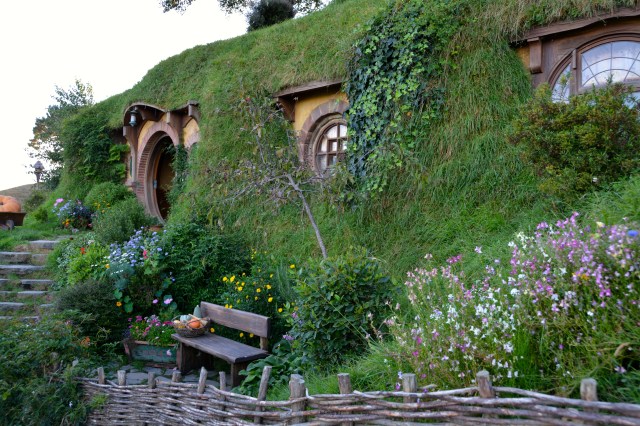
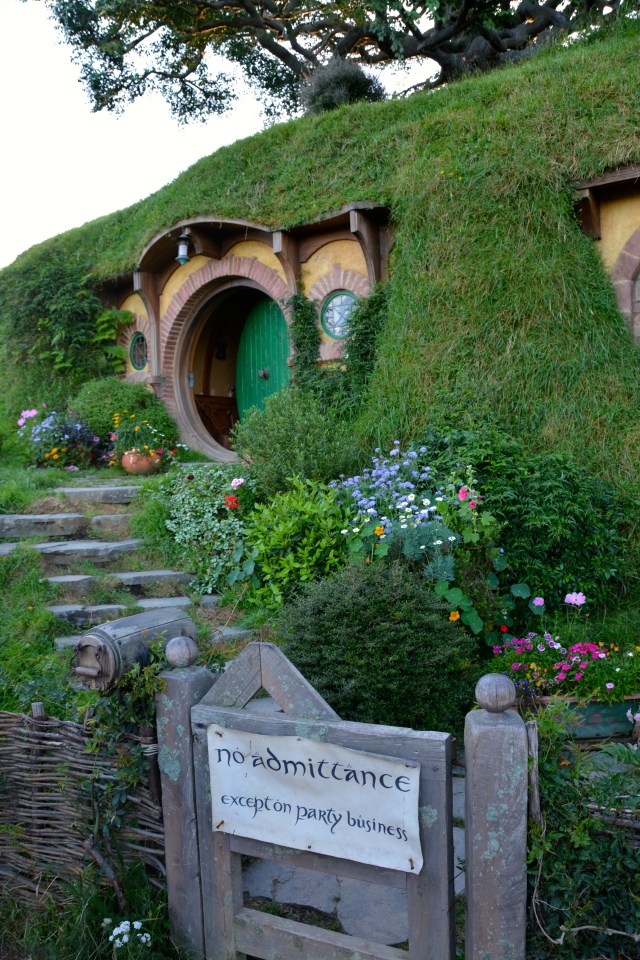
©Jean Janssen Bag End, Hobbiton

Everyone had their favorite spot, but by far the one that was most photographed was Bag End, home to Bilbo Baggins.  I can’t image trying to get a picture of this on a typical tour without lots of bodies getting in the way.

DSC_6724

©Jean Janssen Bag End, home to Bilbo Baggins, Hobbiton

440px-Bag_End

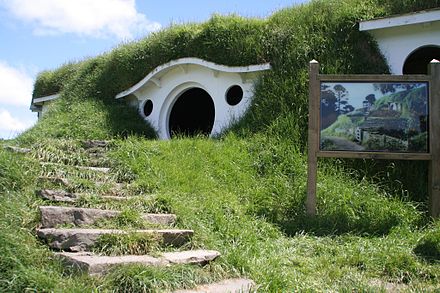
Bag End as it looked in 2006, prior to a 2011 renovation, Hobbiton

I found the entire set charming.  Of course, you want to immediately run home and watch the movies again so you can see the frame where a particular part of the set you just saw was used.  That said, I think that even if you have not seen the films or even read the books you would still enjoy a visit to Hobbiton.  The setting on this farm is truly breathtaking and the fading light of day made it even more magical.

DSC_6697

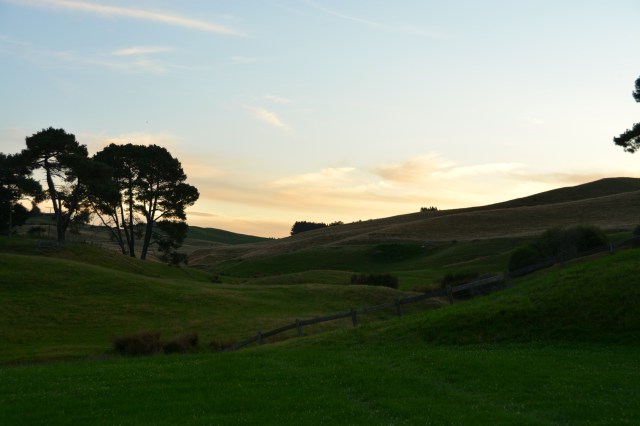
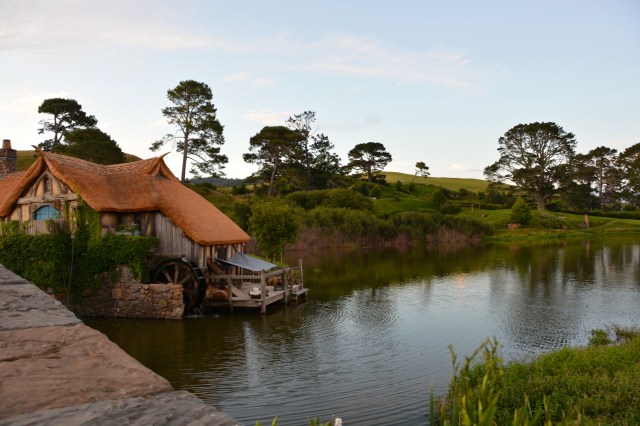
©Jean Janssen The beautiful landscape of the Alexander farm and Hobbiton. Note the bridge, mill, and Green Dragon Inn beyond the water.

DSC_6772

©Jean Janssen Twilight at the Alexander farm and Hobbiton, New Zealand.

As we finished our initial guided tour, we were led to the Green Dragon Inn for our complimentary beverage of ale or cider.  To reach the Green Dragon Inn you pass by the Hobbiton Mill and over the double-arched bridge.  We stepped inside the pub for our beverage and then came back outside to enjoy the lovely view back toward the shire while our banquet was prepared.

DSC_6793

©Jean Janssen Hobbiton Mill as seen from the double arched bridge, Hobbiton

DSC_6768

©Jean Janssen The Green Dragon Inn at twilight, Hobbiton

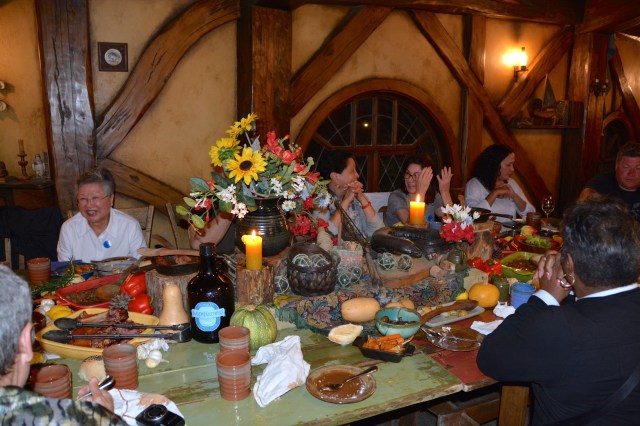
When the feast was ready we were called inside to take a seat at one of the long tables.  In the history of the feast (open since 2014), only one group has eaten all the food offered; it was a rugby team.  There was so much food, some that appeared to be a table decoration at first.  We sat across from a family from Michigan who had one of the few children on the ship; 8 year old Elizabeth took a liking to Boris and chatted with him most of the evening.  Seated to my right was a family from Poland and I enjoyed talking to their high school son who wanted to practice his English (which was quite good).

DSC_6797

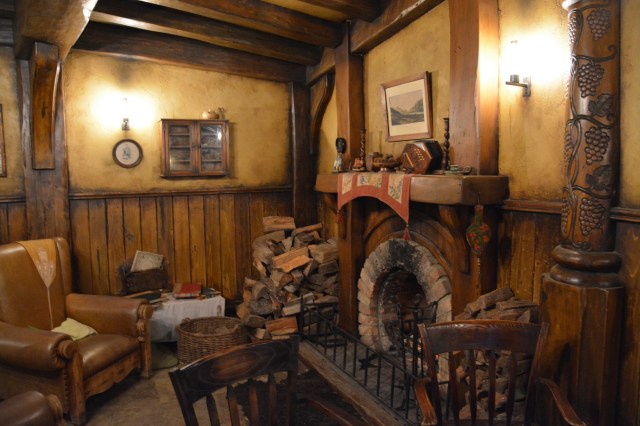
©Jean Janssen Inside the Green Dragon Inn, Hobbiton

DSC_6826

©Jean Janssen A feast fit for a hobbit at the Green Dragon Inn, Hobbiton

DSC_6817

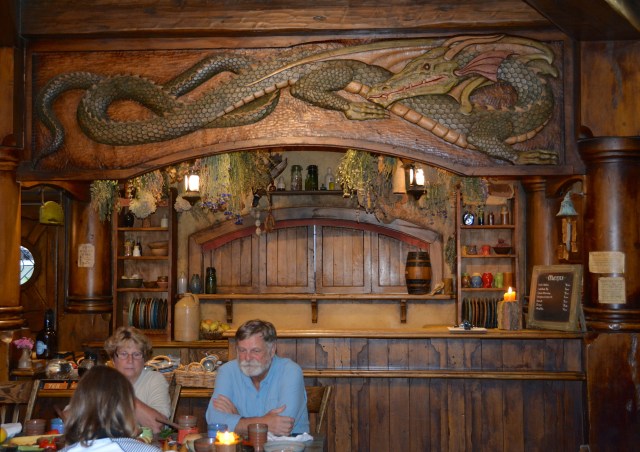
©Jean Janssen A depiction of the Inn’s namesake is over the bar in the banquet room, The Green Dragon Inn, Hobbiton

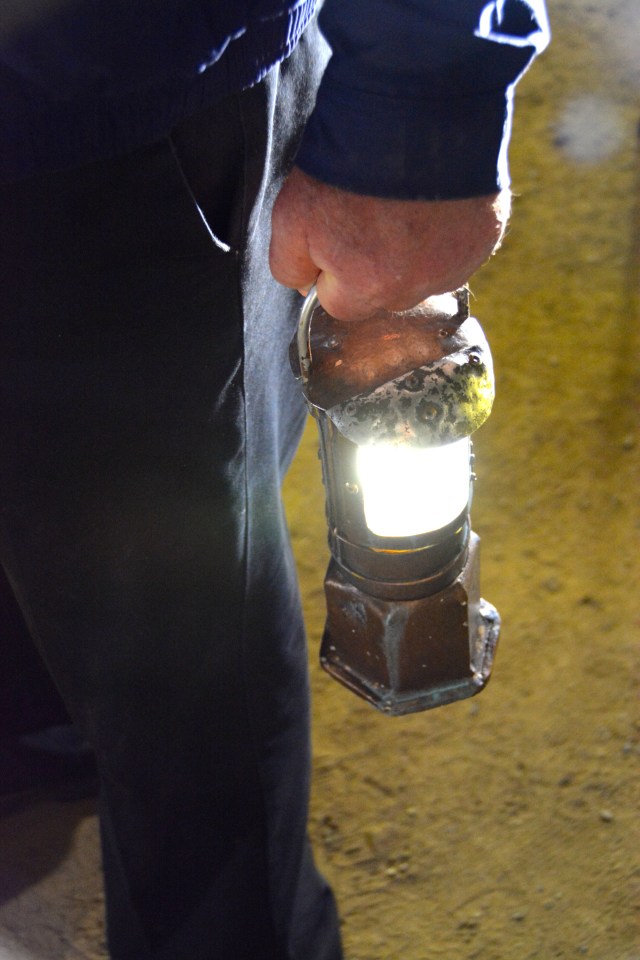
After the feast, lanterns were distributed and we took a modified tour through the shire on the way back to the bus parking.  We made a stop at the party tree and all were invited to dance, although there were few takers.  I highly recommend the evening tour, especially if you can go through the park in a small group.  Hobbiton is a gem that I am so glad that it was preserved.  As a student of film and a fan of these movies, I know Rocky would love Hobbiton.  I hope to be back to share it with him.

DSC_6849

©Jean Janssen Boris was in charge of our lantern for the night tour of Hobbiton

Time to get back for our early morning tour.  When we arrived at the port at 12:30 am, the gate was closed so we had to wait for the security clearance.  We won’t get a lot of sleep tonight but it was so worth it.  “I think I am quite ready for another adventure.”

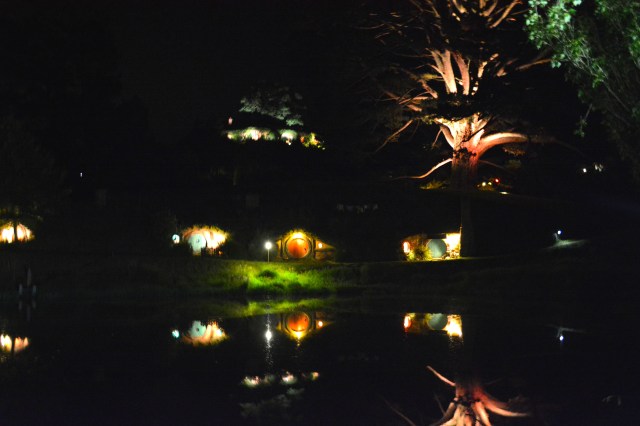
DSC_6848

©Jean Janssen Hobbiton at night viewed by lights and lanterns.

Posted in cruises, international | Tagged , , , , , | Leave a comment

Napier, New Zealand

DSC_6386

©Jean Janssen Gordon sheep station near Napier, New Zealand

We are now on the north island of New Zealand and visiting the town of Napier in Hawk’s Bay celebrated for its Art Deco and Spanish Mission architecture.  Napier is a town of 50,000 and it will be our base for some multi-stop touring today.  We couldn’t visit New Zealand without going to a sheep station (farm) and will see both a herding and sheering demonstration today.  If the weather clears, we next visit a mountaintop lookout point followed by a strawberry farm and local touring.

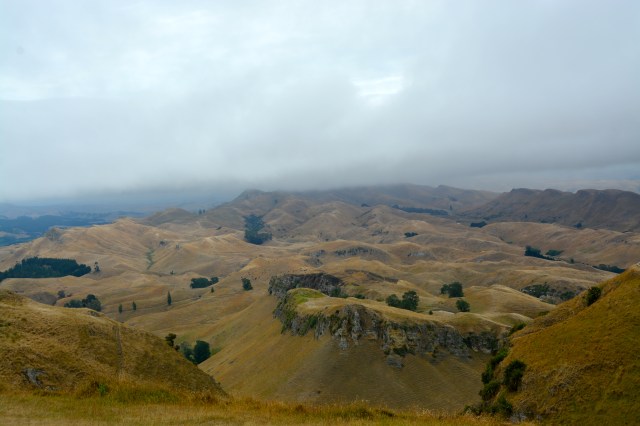
DSC_6460

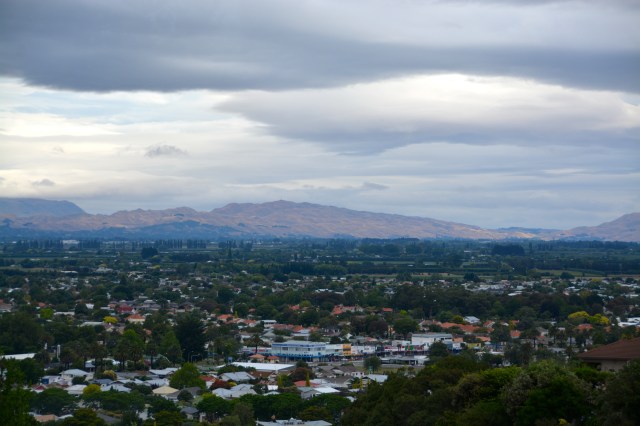
©Jean Janssen One view from Te Mata Peak near Hastings, New Zealand

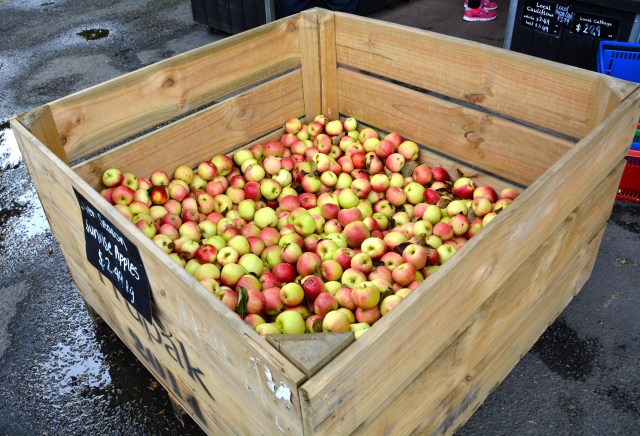
Our guide began by giving us some general facts about New Zealand and the area.  The country’s population is made up of people 62% of whom are of European descent, 15% Maori (who settled the country 700-800 years ago), 10% Asian, and 7% Polynesian.  Chinese immigrants grew crops for miners and still manage the major production of fruits and vegetables.  It is almost time to harvest apples, strawberries, and wine grapes.

DSC_6521

©Jean Janssen Fresh produce is a major export of the Hawk’s Bay area of New Zealand

The Chinese gooseberry or hairy fruit was introduced to the country in the early 20th century.  Renamed kiwi, the fruit is now internationally known and associated with New Zealand.  They are currently developing a red variety for the color; there is no difference in the taste.  Within New Zealand, the fruit is generally not referred to as kiwi as that name is associated with the national bird and often used as a reference to the people themselves.

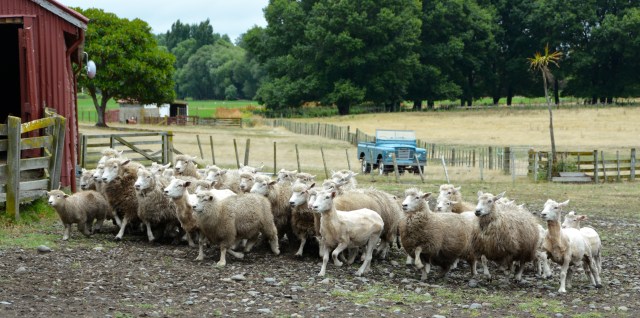
DSC_6383

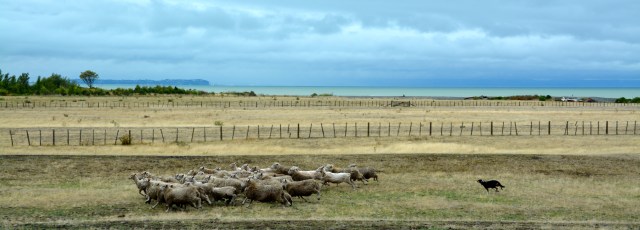
©Jean Janssen    Sheep dog moving the flock on the Gordon farm near Napier, New Zealand.

We drove out of Napier along the coastal road toward Cape Kidnappers, seeing signs of erosion.  One house had only recently literally fell into the bay.  Residents were erecting sea walls, but the government challenges the construction.  We are on our way to the Gordon Sheep Station, where 5 generations of this Scottish family have been sheep farmers in New Zealand.  Wool from this area generally goes into the making of carpets.

DSC_6368

©Jean Janssen Tommy Gordon and Tink, one of the sheep dogs in training at the Gordon Sheep Station near Napier, New Zealand

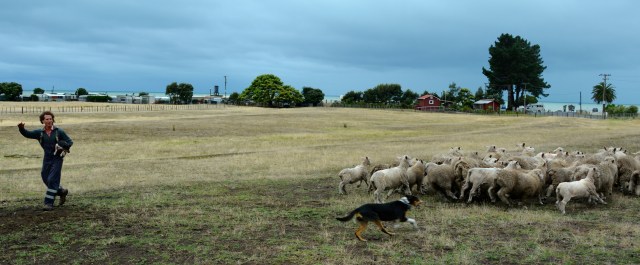
Tommy Gordon introduced us to the sheep dogs and showed us their training and techniques.  He controls the dogs using distinctive whistles, telling them when to move the sheep and which direction to take them.  It was a fascinating demonstration.  Tommy users dogs of many different breeds to assist, each having different talents.  Each time there is one who bark and directs the sheep and a silent dog so stays directly opposite the “barker” who keeps the sheep together in a herd, even going off to  collect one who strayed a little.

DSC_6425

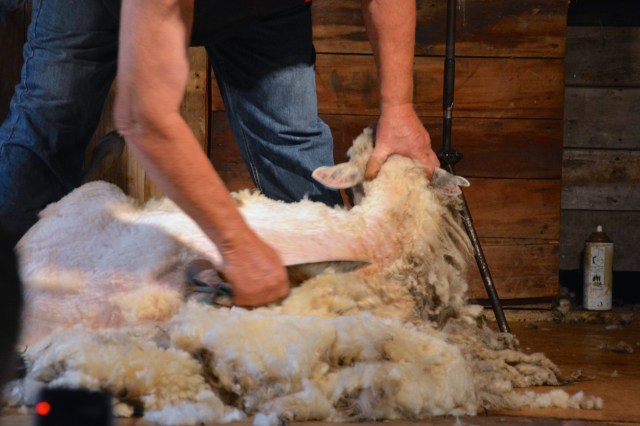
©Jean Janssen Original sheering methods used knives demonstrated here at the Gordon Sheep Station near Napier, New Zealand.

We met the farm’s pet boar before going inside to see the authentic sheep barn with traditional sheering equipment.  Originally knives were used for the sheering, eventually moving to electric equipment, although sometimes hand-pumped.  Workers are paid $3 per sheep and could sheer hundreds in one day.  The sheering specialists move from farm to farm performing their skills.  Sheep used to be sheered once a year; the Gordons now sheer every 8 months.

DSC_6401

©Jean Janssen   Powered sheering equipment at the Gordon Sheep Station near Napier, New Zealand

Sheep are protected by lanolin which their bodies produce to keep them warm even after being sheered.  The sheep are always outside, except for the one or two days a year they are sheered.  It is important that the sheep have shade after the sheering to prevent their skin from being burned. The wool is washed at a separate facility.   The sheep lanolin is floated out when the wool is cleaned and is sent off for use in cosmetics and grease for auto parts.

DSC_6389

©Jean Janssen Tommy Gordon controls the sheep dogs doing the herding by a series of whistles. Gordon Sheep Station near Napier, New Zealand

I walked through their barn to see the displays and antique equipment.  Some of the local children who like to come when there is a bus at the farm to see the show, showed me a possum inside the barn.  It has become quite popular to mix the possum fur and sheep wool in clothing items produced in New Zealand.  After a stop in the gift shop where Boris and I bought two sheep skins-one white, one brown-the group had tea and scones at a small restaurant across the street.  The restaurant was quiet, but had lovely views out to the water.  We were fortunate the rain had stopped and the skies were clearing so we could go to our next designated stop on Te Mata Peak.

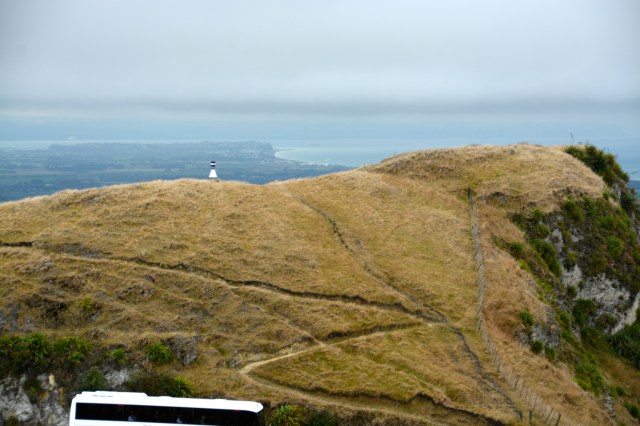
DSC_6457

©Jean Janssen The climb to Te Mata Peak is a steep one for buses. Note the mountain bike trails that start from the peak.  Hawk’s Bay can be seen in the distance.

The Te Mata Park Trust maintains this area as a recreational park; the land was gifted to the community in 1927.  It is an area of extraordinary beauty and of deep cultural significance to the Maori people.  The drive up to the peak is steep and winding.  Bus travel is strictly controlled and our bus company, that started in the business of transportation 150 years ago with car and horse, is the only one who can make the climb.  The drivers have special certification and are escorted by motorcycle security who clear the roadway.  Our driver is actually one of the trainers, so we are in good hands.

DSC_6461

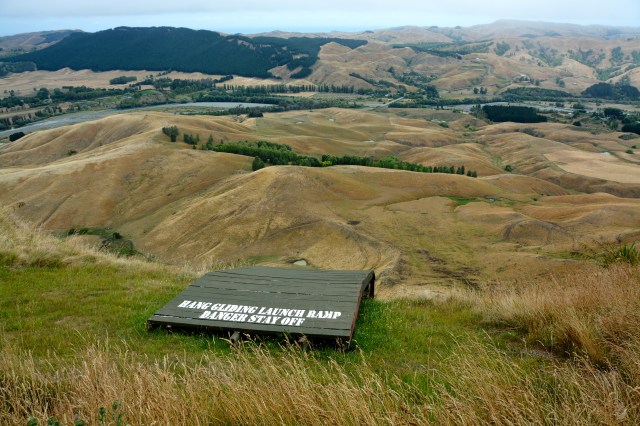
©Jean Janssen Hang Gliding platform at Te Mata Peak

We did see some bicyclists on the road.  There are also mountain bike trails from the peak that are steep and well marked.  At the top, we also saw several launch platforms for hang gliding from the peak.  Te Mata is also known as the “sleeping giant” and is said to be the prostrate body of Chief Rongokako.  There is of course a Maori legend associated with the mountain range.

DSC_6555

©Jean Janssen “The Sleeping Giant”, a view of Te Mata from the hills of Napier, New Zealand

DSC_6483

©Jean Janssen The Peak at Te Mata Park, Hastings, New Zealand

We next drove through Hastings.  Like Napier, it is decorated in the art deco style.  The Hawk’s Bay area was originally settled by the Ngati Kahungunu aboriginal tribe who came to this area by canoe.  The European communities were founded in the 1850s, but almost any building you see dates from 1931 or later.  That year a massive earthquake demolished the brick and masonry structures.  What didn’t fall in the quake, burned in the resultant fires.  Hastings and Napier rebuilt in the art deco style, popular in Europe at the time.

DSC_6537

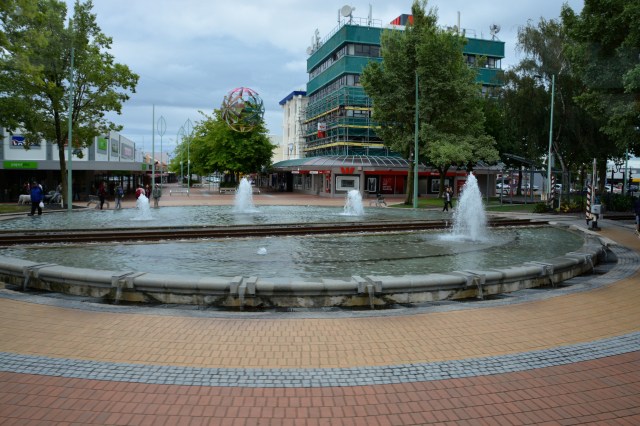
©Jean Janssen Hastings city fountain bisected by the rail line. Hastings is on of New Zealand’s art deco cities

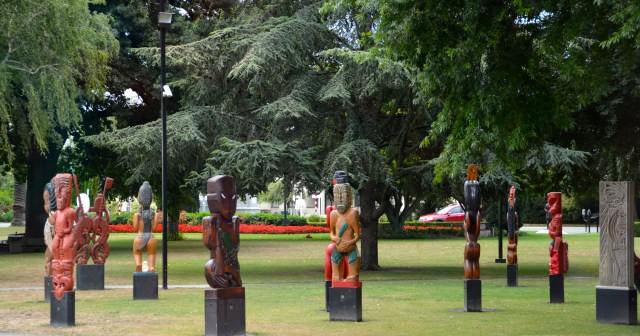
One of the most charming landmarks in Hastings is the fountain which is bisected by the rail line.  It is said to be even more picturesque at night with the lights on it.  Maori heritage is also remembered in the city with totem poles from the various tribes who settled the area.

DSC_6531

©Jean Janssen Totem poles celebrating the Maori tribes who originally settled the area of Hawk’s Bay, New Zealand

At some point the city had difficulties with people leaving bars in the evening and drinking openly in the streets.  This community, followed by others nearby, has enacted stiff penalties if you are found drinking alcoholic beverages outside in public.  The “Liquor Ban” is in effect “Every Day at Any time” and carries penalties of $20,000.  Notice of the Ban is posted as you enter the community.

DSC_6518

©Jean Janssen Pick your own Strawberries in Hastings, New Zealand.

Our final stop was at the Strawberry Patch where you can pick your own strawberries. We are just before the season so the PYO area is not open until next week.  We enjoyed a generous portion of their popular strawberry ice cream.  The stop also had a produce section where everything was very fresh and smelled wonderful.

DSC_6542

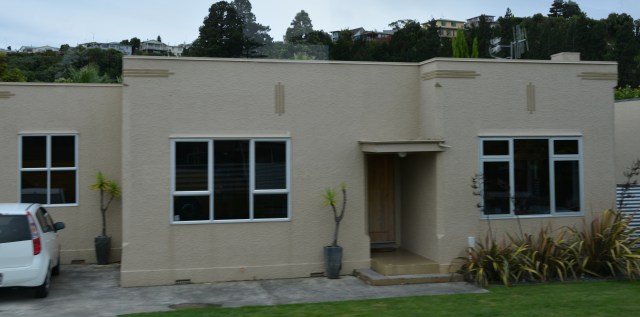
©Jean Janssen Art Deco home in Napier, New Zealand. Note the rounded corners, typical of the art deco style.

We drove back to Napier, passing through the areas where housing was first reestablished after the earthquake of 1931.  Many of the homes are still in use today.  Those reconstructed are often built to blend with the art deco style.

DSC_6547

©Jean Janssen Sailing vessel modeled after a traditional Maori craft. Of course, they didn’t originally have solar panels like this one. Ahurini Harbor, Napier, New Zealand.

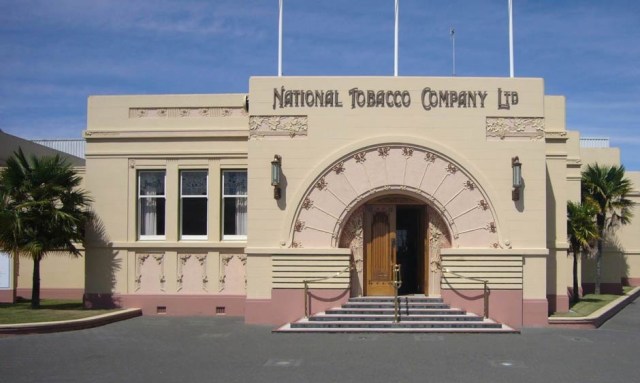
Driving by the waterfront at Port Ahurini, we saw a typical Maori craft in the marina before driving by the National Tobacco Company building, considered the best example of the art deco style in the city.  The company, founded in 1922, had been making heavy profits so it had the funds to rebuild quickly.  Completed in 1933, the building is now open for tours.

national-tobacco_0

National Tobacco Company building in Port Ahurini, Napier, New Zealand, built in the Art Deco style in 1933.

We drove up the hillside and saw small fishermen’s cottages that were not destroyed by the earthquake or fires, before pausing for a view of Te Mata.  At the top, new housing is anticipated in an old hospital and another razed building nearby.  New construction codes have halted work because the original plans do not come up to code.

DSC_6581

©Jean Janssen Art deco style in Napier, New Zealand.

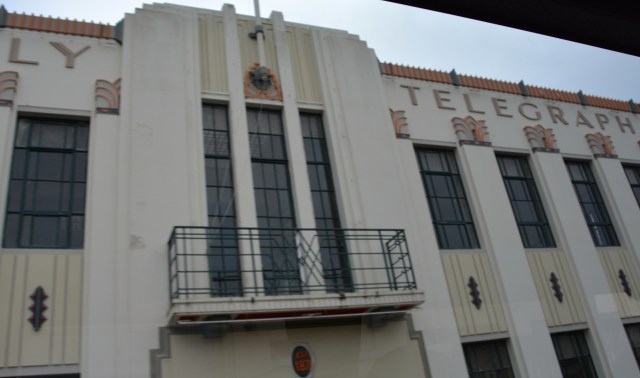
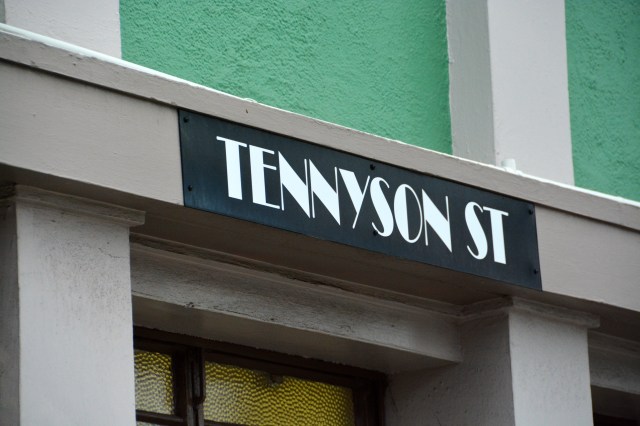
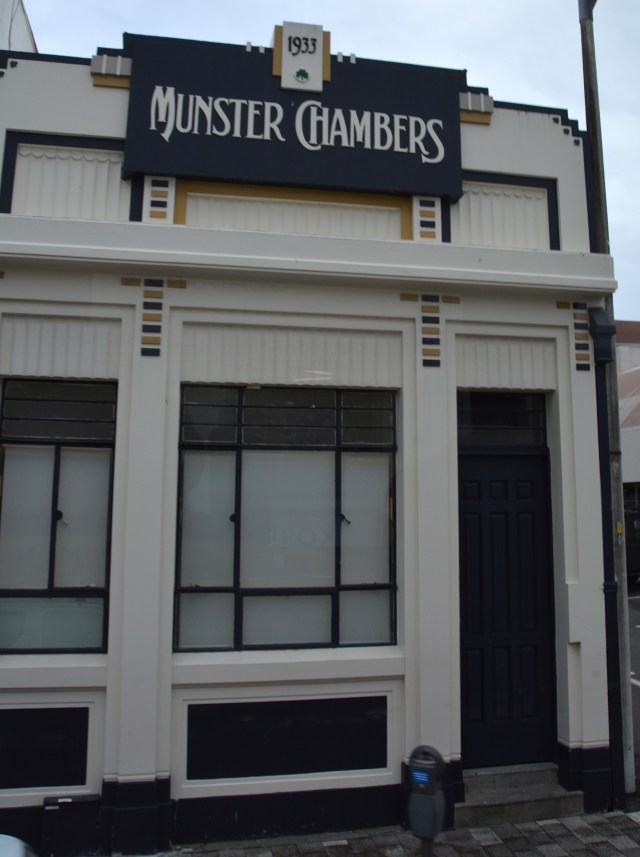
Before returning to the ship, we drove through the town of Napier, which clearly celebrates it art deco style.  It is displayed proudly in renovated buildings (only 4 had survived the earthquake and its aftermath) and even in its street signs.

DSC_6584

©Jean Janssen Stylistic street sign in Napier, New Zealand

Before we left the ship in the morning the captain had announced that there had been some potential damage caused by a miscalculation of the local pilot in Picton.  We had noticed the shuttering the night before and our slower steed.  Our departure was delayed, but the boat was fully inspected and deemed fit.  Slight adjustments took care of the shuttering and speed issues and the night travel was comfortable.

UPDATE: There were problems with our approach into Picton caused by the local pilot who hit the rocks. The cruise company are required to have a local pilot on board when they are close to land and dock in these unique ports. The error was not the fault of the ship’s crew, although they stepped in to correct the problem when it occurred. On the night we left Picton it was thought there was no damage to the ship.  The investigation of the ship took place while we were docked in Napier and was also conducted by divers outside Picton.  The local pilot has been suspended.DSC_6580

©Jean Janssen  Art deco building in Napier, New Zealand

Tomorrow we arrive in Taurango in the evening.  We are part of a select group going to Hobbiton on an evening excursion.  Taurango is our last port of call before reaching Auckland where we disembark the ship.

DSC_6578

©Jean Janssen This art deco building in Napier, New Zealand combines that style popular in the 20s and 30s with the influence of the Maori woodcarving traditional to the country


Posted in cruises, international | Tagged , , , , , , , , , , | Leave a comment

Happy Anniversary

DSC_0259

 ©Jean Janssen

Today is TravelbyNatasha’s 4th anniversary.  Thank you to all my loyal readers and my new friends and visitors.  What started as a class assignment now shapes how I travel.  I find myself taking pictures of things to document what I want to include in the blog post.  I make sure I take notes on tours to give you the correct facts.

DSC_9386_506

I am sometimes asked where I get the information I share.  Some of it comes from written materials I receive on tours or at exhibits, some from tour guides, some from internet research, and some-where noted-is my personal opinion or impression.  If I get conflicting information, I research to confirm the correct facts and omit the information if it can not be confirmed.  Mostly what you see however, is just how I view and interpret the many places I see.

photo 1

While I do give travel advice, I intend my blog to be a source of entertainment and to share a piece of the world that you might not otherwise see.  Thank you for checking in with Natasha and keep reading.  Four more posts on New Zealand will appear soon.  We are renting a villa just south of Verona, Italy this summer so look for those posts when the northern hemisphere enjoys it summer.  Here’s to the next adventure…–Natasha

DSC_0832

Posted in About Me | 2 Comments

Picton, New Zealand

DSC_6333

©Jean Janssen    In the vineyards of Marlborough, the largest wine-producing region of New Zealand

DSC_6302

©Jean Janssen    Making our way into the port at Picton, New Zealand

Today we are docked in Picton, New Zealand at the northern point of country’s southern island. Although there are also small islands that are part of the country, New Zealand is considered a country of three islands, the southern island, the northern island, and Stewart Island. Not surprisingly given its location, Picton is the point where the rail, truck, and car ferries leave for the Northern Island. We are docked right next to the ferry terminal after a nice ride in along the channel. Not all cruise ships have the opportunity to approach the city this way so we are fortunate. Another cruise ship was at anchor, but we are docked today.

DSC_6315

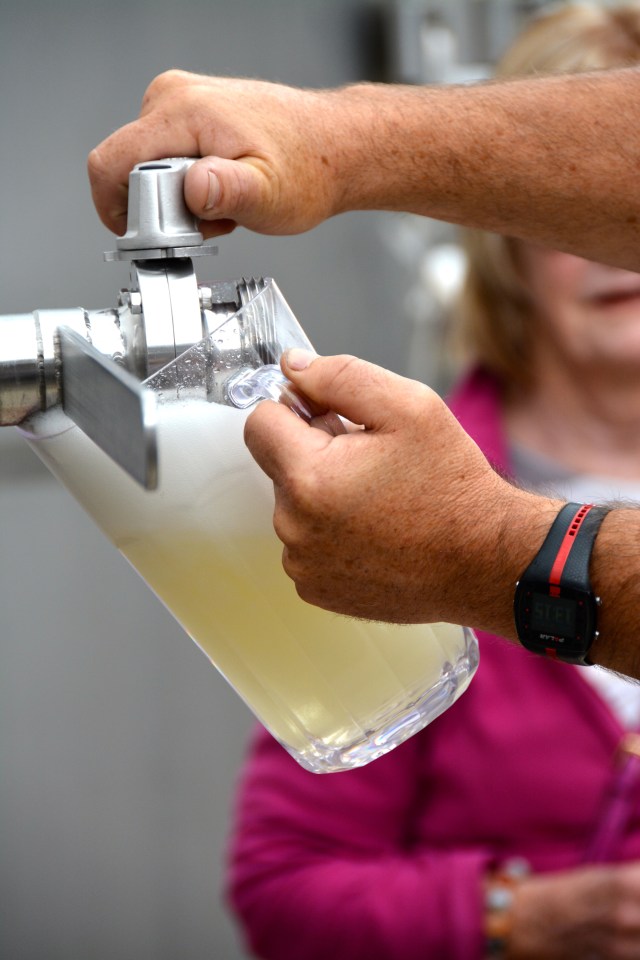
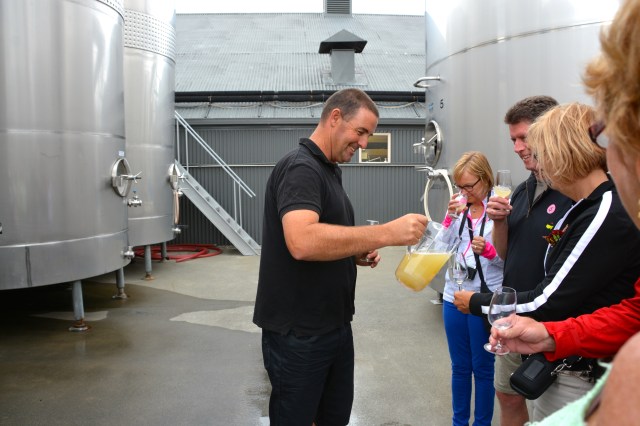
©Jean Janssen   A pitcher of Sauvignon Blanc right out of the stainless steel drum to sample at Allan Scott Winery in Marlborough, New Zealand

By the time we got off the ship the sun had peaked out, the first time in over a week. The winery excursion is by far the most popular and there are four buses going to different regional wineries today. Our first stop was a small winery, Allan Scott, where we were welcomed with a tasting of their sparkling variety. The Winemaker gave us a wonderful introduction to their process, especially for the sparking wines that require far more care. It is only fitting that Natasha’s favorite is Champagne and other sparkling wines; Boris will tell you that I require far more care.

DSC_6317

©Jean Janssen    Sampling the Chardonnay at Allan Scott Wineries in Marlborough, New Zealand

After describing the differences in making the Sauvignon Blanc (easier and quicker turn out time), the winemaker put a pitcher to the stainless steal drum and drew out the processing wine. We all got a tasting of that. Since he saw we were all ok with a cloudy wine, he took us around to another row and we tried a Chardonnay. Finally, out of the oak barrel, we got a sampling of the pinot noir. As we filed inside to sample the finished product, I saw I guide speaking to a gentleman not of our group who was watching the tour. I took a chance and was rewarded with an introduction to the owner/winemaker Allen Scott himself.

DSC_6320

©Jean Janssen Allan Scott Winery in Marlborough, New Zealand

We chatted for a moment about wine, the difficulty of distributing in the United States, and travel to and from Houston, Texas (my home). Inside, I picked up a bottle of the sparkling that I particularly liked. I also sampled and purchased a bottle of another sparkling wine that was enhanced with a touch of cognac. (About now my book club friends are salivating with anticipation that I might share some of this with them.)

DSC_6324

©Jean Janssen The vineyards at Allan Scott Winery, Marlborough, New Zealand

As we departed, Boris reminded me that we were now at our limit of duty free wine bottles. I reminded Boris that Azamara allows us to take the wine to our room so we could always drink some of the bottles before we got off the ship assuming we wanted to buy more at the next two stops. Boris liked that plan.

DSC_6306

©Jean Janssen Newly planted vineyard in Marlborough, New Zealand

We passed vineyards on both sides of the road as we made our way to the next stop. Our guide (who was also the bus driver) did a great job of telling us about the industry. It is obvious that machinery trims the vines by the spacing of the rows and the cropped appearance of the wines. The greatest threats to the harvest are the weather-too much water or frost-disease, and the starlings that like to eat the ripe berries. They use air guns to scare off the birds, but after 25 years in use the birds have learned not to be too weary. As a result, they have reintroduced native falcons to the area. While revitalizing the species, the project also introduces a predator to the starlings. Over several vineyards, I saw falcons gliding and in one instance saw one swoop down and (presumably) capture a bird. The falcons are quite fast.

DSC_6339

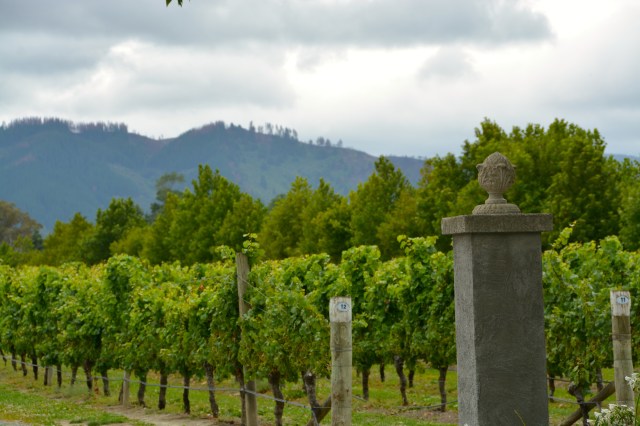
©Jean Janssen The vineyards at Drylands, Marlborough, New Zealand

Our second stop was Drylands, a large producer who distributes under several brand names. They do distribute in the United States. Monkey Bay is apparently one of the well known varieties; later in the tour its namesake body of water was pointed out to us. At Drylands, we were taken to the edge of the vineyard and a representative told us about the wines and their care. Harvesting in this region begins in late March, so we are not too far off. They are not ready, but the vines were heavy with grapes. This region, with its free-draining soil, is best known for the production of Sauvignon Blanc.

DSC_6340

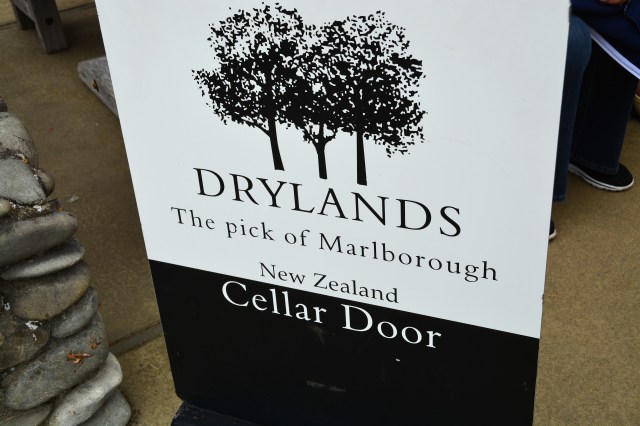
©Jean Janssen The largest producing winery we visited in Marlborough was Drylands. Some of its wines, like Monkey Bay, are exported to the United States

Inside the lobby that was really not large enough for all of us, we sampled the same types (Sparkling, Sauvignon Blanc, Chardonnay, and Pinot Noir) as we had at Allan Scott. Boris and I were in agreement that we didn’t like anything we had sampled. Very few people bought wine, but for some that was because it was easily purchased at home.

DSC_6343

©Jean Janssen   Canopy vineyards in the parking area for Hunter’s Winery in Marlborough, New Zealand

The third stop was a small boutique winery with a long history. The owner has been named the world’s best female wine producer and is very hands on in the process. Hunter’s Winery had a nice setting with canopies of grape wines with space to park cars underneath. They were just for aesthetics and not used in the wine production.  There was also an artist in residence who did lovely work-but there was not a way to get anything like that back home.

This time we were in an even smaller lobby. After an introduction to the winery, they offered a tasting of Sauvignon Blanc, Pinot Gris, Riesling, and Chardonnay, and Pinot Noir. Once again, neither Boris nor I found anything we were particularly fond of. Everyone on the bus was hungry because no food was offered at any stop; the bigger seller was the winery’s bags of potato chips. They were just what I needed.

DSC_6303

©Jean Janssen Treehouse living in Picton, New Zealand

On the way back to the ship, we saw even more of the wood that is grown and harvested in New Zealand.  A pine variety was imported from California and it was found that it grew 2 to 3 times faster in New Zealand.  Faster growth can mean thiner wood so the product is divided into two grades.  Grade B, the thinner grade is exported whole to China where is made into cardboard and paper. Grade A wood is processed in New Zealand and used for home framing there and in Australia.

DSC_6356

©Jean Janssen   I just thought this railroad sign I saw while riding through Marborough was petty cute.

We also saw cattle.  In southern New Zealand, most of the cattle is dairy.  On the northern island, there are both dairy and meat-producing cattle.  Wild deer are scarce here, unlike in North American where deer hunting seasons are used to control overpopulation.  Deer in New Zealand are raised on farms for the venison.  Boar hunting is done on New Zealand with hunters armed only with a large knife and assisted by a pack of dogs.  Boars can weigh up to 300 lb. and have 6-8 inch tusks.

Of course there are also sheep.  It wouldn’t be New Zealand without sheep.  They are sometimes used in the vineyards as “organic lawnmowers”  They are also an excellent source of manure.

DSC_6364

©Jean Janssen We were docked right next to one of the large ferries in Picton, New Zealand.

When we returned to small town of Picton, population 5,000, you could get off in town or ride back to the ship.  There wasn’t much to see in town, but you could stretch your legs a bit and make the 5-minute walk through the ferry port to get to the ship.  Our balcony looked out over the docks and ramps for the ferries and I enjoyed watching them unload and then load again.  There wasn’t much time in between trips.

DSC_6367

©Jean Janssen   Ferries in port at Picton, New Zealand on the north side of the country’s southern island. The closer, larger ferry transported vehicles which loaded and unloaded from a single ramp on the lower level. The more distant, smaller ferry unloaded vehicles from the top level via an elevated roadway. A rail line connects to the bottom level where a special engine moved rail cars on and off the ferry.

One of the ships offloaded walk-on passengers (some with bicycles), cars, motorcycles, 18 wheelers and other large trucks, and mobile homes/campers.  The other smaller ferry, had more of the same on the top that exited off an elevated roadway and rail cars on the bottom with their own track and engine to get them on and off.  The vehicles best represented on the ferries were the campers.  Free campgrounds are found all over New Zealand and campers were out enjoying the summer in full force.

Next stop is Napier, on the northern island of New Zealand.

UPDATE:  There were problems with our approach into Picton caused by the local pilot who hit the rocks.  The cruise company is required to have a local pilot on board when they are close to land and dock in these unique ports.  The error was not the fault of the ship’s crew, although they stepped in to correct the problem when it occurred.  On the night we left Picton it was thought there was no damage to the ship. The investigation of the ship took place while we were docked in Napier and was also conducted by divers outside Picton. The local pilot has been suspended.


Posted in Uncategorized | Leave a comment

Akaroa, New Zealand

DSC_6072

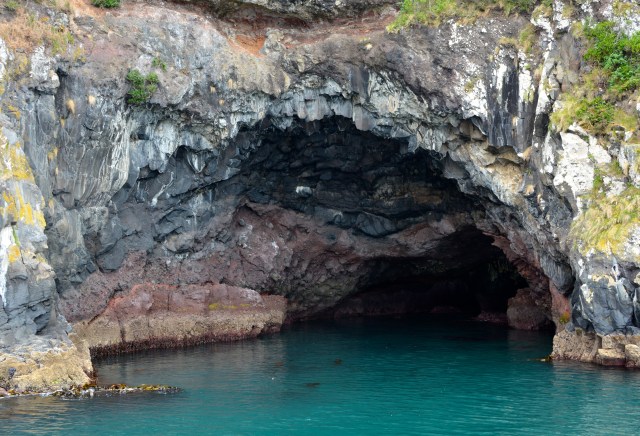
©Jean Janssen   Sea cave in Akaroa Bay. The bay sits in a volcanic crater, the evidence of which can be seen in the rock walls that surround the bay.

Southern New Zealand is an adventurer’s paradise with wonderful hiking, water sports, and amazing scenery. Today we are in Akaroa, a French-influenced seaside town that is a home base for hikers and animal lovers. There is just a small pier in Akaroa harbor, so we are tendering into shore. From this seaside gem, the ship is sending excursions to the New Zealand Alps via train and bus, including a visit to the location for shooting the scenes of Edoras, the fortress city of the Rohan people in Lord of Rings movies. You could also visit Christchurch or enjoy local touring.

DSC_6206

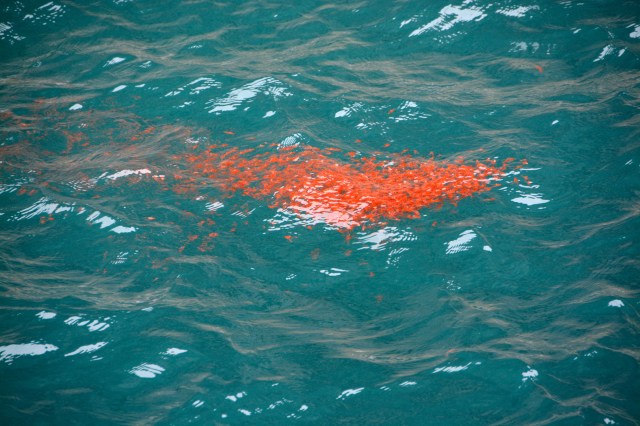
©Jean Janssen   A whale’s delight, krill in the waters of Akaroa Bay, New Zealand

Two of the tours included nine hours of travel and we wanted a chance to stretch our legs, especially after yesterday’s day on the train. We chose a harbor tour aboard the Blackcat. There was outside seating on top of the boat and enclosed seating down below. On the lower level you could also walk around the railed perimeter of the boat. Our boarding spot was just a few feet away from where our tender docked on the same pier.

DSC_6056

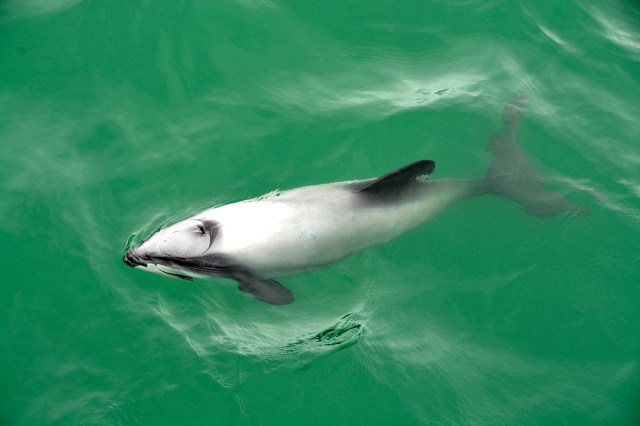
©Jean Janssen   Hector’s Dolphin in Akaroa Bay, New Zealand

We very soon spotted the small (blue, gray, & white) hector dolphin, often called the New Zealand dolphin. These dolphins do not stay in large pods but may come together to play and mate. About five of them swam near the boat, breaking the surface only to breathe. They do not commonly jump out of the water as other dolphins do. Fortunately the water was very clear and you could see them just below the surface.

DSC_6059

©Jean Janssen   Hector’s Dolphins in Akaroa Bay.

Hector Dolphins are endangered. There is only 7,000-10,000 left in the world. They have the same endangered status as the Bengal tiger and pandas. Next we spotted two blue penguins at play on the surface; the blue penguin is an animal unique to this area of the world. They have white flappers. It is tough to see them during the day. They spend the day in the water and don’t like the sound of the boats. They come to shore at dusk. In Akaroa harbor you can arrange an excursion to see them come in. Like the miss at Phillips Island in Australia, we will not be in port at the opportune time.

DSC_6112

©Jean Janssen   Salmon Farming in Akaroa Bay. The worker sitting on the edge of the boat is shooting food pellets into the circular netted keep for the fish.

They farm green lip mussels and salmon in the waters of Akaroa Bay. The mussel farm looked like someone had set up swim lanes in a cove of the bay. The salmon farming was done in round, netted areas.  A worker blew food pellets out of an air gun while we passed by at feeding time.

DSC_6178

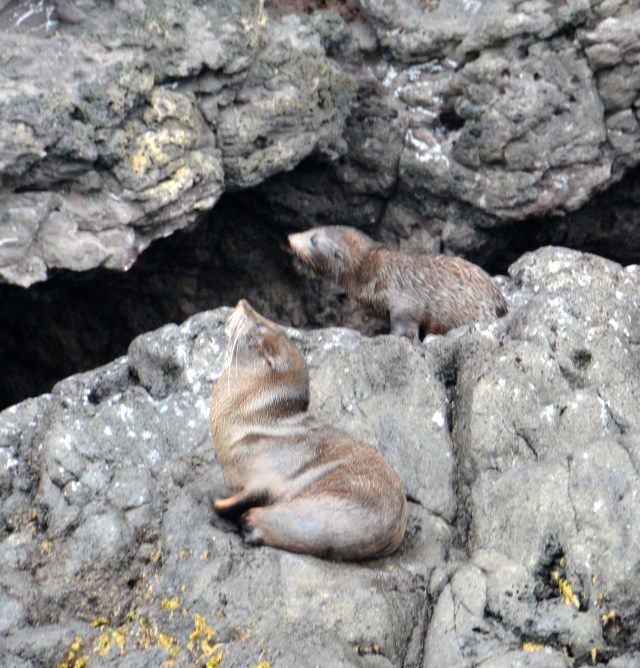
©Jean Janssen   Mother and (wet) baby fur seal on the volcanic rock of Akaroa Bay, New Zealand

Along the shore the evidence that the bay was a volcano crater was evident. You could see the line of various minerals and rock as the sides rose up out of the water. We also saw wonderful sea caves. The water was clear and of a beautiful color.

DSC_6192

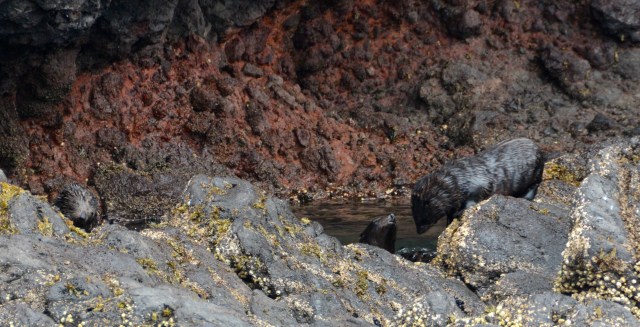
©Jean Janssen   Baby fur seals play on the rocks and swim in the tide pools along Akaroa Bay, New Zealand

I thought it was all about the penguins for me, but I was most taken by a family of fur seals. While mother sunned on a rock, four of her babies frolicked in a tide pool the adventurous ones coming out to explore around the rocks before returning to swim once again. It didn’t matter that there was a strong wind and a light rain; I stood there enjoying their play.

DSC_6234

©Jean Janssen   Volcanic rock formations line Akaroa Bay. This one resembles the profile of an elephant.

After watching the seals, we crossed to the over side of the bay spotting more caves and a wonderful rock formation that looked like an elephant. Each two-hour tour varies depending on what animals you see and how much time you spend watching them. I thought I was going to be disappointed about not taking one of the longer excursions, but I was not.

DSC_6240

©Jean Janssen My fabulous lunch of green- lipped mussels enjoyed at one of the sidewalk tables for The Trading Rooms in Akaroa, New Zealand. The fresh mussels were farmed in the Akaroa Bay.

When the Blackcat reached the dock, we could have taken the tender back to the ship for lunch, but I suggested we eat in town and see if we could get some fresh mussels. Boris is not a fan of mussels, but he enjoyed his fish and chips. The green lip mussels, prepared in a white wine sauce, were fresh, huge, and delicious. Boris tried a New Zealand beer before joining me in sampling the New Zealand cider. We sat outside, the rain having passed.

DSC_6278

©Jean Janssen   A summer day in Akaroa, New Zealand

After lunch we explored the city of Akaroa, which winds around the harbor. There were children enjoying the swimming platform out in bay during this, their summer holiday. They return to school in February.

DSC_6267

©Jean Janssen   A charming cafe in Akaroa, New Zealand

Akaroa has a very French flavor. A large group of French settlers arrived only seven days after the English had taken possession of the area. Rather than return home, they remained here under English rule (although flying the French flag); their influence is still seen today. The city is charming with sidewalk cafes, hotels for backpackers, a historic church with a welcome sign out, shops, and local craftsmen in tented booths. All the beautiful summer flowers just added to the town’s charm. (There is only one ATM in Akaroa, so plan accordingly. This is where we got our first New Zealand dollars.)

DSC_6285

©Jean Janssen   This gentleman was raising money for an animal hospital in Akaroa. He had both his pet dog and Mary, a lamb, on leashes as an incentive.

The dining room was quiet that evening with so many returning late from their long tours. We did ask about Christchurch because Boris had been interested in visiting there. In 2011, Christchurch experienced a horrific earthquake that caused massive destruction. Aftershocks continued for another two years, so reconstruction is slow to get going. In some cases, there is controversy on how to proceed. For example, many want the lovely Cathedral rebuilt at a cost of 10 million. Others say that it is more prudent to tear down and rebuild a more economical building at 4 million. The controversy continues and the Cathedral ruins sit propped up and waiting. We both were glad we had not chosen that tour.

DSC_6297

©JeanJanssen   A tree in full summer bloom in Akaroa, New Zealand

Tomorrow we are going to do wine tasting in Marlborough, the largest wine-growing region in New Zealand.

DSC_6301

©Jean Janssen  The lighthouse at Akaroa, New Zealand. You can tour this operating (although decommissioned) lighthouse.

Posted in cruises, international | Leave a comment