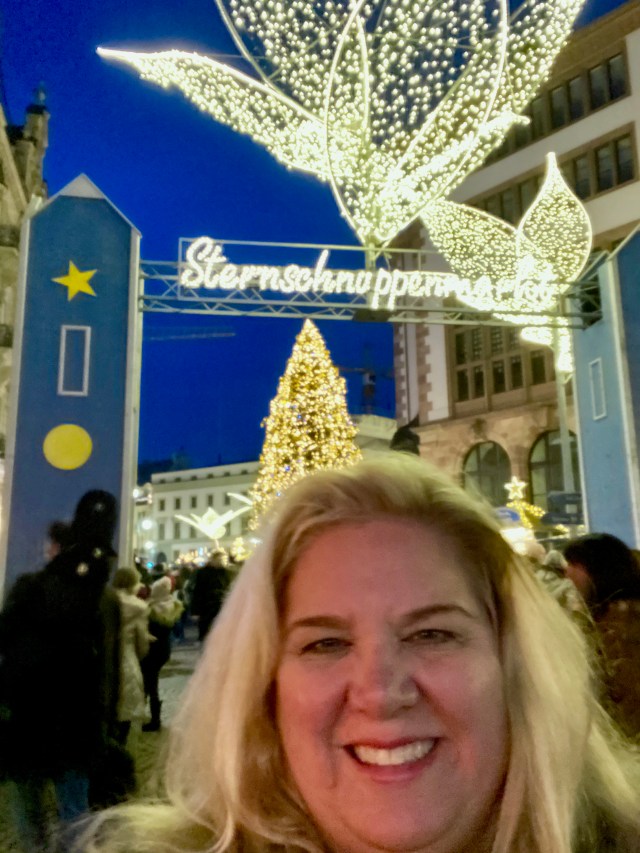
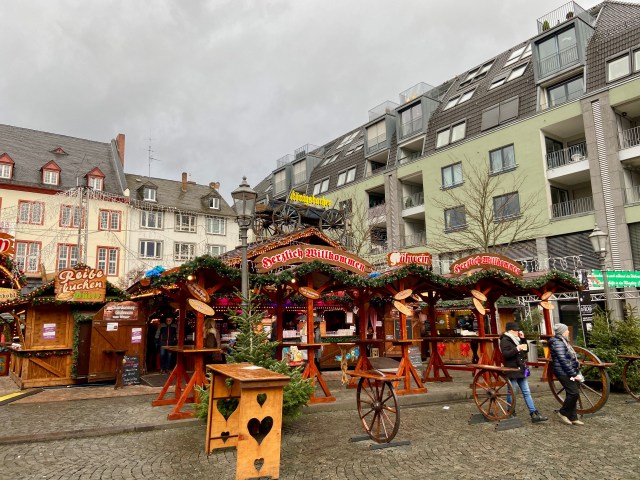
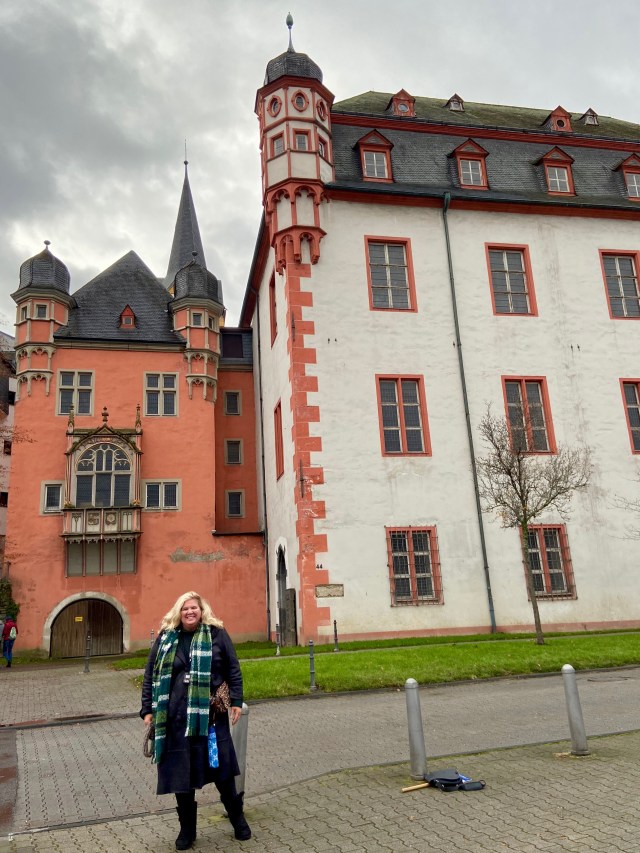
A castle and Christmas markets in Heidelberg, Germany

IMG_0642

Photo ©Jean Janssen. Heidelberg, Germany

Today we have a day-long trip into Heidelberg to visit the castle and Christmas Markets.  Its a familiar ride given my summer visit here.  You go through the industrial areas before reaching one of the most fairytale-like cities in Germany.

IMG_0588

Photo ©JeanJanssen. Arch added by Friedrich V to honor this English wife Elizabeth Stuart at Heidelberg Castle, Heidelberger Schloss in German, Germany.

IMG_0572

Photo ©Jean Janssen. Heidelberg Castle, Germany. On the left is the Fat Tower added for defense by Ludwig V. On the left is the English building, with its relatively plain facade, added to the Palace by Friedrich V to accommodate his English Queen since the spaces within the castle courtyard were occupied. Just outside was the leveled garden he commissioned for her.

IMG_0564

Photo ©JeanJanssen. Heidelberg Castle, Heidelberger Schloss in German, Germany.

IMG_0580

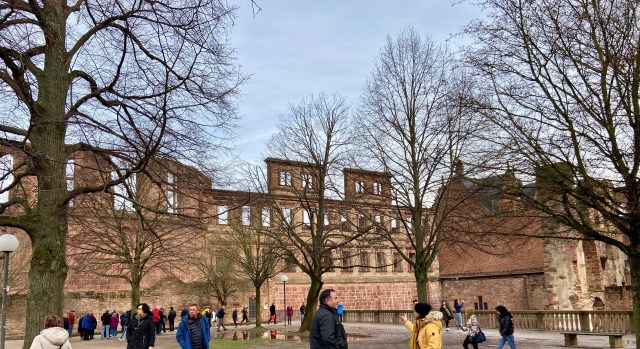
Photo ©JeanJanssen. As seen from the garden the entrance gate, castle ruins, and moat of Heidelberg Castle, Heidelberger Schloss in German, Germany.

Heidelberg is set along the Neckar River.  We first climbed the hill to reach the narrow car park at the castle.  We’ll take the funicular down into the city.  As crowded as it was in the car park, the number of visitors this day is nothing like what I experienced here in the summer.  We first stopped to see the arch and artillery garden with its sweeping views of the city before going inside the castle where you need a ticket to enter.  To create the garden, it was necessary to level the hillside next to the moat surrounding the complex of castle buildings that open onto the courtyard beyond the tower gate.

IMG_0571

Photo ©JeanJanssen. View of the city of Heidelberg from Heidelberg Castle, Heidelberger Schloss in German, Germany.

Heidelberg is home to Germany’s oldest University and it is clearly a University town.  25% of the city’s population are students.  In fact, much of what we could see from the castle garden was University buildings.  The University has an interesting fraternity history.  Many of the buildings we passed on the winding ride up to the castle were originally fraternity houses.

IMG_0565

Photo ©JeanJanssen. Leveled Garden and English Building at Heidelberg Castle, Heidelberger Schloss in German, Germany.

The arch, the artillery garden where we took in the view, and English Building were added by one of the castle’s famous residents, Friedrich V, who married Elizabeth Stuart, daughter of the King James I of England.  The young couple married in 1613.  To please his wife, there were elaborate wedding festivities and extensive renovations to a castle which dates from the 11th century and has been ravaged by invaders, fires, lighting, and war.

IMG_0591

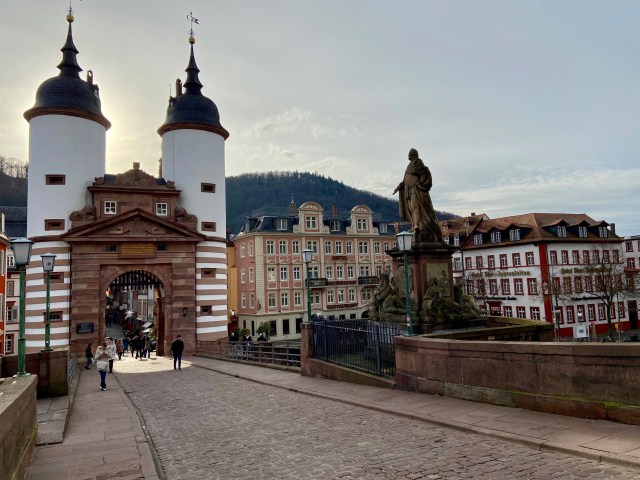
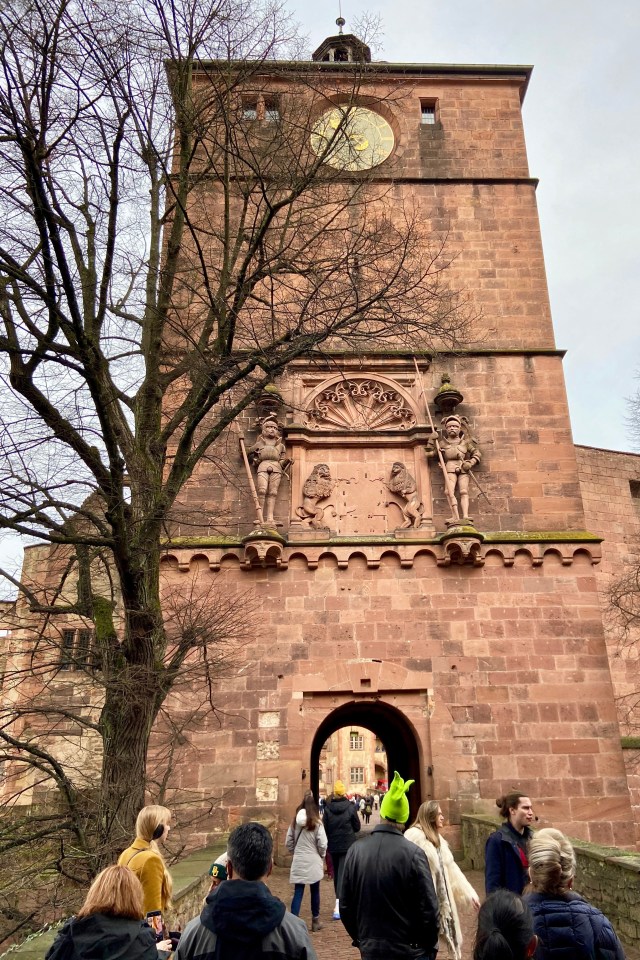
Photo ©Jean Janssen To enter the courtyard of Heidelberg Castle you cross the bridge and through this tower.

IMG_0594

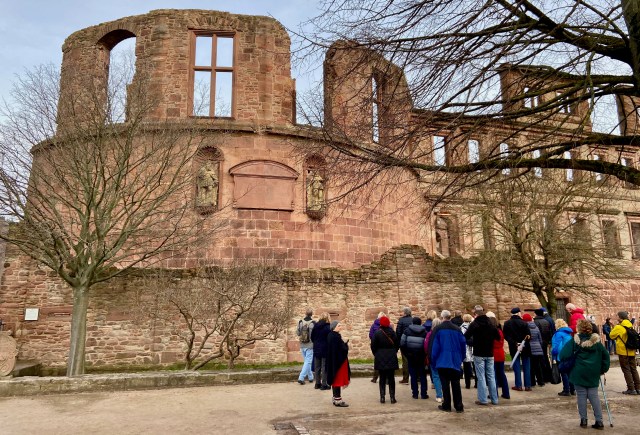
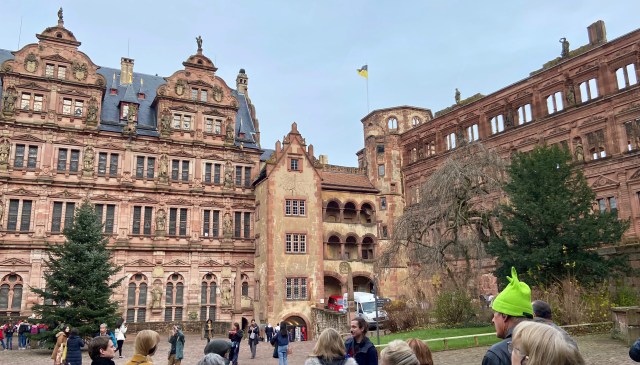
Photo ©Jean Janssen. As you enter Heidelberg Castle, the Ruprecht Building, the oldest surviving residential palace within Heidelberg Palace, is to your left. Straight ahead is the reconstructed Friedrich Building.

IMG_0597

Photo ©Jean Janssen.  In the courtyard of Heidelberg Palace, you see the Friedrich building to the left, The Hall of Glass in the center and the Ottheinrich Building on the right

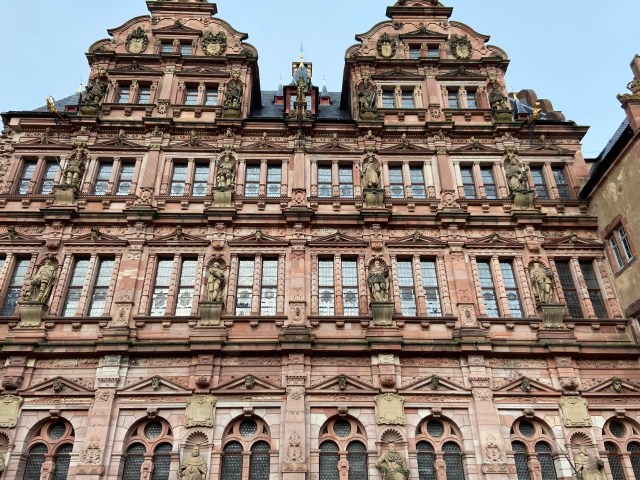
You take a stone bridge over the moat/ditch to reach the castle courtyard.  There is a rich mix of architectural styles from the Gothic Ruprecht Building-the oldest surviving residential palace within Heidelberg Palace- to the beautiful Renaissance Ottheinrich Building and the Italian-arched Hall of Glass to the reconstructed Late Renaissance Friedrich Building.  Before reconstruction took place from 1897 to 1900, castle bricks had been looted to construct the town below and the area was used to graze cattle and keep chicken and geese.  The structures had been used to dry laundry.   To maintain the romanticized version of the setting which had begun to draw visitors in, only the Friedrich Building which had been damaged by fire was reconstructed.

IMG_0604

Photo ©Jean Janssen. The Ottheinrich Building at Heidelberg Castle. According to the Castle’s website, “[t]he sovereign’s self-image and his political agenda were immortalized in stone here. Ancient heroes and Roman emperors represent military and political power. However, the Christian virtue that a ruler is also expected to possess, is likewise represented. Ottheinrich had himself installed in the central portal pediment.”

IMG_0614

Photo ©Jean Janssen. The Friedrich Building at Heidelberg Castle. According to the castle’s website, “Prince-Elector Friedrich IV had the stately residential palace built by his architect, Johannes Schoch, between 1601 and 1607, on the pedestal of a previous medieval structure..An idealized gallery of ancestors from the electoral family were used to demonstrate his claim to power. Thus, visitors can also see a depiction of Friedrich IV, as the final representative of his illustrious ancestral line, reaching back to Charlemagne.”

Of less historic significance is the popular attraction which is inside-the world’s largest wine barrel-in the appropriately-named Barrel Building.  The current barrel is the third iteration and was installed by Prince-Elector Carl Theodor.  This barrel holds 220,000 liters (over 58,000 gallons) of wine.  It has it own viewing platform; the platform had previously been used as a dance floor.

IMG_0612

Photo ©Jean Janssen. The Great Barrel at Heidelberg Castle. The statute of Perkeo is to the left side.

IMG_0659

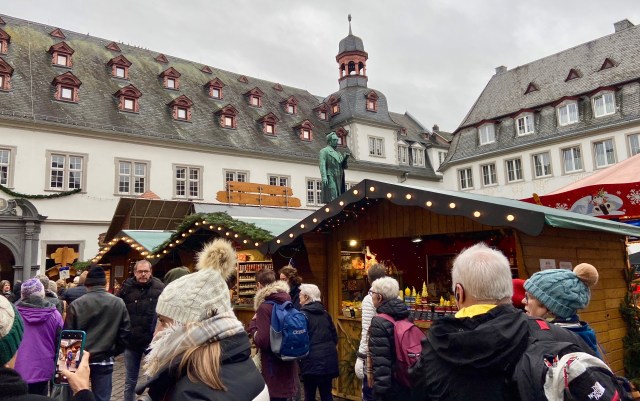
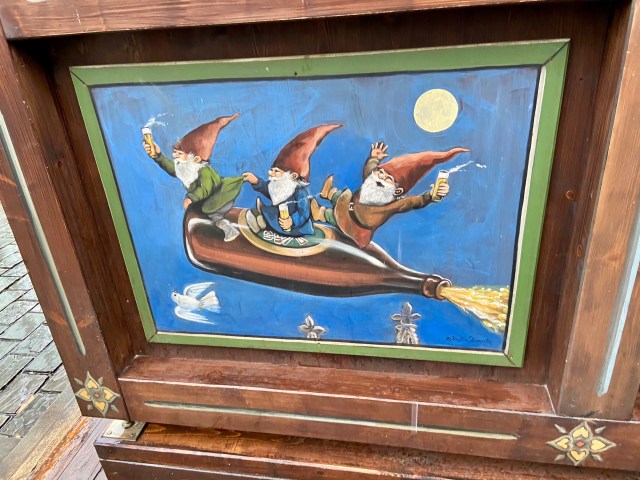
Photo ©Jean Janssen. A statute of Perkeo sits atop a wine barrel stall in a Heidelberg Christmas market. No surprise that the stall sells gluhwein.

A famous figure associated with the barrel is Perkeo and a statute of him stands guard by the barrel.  Little Perkeo was the court jester of Price-Elector Carl Philipp famous for holding his liquor.  We saw other references to the famous jester in the city’s Christmas Markets.

IMG_0620

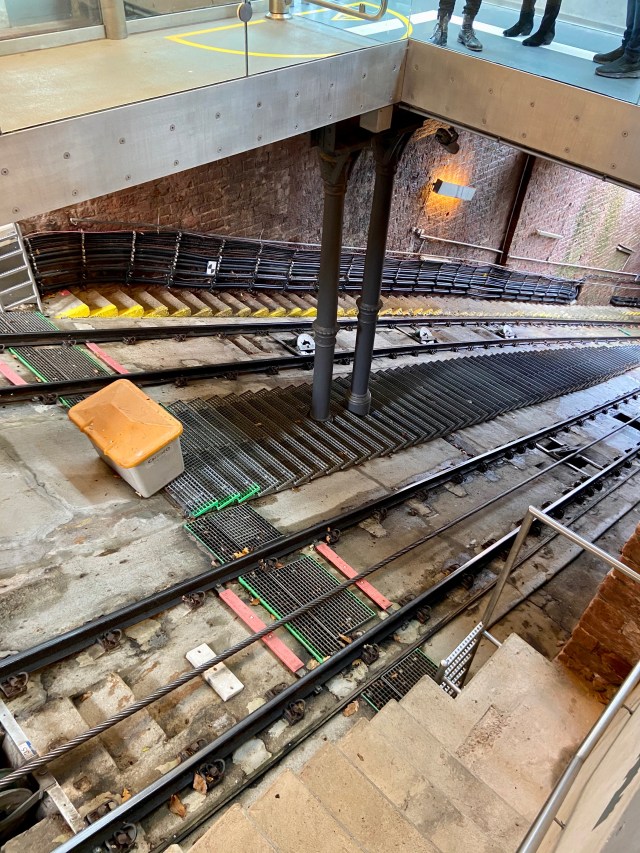
Photo ©Jean Janssen. The funicular path down from the castle to the Kornmarkt in the city of Heidelberg.

IMG_0621

Photo ©Jean Janssen. Riding the Funicular down to Heidelberg, Germany.

After our castle visit, we took the funicular down to the city station at the Kornmarkt to visit the many Christmas markets in the city’s various squares.  This lower portion of the funicular has been in operation since 1890.  One member of our group chose to upgrade his funicular ticket and took the trip up to the ruins of the upper castle at Konigstuhl, the city’s highest point.  He told me later it was worth the trip.

IMG_0626

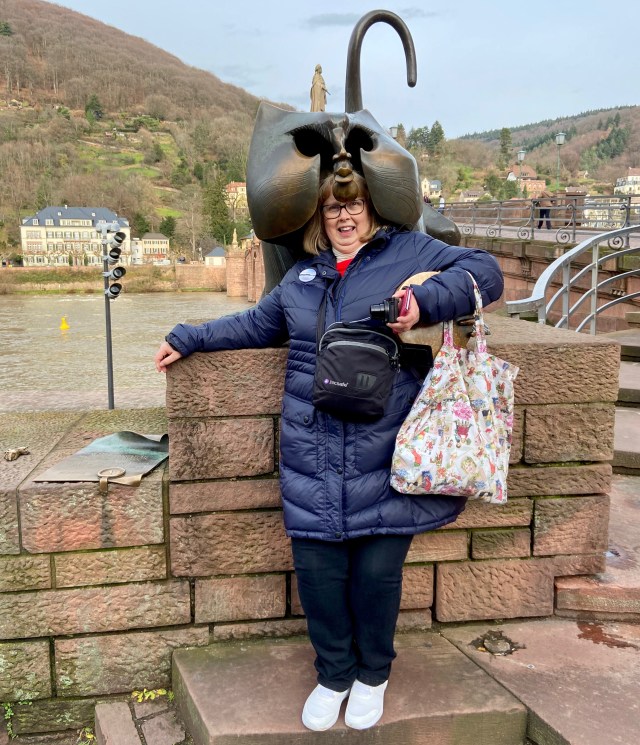
Photo ©Jean Janssen. Gill in the “famous” monkey statute near the Karl Theodor Bridge in Heidelberg Germany.

IMG_0635

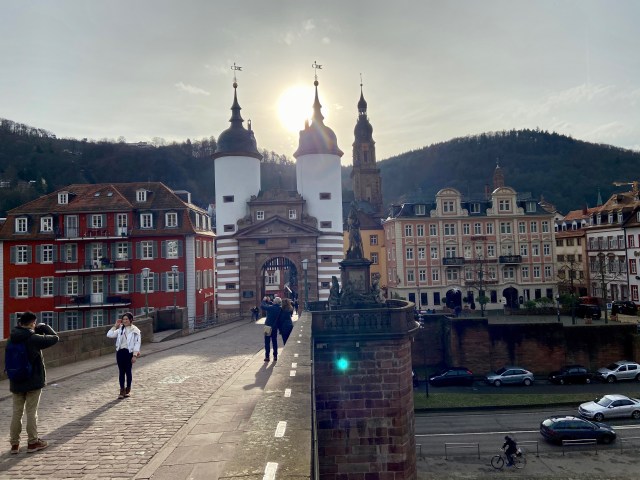
Photo by Jean Janssen. Karl Theodor Bridge, Heidelberg, Germany.

IMG_0632

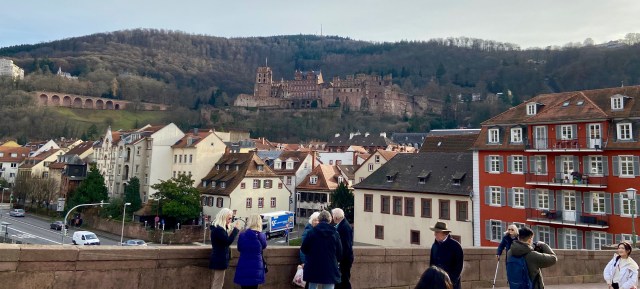
Photo ©Jean Janssen. View of Heidelberg Castle from the Karl Theodor Bridge.

Our guide gave us a bit of tour in town, pointing out the major sites and the pathway to others.  Gillian had something she particularly wanted to see, a statute of a monkey that she had seen with her parents as a child.  I went along as the guide took us there.  It was right next to the Karl Theodor Bridge that crosses the River Neckar.  The Karl Theodor Bridge, commonly known as the Old Bridge, was built in 1788 by Prince-Elector Charles Theodore.  The arched bridge visible from the castle is “one of the best-known landmarks and tourist destinations in Heidelberg.”  Gillian got a picture with the statute of the monkey, designed so you can put your head inside, but it wasn’t the one she remembered from her childhood.

IMG_0663

Photo ©Jean Janssen. Shopping in the Kornmarkt in Heidelberg with views of the castle in the distance.

IMG_0650

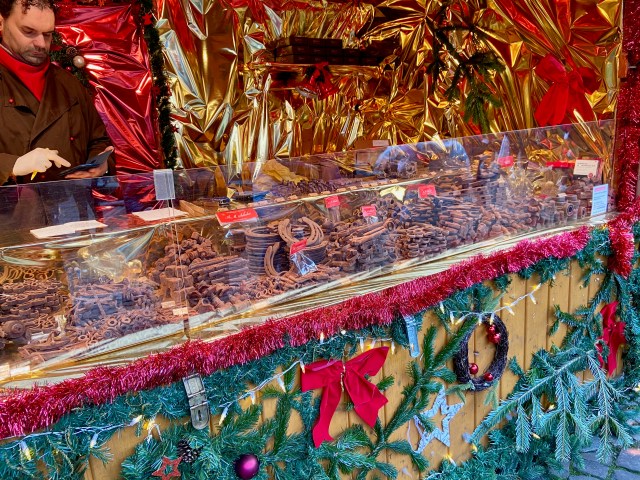
Photo ©Jean Janssen. Something unique, chocolate in the shape of tools in the Christmas market in Heidelberg, Germany.

IMG_0647

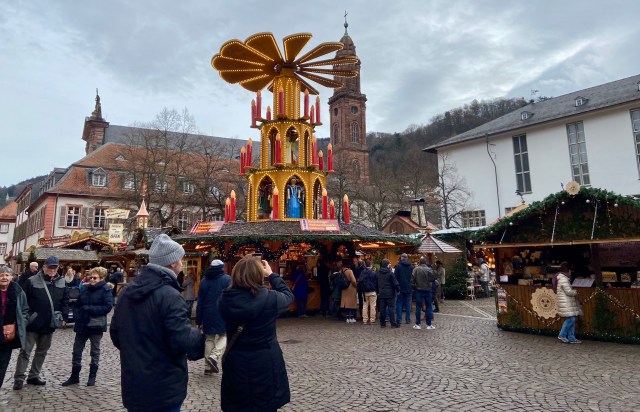
Photo ©Jean Janssen Christmas Markets in Heidelberg Germany

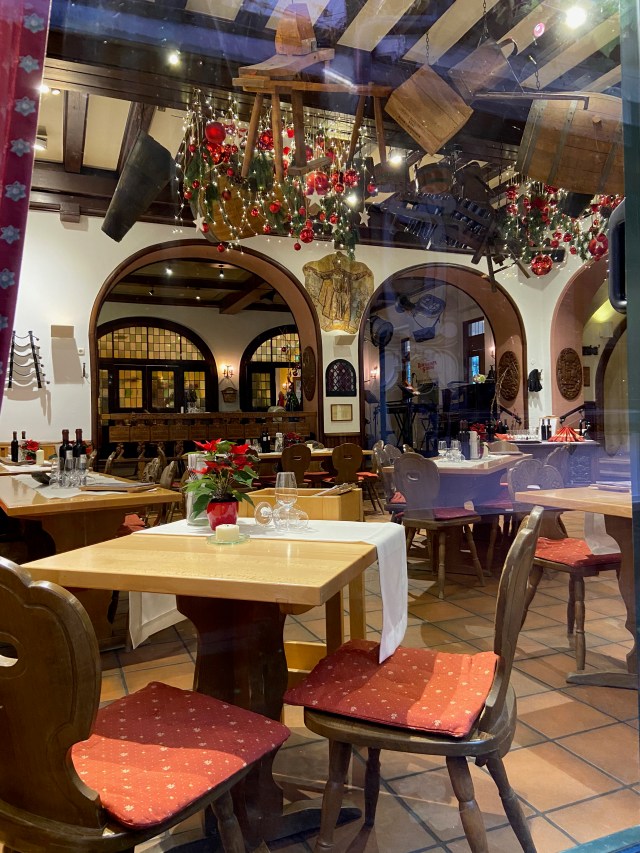
Gillian and I stayed together and walked through a few markets before deciding we would rather sit down for a nice traditional German meal in a restaurant rather than stand to eat in one of the markets.  We went to a wonderful place that the guide-who lives in Heidelberg and runs a theater company-suggested.  We liked the decor, particularly the light fixtures made from violins, and had great service from a woman who was originally from England but had lived with her family in Germany for over 35 years.  She was more than a little concerned about what Brexit would do to her status.

IMG_0654

Photo ©Jean Janssen. Cocktails, not beer, to start our traditional German lunch in Heidelberg, Germany

We started with a cocktail and then had one of the best German meals I have ever tasted, hardy and fabulous.  My German father would be so proud.  We were fortified for the shopping ahead.  Afterwards, we went into a grocery store to buy chocolate at prices far better than I can get in the states.  We did split up at the end to get in those power purchases before meeting up with our group.  There is a lot to see in Heidelberg beyond the castles and the markets.  I tried to hit the highlights on my last visit.  Wouldn’t mind returning once again.

IMG_0649

Photo ©Jean Janssen Christmas Market in Heidelberg Germany

IMG_0669

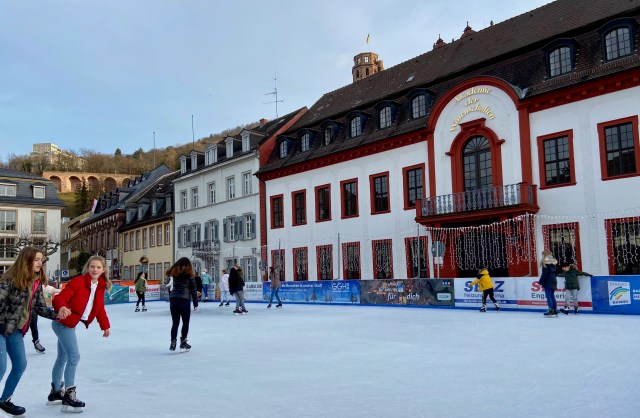
Photo ©Jean Janssen. I have started looking for these in each city where we go to markets. There is generally a skating rink. Heidelberg, Germany

IMG_0662

Photo @Jean Janssen. Shopping with a view. A Christmas market in Heidelberg with the castle in the background.

This might actually be one of the best times to visit the city.  In spite of the markets, the crowds were far thiner than they had been during our summer visit.  Heidelberg is definitely a city to put on your bucket list.

IMG_0665

Photo ©Jean Janssen. Everywhere you look there is another amazing view of the castle. Heidelberg, Germany

IMG_0642

Photo ©Jean Janssen. Heidelberg, Germany

Posted in cruises, international, River Cruise | Tagged , , , , , , , , , , , , , , , , | Leave a comment

Eberbach Abbey, Rudesheim, and Wiesbaden Germany

IMG_0478

Photo ©Jean Janssen Erberbach Abbey, Eltville, Germany

There was an early buffet dinner this evening to accommodate those wanting to go to the Christmas Market in the evening and for the group of us that wanted to take an optional tour to Kloster Eberbach in nearby Eltville.  I elected to take the tour as I didn’t want to go to the Christmas Market alone at night.  We are docked in Rudesheim, a city I have visited before.

IMG_0450

Photo ©Jean Janssen. Looking out into the cloister from the Chapter Meeting Room in Eberbach Abbey, Eltville, Germany

It was a relatively short drive to the beautiful Abbey (Kloster in German).  The first monastery on the site was started in 1116 by Augustinians.  The Bishop bestowed it on the Benedictines in 1131 and it became a Cistercian Abbey in 1136.  The prosperity of the Abbey was founded in its wine production.  It the old wine storage room where we made our first stop.  Half of our tour group will be guided through the Abbey first; our group was starting with the wine tasting.  I enjoyed all the wine, but it was rather sweet for my taste.  Oddly the store was closed during our visit so you were unable to make any purchases.  Perhaps a missed opportunity for the Abbey.

IMG_0437

Photo ©Jean Janssen. The wine storage rooms at Eberbach Abbey.

IMG_0438

Photo ©Jean Janssen. The wine storage rooms at Eberbach Abbey.

The former storage facilities was very atmospheric.  The had (empty) wine barrels with lovely lit candles on them as the room’s only illumination.  The candles had actually served a purpose in former times to detect air or gas levels in the room; flickering flames were the early warning system.  There was also a mold that grew on the arches supporting the ceiling that feed off the alcohol in the room.  Although wine is no longer stored in the barrels, they do enough tastings in this space that the (safe) mold continues to thrive.

IMG_0449

Photo ©Jean Janssen. Chapter meeting room, Eberbach Abbey, Eltville, Germany

After our tasting we toured the Abbey by candlelight.  I loved the cloister and the chapter meeting room where the monks sat in rows determined by rank and years of service.  This was the only place in the monastery where they spoke.  We also toured the lay brothers’ refectory where 12 traditional wine presses are on display.  These non-noble men who committed themselves to the monastery did the heavy physical labor and dirty jobs associated with the operation of the Abbey.

IMG_0462

Photo ©Jean Janssen. One of 12 traditional wine presses in Eberbach Abbey. This one is dated 1668.

IMG_0461

Photo ©Jean Janssen. Historic wine presses in the lay brothers’ refectory of Eberbach Abbey.

The Abbey was severely damaged during the 30 Years’ War and the monastery was heavily looted.  Only 20 members of the order returned in 1635 to revitalize it.  However, the 18th century brought economic prosperity through the wine production.  The Abbey’s decline started with the French Revolution and the religious presence ended in 1803.  The facilities served as an asylum for some period of time.   In the 1980s, the Abbey was used to film interior shots for the Sean Connery/Christian Slater film, The Name of the Rose, an historical Mystery story.  Today it is a wedding venue, the site of an annual music festival, and offers regular wine tastings.

IMG_0470

Photo ©Jean Janssen. Ceiling decoration in the the Eberbach Abbey, Eltville, Germany.

Our last stop was a highly decorated room where the Abbey officials met with lay persons.  There was lovely ceiling decorations and a few remaining pieces of wood furniture.  However the room was set up for a film crew and we couldn’t stay long.  I believe a remake of The Name of the Rose is in the works.

IMG_0465

Photo ©Jean Janssen The Eberbach Abbey cloister.

It was actually dark enough on our way back to the bus that we got a bit lost.  All accounted for in the end though and we went back to the ship where some people decided to walk into town.  I was ready to pack it in and be ready for shopping in the market in the morning.

IMG_0494

Photo ©Jean Janssen Rudesheim, Germany

IMG_0493

Photo ©Jean Janssen Rudesheim, Germany

Since I had been to Rudesheim before, in the morning I just walked into town along the waterfront and enjoyed the markets.  I did add to our ceramic house collection here with a town gate that I hadn’t seen before.  The store where we bought these items at on our last visit was closed, but I found the gate in one of the market stalls.  It will make an excellent Christmas present for Boris.  I enjoyed seeing the city decorated for the holidays.  All around town were large ceramic Santas just begging you to take a picture with them.

IMG_0510

Photo ©Jean Janssen Rudesheim, Germany

IMG_0504

Photo ©Jean Janssen. Rudesheim, Germany

IMG_0496

Photo ©Jean Janssen Rudesheim, Germany

Its a charming city and always worth a visit.  Just walk down the narrow lanes and you’ll find shops, restaurants, and hotels all in compact traditional buildings.  There is also a lovely square near the church.  I didn’t make it that far on our last visit.  They had a large outdoor nativity.  All of the markets we have visited have featured children’s rides; this one had a small train.

IMG_0489

Photo ©Jean Janssen Rudesheim, Germany

IMG_0488

Photo ©Jean Janssen Rudesheim, Germany

We traveled further upriver and docked.  Here we could stay in town or take a trip to Wiesbaden for the Twinkling Star Market.

IMG_0517

Photo ©Jean Janssen

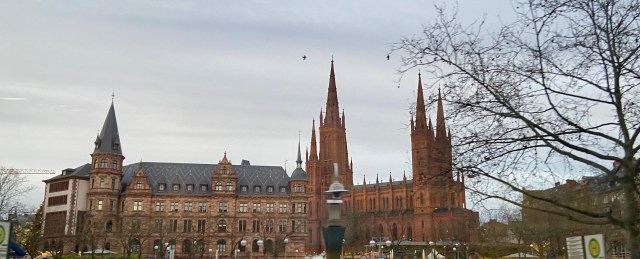
Wiesbaden’s mineral springs have made the location a “spa” destination since Roman times.  It had its heyday in the 19th century.  Its Marktkirche, a brick Neo-Gothic church, was built in 1862 to accommodate a population that had doubled in the last twenty years.  Marktkirche sits in Wiesbaden’s central Schlossplatz which is the site of the city’s beautiful night market and our destination.

IMG_0521

Photo ©Jean Janssen. Marktkirche and the city hall, Wiesbaden, Germany

This was a wonderful market, great shopping and unique and varied food choices.  I met up with Gillian and she shared with me a few of her finds.  I did some copycatting on her purchases.  I loved the lighting, the huge Christmas tree, and the fantastic setting.  It quickly grew dark and the real beauty of the Twinkling Star Market shown.  It lives up to its name.

IMG_0527

Photo ©Jean Janssen Twinkling Star Christmas Market Wiesbaden, Germany

IMG_0529

Photo ©Jean Janssen Twinkling Star Christmas Market Wiesbaden, Germany

IMG_0538

Photo ©Jean Janssen Twinkling Star Christmas Market Wiesbaden, Germany

IMG_0539

Photo ©Jean Janssen Twinkling Star Christmas Market Wiesbaden, Germany

I did stop by a few of the city’s main attractions that were nearby.  I saw the outdoor skating rink, the Staatstheater (The Hessian State Theater), and the Kurhaus (the Spa House).  Just the walk down the main lit street was magical.  That makes two very special nighttime events in a row.  Heidleburg is tomorrow.

IMG_0543

Photo ©Jean Janssen. The Staatstheater, the Hessian State Theater in Wiesbaden, Germany

IMG_0550

Photo ©Jean Janssen. Kurhaus, the Spa House, in Wiesbaden, Germany.

IMG_0555

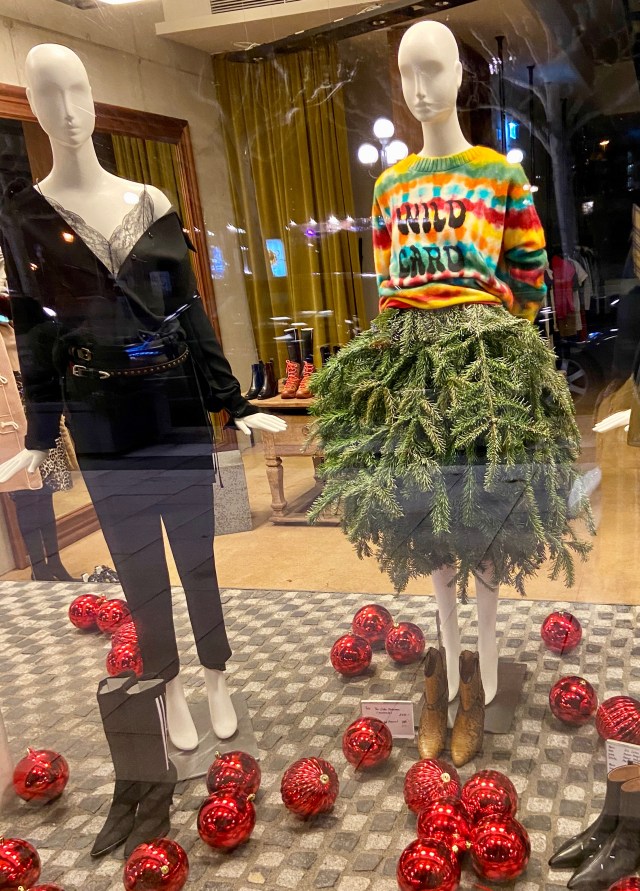
Photo ©Jean Janssen Window Shopping in Wiesbaden, Germany. Ever wondered what to do with the Christmas trees after the holidays?


Posted in cruises, international, River Cruise | Tagged , , , , , , , , , | Leave a comment

The German Corner and Castles on the Rhine

IMG_0349

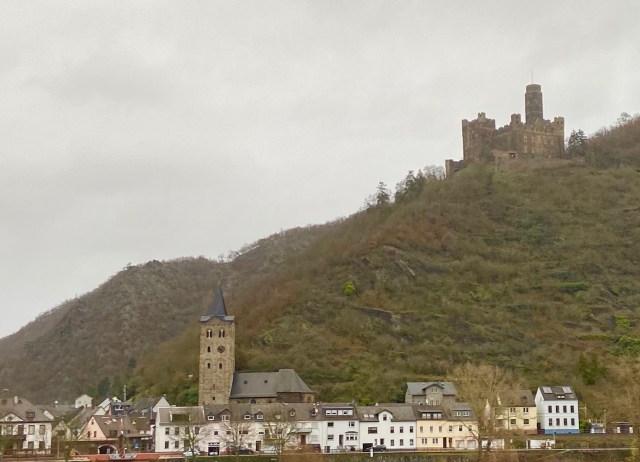
Photo ©Jean Janssen. Schloss Stolzenfels just outside Koblenz, Germany in the Upper Middle Rhine Valley.

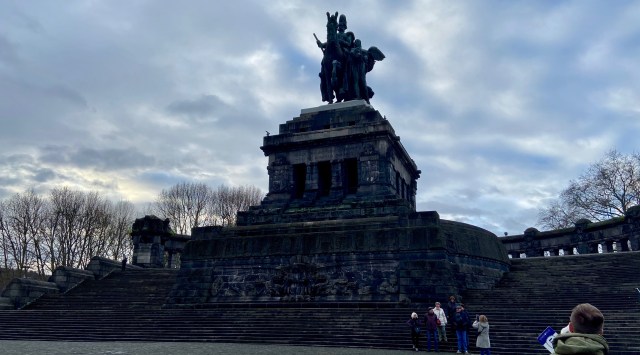
Our second full day of the Christmas market cruise began with a stop at the German Corner where the Rhine and Moselle Rivers meet.  The landscape is dominated by the Ehrenbreitstein Fortress on one side of the Rhine and the Statute of Kaiser Wilhem I sitting on horseback atop a pedestal on the opposite side where the rivers converge.  We detoured onto the Moselle to dock along its banks at the city of Koblenz.

IMG_0286

Photo ©Jean Janssen. A replica statute of Kaiser Wilhelm I erected in 1993 (after the original was destroyed during WWII) at Deutsches Eck (German Corner) where the Rhine and Moselle Rivers meet.

The Teutonic Order founded one its command posts here in the 13th Century and the statute was added in the 19th Century to honor that history and “to rouse German nationalistic fervour”.  The statute had been destroyed during the war.  With the history of its purpose in mind, it is no surprise that after WWII it was many years and arguments later before the statute would be replaced (in 1993).

IMG_0283

Photo ©Jean Janssen. View of the Ehrenbreitstein Fortress from Deutsches Eck, the German Corner, Koblenz, Germany.

IMG_0277

Photo ©Jean Janssen. Sections of the Berlin wall along the Moselle waterfront in Koblenz, Germany

Leaving the ship for our land tour, we made a stop beside three segments of the Berlin wall that had been removed and erected here.  Walking along the water front, there was more attempts to symbolize unity with the flags of several nations flying along the water’s edge.  We made a stop at the monument before turning the corner to walk along the Rhine.  On my last visit we took the cable car across the river for a visit to the Ebrenbreistein Fortress.  I recommend both the cable car ride and the fortress visit.

IMG_0290

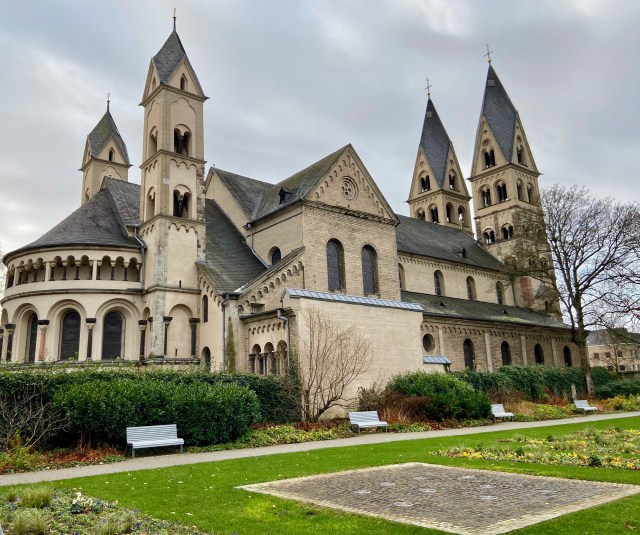
Photo ©Jean Janssen. Basilica of St. Castro, Koblenz, Germany

IMG_0300

Photo ©Jean Janssen. Basilica of St. Castro, Koblenz, Germany

Touring Koblenz, we stopped at the Basilica of St. Castro, formerly part of a monastery that stood here.  Although we saw the exterior on our last visit, this time we were able to go inside and enjoy the church with its modest advent decorations.  The facade features beautiful Romanesque towers.  The Basilica is a UNESCO World Heritage Site and the oldest church in Koblenz.  “It was at this place in 842 that 110 representatives negotiated the division of the Frankish Empire.”

IMG_0299

Photo ©Jean Janssen. Basilica of St. Castro, Koblenz, Germany

IMG_0303

Photo ©Jean Janssen. View of the Romanesque towers of the Basilica of St. Castro in Koblenz, Germany

Leaving the Basilica, we toured through parts of Koblenz, with our guide noting the locations of many of city’s Christmas markets.  We saw the “Schangel” fountain in the courtyard of the town hall (Willi-Horter Platz) depicting a spitting boy in reference to one of the Schang boys (slang reference to the boys born during the French occupation).  I was more intrigued by the Renaissance and Baroque Jesuit Buildings.  The town hall is the former Jesuit College, with towers on either end and a beautiful portal in the middle.  The Jesuits had a presence in Koblenz for almost two hundred years before they were expelled in 1773.

IMG_0315

Photo ©Jean Janssen   Some of my favorite decorations were in this market near the Jesuit College where everything was in gold and white.  Koblenz, Germany

IMG_0340

Photo ©Jean Janssen. The Jesuit church, built in 1610,  is tucked into a corner of Jesuitenplatz in Koblenz, Germany.

IMG_0319

Photo ©Jean Janssen Within the former Jesuit College, now the town hall, Koblenz, Germany

IMG_0317

Photo ©Jean Janssen Koblenz, Germany

IMG_0322

Photo ©Jean Janssen. I could only catch a glimpse of the Liebfrauenkirche in Koblenz, Germany.

We also caught a glimpse of the Liebfrauenkirche.  After our tour, we had time to walk around the town and visit the various Christmas Markets.  I bought only a few things, some unique jewelry and an ornament.  Since the markets are in the various squares, often beside a church, I got to sightsee while shopping.

IMG_0337

Photo ©Jean Janssen Christmas Market in Am Plan Square with the onion towers of Liebfrauenkirche in the background, Koblenz, Germany

IMG_0312

Market in Jesuitenplatz. The former Jesuit College is now the town hall, Koblenz, Germany. The Jesuits were in Koblenz for almost 200 years until they were expelled in 1773.

IMG_0329

Photo ©Jean Janssen Koblenz, Germany

IMG_0331

Photo ©Jean Janssen Koblenz, Germany Tops of the stalls are often the fun part.

IMG_0328

Photo ©Jean Janssen Koblenz, Germany

Much of Koblenz was destroyed during WWII, but I spotted a few architectural finds that depicted a traditional Germany city.

IMG_0343

Photo ©Jean Janssen Koblenz, Germany

IMG_0333

Photo ©Jean Janssen Koblenz, Germany

IMG_0310

Photo ©Jean Janssen Koblenz, Germany

IMG_0332

Photo ©Jean Janssen Koblenz, Germany

IMG_0334

Photo ©Jean Janssen Koblenz, Germany

All too soon it was back to the boat for our lunch of German sausages and our scenic tour of castles on the Rhine.  Even though I have been to Koblenz before, this morning was an interesting look at this charming city during the holiday season.

IMG_0345

I saw our guide as I began my walk back to the ship and she took this picture of Natasha-with scarf, hat, boots, crossbody bag and a dangling umbrella- along the waterfront of the Moselle River in Koblenz, Germany.

IMG_0351

Photo ©Jean Janssen. Schloss Stolzenfels in the Upper Middle Rhine Valley near Koblenz, Germany

Only minutes after leaving Koblenz, we came to a lovely castle on the Rhine, Schloss Stolzenfels.  Schloss means castle in German.  It was built in the 14th century, but was destroyed in the 17th century by the French during the Nine’s Years War.  Eventually the land was gift by the city to Frederick William IV of Prussia in 1823.  He rebuilt the castle in a romanticized Gothic-Revival Style.  Today you can tour the fairytale castle by taking a winding garden path.  Going inside this schloss is just one more reason for Natasha to return to Koblenz.

IMG_0352

Photo ©Jean Janssen. Castle along the Rhine River, Lahnstein, Germany

IMG_0357

Photo ©Jean Janssen. Castle along the Rhine River, Brey, Germany

IMG_0366

Photo ©Jean Janssen. Warring brothers’ castles along the Rhine River, Bobbard, Germany

IMG_0375

Photo ©Jean Janssen. Castle along the Rhine River, Germany

IMG_0378

Photo ©Jean Janssen. Castle along the Rhine River, Germany

IMG_0384

Photo ©Jean Janssen. Castle along the Rhine River, Germany

IMG_0389

Photo ©Jean Janssen. Castle along the Rhine River, Germany

IMG_0393

Photo ©Jean Janssen. Castle along the Rhine River, Germany

For the next several hours, we sailed along the river with commentary by our cruise director and had the opportunity to see the many castles along the Rhine.  Last time I came in the summer and it was too hot to sit out for long.  Today it was too cold.  I braved it-bundled up-for as long as I could.  In addition to the castles, we saw an example of a German tradition.  It was not uncommon for people to head straight from church on Sundays straight to the brewhouse.  This location eliminated the delay by attaching the two buildings; the church and the brewery are connected.

IMG_0372

Photo ©Jean Janssen A match made in heaven? This brewery and church are attached to each other. Along the middle Rhine at mile marker 560, Germany.


IMG_0405

Photo ©Jean Janssen. Loreley Rock, along the Rhine, Germany

We also passed the famous Lorelei. Lorelei, or Loreley in German, is a “steep slate rock on the right bank of the River Rhine in the Rhine Gorge (or Middle Rhine) at Sankt Goarshausen in Germany.”  The formation of the rock contributes to a particular sound heard with wind travels around the corner.  Loreley is the subject of many legends, poems, and songs.  “An old legend envisioned dwarfs living in caves in the rock.”

IMG_0412 2

Photo ©Jean Janssen. When I got cold, I watched for some of the castles from the lounge and then  later through the Juliet window in my cabin.

“In 1801, German author Clemens Brentano composed his ballad… [which] told the story of an enchanting female associated with the rock. In the poem, the beautiful Lore Lay, betrayed by her sweetheart, is accused of bewitching men and causing their death. Rather than sentence her to death, the bishop consigns her to a nunnery. On the way thereto, accompanied by three knights, she comes to the Lorelei rock. She asks permission to climb it and view the Rhine once again. She does so and thinking that she sees her love in the Rhine, falls to her death; the rock still retained an echo of her name afterwards.”

IMG_0419

Photo ©Jean Janssen. Along the Rhine River, Oberwesel, Germany

“In 1824, Heinrich Heine seized on and adapted Brentano’s theme in one of his most famous poems, “Die Lorelei”. It describes the eponymous female as a sort of siren who, sitting on the cliff above the Rhine and combing her golden hair, unwittingly distracted shipmen with her beauty and song, causing them to crash on the rocks.”

IMG_0430

Photo ©Jean Janssen. Along the Rhine River, Oberwesel, Germany

Accidents at the dangerous corner only reinforce the legends. In 2011, a “barge carrying 2,400 tons of sulphuric acid capsized…near the Lorelei rock, blocking traffic on one of Europe’s busiest waterways.”  Guess what was the easy target to blame?  After Loreley we were losing light.  We will dock in Rudesheim tonight where I am going on an Abbey wine tasing tour before touring the Christmas markets in the morning.  More to come…

IMG_0341

Photo ©Jean Janssen. The prettiest Christmas market in Koblenz.


Posted in cruises, international, River Cruise | Tagged , , , , , , , | Leave a comment

Christmas in Cologne

IMG_0242

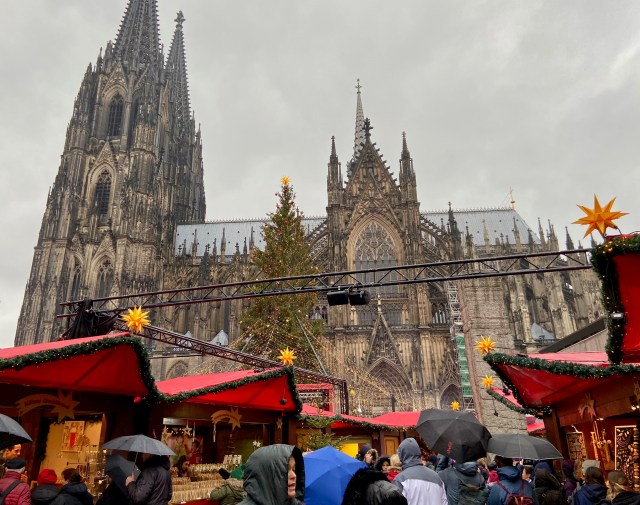
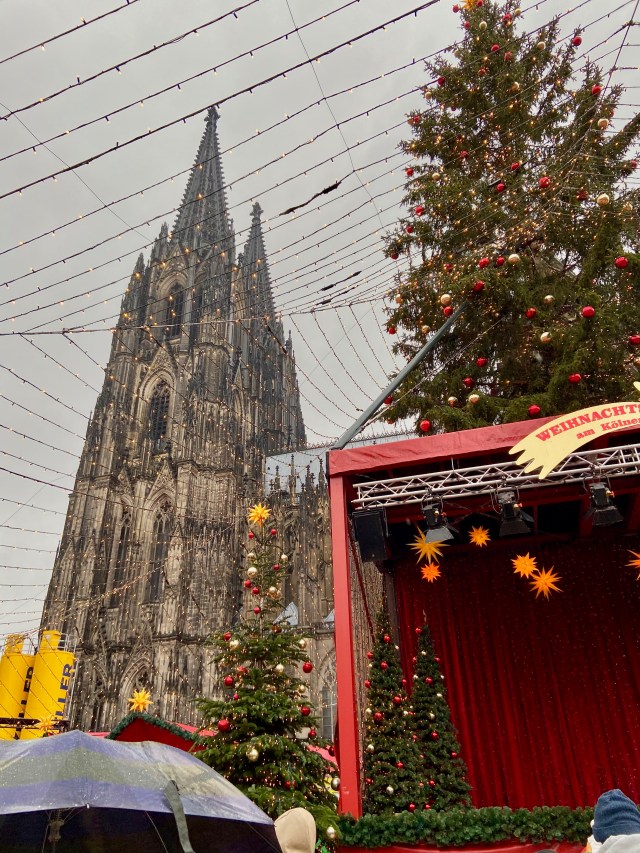
Photo ©Jean Janssen. Holiday Christmas Market in the foreground with Cologne Cathedral in the background. Cologne, Germany.

Once again I was off on an river cruise adventure to the Christmas Markets.  The itinerary is actually the same as one I did in the summer.  This was to be my market trip with my sister Emma.  We had booked last year and the water levels were too low for the ships to maneuver, so that trip was cancelled.  This year Emma had emergency surgery the week before our departure.  Having lost more than half the blood in her body, she was unable to travel.  Emma is fine now, but it took many weeks of recovery.

IMG_0241

Photo ©Jean Janssen. Braille map of the churches surrounding the Cologne Cathedral as of 1794.

We didn’t take the travel insurance so I went ahead rather than lose the money.  Emma got nothing back, although she could book the air miles for a future trip within one year.  So, give serious consideration the next time you book travel.  My other take-away from this experience is that to some men, women traveling alone are considered fair game.  I did not appreciate the advances of married men, who knew I was married, but were not deterred.  Just be prepared.  It was a new experience for me.

IMG_0193

Photo ©Jean Janssen Cologne Cathedral in Advent.

Our travel started in Cologne, Germany, most famous for its beautiful Cathedral.  The first night we were not docked close to the city, so I decided a nap was in order after the long overnight flight; I can not sleep on planes.  The next morning I woke ready to go.  They had moved the boat at midnight and we were now docked along the Rhine about a half hour’s walk from the church.

IMG_0168

Photo ©Jean Janssen Cologne, Cathedral, Cologne, Germany.

We took a bus in.  Once again it is raining just like my last visit to Cologne during the summer.  One day I am going to see this city in the sunshine. We started with a tour of the Cathedral, declared a World Heritage Site in 1996.  Construction on the Cathedral began in 1248, but halted in 1473.  Work did not resume until the 1840s.  The Cathedral was completed according to the original medieval plan in 1880. Today, it is the country’s “most visited landmark” receiving an average of 20,000 visitors each day.

IMG_0273

Photo©Jean Janssen. Cologne Cathedral, Cologne, Germany

Cologne Cathedral is “the tallest twin-spired church in the world…and the third tallest church in the world.  It is the largest Gothic church in Northern Europe and has the second-tallest spires.”  Architecture aside, the Cathedral is most famous for a very special work of art, the Shrine of the Three Kings, which is said to contain the remains of the three wise men.  The “relics were acquired by Frederick Barbarossa at the conquest of Milan in 1164. The shrine takes the form a large reliquary in the shape of a basilican church, made of bronze and silver, gilded and ornamented with architectonic details, figurative sculpture, enamels and gemstones. The shrine was opened in 1864 and was found to contain bones and garments.”

IMG_0172

Photo©Jean Janssen. The refectory containing the remains of the three wise men in Cologne Cathedral, Germany.

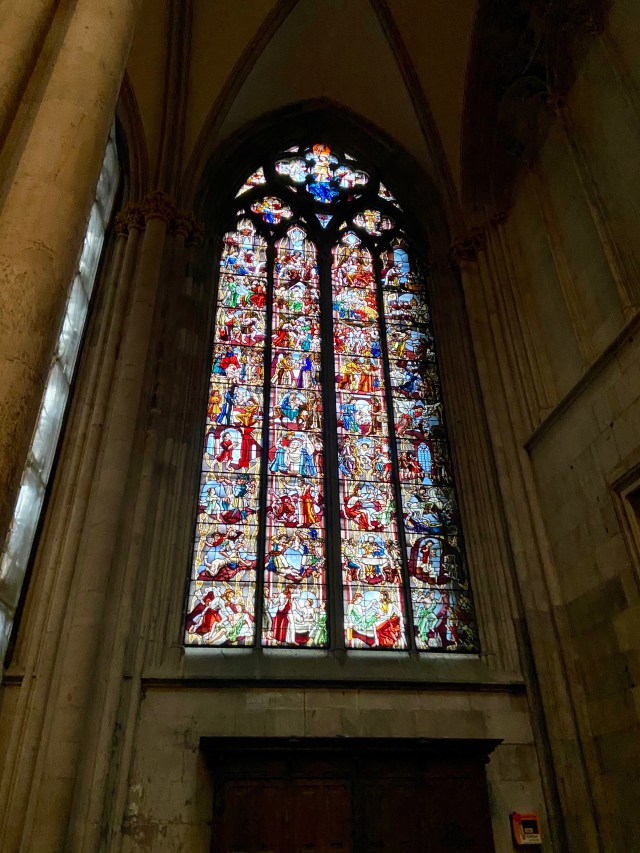
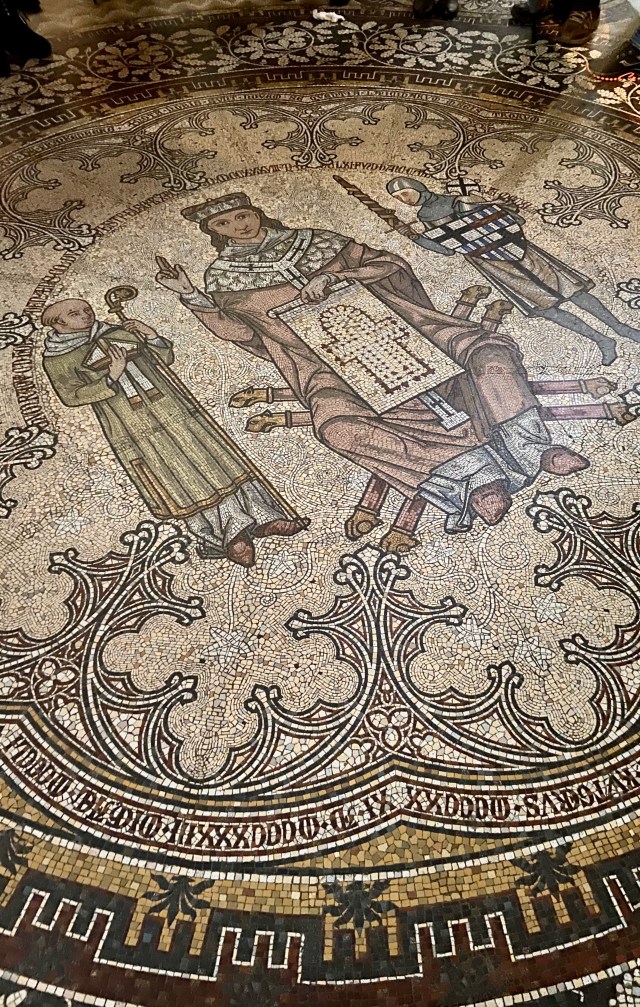
The Cathedral’s tall interior pillars are a marvel, but I was enchanted by the church’s beautiful stained glass, marble and decorated floor, and one particular painted ceiling.

IMG_0177

Photo©Jean Janssen. Cologne Cathedral, Cologne, Germany

IMG_0192

Photo©Jean Janssen. Cologne Cathedral, Cologne, Germany

IMG_0182

Photo©Jean Janssen. Cologne Cathedral, Cologne, Germany

IMG_0189

Photo©Jean Janssen. Cologne Cathedral, Cologne, Germany

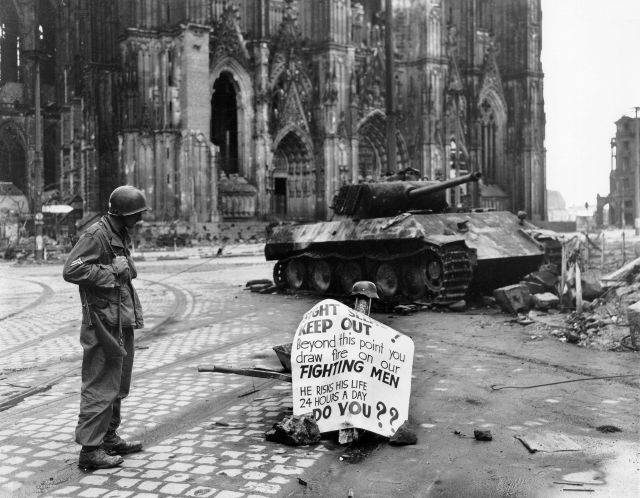
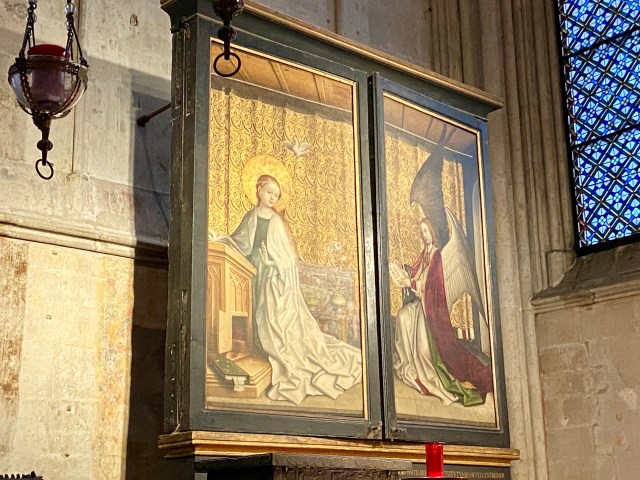
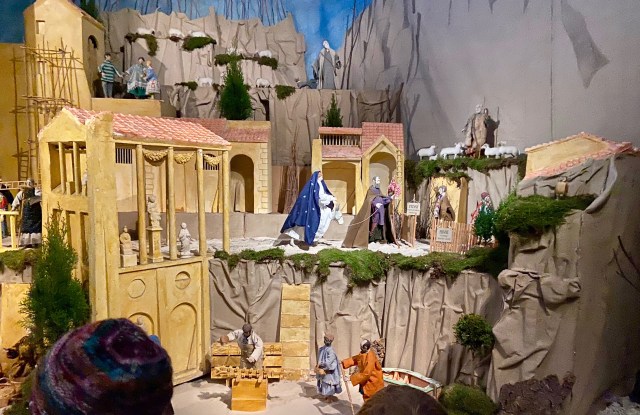
The Cathedrals’s twin spires were a landmark for the Allied forces during WWII and fourteen arial bombs struck the Cathedral during the war.  Although heavily damaged, the Cathedral remained standing in a city that was almost completed destroyed.1920px-Warning_sign_in_cologne It was particularly special to visit the Cathedral during Advent.  We saw the reverse side of one the churches famous altar screens depicting the annunciation.  The other holiday touches were subtle, but the advent wreath, nativity scene, and the refractory made the timing of this visit noteworthy.

IMG_0167

Photo©Jean Janssen. Cologne Cathedral, Cologne, Germany

IMG_0166

Photo©Jean Janssen. Cologne Cathedral, Cologne, Germany

IMG_0157

Photo©Jean Janssen. Cologne Cathedral, Cologne, Germany

IMG_0200

Photo©Jean Janssen. Cologne Cathedral, Cologne, Germany

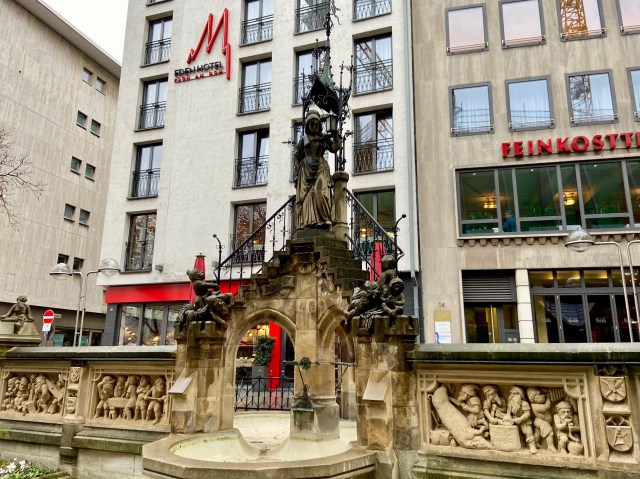
After the Cathedral, we toured some of the area nearby and our guide pointed out some of the area museums we might want to visit in our free time.  In particular, we saw part of the discovered Roman ruins in the archeological museum.  Gnomes are also a symbol of the city and we went by the fountain that depicts the legend.  Afterwards, she gave us the layout of three of the nearby Christmas Markets.  I did a little looking and then headed back to the ship for lunch with the tour group.

IMG_0138

Photo ©Jean Janssen. Preserved roman remains in Cologne, Germany.

IMG_0136

Photo ©Jean Janssen. Cologne, Germany

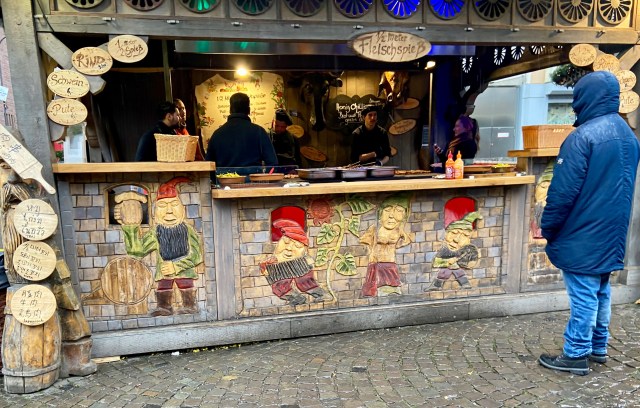
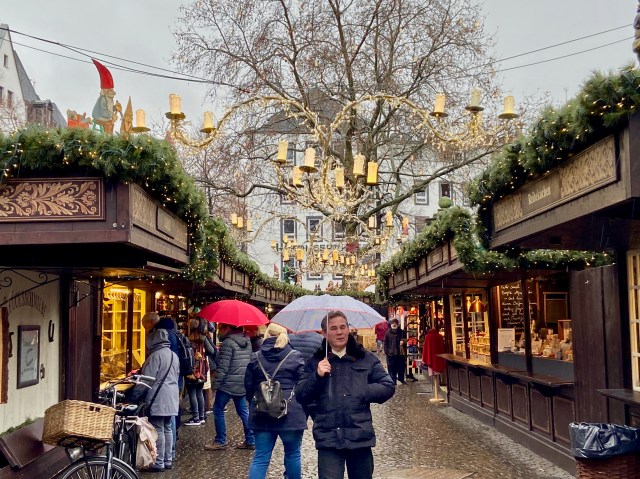
After lunch, I rode the shuttle back to the city to take another look at the various markets the guide had pointed out to us.  The Cathedral market was what I expected, but it was the others nearby that I really enjoyed.  Near the town hall was a charming market decorated with gnomes throughout.  In route I even found an office conference space decorated as if the gnomes had taken it over.

IMG_0237

Photo ©Jean Janssen. Gnomes take over a local conference space in Cologne, Germany

IMG_0222

Photo ©Jean Janssen Cologne, Germany

IMG_0218

Photo ©Jean Janssen Cologne, Germany

IMG_0216

Photo ©Jean Janssen Cologne, Germany

IMG_0211

Photo ©Jean Janssen Cologne, Germany

IMG_0208

Photo ©Jean Janssen Cologne, Germany

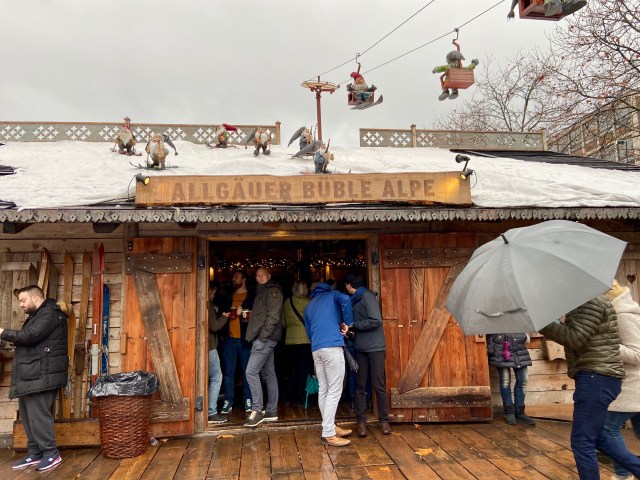
Further on was a section of the market with even more food and drink outlets.  This one also included a large skating rink around a monument and curling lanes outside a brew stand.  The curling was very popular.

IMG_0253

Photo ©Jean Janssen Cologne, Germany

IMG_0252

Photo ©Jean Janssen Cologne, Germany

IMG_0251

Photo ©Jean Janssen Cologne, Germany

IMG_0261

Photo ©Jean Janssen Cologne, Germany A picture is worth a thousand words.

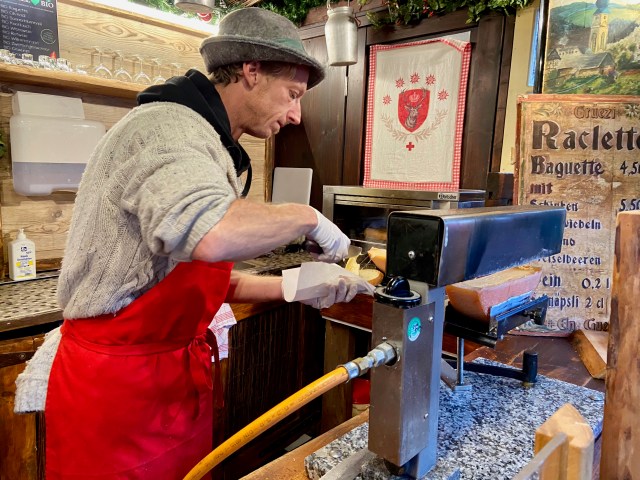
I wasn’t hungry at all, but the market included such enticing treats that I decided I would get something.  I like savory over sweet, so a tried this wonderful melted cheese on bread.  The server placed a large block of cheese under heat, when the top was melted he spread it onto a fresh baguette.  Then you could add whatever you wanted-sweet or savory-as the topping.  I went with the bacon.  It was fabulous!

IMG_0262

Photo ©Jean Janssen Cologne, Germany

IMG_0265

Photo ©Jean Janssen Cologne, Germany

IMG_0266

Photo ©Jean Janssen Cologne, Germany

I went to a far point and then walked back to our meeting place for the bus.  It was cold and more rain was threatening so I wanted to take the shuttle back rather than walk back alone.  I noticed all the wood carvings scattered about as I made my way to the Cathedral.  There was definitely more food booths proportionately than I remember from previous Christmas market visits.

IMG_0267

Photo ©Jean Janssen Cologne, Germany

IMG_0221

Photo ©Jean Janssen Cologne, Germany

IMG_0269

Photo ©Jean Janssen Cologne, Germany

I arrived at the bus stop early and ran into a few people from the ship.  We waited a long time and finally gave up and walked back.  The estimated 15 walk took closer to 30 minutes.  Good thing I was fortified with that baguette with cheese and bacon.  My feet were tired and it was probably a little tougher because we had already been walking around all day.  I did make some new friends during the walk and got back in time to hear at least some of the cruise briefing.  Then there was just enough time for a nap before dinner.  And so the adventure begins…

IMG_0244

Photo ©Jean Janssen Cologne, Germany

IMG_0228

Photo ©Jean Janssen Cologne, Germany

IMG_0246

Photo ©Jean Janssen Cologne, Germany

Posted in cruises, international, River Cruise | Tagged , , , , | 1 Comment

Vila Nova de Gaia and another look at Porto, Portugal

DSC_7316

Photo ©Jean Janssen. Boats tied up along the Vila Nova de Gaia waterfront. Note the barrels. Use of boats such as these was the traditional method of moving wine from the Douro Valley to Gaia. Across the Douro River is the Ribeira District of Porto.

We have been looking at those Port wine cellars across the river since we arrived in Porto and today is our day to visit.  After you cross the Dom Luis I Bridge over the Douro River, you are actually in another city, Vila Nova de Gaia.  Ironically, the city from which Port wine takes it name is not the location where the wine is produced or stored.  It is the Gaia (as everyone calls it) side that has this honor.

DSC_7330

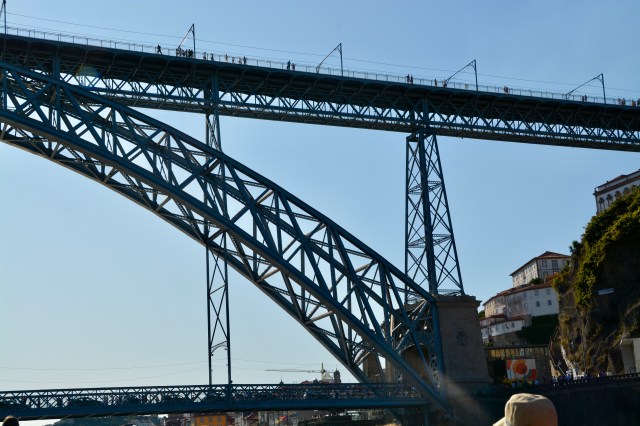
Photo ©Jean Janssen. Dom Luis I bridge connecting Porto and Gaia, Portugal (as seen from the Gaia side)

So why are the Port wine cellars in Gaia?  Well I found a great article by a private tour guide (Porto and Northern Portugal) and writer Sara Riobom.  She shares the following online on her web presence, Portoalities:  “Port wine never sets ‘a foot’ in the city of Porto, despite its name. It comes straight from the vineyards in the Douro Valley to Port wine cellars located in Vila Nova de Gaia, just across D. Luis I bridge. Why so?  The main reason was politics. In 1255, [the] king D. Afonso III [issued]… a Foral letter… The goal was to transfer commercial trade away from Porto, as only the Bishop and the Catholic Church were benefitting from it…[T]he Bishop was entitled to charge [various taxes]…in Porto…Port wine traders, in order to escape these tolls, opened up their Port wine cellars in Gaia, much to the dismay of the Bishop of Porto.  There were also other reasons…[the] terrains in Vila Nova de Gaia were rich in water mines, so almost each cellar had their own private water supply. Moreover, Gaia is a facing North (so it has less solar exposure) and it is sheltered from strong winds, therefore having a milder temperature, providing good aging conditions for Port wines.”

DSC_7321

Photo ©Jean Janssen. Gaia boardwalk along the Douro. Still pretty quiet mid morning on a Saturday.

I added a link to Sara’s website; you might want to check out the full article and the wonderful pictures that she has collected.  In addition to the wine cellars on Gaia, our plans for the day also include a city tour of Porto.

DSC_7311

Photo ©Jean Janssen. Old barrel transport boats moored on the Gaia riverfront. This was the traditional method of transporting the wine from the Douro Valley to Gaia.

Our day started with a fabulous hotel breakfast at the Gran Cruz House in the Casario restaurant.  You could order as much or as little as you liked and sit inside or on the second floor terrance.  We went down at 9 am and got a wonderful table on the balcony.  We enjoyed the standards as well as some amazing pancakes-mine with apple, Boris’ with ricotta cheese.  Our thought was that tours would get started around 10.  Our cellar tours are set for the late afternoon and we have late (for us) dinner reservations after that.
DSC_7317

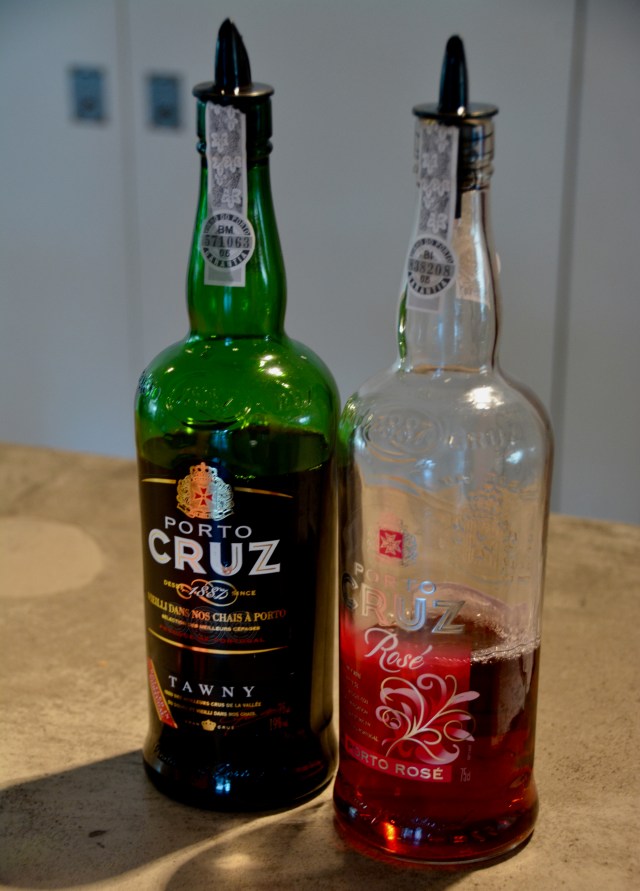
Photo ©Jean Janssen. Tasting options at Cruz in Gaia, Portugal

DSC_7318

Photo ©Jean Janssen. View from the Cruz boardwalk tasting room in Gaia.

I was still of the mind that we should do the hop on/hop off bus and get those great upper levels views, but Boris really wanted to try the tuk-tuk.  There were no available reservations for an English guide until 12 noon,  so we decided to use our free tasting ticket at Cruz.  We walked across the Dom Luis I bridge (lower level) and into Gaia.  There are so many tasting cellars along the river I don’t know how you chose.  Our choice is just based on a free ticket.
DSC_7306

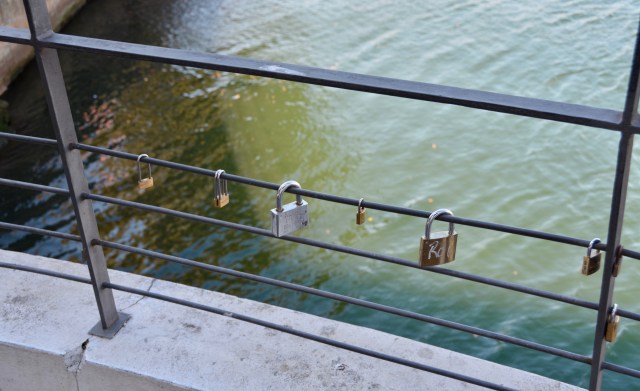
Photo ©Jean Janssen. We see these all over the world now. Couples put locks on the bridge and toss the key into the water to symbolize the eternity of their relationship.  The gesture has gotten so popular that a section of one bridge in Paris collapsed under the weight of the locks.   This picture is of locks on the Dom Luis I Bridge connecting Porto and Gaia in Portugal.

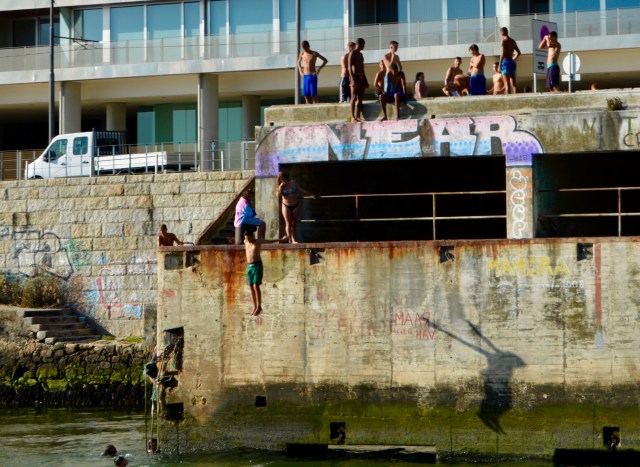
There were lots of old barrel boats mored by the river’s edge and it was still pretty quiet along the waterfront given it was only mid morning on a Saturday.  We got a free tasting and did some people watching before heading back across to meet our tuk-tuk tour guide.  By the time we walked back, there was a lot more activity and the boys were out to make their bridge jumps.  The bridge had a narrow sidewalk on each side-tough to be two abreast with the vehicular traffic.

DSC_7334

Photo ©Jean Janssen. The Funicular dos Guindais on the Porto side just after crossing back over the bridge.  This photo only shows part of the climb it makes up the steep hill to the city wall.

After we crossed back over, I noticed the funicular.  The Funicular dos Guindais, also known as the Guindais Funicular, travels along a steep hill connecting the Ribeira district with Batalha at the top of the city.  The first funiculars appeared in Porto in 1891.  The Guindais funicular was renovated in 1994.  At the top is a well preserved section of the medieval walls.  I had a great view of the wall during our river boat tour.  This is one of two  sections of the Fernandine Wall that still exist today.  It was built between 1368 and 1437 to replace the old defensive wall that was then too small to protect the growing city.  Wonder what those wine transfer taxes paid for?  This is one thing.  This section of the wall is called the Trecho dos Guindais.

DSC_6916

Photo ©Jean Janssen. Trecho dos Guindais is one of two remaining sections of the Porto’s Fernandine Wall. The funicular runs along this steep hill rising from the Ribeira neighborhood. You can also see the top level of the Dom Luis I Bridge on the left.

DSC_7339

Photo ©Jean Janssen. I saw some lovely exterior tile work in the Ribeira district as we waited for our Tuk-Tuk driver.

We did not go down to the waterfront after we crossed back over but headed into town through the tunnel to meet our tour guide.  We will be touring with a company called Tuking People.  We were all a little early and got started right away.  Our driver/guide is a 19-year-old Porto native and currently a student.  In fact, this was his last day of work.  He is heading to Poland to study.  He will be back for the Christmas holidays, but doesn’t finish his course work in Poland until March.

DSC_7347

Photo ©Jean Janssen. The River Douro in the center; historic Porto on the upper right. Gaia on the left. In the bottom right hand corner is the upper level of the Dom Luis I Bridge with a metro car and pedestrians crossing the river. We are at Jardim do Morro at the Monastery of Serra do Pilar in Vila Nova de Gaia, Portugal.

We headed right back across the Dom Luis I Bridge and up to Jardim do Morro.  We are accessing the lookout platform at the monastery by tuk-tuk; in fact he drove right up the sidewalk.  You can also reach the gardens by taking the subway (Jardim do Morro stop), walking across the upper level of the Dom Luis I bridge (an experience in and of itself) or by taking the cable car.  From the gardens you have lovely views of historic Porto and the Douro River.  It is considered the best spot for seeing a sunrise or sunset in the area.  I saw the crowds gathered at sunset on our first evening in town from my hotel room window.
DSC_7349

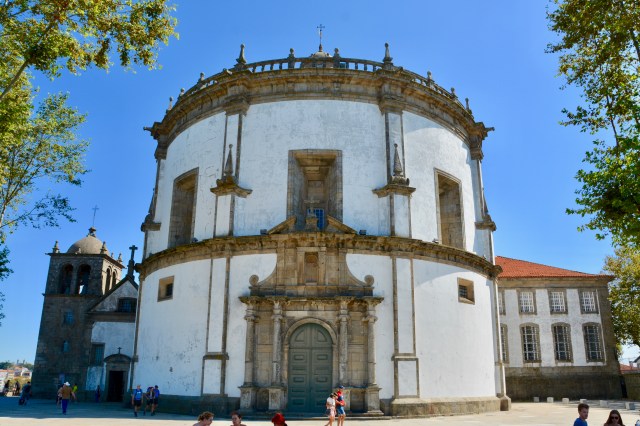
Photo ©Jean Janssen. The Monastery of Serra do Pilar sits on the top of hill overlooking the Douro and the city of Porto, Portugal.

A monastery was first constructed on this site in 1538, but the circular church now in place was consecrated in 1672.  Now a monument, the Monastery of Serra do Pilar is famous for the circular design of the church and cloister and for its views from the jagged mont on which it sits of the same name.  The monastery was designated a UNESCO World Heritage Site in 1996.

DSC_7371

Photo ©Jean Janssen. Entrance to the military barracks on Mont Serra do Pilar, Gaia, Portugal

Mont Serra do Pillar was also a strategic military site.  “Reconstruction of portions of the monastery that had been destroyed by successive wars began in 1927. In 1947 some of the monastery grounds were converted into military barracks which remain on the site to this day.”  We passed by the entrance to the military grounds on our way out and down.

DSC_7373

Photo ©Jean Janssen. Historic Porto, Portugal

DSC_7380

Photo ©Jean Janssen. I saw this church on our way to the Douro Valley yesterday. We passed it again today in the tuk-tuk. Love it. Porto, Portugal.  (I am leaving the corner of the tuk-tuk in these pictures to give you a little perspective.)
DSC_7389

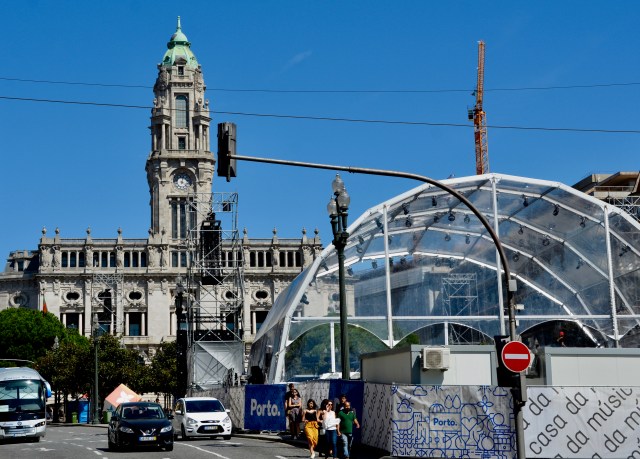
Photo ©Jean Janssen. Porto City Hall with a concert venue in front.

Leaving Gaia behind, we crossed back over the Douro and headed into the historic part of Porto.  The wonderful thing about the tuk-tuk was that it could weave in and out of traffic and go down narrow pathways that no bus could ever navigate.  Boris was right.  This was the way to see historic Porto.  The tour companies do offer packages where you could do the hop-on/hop off bus as a transportation vehicle, the boat ride for a different perspective and bridge touring, and a tuk-tuk to get you in the Alleyways.  This would be the perfect combination.  The down side of the tuk-tuk was we passed by things, but did not stop.  (Although we did have the stop at the monastery to take in the view.)  If you want to go back to anything, you would need another form of transportation.

DSC_7384

Photo ©Jean Janssen. Shopping, Porto style. Check out the cool door on this building.

DSC_7385

Photo ©Jean Janssen. Porto shopping street. This photo gives you good idea of your view from a tuk-tuk.
DSC_7391

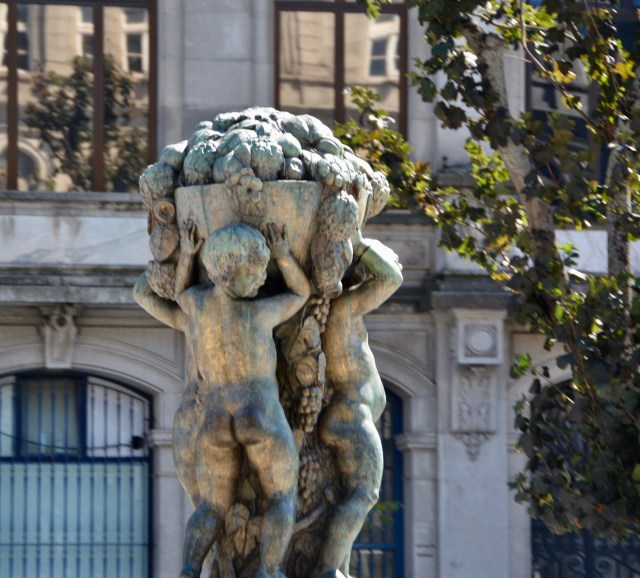
Photo ©Jean Janssen. Porto, Portugal

We passed quickly (I got a quick look at the interior) by the Sao Bento train station which I really wanted to see, especially with my love of Portuguese tiles.  The station is built on the site of a Benedictine monastery and has 20,000+ blue and white tiles (azulejos) telling the history of Portugal.  The station began operations in 1916 and still serves trains between Porto and its northern suburbs.

DSC_7397

Photo ©Jean Janssen. Porto, Portugal

DSC_7399

Photo ©Jean Janssen. The exterior (not the good part) of the San Bento Train Station, Porto, Portugal.

Another site we zipped by was the Porto Cathedral.  Although it got a Baroque remake in the 17th century, the Cathedral still maintains part of its 12th century original construction and some of its defensive structures.  The crowds here were overwhelming.  I could tell we won’t have the time to make it back today to visit.  I would have loved to have seen the titled cloisters and the gilded interior (reminiscent of Sao Francisco in Ribeira).  Just another reason to come back to Porto.

DSC_7402

Photo ©Jean Janssen. Porto Cathedral

DSC_7405

Photo ©Jean Janssen. Porto Cathedral

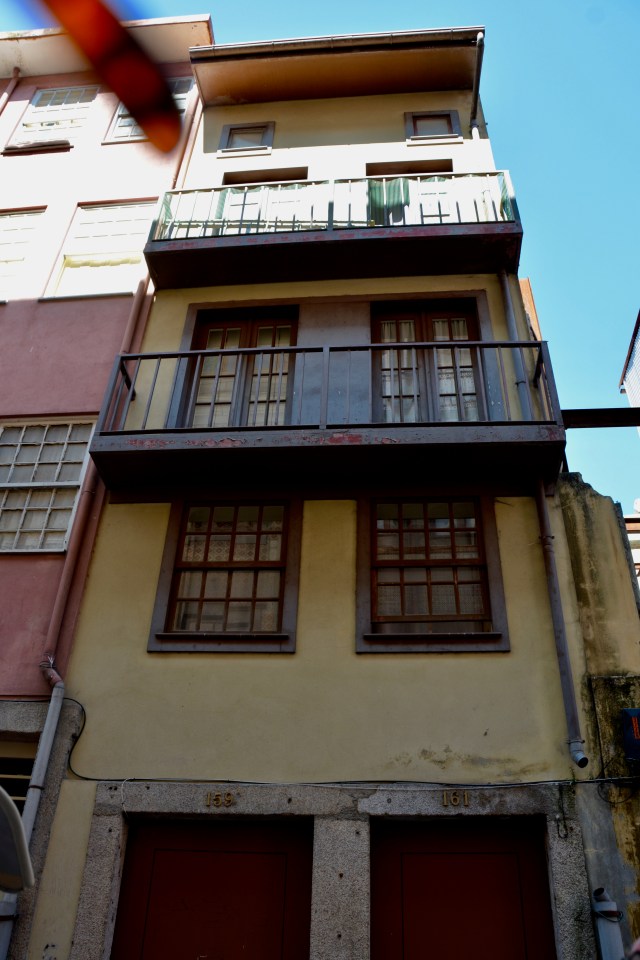
After we passed by the Cathedral and not far from the train station, we toured through the old section of Porto built just outside the former city walls.  Here we were on narrow lanes that get very little sunlight due to the tall buildings.  Our guide Carlos explained that you paid taxes based on the width of your property.  People built very narrow homes, put could make them as high as they wanted without incurring additional taxes.

DSC_7411

Photo ©Jean Janssen Oldest section of Porto.
DSC_7414

Photo ©Jean Janssen. This narrow building represents two houses. Taxes were based on the width of the home so people built their houses narrow and tall. Each of the bottom doors indicates the width of one home in old Porto, Portugal

DSC_7417

Photo ©Jean Janssen. The tall narrow buildings of the old quarter don’t let in much light. Porto, Portugal

This is where the benefit of the tuk-tuk choice really shines.  Wandering through this section of Porto means a lot of up and down through narrow lanes where you might get lost.  Love that we had a native local tour guide.  Carlos pointed out what he has been told is the oldest street in Porto.

DSC_7419

Photo ©Jean Janssen. Porto city hall in the distance from the narrow lanes of Porto’s oldest section of the city.

DSC_7421

Photo ©Jean Janssen. Porto’s oldest residential section.

DSC_7423

Photo ©Jean Janssen. Porto’s oldest street.

Finally, we returned to the Ribeira district where we started.  We passed by Rua de São João, the steep pathway that leads directly to our hotel on the waterfront.  The street has cultural significance.  Named for the patron saint, it plays a central role in the city’s annual Saint John Festival around June 23.
DSC_7432

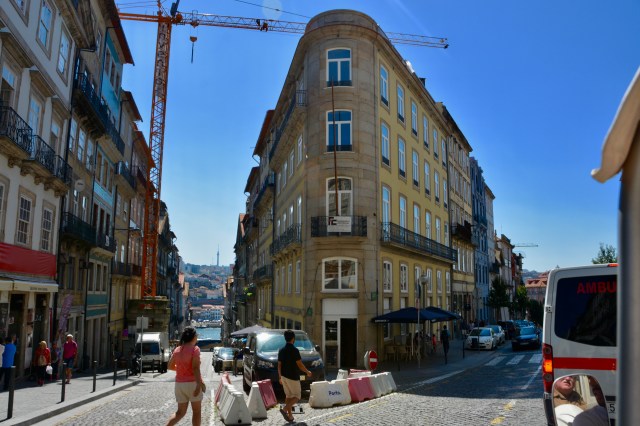
Photo ©Jean Janssen. Love the construction of the corner building. We are back in the Ribeira District. To the left is Rue Sao Jao, the steep street that leads straight to the our hotel on the river. We will be back this upper section this evening for dinner.

DSC_7444

Photo ©Jean Janssen. A view of Sao Francisco from the tuk-tuk

Outside St. Francis church we saw the tram car whose tracks we followed on our first day in town.  This is another way to tour the city.  The Porto Tram City Tour offers three different lines to local attractions and as far out as the coastal city of Foz do Douro at the river’s month (think beaches).  You ride on vintage tram cars.

DSC_7445

Photo ©Jean Janssen. You can take a city tour on a vintage tram car in Porto, Portugal

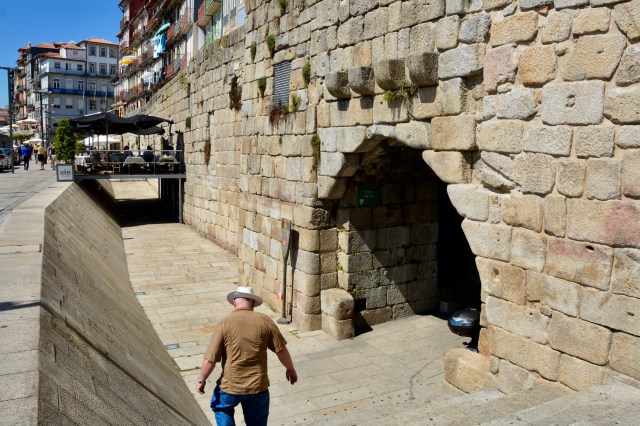
We were hot and tired by the end of the tour so we went back to the waterfront.  Before going by the hotel, we made a stop at the wall opening Boris had spotted the first day.  Along the Ribeira waterfront in Porto there were 18 doors and hatches in the 14th century wall built to connect the water with the commercial street.  This is the only surviving one.  “This hatch has a gothic inscription from 1386.”
DSC_7451

Photo ©Jean Janssen.   The only tunnel entrance to the Ribeira waterfront wall to survive to this day.   It is dated 1836.

We thought we would take a short break and then head to lunch.  Our hotel concierge has been great with recommendations and we have heard nothing but negatives about the sidewalk cafes so it is worth stopping by the desk to get a suggestion for an alternative to eating in one of the nearby sidewalk cafes.

DSC_7463

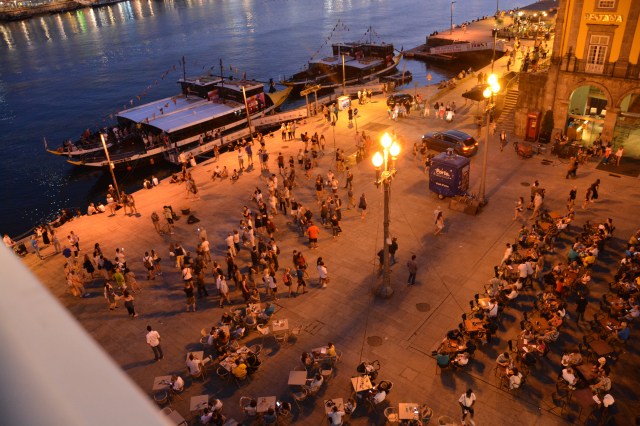
Photo ©Jean Janssen. Lots of activity on the square next to our hotel.

DSC_7464

Photo ©Jean Janssen. Spotted on the Porto waterfront.

With a recommendation in hand, we headed up toward the center of town for lunch on one of the famous streets of Porto, Rua das Flores (flowers street).  This land was originally flower plantations.  It was a major commercial street and home to noblemen in the 15th century.  We were right in the hub of all the activity when we stopped at Impar for a late lunch (although this is when the locals eat).  It was uphill the whole way and we were ready to sit down for food and drinks by the time we reached the restaurant.  It wouldn’t be as bad if it wasn’t so hot.  We did pass one interesting shop on the way.

IMG_2461

Photo ©Jean Janssen. Spotted on the way to lunch in Porto; wouldn’t find this at home.

The food was delicious and this was a great spot for some people watching.  We started with the garlic prawns.  Be sure to use the basket of bread to soak up any extra sauce.  This was one of their specialties.  I followed that with steak and fries, an added recommendation from our concierge.  Wonderful!  He also recommends the octopus here; it is a local speciality and quite common on the Porto menus.

IMG_5936

Photo ©Jean Janssen. First lunch course at Impar in Porto. Garlic prawns. Yum!

Our first Port wine cellar tour was on the far end of the Gaia boardwalk and we weren’t sure we would make it by the time we finished lunch.  We started out on foot (at least we were going downhill this time), but Boris grabbed a cab.  The problem was the cabs can only go a short distance down the Gaia boardwalk.  We should have just got out there, but instead the cab driver wound us around for while before dropping us off at theFerreira Tasting Room.  Unfortunately this is where the tour ends, not begins, so we set off on foot again to the bottom of the hill.

DSC_7472

Ferreira wine cellar in Gaia. Depends on what variety you chose where they are stored. The tawny is stored in the smaller barrels which allow more contact with the oak.

We are at Ferreira, one of the traditional larger producers.  Pretty fancy set up for a tour. They are apparently in high demand (at least on a Saturday).  Good thing we had reservations; their tours were sold out for the day.  They were only offering the “Classic Tour” with two tastings.  The premium options (with food, more wine options, and/or aged Port) were not available today.

DSC_7476

Photo ©Jean Janssen. The Ferreira tour included a museum. Gaia, Portugal

Our tour was in English.  Their facilities are spread out up the hill side and they use a tunnel system during the tour to get guests safely across the streets.  The Ferreira tour presentation was definitely focused on tradition.  They even included a small museum with old equipment and photographs on the tour.   Ferreira is also scooping up other companies like Sandeman, whose sign we can clearly see from across the river when it is lit up at night.
DSC_7482

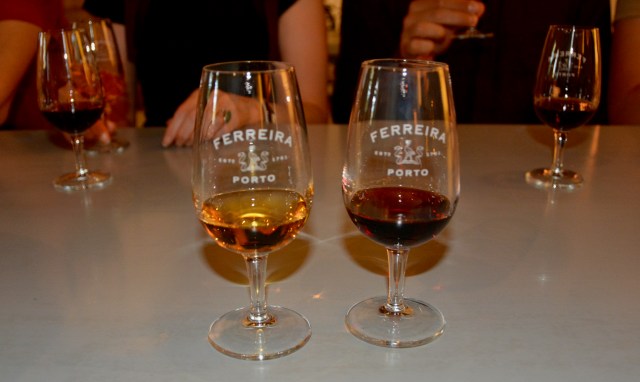
Photo ©Jean Janssen. Our Port samples at Ferreira, Gaia, Portugal

Our last stop at Ferreira was the stone tasting room and shop we had stopped in before.  The tawny was again my favorite; I don’t particularly care for the white ports.  We bought a bottle.  They sell their product in the United States, but I am not sure we can get the Tawny variety.  Our tour guide checked out our purchase and we talked about yesterday’s tours.  She was very surprised that we hadn’t like Croft; she said it is popular.  As I told the guide, the location, facilities, and tour were lovely; I just didn’t like the product.

DSC_7489 2Ferreira is on one end of the Gaia waterfront; our next tour is at Calem on the other end.  You can’t miss Calem; it is the first large producer you come to after you cross the Dom Luis I Bridge.   We were early for the tour, but it was too hot to linger outside.  We sat down in the museum.  Where Ferreira was all about highlighting the history, Calem was into sleek, modern presentation.  They used a lot of technology not only in their museum, but on the tour.  We have specifically chosen the last English tour of the day because it includes a Fado show at the end.

DSC_7492

Photo ©Jean Janssen. A tasting at the end of our second tour of the day. This time at Calem, just after the bridge in Vila Nova de Gaia, Portugal

We didn’t walk through much of the cellars, so I was glad the show was included or there wouldn’t be much to the tour.  I admit I may be on wine tour overload at this point given the last two weeks and the type of tours we have done.  We will be enjoying a performance of Fado.  Although it may have earlier origins, Fado is a music genre that can be traced to the 1820s in Lisbon, Portugal.  While often associated with sorrowful music, it is decidedly beautiful.  It can include vocal performances and the instruments used are often unique.

IMG_7694

Photo ©Jean Janssen. The Fado show at the end of our tour at Calem.

We had a tasting during the Fado show; the show was relatively short, but good.  The female singer was much better than the male.  The musicians were very good.  I would upload a clip, but the people at the table in front of us talked through the entire show.  I tapped her and asked her to be quiet and the people beside them suggested they leave if they wanted to talk.  Clearly they could care less that they were disturbing other people.   The wine was good, but not necessarily better than anything else we have tasted.  We decided not to get a bottle.
DSC_7493

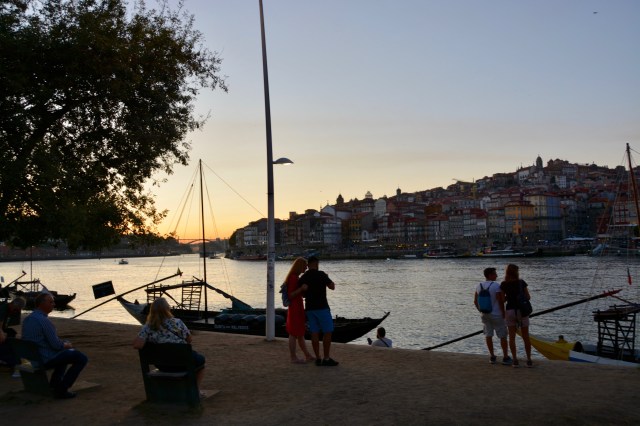
Photo ©Jean Janssen. The sun was setting when we came out of the Fado show at Calem.

At the end of Fado show, we went outside in time to see the sun setting in the distance.  We walked back across the bridge to Porto.  These two tours were extremely different so it was a good contrast if you wanted to do multiple tours and see the differences in the various company approaches to Port production.  However, I wouldn’t do more than 1 or 2 of these tours.  I recommend filling in the rest of your day with tastings instead.  Just remember to pace yourself.  Having the tastings was also a great excuse to have some wonderful meals.  Natasha didn’t want to do her tastings on an empty stomach.

IMG_8640

Photo ©Jean Janssen. I had to stop eating my venison carpaccio long enough to take a picture. Fabulous. At Traca, Porto, Portugal.

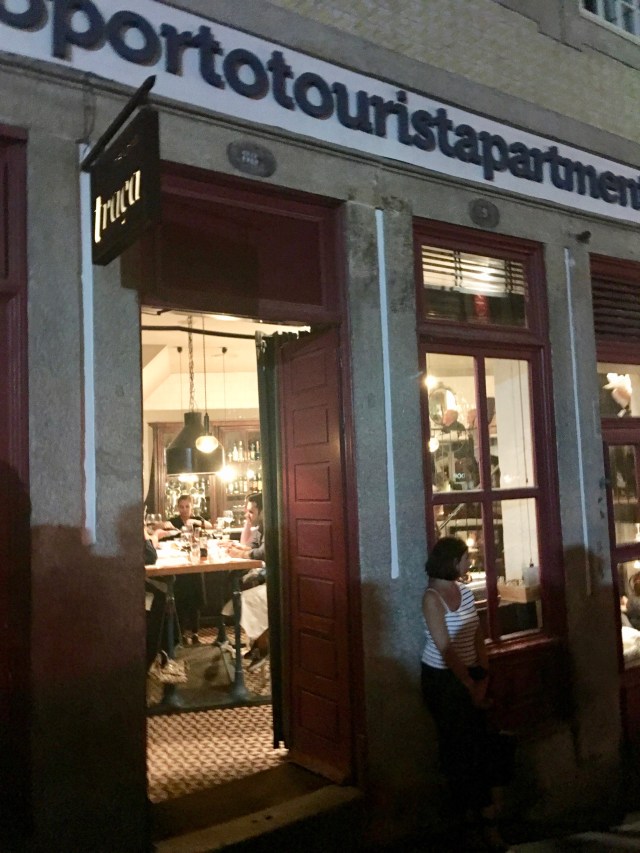
We had a little while before dinner, so I grabbed and shower and changed.  It had been a hot day and the water felt great.  We made the climb up Rue Sao Joao to our dinner venue, Traca.  Traca sits at the Largo San Domingos; if you keep climbing , it spills into Rua das Flores.  It was recommended to us by our concierge who also suggested the venison carpaccio.  I was a little nervous about this choice.  However with a touch of vinegar, some olive oil, chives, and parmesan cheese it did not disappoint.  In fact it was wonderful.

IMG_6307

A satisfied customer at Traca, Porto, Portugal.

Traca was great.  The restaurant was multi-leveled with bar type seating as you walked in, outdoor seating, and table seating on the lower level.  The building was on a corner with an incline so regardless of what level of the restaurant you were on you could see outside.  Although we were there from 9:15 to after 10:30, there were actually a lot of families in the restaurant with their children.  Traca was packed and I was glad we had reservations.  Lots of people were in the area and buskers performed outside.
IMG_4942

Photo ©Jean Janssen. Our dinner venue in Porto.

After the water, cocktails, more bread, appetizers, and main courses, both Boris and I decided to skip dessert.  We had had a full day.  We didn’t do much packing when we got back.  We’ll do that in the morning before we go down for that fabulous Gran Cruz House breakfast.  Its our last night in Porto, so I got the night view of the waterfront on our walk back and from our riverview windows.
DSC_7503

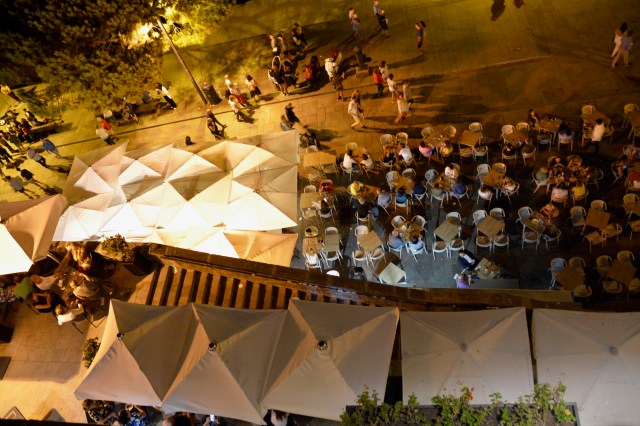
Photo ©Jean Janssen. Along the Porto Riverfront at night.

IMG_5580

Photo ©Jean Janssen. Along the Porto Riverfront at night.

DSC_7502

Photo ©Jean Janssen. Along the Porto Riverfront at night.

The next morning we got up and finished packing.  We had only pulled out what we needed for Porto.  Most of our stuff was still in the suitcases from the cruise.  Of course we had to figure out how to safely pack all our Port in our checked bags.  Afterwards we went down for the wonderful breakfast and snagged the last seat on the balcony.  Weren’t we surprised to see Hugo and Ruth (from our Douro Valley tour on Friday) run by).  I know we caught them off guard when I called out to them, but they waved on the return.

Version 2

Natasha and Boris and a view of Porto and Vila Nova de Gaia.

We loved Porto and there is still so much to see that we will be back again.
DSC_7449

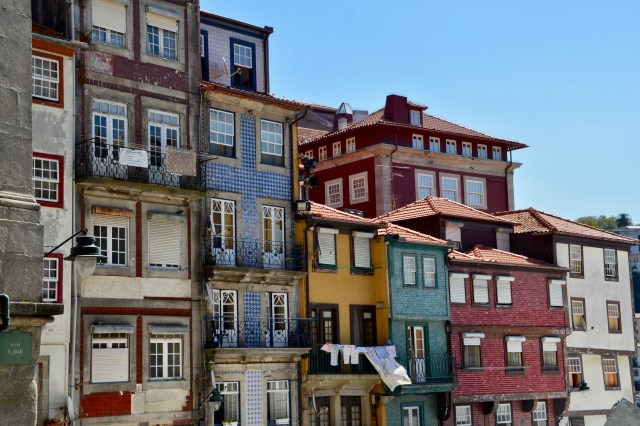
Photo ©Jean Janssen. Just one last look at our Porto home of four days.

Just an update before I post this now that we are back.  To reach Houston, we flew from Porto to Newark, connected, and then direct to Houston.  We went through passport control and customs in Newark, New Jersey.  The queue to get through customs wrapped around all four walls of the luggage claim area and then did a second line against one of the walls.  I am including that video-look to the far ends of the large room to see the line-because it is so unbelievable.  Luckily, Natasha has global entry.  Unfortunately, Boris let his lapse.  On another note, we only lost one bottle of Port in transit.  Luckily it was not the 30-year old Port.  I look forward to the next adventure.  –Natasha

DSC_7304

Photo ©Jean Janssen.  The Douro River and Porto, Portugal


Posted in international | Tagged , , , , , , , , , , , , , , , , , | Leave a comment

The Douro Valley, Portugal

DSC_7278

Photo ©Jean Janssen The Douro Valley, Portugal

Today we have an early departure from the hotel for our small group tour of the Douro Valley, the region of Portugal where the grapes for fortified wine known as Port are grown. Because we will miss the standard breakfast time, the hotel set out a lighter breakfast for us in the restaurant.   It was wonderful and so much more than standard. We were downstairs to meet our guide Sylvia on time.

DSC_7009

Photo ©Jean Janssen. This statute and fountain sit on Praca da Ribeira, the square where our hotel is located. This is early morning; you see the chairs waiting to be set out for the sidewalk cafes. Vehicles are allowed in in the morning for deliveries and then the street is closed. After that, access is provided remotely to residents and cabs (no UBERs).

There are 7 guests on today’s tour.  We were the first picked up so Boris took the shotgun seat and I am in the first row of the van.  Like on tour in Lisbon, all the other participants were far younger than us. There was a young married couple from London, Hugo and Ruth (although she is originally from Edinburgh, Scotland). He is a lawyer and she is a dance instructor.  There were two girls from Taiwan, one a journalist and the other an event planner. Rounding out the group was Bianca from New York City, also a journalist.  She was scheduled to come with a friend who backed out on the trip; I was proud of her for not missing the opportunity.

DSC_7448

Photo ©Jean Janssen. Our hotel (taller red building in the back) sits among other residential buildings and lots of sidewalk cafes. Rents had skyrocketed such that many longtime Porto residents are being forced out as buildings are renovated.

Our guide Sylvia was a lot of fun.  She lives in Porto now, but is originally from the area we will be visiting.  She told us a little about the rent in Porto. With all the renovation going on (particularly in the Ribeira section where we are staying) and the increased tourism in Porto, rents have really gone up.  So much so, that many people who work in the city can no longer afford to rent there.  Typical rent is now 600 euros a month for a small one-bedroom apartment.  That is more than most of the residents make in one month.

DSC_7092

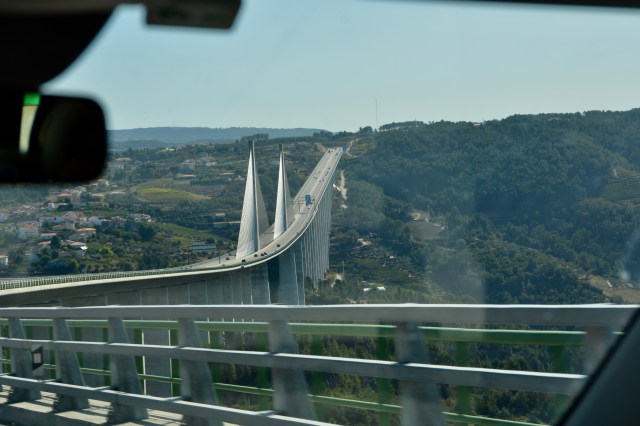
Photo ©Jean Janssen. Spotted from the car on our way to the Douro Valley from Porto. We crossed this bridge.

DSC_7093

Photo ©Jean Janssen. Spotted from the car on our way to the Douro Valley from Porto.

As we headed out of the city I was impressed with the state of the art highway system and the cool tunnels and bridges.  I clocked one tunnel at a minute and 50 seconds.  There were markers all along the way showing your progress and location. Unlike many long tunnels I have been in, there was cell service/reception anywhere in the tunnel.

DSC_7049

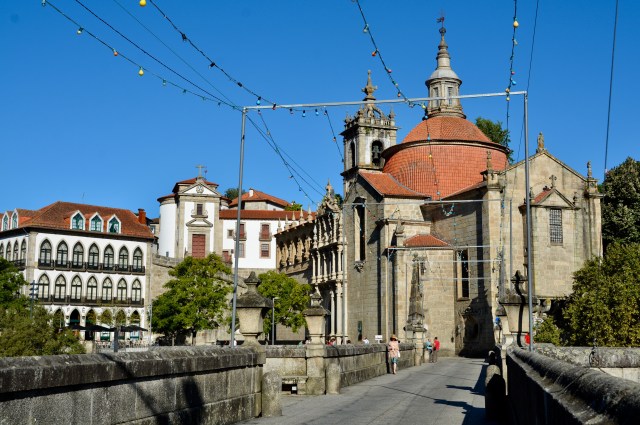
Photo ©Jean Janssen. The São Gonçalo bridge on the Tâmega leads into the city of Amarante, Portugal

The first stop Sylvia made was in the small city of Amarante.  It was wonderfully charming with the one lane stone bridge leading to the church.  On the way in she told us about the patron saint, São Gonçalo, whose tomb is in the church.

DSC_7083

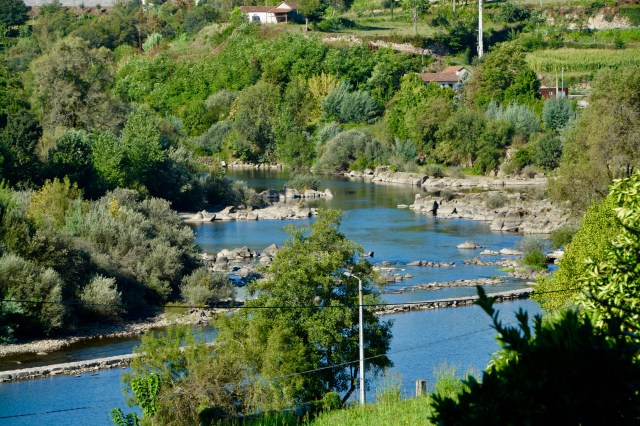
Photo ©Jean Janssen Rio Tamega, as seen from the stone bridge leading into Amarante, Portugal.

San Goncalo is said to help young women who want to marry.  It was a custom in the town for the young women to dance before the image of the saint.  A trickster would raise the priestly robe of the saint.  I thought this a strange story to tell until we reached the church and a local baker had out treats to sell.  She sold baked goods fashioned as a large penis in honor of the saint.  The“bolos de São Gonçalo”, a sweet pastry and fertility symbol, are exchanged on the Feast of San Goncalo, the first weekend of June.  Boris bought a different shaped cake.

DSC_7024

Photo ©Jean Janssen. “Unique” cakes sold next to the church in Amarante Portugal. “'[B]olos de São Gonçalo’ [are] a sweet pastry and fertility symbol, unmistakably shaped like a man’s private parts”

This stop was perfect for everyone.  You could tour the church; hike up through the town or across the bridge, sit down for a coffee in the square, feed the ducks in the river, or just take a lot of pictures.  You can probably guess what option Natasha chose.  Boris grabbed a coffee to go with his cake.

DSC_7056

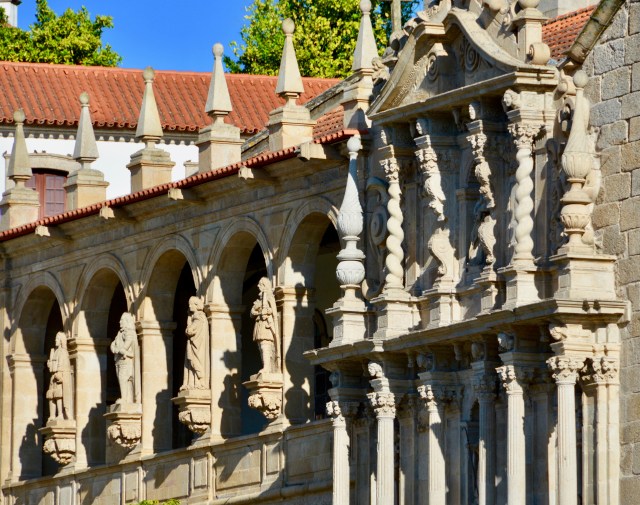
Photo ©Jean Janssen.  Igreja de São Gonçalo in Amarante, Portugal

DSC_7060

Photo ©Jean Janssen.  Igreja de São Gonçalo in Amarante, Portugal. I loved the organ pipes.

The town was fairytale like and I enjoyed just wandering around.  You could easily spend half a day there or extend your visit with a little hiking or cycling in the area.  A new paved bike trail passing vineyards and forests, including a crossover of the River Tamega, was opened in 2013.  It is the same route as the old Linha do Tâmega railway. line

DSC_7085

Photo ©Jean Janssen. Title work image of Amarante I spotted in town.

DSC_7033

Photo ©Jean Janssen. Amarante, Portugal. Across the stone bridge crossing the River Tamega.

After our break it was back to the van to head to Sabrosa, the birthplace of Magellan and the location of the small independent vineyard and winery we will be visiting.  In case your history is escaping you, “Ferdinand Magellan was a Portuguese explorer who organized the Spanish expedition to the East Indies that result[ed] in the first circumnavigation of the Earth.”

DSC_7113

Photo ©Jean Janssen Magellan’s birthplace, Sabrosa, Portugal.

DSC_7100

Photo ©Jean Janssen. Casa dos Barros, Sabrosa, Portugal

DSC_7108

Photo ©Jean Janssen. A touch of fall in Sabrosa, Portugal

The town was preparing for a festival when we arrived on Friday morning.  Crews were setting up wooden booths.  We were early for our tour and lunch so we wandered around the older section of this small city.  Magellan’s birthplace is a private home, but Boris found it right behind Casa dos Barros, the beautiful home (now an inn) and event space we will be visiting.

DSC_7109

Photo ©Jean Janssen. Hugo and Ruth explore Sabrosa, Portugal

DSC_7124

Photo ©Jean Janssen Sabrosa, Portugal

DSC_7122

Photo ©Jean Janssen. Sabrosa, Portugal

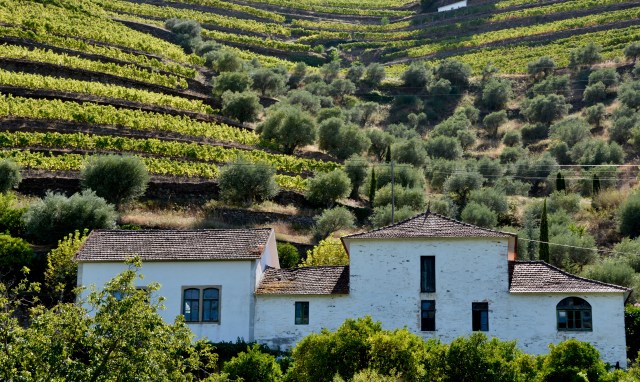
When it opened we walked through Casa dos Barros lobby area to the courtyard, past the event space, and ended up at the outdoor pool overlooking the vineyards.  What gorgeous views.  The inn might be a wonderful place to spend a few days or as a travel base for the region.

DSC_7148

Photo ©Jean Janssen. Peaking into the event space from the courtyard of Casa dos Barros, Sabrosa, Portugal.

DSC_7156

Photo ©Jean Janssen. Casa Dos Barros, Sabrosa, Portugal has a lovely pool deck overlooking the vineyards.

DSC_7157

Photo ©Jean Janssen. The vineyards at Casa dos Barros, Sabrosa, Portugal

When they called us in, we enjoyed a tour of the traditional wine-making vats and a tasting.  We had a stop in the chapel-rarely opened for visitors-before walking into the wine storage area for a taste of 10, 20, and 30-year port.  I like the 10 and 30 yr varieties.  Oddly, I didn’t like the taste of the 20.  Port is a mix of a variety of grapes that changes each year to maintain the consistency of the taste of that “brand”.  For the 100 year port, you had to pony up more than 300 euros for a taste or purchase one of the few remaining bottles for 3,000 + euros.

DSC_7169

Photo ©Jean Janssen.  The private estate chapel at Casa dos Barros, Sabrosa, Portugal. I love the candle which has started to melt from the heat.

DSC_7182

Photo ©Jean Janssen. The old stuff at a small independent winery in Sabrosa, Portugal.

DSC_7183

Photo ©Jean Janssen. Vintage Quinta dos Mattos established 1875.

DSC_7185

Photo ©Jean Janssen. Looking for the “legs”, Sabrosa, Portugal

Next was a wonderful lunch under the shade trees by the pool and overlooking the vineyards.  Our tour group sat together and got to know each other.  I enjoy this part of traveling with small groups.  You had a choice of fish or beef with risotto.  Of course the bread was terrific as was the dessert.  There was plenty of red or white wine on the table, but oddly no port.

DSC_7150

Photo ©Jean Janssen.   Dining in the shade at Casa dos Barros, Sabrosa, Portugal

After lunch we had a short time to do some shopping.  Having told Boris my preferences, I was curious to see what he would buy.  All of our group made a purchase at this vineyard.  Boris got all three (10, 20, and 30).  Nobody went for the 100 year.

DSC_7171

Photo ©Jean Janssen. Peaking into the chapel at Casa dos Barros, Sabrosa, Portugal.

DSC_7135

Photo ©Jean Janssen. Sabrosa, Portugal

DSC_7294

Photo ©Jean Janssen. Statue of Magellan, Sabrosa, Portugal, his birthplace.

Next we set out for Pinhao in the heart of the Douro Valley and right on the river.  In town, our first stop will be a large producer, Croft.  I have seen one of their cellars in Gaia across the river from our hotel room in Porto.

DSC_7218

View of the newly planted vineyard and the Douro River from the Croft winery in Pinhao, Portugal

DSC_7238

Photo ©Jean Janssen. At the Croft vineyard, Pinhao, Portugal

Croft has a big operation right on the Douro River in Pinhao.  There is a nice tasting room with a wonderful deck and small private patio/dining area overlooking the Douro.  Great views.  We started the tour on the deck and then went into the vineyard.  We were paired with another tour group.  There was a fig tree just beside the grapevines and one of the Australian visitors decided to pull until he got a fig.  He broke one of the large branches.  After the guests left the area, the guide had to chop off the entire branch.  It was beyond saving.  I was embarrassed by the casual attitude the guest took to harming the tree.  Hugo, Ruth, and I stayed behind and Hugo carefully got me a fig.  It was the absolute best fig I had ever tasted.

DSC_7234

Photo ©Jean Janssen. In the Croft vineyard, Pinhao, Portugal

DSC_7235

Photo ©Jean Janssen. In the Croft vineyard, Pinhao, Portugal

From the vineyard we went into the production facilities.  Croft still presses their grapes by having people stomp on them.  Since harvest is less than two weeks away, we were invited back as unpaid labor.  After the tour of the production facilities, we went back to the tasting room.

DSC_7232

Photo ©Jean Janssen. The picturesque Croft vineyard in the Douro Valley, Pinhao, Portugal

Several of the large producers are now pushing their “pink” port; it is not really made to be drank straight, but chilled and as a cocktail mixer.  We had it room temperature and straight.  Yuk.  We were also offered three other varieties.  I didn’t care of any of them.  Neither did Boris.  As it turned out, although we all bought something at the last venue no one in our group made a purchase at Croft.

DSC_7240

Photo ©Jean Janssen. Bridge across the Douro River, Pinhao, Portugal

DSC_7267

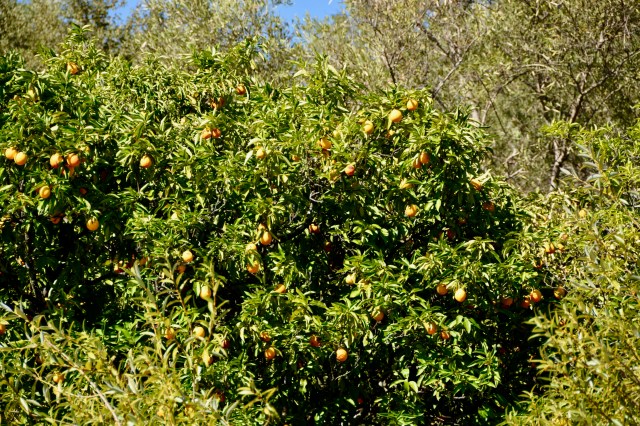
Photo ©Jean Janssen. We saw lots of orange trees along the Douro.

DSC_7273

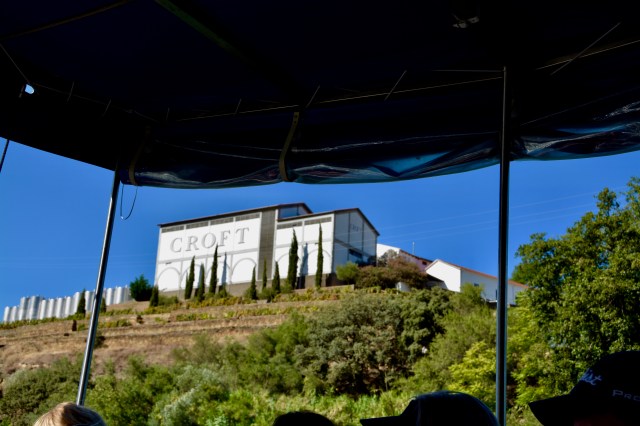
Photo ©Jean Janssen A view of the Croft winery as seen from our boat along the Douro.

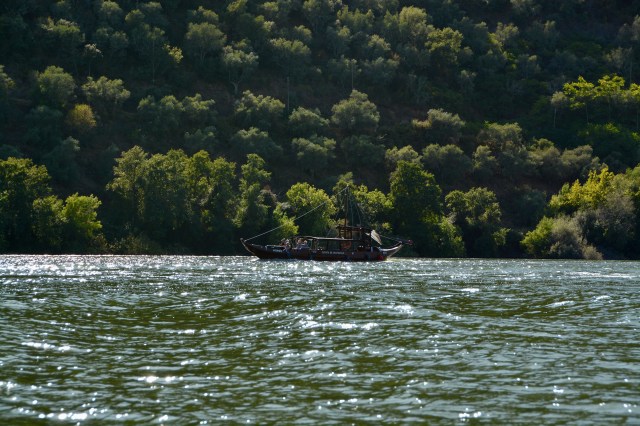
Leaving Croft, it was time for our last stop.  We are taking a short boat trip on the River Douro.  We are traveling in a replica craft from those that transported barrels of port from the valley along the Douro to the cellars in Gaia, across the river from Porto.  Today, the barrels are transported by quicker means, but the boats have found a new use, ferrying tourists.

DSC_7265

Photo ©Jean Janssen. Former port barrel transport boat along the River Douro. The boats are now used for tourists.

DSC_7253

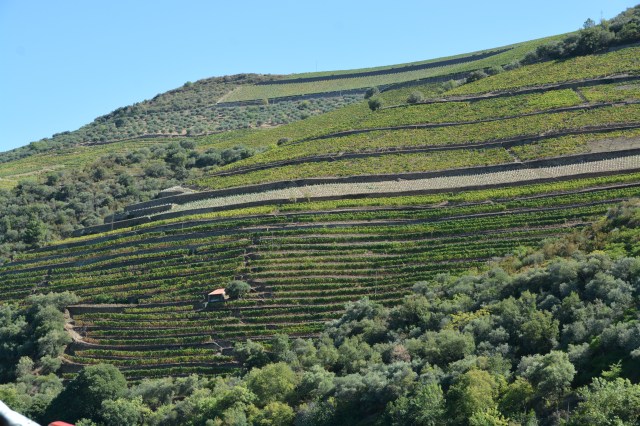
Photo ©Jean Janssen. Terraced vineyards along the Douro River in Portugal. The rows had be planted and harvested by hand. The white strip is a new planting.

The planting was extremely labor intensive.  These terraced rows were planted and harvested by hand.  Some of the new plantings have been set so some machinery can be used, but much of the work on the established vines is still done by hand.

DSC_7247

Photo ©Jean Janssen. Along the River Douro, Portugal.

DSC_7274

Photo ©Jean Janssen. Former barrel transport boat now used for tourists along the Douro River. The winery identified is one we are visiting tomorrow.

From Pinhao, we went back to Porto enjoying a music mix prepared by Sylvia.  Some selections were Fado, but others were just based on the themes of the day.  I discovered a new singer. Mariza, whose music I really liked.  She is a well known Fado artist in Portugal, just new to me.

DSC_7300

Photo ©Jean Janssen. Catching the sunset from our room at the Gran Cruz House on the Porto waterfront.

DSC_7301

Photo ©Jean Janssen. A lot of people had the same idea….Porto waterfront along the Douro.

We had a dinner reservation outside the Ribeira district and both of us were too tired to hunt down a cab and make the trek there and back.  We cancelled our reservations and got a couple of pizzas and just enjoyed the sunset from our room.  Tomorrow we plan to see more of Porto and then visit some of the port wine cellars in Gaia.

DSC_7227

Photo ©Jean Janssen. View of the vines and the Douro River from Croft’s vineyard in Pinhao, Portugal


Posted in international, River Cruise | Tagged , , , , , , , , , , , | Leave a comment

Porto, Portugal
DSC_6885

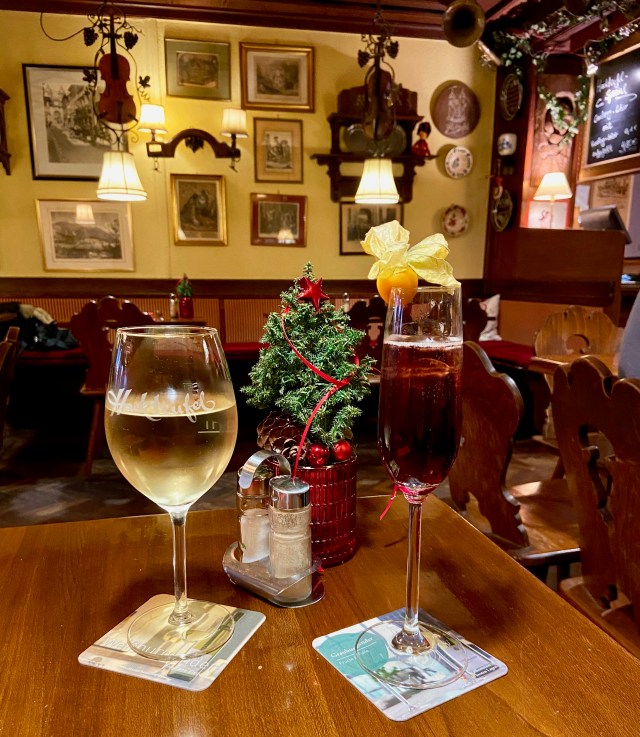
Photo ©Jean Janssen Porto, Portugal
We are disembarking our cruise ship today in Lisbon.  We were here in May at the conclusion of our transatlantic cruise.  We stayed on for a few days then and even took some day trips out of the city.  The one place we had really wanted to visit was Porto, aka Oporto.  It was far enough away and had enough to see, that we needed more than a day trip out of Lisbon.

IMG_5779 2

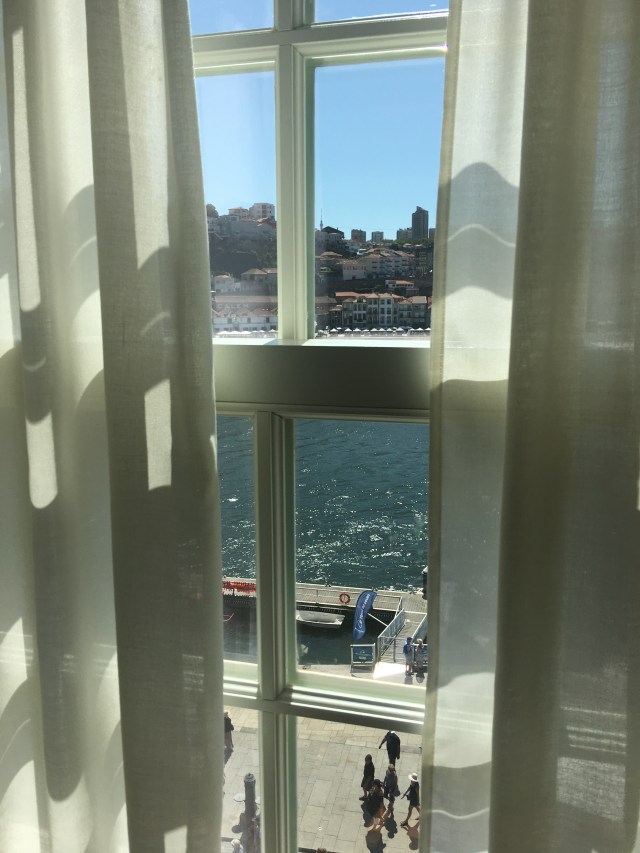
Photo ©Jean Janssen. View of the Douro River from the balcony of our hotel, Gran Cruz House, in Porto, Portugal.

Since we found ourselves in Portugal again, we decided to extend our trip through a long weekend to enjoy the city of Porto and the nearby Douro Valley where the grapes of the city’s most famous product are grown and in some cases produced.  We are taking the train to Porto.  Porto is the second largest city in Portugal, following Lisbon in size.  It sits on a estuary of the Douro River.

DSC_6996

Photo ©Jean Janssen Porto Cathedral, Portugal.

After disembarking the ship, we took a cab to the train station.  The driver said that all city destinations leaving from the cruise terminal were a fixed price of 35 euros.  Outrageous, but Boris just wanted to go.  I had researched the trains and knew the direct and fastest trains to Porto left from the Lisboa Oriente Station.  You enter on the bottom level of the station where services are available.  Go up one level for the ticket booths.

DSC_6930

Photo ©Jean Janssen. View from Porto, Portugal of the gondola ride over the Douro River.
Unfortunately nothing is sign posted at this station in English.  We figured most of it out.  There are ticket booths at each corner of the upper level, but they service different trains.  The booths are not necessarily on the side you think they are.  We walked right past the right one on the first go around.  Luckily one of the station workers offered help and spoke English.

IMG_3653

Photo ©Jean Janssen Train platform at the Lisboa Oriente Train Station in Lisbon, Portugal

The direct trains from Lisbon take about 2 hours/35 minutes to 3 hours (depending on the departure time you choose) to reach Porto.  We were on one of the high-speed trains called Alpha Pendular that go directly to Porto’s main railway station.  The current cost is  28 euros ($31 US) for second class and 42 euros ($47 US) for first class.  The ticket agent spoke English and they take credit cards.  There were two young men with passes who were having a difficult time getting tickets to Paris.  They were there before we arrived and after we left the booth 20 minutes later. The line had really grown and they finally got another agent to sell tickets.  It moved swiftly for all the other passengers.  Make sure you go to the booth for international and longer routes.

IMG_5629

Photo ©Jean Janssen. Our first class coach on the fast train to Porto.

Boris decided we needed first class tickets, so we could sit together.  We would have been separated in second class.  I didn’t complain.  We had a coach with fewer, wider seats; electrical outlets (European plug); a drink cart that comes to your seat; free newspapers and headphones; and a nice, clean bathroom.  Usually you don’t need to reserve early, especially on a Thursday.  I guess we are still in the season in Europe and Porto has become much more popular.  So for this route, I recommend pre-booking; the prices quoted on-line were the same as at the station.

DSC_6970

Photo ©Jean Janssen. Arrabida, one of Porto Portugal’s six bridges over the River Douro.

It was a scenic ride.  We arrived into Porto’s main railway station, the Campanha Train Station, passing over one of the city’s six main bridges.  I didn’t know to be ready, but I recommend getting out your camera about 30 minutes before your arrival into the city.  After the long tunnel, look to the seaside and you will see a wonderful and very long wooden boardwalk and the beach; it was lovely.  Just before our arrival at the station you pass over the Douro River and have wonderful views of the city riverfront.  That is where we were headed.

DSC_6874

Photo ©Jean Janssen. Our Hotel, Gran Cruz House, Porto, Portugal
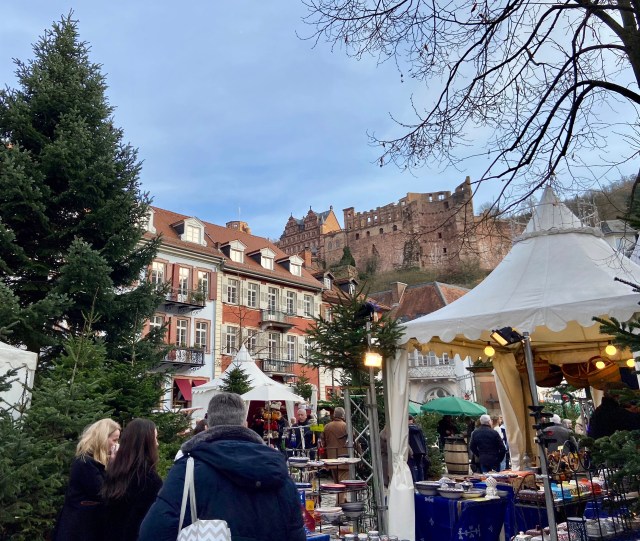
It was a short cab ride to the Gran Cruz House.  The road down to the riverfront was blocked.  After our cab driver hit the speaker button one of those pylons was lowered so we could drive right down to the hotel.  They will let cabs through, but not UBERs.  We unloaded and paid a very reasonable fee for the ride.  It was a little tough to find the main entrance to the hotel and the staff was at lunch but they came right down when we called.  The entrance is on the side of the building by the sidewalk cafe’s drink station.  We were greeted with our choice of one of four of the Cruz ports.

IMG_1239

Photo ©Jean Janssen River view from our room at the Grand Cruz House in Porto, Portugal
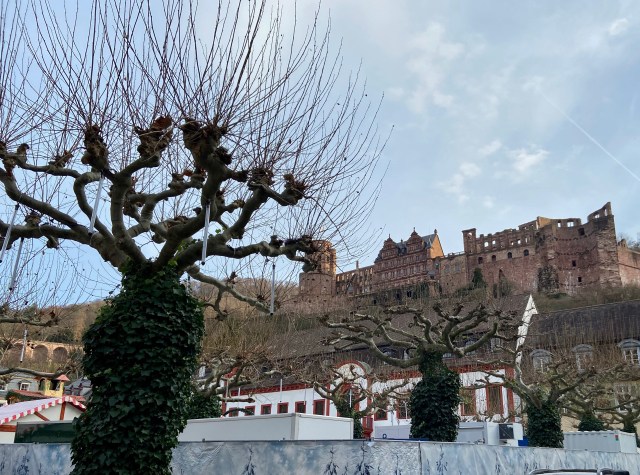
IMG_3238

Photo ©Jean Janssen Cool bathroom door in our room at the Grand Cruz House, Porto, Portugal
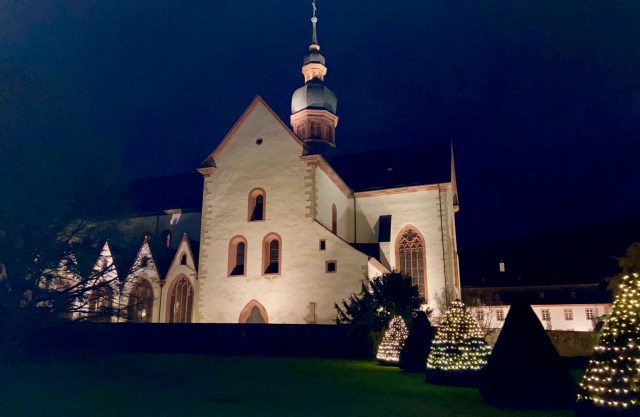
We were shown up to our gorgeous room overlooking the river.  We were so glad it was ready even though we arrived before check-in time.  The desk manager was great about helping us with restaurants, scheduling a tour to the Douro Valley for the next day, early breakfast arrangements given the time of our tour departure, and even reservations for some of the most popular Port Wine Cellars across the river.

IMG_1995 2

Photo ©Jean Janssen Taberna dos Mercadores, Porto Portugal

IMG_7444

Photo ©Jean Janssen  Taberna dos Mercadores, Porto Portugal

We rested for a while and then went out for lunch nearby.  The restaurants along the waterfront are not particularly good, mostly just tourists traps.  Our concierge said he knew of one exception just up the street, Taberna dos Mercadores.  It was very small; it only had 8 tables for 2 persons each (although they will push tables together to accommodate a group of 3 or 4).  The restaurant was full and there was a group of three already waiting.  We decided it was worth it; we only waited about 15 minutes and enjoyed watching the dog that had accompanied the couple with the open window seat table.  Taberna dos Mercadores does not take same-day reservations.

IMG_5062 2

Photo ©Jean Janssen  Flaming, salted cod at Taberna dos Mercadores, Porto Portugal

The food was fabulous.  I had the traditional salt-crusted cod.  It was brought to the table whole and flaming.  The server deboned it table side.  It came with a side of potatoes and vegetables.  Boris had steak and side dish of traditionally spiced rice which he also thought was wonderful.  We enjoyed lunch with some of the local wines and sparkling water.  The bread was also very good.

IMG_7235 2

Photo ©Jean Janssen  My coconut dessert at Taberna dos Mercadores, Porto Portugal

Boris loves his desserts while on vacation so he opted for chocolate and I went with the coconut.  Of course we had to try some port as well.  I think the servers were a little frustrated with Boris regarding getting a table when we first arrived, but by the end they loved us since it was obvious how much we appreciated the food.  Leaving a tip probably didn’t hurt either.  Taberna dos Mercadores is a definite keeper and worth the wait for a table.

DSC_6798

Photo ©Jean Janssen  Palacio da Bolsa on Porto’s historic square

After lunch we headed uphill to the see some of the special sights near the hotel.  We are staying in the medieval Ribeira (riverside) district with narrow cobbled streets. It was an extremely hot day, so we really didn’t want to sit atop a hop on/hop off bus and fry.  That bus had been the original plan for the afternoon.  After our touring on-foot, we looked into one of the tuk-tuk tours in English, but they were full for the rest of the day.

DSC_6801

Photo ©Jean Janssen  Statute of Henry the Navigator on Jardin do Infante Dom Henrique, the historic heart of the city of Porto, Portugal

We passed the city’s historic square, Jardin do Infante Dom Henrique and the Palacio da Bolsa, the 19th century building that was the city’s commercial center.  It was once part of the 13th century St. Francis Convent.  Dominating the Jardin do Infante Dom Henrique is the statute of Prince Henry the Navigator.  The statute was dedicated in 1900 to celebrate the five centuries since the birth of the “main figure of Portuguese discoveries.”

DSC_6805

Photo ©Jean Janssen St. Francis Monument Church and Monastery, Porto, Portugal
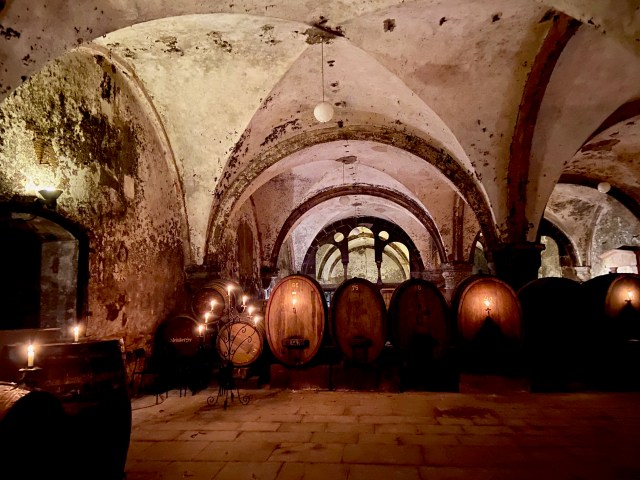
Next to the Palacio da Bolsa (formerly the St. Francis convent) is the beautiful Franciscan church and monastery, São Francisco.  Secular and other religious groups did not accept the Franciscans and life for them in 13th century Portugal was very difficult.  According to the Church’s guide book, “it was in Oporto that they suffered most.”  However, the friars’ devotion and generosity appealed to the people and a follower donated the land where the Gothic Style church sits.  Construction began in 1245, but was not completed until 1410.  The architecture in this part of Portugal was mostly Romanesque at the time and the Gothic style church was a novelty.  The church itself “is known for its lavish baroque interior with ornate gilded carvings.”
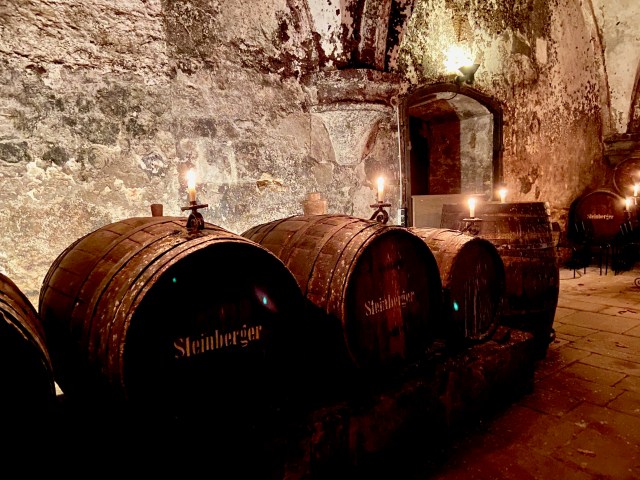
DSC_6818

Photo ©Jean Janssen. The monastery at St. Francis in Porto, Portugal. It is now a museum.

DSC_6836

Photo ©Jean Janssen. Ceiling of the private chapel at the St. Francis monastery in Porto, Portugal.

You can tour the monastery and the church, but photographs are only permitted in the monastery.  The monastery chapel and the rooms were very opulent (although nothing compared to the church we would tour after).  For me, the most interesting part was the friars’ graveyard on the lower level underneath the friars’ private church.  I made this part of the visit alone.  Boris once got lost in the catacombs in Rome and now refuses to go into tombs.

DSC_6845

Photo ©Jean Janssen Friars’ graveyard at St. Francis Museum, Porto, Portugal.

DSC_6848

Photo ©Jean Janssen Friars’ graveyard at St. Francis Museum, Porto, Portugal.

After touring the museum, we went into the St. Francis church.  No photographs, but what a sight!  The church is covered with carved wood that has been gilded.  The effect is overwhelming.  Each of the side chapels, tombs, and altars are detailed and quite impressive.  Definitely worth a visit on your trip to the Ribeira district of the city.

DSC_6853

Photo ©Jean Janssen Friars’ graveyard at St. Francis Museum, Porto, Portugal.

DSC_6861

Photo ©Jean Janssen Friars’ graveyard at St. Francis Museum, Porto, Portugal.

DSC_6939

Photo ©Jean Janssen St. Francis Church and Museum, Porto, Portugal
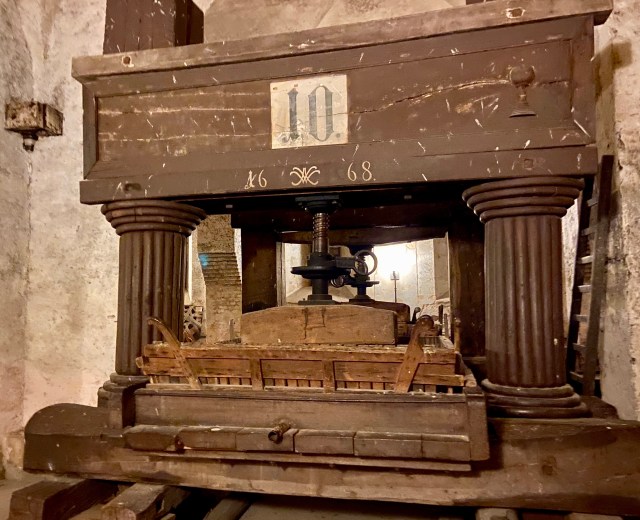
We walked down along the tram line that stops just outside the church.  After we had no luck with securing a tuk-tuk tour, we decided we would try the boat tour of the bridges along the Douro River and the sights along the Ribeira district.  No luck at the booking agents by the square; the openings all conflicted with our dinner reservations.  We headed down to the waterfront where we had better luck.

DSC_6881

Photo ©Jean Janssen. The Dom Luis I Bridge connect Porto to the city of Vila Nova de Gaia just across the River Douro.

Next to its connection to the production and distribution of the fortified wine known as port, Porto is perhaps best known for the “stately” bridges that cross the River Douro.  The short river cruises focus on these bridges.  There are multiple companies that offer the tours continuously on the whole and half hour most of the day.  There are also full day tours to the Douro Valley that depart from the riverfront right in front of our hotel.

DSC_6924

Photo ©Jean Janssen The two-level Dom Luis I Bridge, Porto, Portugal

We chose one of the 50 minute tours; the cost was 15 euros/person.  The most famous bridge is the Dom Luis I Bridge that we can see from the window of our hotel.  It crosses from Porto to the city of Vila Nova de Gaia, the residential community with a commercial waterfront dominated by the port wine cellars.  The bridge has two levels.  We walked on foot across the lower level.  There is also vehicular traffic on this level.  The upper level serves the city’s metro.  The bridge was constructed in 1886 by a disciple of Gustave Eiffel.

DSC_6894

Photo ©Jean Janssen. The Dona Maria bridge designed by Gutave Effiel is Porto’s oldest bridge. It went out of use in 1991. In the background is its replacement the São João bridge.

Gustave Eiffel himself designed the city’s oldest bridge.  Raised in 1877, the Maria Pia Bridge was named for the then queen of Portugal.  Also known as Dona Maria, the bridge was a railway bridge.  Although out of service since 1991, the bridge is a popular tourist attraction and remains in place.  It’s replacement, São João, was built between 1984 and 1991.  It sits nearby and is the one we crossed over into the city.

DSC_6965

Photo ©Jean Janssen The underside of the Arrabida bridge Porto, Portugal

Farther down the Douro is the concrete Arrabida bridge that opened in 1963.  At the time of its opening, it was the concrete bridge with the longest arch in the world.  Although it is “[c]onsidered by some the least attractive of all the bridges in Porto”,  the Arrabida bride was one of my favorites with its interesting design on the underside.

DSC_6962

Photo ©Jean Janssen. Along the Douro’s edge, Porto, Portugal

DSC_6991

Photo ©Jean Janssen. View of St. Frances and the Palace from the Douro River.

DSC_6978

Photo ©Jean Janssen. Along the Douro, Porto, Portugal

All along the way, we saw wonderful sites of the city and the buildings that line the river’s edge.  It was a hot ride, even in the evening, but I had some favorites along the waters edge.  There was a beautiful white-washed church from with amazing title work (so traditional for Portugal) along the water’s edge.  The Monastery of Serra do Pilar was at the top of the hill at the Gaia side of the river.  The station for the sky ride that climbs along the Gaia side of the edge of the River Douro is just below the Monastery.  The Jardim do Morro offers an amazing lookout point citizens and tourists go to for a striking view of Porto and a fabulous sunset.
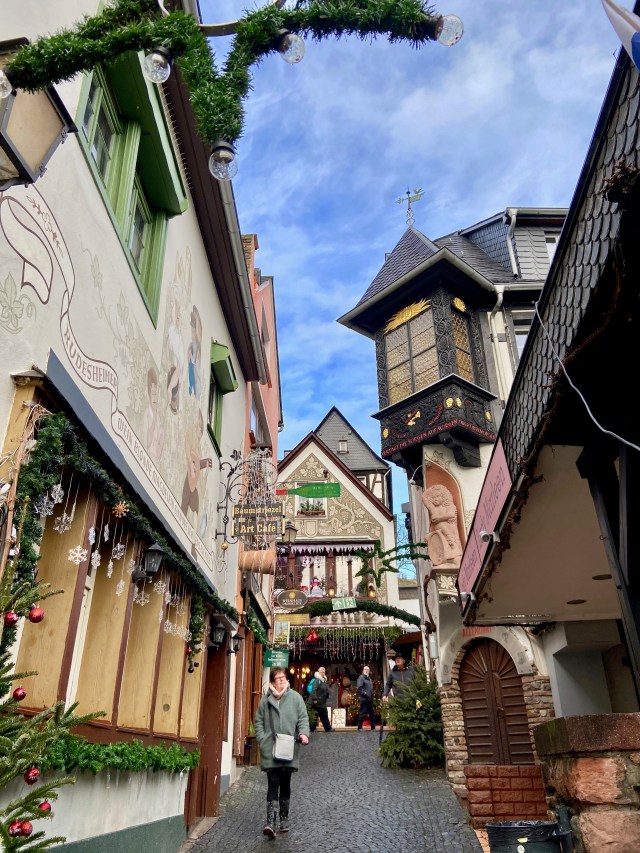
DSC_6957

Photo ©Jean Janssen Along the River Douro, Porto, Portugal
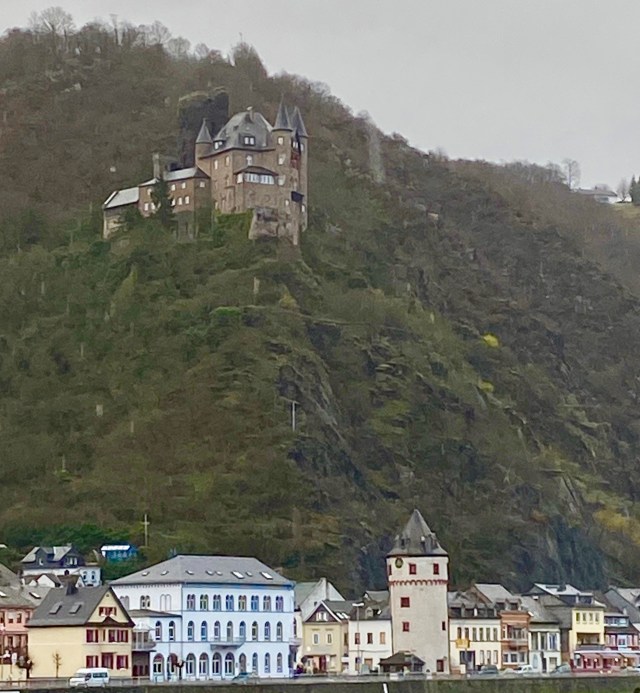
DSC_6988

Photo ©Jean Janssen. Monastery of Serra do Pilar, Vila Nova de Gaia, Portugal

DSC_7003

Photo ©Jean Janssen. A closer look at the Monastery of Serra do Pilar, Vila Nova de Gaia, Portugal. Note the cable car station on the right side. The upper level of the Dom Luis I Bridge on the left side.

We noted the young boys who liked to jump off pilars along the river.  It looked dangerous, but at the same time I envied their chance to cool off in the Douro.  It is also not usual to see young boys jumping off the Dom Luis I Bridge to the cheers of the tourists and in the hope for a “tip”.  I did see one boy on the edge of the bridge holding on with one hand and egging on the crowds.  I did not see him jump, but when we walked by later he was sitting on the side, soaking wet.  I missed the good part, but was glad he was ok.

DSC_6969

Photo ©Jean Janssen. Jumping in the Douro near Porto, Portugal.

DSC_6870

Photo ©Jean Janssen Along the Douro, Porto, Portugal

After a full day, we headed back along the waterfront to our hotel for a break and to change before dinner.  A shower never felt so good.  We were eating in the wonderful hotel restaurant, Casario, on the second story balcony overlooking the Douro waterfront.  From our hotel room we could see the buskers on the water’s edge.  Every 30 or 45 minutes the entertainment changed.  We only had to open the shutters (and even the window for more volume) in our room to enjoy the show.

DSC_7008

Photo ©Jean Janssen. Buskers along the Douro waterfront, Porto, Portugal

IMG_3984 2

Photo ©Jean Janssen. The fading light on the Douro, Porto, Portugal
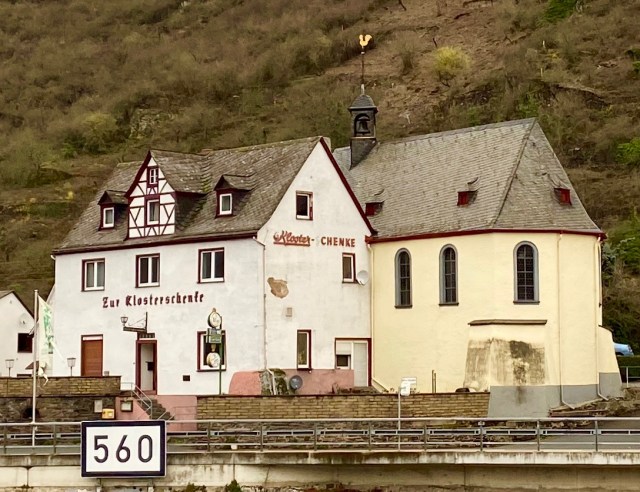
Dinner at Casario at the Gran Cruz House was wonderful.  We enjoyed three courses, and port of course.  We lost the light, but the entertainment and excitement on the boardwalk was maintained.  The flame juggler was my personal favorite.

IMG_6683

Photo ©Jean Janssen. View of the Douro and the port wine cellars on the Vila Nova de Gaia riverfront.

IMG_7157

Photo ©Jean Janssen.  View of the Douro River and the Monastery of Serra do Pilar in Vila Nova de Gaia, Portugal.

We have just seen a little, but Porto is everything we hoped for.  Tomorrow we are off to the Douro Valley to see the special region of Portugal where the grapes for the fortified wine are grown.  Great start to our visit to this special region of Portugal.

DSC_6808

Photo ©Jean Janssen St. Francis Church, Porto, Portugal

DSC_7005

Photo ©Jean Janssen. The Monastery of Serra do Pilar, the edge of the Dom Luis I Bridge, the Gaia waterfront, and a old wine barrel transport ship.


Posted in international | Tagged , , , , , , , , , , , , , , , , , , , , , | Leave a comment

The Principality of Asturias, Spain

DSC_6683

Photo ©Jean Janssen Oviedo, Spain

DSC_6728

Photo ©Jean Janssen. Cathedral Square, Oviedo, Spain

Today we are docked in Gijon in the Bay of Biscay for a tour of the Asturias providence of Spain.  This is our last stop before reaching the port of Lisbon, Portugal where we will disembark.  We are doing the lazy panoramic tour by bus today.  Boris chose.  I would have gone for the kayak tour.  The other option was a apple orchard with cider tasting.  Cider is to Gijon and the surrounding region of Asturias as wine is to Bordeaux.  It holds another distinction; Gijon has the honor of having the largest number of bakeries per capita in all of Spain.

DSC_6787

Photo ©Jean Janssen. Near the shuttle bus stop along the waterfront in G, Spain.

There is a shuttle bus into the port city of Gijon and quite a few of the cruise passengers are not doing organized tours today.  During our drive through, I didn’t see much to do in the city so we probably made the better call going a bit farther afield.

DSC_6589

Photo ©Jean Janssen. The sun was just rising as I had my breakfast on the balcony as we entered the industrial port of Gijon, Spain.
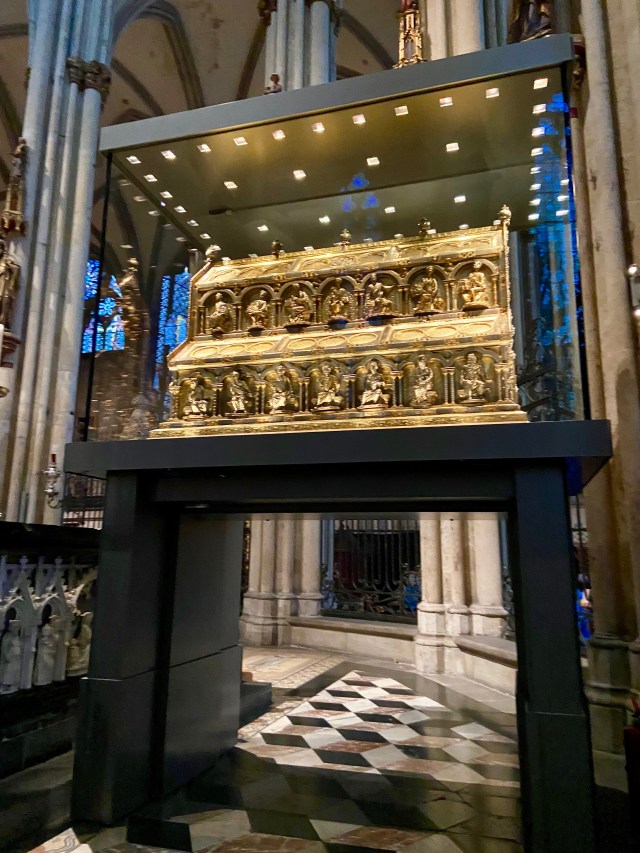
We are in smaller buses that can make some of the turns needed on our route.  Usually by the end of the cruise you recognize lots of people on your tours.  I didn’t recognize a single person; we have been doing (at least some) higher energy excursions.

DSC_6595

Photo ©Jean Janssen. The Oscar Niemeyer International Cultural Centre, Aviles, Spain
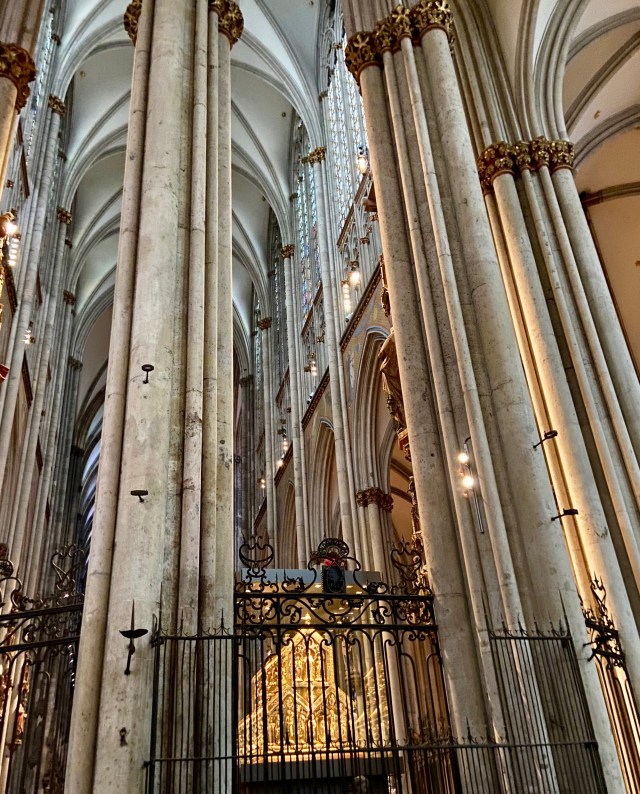
Our first destination was the industrial city of Aviles and a drive by the Oscar Niemeyer International Cultural Centre that sits along the city’s natural seaport.  The city’s goal was for the center to springboard revitalization to this industrial area.  It is an odd-looking modern building by award-winning Brazilian architect Oscar Niemeyer that didn’t do anything for me.  That was 45 minutes of my life wasted.  Perhaps if the guide had told us more about what was done or actually made a stop rather than just name dropping (Brad Pitt) celebrities that have visited.  I took the photo out the bus window on the drive by.  We didn’t make any stops in the city.
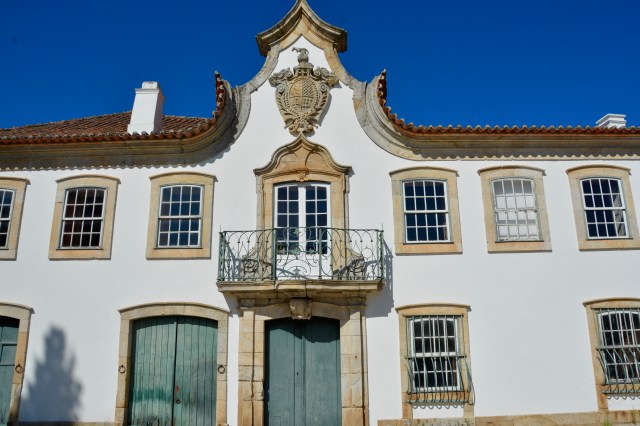
DSC_6617

Photo ©Jean Janssen. View from Monte Naranco, Spain with the morning mist.

DSC_6616

Photo ©Jean Janssen. View from Monte Naranco, Spain

Next we climbed (by bus) to a lookout point on Monte Naranco for a panoramic view of the region.  Oddly for a bus tour that caters to those with mobility issues, the driver stopped in a valley that meant you had to walk up to the lookout point or up the opposite direction to reach the statute of the Sacred Heart of Jesus reminiscent of that found in Brazil, at least that was the guide’s comparison.  The statute is 114 ft (35 m) tall.  The roadway on Monte Naranco is also the site of the finish of famous Spanish bicycle races Subida al Naranco and Vuelta a España  It is a steep climb with some serious switchbacks.

DSC_6623

Photo ©Jean Janssen. This 114 statute of the Sacred Heart of Jesus stands in the mountains outside Oviedo, Spain

From Monte Naranco, you have views of the Asturias capital of Oviedo.  I walked through the damp grass in an effort to get a clear shot, but mostly got electrical wires.  I actually found the opposite side with the morning mist more picturesque.  Some members of our group made the walk up to the statute.  I got about half way and realized that I could not make it up and back in the allotted 15 minutes, so I headed back down.  No one made it in the allotted time.  We were there at least 30 minutes waiting for everyone to get back.  I should have gone.

DSC_6655

Photo ©Jean Janssen Santa Naria de Naranco Church

Along to the road are the Pre-Romanesque shrines, Santa María del Naranco and San Miguel de Lillo, dating from the Kingdom of Asturias.  We had to ask, but on the way back down we made a 3-minute photo stop at Santa Maria del Naranco church completed in 842 and consecrated in 848.

DSC_6736

Photo ©Jean Janssen. Like the shrines on Monte Naronco, San Julián de los Prados is a Pre-Romanesque shrine in Oviedo, Spain.

DSC_6680

Photo ©Jean Janssen. On Cathedral Square in Oviedo Spain

Next it was down to Oviedo, the capital city of Asturias.  “The Kingdom of Asturias began in 720, with the Visigothic aristocrat Pelagius’s revolt against the Muslims who at the time were occupying most of the Iberian Peninsula. The Moorish invasion that began in 711 had taken control of most of the peninsula, until the revolt in the northern mountains by Pelagius. The resulting Kingdom of Asturias, located in an economically poor region of Iberia, was largely ignored by the Muslims.”  The area where Oviedo is located was uninhabited at that time.  The city was founded in 761 by two monks.

DSC_6677

Photo ©Jean Janssen. Cathedral of San Salvador, Oviedo, Spain

DSC_6703

Photo ©Jean Janssen Oviedo, Spain

Oviedo was to be the highlight of the tour.  Boris and I agreed that we would rather have spent the whole day here.  We just got a taste in the 30 minutes of free time we were allowed.  After I located and waited in line for a toliet (free in the city market-go upstairs), I was down to 20 minutes so I just walked around and took pictures.  I really wanted to go into the Cathedral-6 euro charge-but there just wasn’t time.

DSC_6695

Photo ©Jean Janssen Town Hall, Oviedo, Spain

DSC_6692

Photo ©Jean Janssen. City Market next to San Isodoro del Real Church in Oviedo, Spain

DSC_6705

Photo ©Jean Janssen Oviedo, Spain

We met back at the large square by the Cathedral before heading to the bus.  On the way out of the city, the guide told us about the cider production in the region and all the apple orchards.  She said she would give us an opportunity to try it and that is where everyone thought we were heading.

DSC_6715

Photo ©Jean Janssen. Lovely fountain on Cathedral Square in Oviedo, Spain

DSC_6731

Photo ©Jean Janssen Oviedo, Spain

DSC_6711

Photo ©Jean Janssen San Salvadore Cathedral, Oviedo, Spain

Instead we climbed a narrower and narrower road that became rutty and very steep. At the top, there was another lookout and not a cider vendor in site.  We are at the top of Picu Sol.  There were two young women who had made the climb on horseback and were resting their horses.  This time we had views of the city of Gijon and the bay.
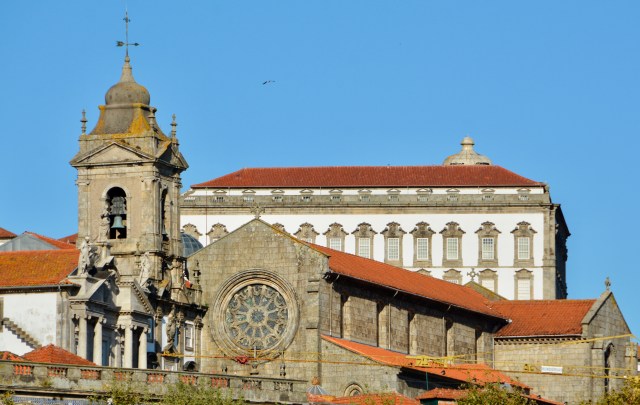
DSC_6757

Photo ©Jean Janssen Resting after the climb near Gijon, Spain

DSC_6768

Photo ©Jean Jansen At the lookout point over Gijon, Spain a map let you know what you were seeing.
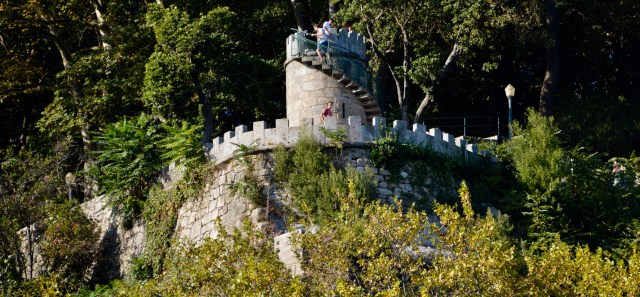
DSC_6759

Photo ©Jean Janssen A view of Gijon, Spain

DSC_6771

Photo ©Jean Janssen Headed back down the mountain.

Going back to Gijon, we passed through village where the land was owned by the families of former miners.  The mining infrastructure is still there but no longer in operation.  We saw orchards along the road and traditional horreos, grain storage rooms on stilts.  There is estimated that there are still about 10,000 in existence.  These were similar to the ones I had see at the Village Museum in Bucharest.

DSC_6748

Photo ©Jean Janssen. Traditional horreos, raised grain storage houses near Gijon, Spain.

DSC_6744

Photo ©Jean Janssen. Homes and orchards near Gijon, Spain owned by the families of former miners.

We made our way back to Gijon and were going into town when one of the women asked when we would be back (we were already a half hour late at this point) as she needed a toilet.  The guide announced that she was taking us into town to get apple cider.  There was a minor revolt.  When the bus stopped in town and the guide told us we had 15 minutes, people actually started screaming NO, NO, NO.  Boris had moved to his own row in the back of the bus and I have no doubt he was among the chanters.  People were ready for their late lunch.  Since we could come back into town by shuttle if we wanted, people preferred to go back.  I would have liked the cider, but I wisely kept quiet given the angry mob.  As it was, we got back an hour late.

DSC_6699

Photo ©Jean Janssen Oviedo, Spain

I would need to do a little more early research if I was going to visit this area again.  As it was, we visited the three largest cities in Asturias.  Not sure I would return to or recommend a visit to Aviles.  I would definitely have liked more time in Oviedo.  I enjoyed visiting this region of Spain which was new to me.  Our cruise comes to end after a sea day.  Today it is adios to Spain.

DSC_6780

Photo ©Jean Janssen Gijon, Spain

Posted in cruises, international | Tagged , , , , , , , | Leave a comment

Bilbao, Spain: A City Transformed by a Museum and the Largest City of the Basque Country

DSC_6541

Photo ©Jean Janssen. Bilbao, Spain

Today we are in Bilbao, located in the northern part of Spain.  Bilbao is the largest city of the Basque Country which cover parts of Spain and France.  Twenty-three years ago this was considered a gritty, industrial city and not on anyone’s bucket list for travel.  However, I knew we were in for something special when early in our trip a fellow cruise passenger told me that this stop was the reason she had chosen this cruise.

DSC_6544

Photo ©Jean Janssen. The Guggenheim Museum-Bilbao, Spain.  Next to the museum is the iconic La Salve Bridge

This is the workers’ city of the Basque Country, its waterfront formerly dominated by factories and warehouses.  The Basque Administration plans for redevelopment of the city began in the 1980s, but it was the inspired move in 1991 to lure the Guggenheim Foundation to Bilbao that would transform the city.  American Frank O Gehry’s limestone, titanium, and glass structure, the Guggenheim Museum-Bilbao, opened in 1997.  The museum sits along the Nervión River in the old industrial heart of the city.

DSC_6444

Photo ©Jean Janssen   The Abando Train Station in Bilbao, Spain.  Its interior stained glass is one of the city’s major attractions.

Suddenly other architects wanted to leave their mark on city.  Over the past twenty years the city has created a whole new identity.  It is a beautiful mix of the old and the new.  In 2010, Bilbo received the World City Prize, “considered the Nobel Prize for urbanism”.  The city’s mayor received the World Mayor Prize just two years later.  Bilbao was chosen the Best European City 2018 by the Academy of Urbanism.

DSC_6530

Photo ©Jean Janssen. Flying the Basque flag, Bilbao, Spain

Even though the architecture, the museum, and the transformation are enough reasons to visit, come for the culture.  Bilbao is the largest city in the Basque Country, the only region in Spain not to be conquered by the Moors.  The Basque people were often isolated.  Their language is considered one of the world’s oldest surviving languages and is unrelated to any other existing language.

DSC_6468

Photo ©Jean Janssen. Native dress in a shop window in Bilbao Spain.

Just take a look at the blood types and you will see the uniqueness of these people.  “Basques have the highest concentration of type O in the world — more than 50 percent of the population — with an even higher percentage in remote areas where the language is best preserved…Most of the rest are type A. Type B is extremely rare among Basques… [Additionally, ] Basques were found to have the highest incidence of Rh negative blood of any people in the world, significantly higher than the rest of Europe, even significantly higher than neighboring regions of France and Spain.”

DSC_6490

Photo ©Jean Janssen. Bilbao La Vieja.  The city’s trendy area with bars, clubs, cafes, boutiques, and galleries.  Also called Bilbi, the area all features some funky street art.

Today, I picked the tour.  Boris’ only stipulation was that he didn’t want to spend the day at the Guggenheim.  Sorry if any of you are reading this post to hear about that.  I knew we only had one day, so I wanted the overview and a chance to see a little of the culture.  I chose a walking tour with wine and tapas.  Tapas was the tour title as a way of explanation, but the treats we commonly know as tapas have their own name here.

DSC_6528

Photo ©Jean Janssen. Pintxos in Bilbao, Spain

Pintxos are a type of tapas.  Our guide said that there were distinguished as being more artistic and with a special taste.  I just thought it sounded yummy and a chance to have some Spanish wine as well.  We’ll make three stops for pintxos as we walk through the medieval part of the city known as Casco Viejo.

DSC_6426

Photo ©Jean Janssen. Mansion along the waterfront in Getxo, Spain where we docked for our visit to Bilbao.

Our ship is actually docked in Getxo, one of the ritzy suburbs with mansions along the waterfront.  We rode into Bilbao by bus and our guide pointed out the one remaining industrial area where redevelopment is currently being planned.

DSC_6446

Photo ©Jean Janssen. Bilbao’s waterfront.

DSC_6438

Photo ©Jean Janssen. Living along the waterfront in Bilbao, Spain.

DSC_6440

Photo ©Jean Janssen. Small stage along the Bilbao waterfront.

Our bus left us off along the waterfront of Rio Nervion in the historic heart of the city.  This is the edge of the Casco Viejo, the old city.  We walked toward the Bilbao Cathedral where the Casco Viejo’s seven major streets meet.  The cathedral has lovely stained glass but one of the interesting things about the church is the facade that was to have two spires.  The second was never constructed due to settlement.

DSC_6465

Photo ©Jean Janssen. Bilbao Cathedral

Our first stop was at Berton.  The bar had patrons even in the morning.  They had cool business cards with translations from English to Basque to Spanish on the reverse side.  I enjoyed my first pintxo.  “Although they are similar to tapas, generally speaking, pintxos are smaller. The name comes from the Spanish verb “pincher” meaning to poke or stab.  Historically, pintxos used to be served on a small slice of bread and have a toothpick piercing them through the middle.” Our first pintxo was toothpick free.  It was delicious, as was the wine.

DSC_6458

Photo ©Jean Janssen. My first pintxo at Berton in Basque Country. Bilbao, Spain.

DSC_6459

Photo ©Jean Janssen. Natasha’s first pintxo bar, Beton, Bilbao, Spain.

After our stop at the pintxo bar, we wandered through the winding streets of Casco Viejo, arriving at the Merkatua La Ribera.  This is Europe’s largest indoor market.  The art deco building housing the city’s main market has been extensively renovated-too expensively to the taste of our guide.  The market features modern stalls and access while retaining the building’s lovely stained glass.  The market had a nice display on Bilbao’s history (and public toilets if you are in need of such while you are in the area.

DSC_6474

Photo ©Jean Janssen Merkatua La Ribera, Bilbao, Spain.

DSC_6482

Photo ©Jean Janssen Interior of the Merkatua La Ribera, Bilbao, Spain

DSC_6485

Photo ©Jean Janssen Historical display in the La Ribera Market, Bilbao

We got a good view of one of the few remaining homes of the old city.  My favorite part was the portico and the beautiful painting on the underside.  Beside the market was the one of the city’s oldest churches.  This is truly a scenic part of the city with views over the river to trendy Bilbi and beautiful stone bridges.

DSC_6478

Photo ©Jean Janssen. Historic architecture in the old city of Bilbao

DSC_6472

Photo ©Jean Janssen. Underside of a portico across from the market in Bilbao, Spain

DSC_6488

Photo ©Jean Janssen. Near the market, Bilbao

DSC_6491

Photo ©Jean Janssen. Near the market in Bilbao, Spain.

We left the water behind, and returned to Casco Viejo for more pintxos.  After more wandering, we stopped at the Plaza Nueva (aka Plaza Barria).  The Plaza features neoclassical buildings on four sides with wonderful porticos where you find restaurants and pintxo bars. You access the Plaza through “arches known as cuevas (caves).” The main building of the plaza is “the site of Eukaltzindia, the Basque language Royal Academy.”  The plaza was constructed in 1821 and the main building originally housed government offices.

DSC_6510

Photo ©Jean Janssen Plaza Nueva, Bilbao

DSC_6518

Photo ©Jean Janssen. Pintxos at stop #2 Bilbao, Spain.

DSC_6519

Photo ©Jean Janssen. Pintxos at stop #2 Bilbao, Spain.

The first pintxo bar we visited on the plaza is a traditional one established in 1911.  We also ate in the traditional style, standing up at a long counter.  We had two treats at this pintxo bar and they were both yummy.  I love the taste, but I will say that nothing we had was too spicy.  I don’t know if that is because they traditionally are not spicy or if the cruise line requested those types to insure everyone was happy.

DSC_6508

Photo ©Jean Janssen. Our traditional pintxo bar on Plaza Nueva in Bilbao, Spain.

DSC_6512

Photo ©Jean Janssen. Traditional Pintxo Bar on Plaza Nueva, Bilbao.

In addition to the wonderful pintxos and wine, the plaza offered great people watching.  Our pintxo bar was packed.  There were sidewalk tables to sit at if you were not into the traditional standing.  As it turned out, our third pintxo bar was also on the plaza at the far corner from where we entered.  This is a more modern approach to the pintxo and we sat inside for our single sample.  I stuck with the Spanish wine, but Boris went for a beer at this location.

DSC_6527

Photo ©Jean Janssen. A modern pintxo bar on the Plaza Nueva, Bilbao, Spain

DSC_6529

Photo ©Jean Janssen. Ready for sale or to make those pintxos on Plaza Nueva, Bilbao

One of my favorite things about wandering around Bilbao were the apartments all over the city with their wonderful balconies and glassed-in porches.  We saw both older buildings and modern structures adopting this style.

DSC_6469

Photo ©Jean Janssen. Check out the cool porches all over Bilbao, Spain.

DSC_6470

Photo ©Jean Janssen. A closer look at those porches and balconies.

DSC_6466

Photo ©Jean Janssen. In Casco Viejo, Bilbao, Spain

DSC_6502

Photo ©Jean Janssen. Casco Viejo, Bilbao

Leaving behind the Plaza Nueva, we went back to the waterfront to catch our bus.  It was really just around the corner.  I loved Casco Viejo as well as the more modern parts of the city.  You would have a wonderful time just wandering up and down the waterfront,  not to mention the many museums I didn’t get to see.  This is a teaser trip for Bilbao.  With all the construction still going on, I anticipate more to see on my next visit.

DSC_6456

Photo ©Jean Janssen. Street signs in the Casco Viejo, Bilbao

DSC_6460

Photo ©Jean Janssen. Casco Viejo, Bilbao

DSC_6443

Photo ©Jean Janssen Casco Viejo, Bilbao

DSC_6464

Photo ©Jean Janssen Casco Viejo, Bilbao

DSC_6500

Photo ©Jean Janssen Casco Viejo, Bilbao

As we were departing the city, we saw an example of some groups not happy with all of Bilbao’s changes.  There was a protest of older citizens regarding their pension rights at the city hall.  Our guide told us that this was one of the smaller protests and that protests were quite common.  They are part of the European culture.

DSC_6534

Photo ©Jean Janssen. Protest in Bilbao.

DSC_6525

Photo ©Jean Janssen. What a Natasha post without a picture of a door or a window? Bilbao, Spain.

Before heading back to the ship at Getxo, we are headed up to the city’s lookout point.  There were amazing views of this transformed city and just in case you forgot where you were, big letters with the city’s name in a bold red (which are actually intended to be read from below).

DSC_6540

Photo ©Jean Janssen  Bilbao, Spain

DSC_6562

Photo ©Jean Janssen Bilbao, Spain

Just before reaching the port we passed the Vizcaya Bridge that connects the Bilbao suburbs of Portugalete and Las Arenas (part of Getxo)  The transporter or ferry bridge crosses the Nervion River.  “People in the area, and even the official website, commonly call it the Puente Colgante (literally “hanging bridge”, used for suspension bridge in Spanish), although its structure is quite different from a suspension bridge.”  Our guide correctly referred to it as a ferry bridge.  In spite of everything else we had seen today, our guide considers it the most iconic symbol of Bilbao.

DSC_6578

Photo ©Jean Janssen. Vizcaya Bridge, iconic ferry bridge outside Bilbao, Spain.

After our tour it was back to Getxo and the ship.   Tonight is our Azamazing Evening, the cruise line signature event.  Each cruise (except transatlantic ones) the ship hosts an evening out in one of our ports focusing on the unique culture of that region.  In is included in the price of our cruise.  Azamara does not cut cost on these events.  All we have attended have been fabulous.

DSC_6586

Photo ©Jean Janssen The port at Getxo, Spain.

Tonight we are going to the Theatre Campos Eliseos, commonly called the “chocolate box” in reference to its unique facade.  The brown paint of the interior also serves to reinforce this.    The theater was originally designed in 1910 and reopened in 2010.  We will be seeing Korrontzi with 5 musicians and a troop of 40 dancers.  They perform “a unique blend of Basque, and modern dance art, whose roots are based in the movements and steps that define the Basque Culture.”

IMG_1742

Photo ©Jean Janssen. Theater Campos Eliseos, the “Chocolate Box”, Bilbao, Spain

IMG_0786

Photo ©Jean Janssen. Facade of the Theatre Campos Eliseos, The “Chocolate Box”, Bilbao Spain

IMG_6131

Photo ©Jean Janssen. Musicians greeted us during our red carpet entry to the Theatre Campos Eliseos, The “Chocolate Box”, Bilbao, Spain.

Buses took us to the performance.  After a brief reception we took our seats for what turned out to be an exhilarating performance.  I loved every minute of it.  The music was wonderful.  They made use of several unique accordions-including a trikitixa (a Basque diatonic accordion), drums, a bass, a traditional guitar, and a tambourine (with an attached microphone). Korrontzi took the name of an old trikitixa player who went down from the mountain each Sunday to the Mungia main square to play his accordion for the generous crowds.

IMG_7588

Photo ©Jean Janssen. Korrontzi performs at the Chocolate Box in Bilbao, Spain

We headed back to the ship afterwards where they served champagne on the dock as we boarded.  A late night buffet was also served.  We leave behind the Basque Country today, but have one more stop in Spain before heading to Lisbon.

Posted in cruises, international | Tagged , , , , , , , , , , , | Leave a comment

Margaux, the Bordeaux Wine Region, France

DSC_6336

Photo ©Jean Janssen. Almost harvest time in the Bordeaux Wine Region

Today we are taking our most expensive excursion of the cruise.   We are going to the Margaux region outside Bordeaux to visit a winemaker, tour a chateau, and have lunch.  I thought we were also doing tastings yesterday, but Boris and I got our wires crossed.  I am hoping for a special day today.  We are just before the harvest.  The grapes are being picked in a few weeks.

DSC_6403

Photo ©Jean Janssen. Gate in a field between two wine producing estates in Margaux, France.

Tom and Patty are on our tour today too so we made sure we were on the same bus so we could enjoy lunch together.  Noreen and Jeff were sitting behind us. Although I have seen them on some of our other tours, I met them on this tour on the return ride back to the ship.

DSC_6408

Photo ©Jean Janssen Football stadium, Bordeaux France

DSC_6419

Photo ©Jean Janssen  La Cite du Vin, Bordeaux, France

As we left the city, our guide pointed out a few local landmarks like the wine museum and the football (soccer for my USA readers) stadium.  Several people from our ship are visiting the museum.  La Cite du Vin is considered more than a wine museum; it is billed a wine experience. The interesting multilevel structure has a different experience on each floor.  There is more than 10 hours of audiovisual material.  They say it takes 2-3 hours just to see the permanent exhibits and 4-hours for a themed visit.  Of course, you will want to take some additional time to sample some of the wine.

DSC_6381

Photo ©Jean Janssen. Near Margaux in the Bordeaux wine region

We quickly started to see the vineyards as we left the city.  Our guide told us about the regulation of the wines, how they were classified, and a little about the process itself.  One of the things I was surprised to learn was that most Bordeaux wines are a blend of different grapes.  “At the Exposition Universelle of 1855 in Paris, Emperor Napoleon III asked each wine region to establish a classification.”  This classification is the most prestigious and our destination, Château Prieuré-Lichine, Cantenac, AOC Margaux, holds the honor.

DSC_6374

Photo ©Jean Janssen. Margaux, France

We also found out that each winemaker bills itself chateau, regardless of the structures and their size. The designation has nothing to do with a castle or manor house, which I always thought was the meaning of château (plural châteaux) in French. Well actually it is, but not in this context.  This should have been my first clue that this tour was not going to be all that I expected.

DSC_6379

Photo ©Jean Janssen. Château Prieuré-Lichine, Margaux, France

When we reached Château Prieuré-Lichine, we were taken into the wine shop.  I joined the long queue for the toilets.  Boris went shopping.  When they were finally ready to get started, we all gathered outside a small house. We learned that the property was originally the priory for a group of monks and this was where they lived and made wine. The structure was right next to a small church.  Only two items from the priory remain.  With the French revolution, the monks were forced to flee. The tradition of wine making continues.

DSC_6375

Photo ©Jean Janssen Château Prieuré-Lichine

Most of the properties started out in families but over the years many have had to sell out to companies and foreign investors.  Few can afford to self-pay the estate taxes when the older generation dies.

DSC_6346

Photo ©Jean Janssen. Château Prieuré-Lichine. Not the “castle” I was expecting.

Well back to that small house.  We found out that no one lives on the property except when the owner comes to visit from outside the country or if special visitors are on site.  It was shuttered closed.  If you look at the picture on the company’s label and on the promotional literature for the excursion, you will see what looks like a large home on a vast estate, not this shuttered building with wine production buildings and a church around it.   It was probably that picture and the word chateau that made me think we were going to visit a French estate in addition to a winery.  Apparently not.

DSC_6350

Photo ©Jean Janssen. Iron fireplace backs cover openings to the taps at Château Prieuré-Lichine.

The tour continued with a stop at the owner’s vast collection of fireplace backs.  These were rather interesting and in some cases opened to the vats in the room behind it.  This used to be the way that they reached the vats.  You could still see some of the taps.  It was an attractive display.

DSC_6361

Photo ©Jean Janssen Château Prieuré-Lichine

DSC_6357

Photo ©Jean Janssen Château Prieuré-Lichine

Next we went into the room with the large concrete vats.  Apparently the company had innovated and moved to concrete on a previous occasion.  However, concrete is porous and it was determined that it effected the taste of the wine.  They moved away from that method, but have previously returned to it as concrete varieties have improved.  From our tours in California, we know that the material the vats are constructed with is just one area where winemakers options differ.  The shape of the vat has to do with how the liquid is separated from the skins.

DSC_6367

Photo ©Jean Janssen Château Prieuré-Lichine

We stopped in the room where barrels were stored and then we were taken back into the shop that also served as the tasting room.  We tried two of their wines.  Very good, but neither Boris nor I was interested enough to purchase them.   I walked around outside and got a few pictures of the grapes on the vine.  They are just a few weeks from the harvest.

DSC_6394

Photo ©Jean Janssen Our lunch spot in Margaux, France in the Bordeaux region.

So apparently that was the winery and chateau visit.  We drove next into the village of Margaux to have lunch.  In spite of the very warm day, we are eating outside on a covered patio that was surprisingly cool.  It was a charming setting.  Lunch was a fixed menu with open bottles of water and wine on the table.  The bread was wonderful.

DSC_6371

Photo ©Jean Janssen Château Prieuré-Lichine

Everyone gave himself or herself a generous pour of wine, so there was little left when it reached our end of the table.  Patty wisely ordered another bottle and then sat it on the ground next to her for refills. I think the four of us drank three bottles.

DSC_6405

Photo ©Jean Janssen Margaux, France

Then I learned I was having salmon.  I love seafood, but am not a fan of salmon.  I also thought it was an odd choice.  I asked the waiter if I could have something else and he said that I had confirmed the order.  Wait; I was never asked.  Apparently the cruise line confirmed for me.  I couldn’t even offer it to Boris since he doesn’t like salmon either.  Okay so at least there were potatoes…and wine.

DSC_6334

Photo ©Jean Janssen Château Prieuré-Lichine

Then I saw a couple of other people getting something else, so I asked again.  Still no.  Boris, Tom, and Patty all thought I should see if the guide could do something about it. So he came over and said that they had all this salmon prepared and that it would go to waste and that I had confirmed my selection last week.  I said that others got an alternative and he added that they had an allergy.  Boris told them I was allergic in French, but I didn’t want to be dishonest about it so I said that wasn’t the case.  Boris asked them to bring me more potatoes.  I just let it go.

DSC_6396

Photo ©Jean Janssen Margaux, France

Then a woman three seats down announced that she had just asked for something else, was not allergic, was not even asked if she was allergic, and that she was being served an alternative.  That was it. It became the quest of the people at my dining table that I should be served something else.  The French waiters just glared at me.  I was ready to eat more bread and my potatoes.  About 10 minutes later, I received duck.  It was fabulous.  I even shared with Boris.  The women down the table asked if I wanted her duck; she liked that less than salmon.

DSC_6401

Photo ©Jean Janssen Margaux, France

Since that was the whole tour, I was glad I got a lunch I enjoyed.  I did thank the servers later for accommodating me.  Really it wasn’t their fault at all.  There was lots of rumbling around the room.  Apparently one woman was highly allergic and had to completely leave the patio because she couldn’t be around the salmon and was worried about cross contamination.  Others were very upset that only seafood was being served.  One of the servers made the mistake a telling a guest how much the cruise line was paying per person-it was less that 14% of the cost of the tour-that caused more problems.

DSC_6398

Photo ©Jean Janssen. Margaux, France

Everyone was confused about what the tour included-how many places we were going.  Some thought the lunch was supposed to be at the winery.  Others were frustrated with the lack of choice with the food.  The cruise line had started passing around a tablet for us to complete a survey on the way back on each tour.  The tablet was not passed today.

DSC_6331

Photo ©Jean Janssen Back in Bordeaux.

I learned a lot of what was said when I met Noreen on the bus.  She and Jeff were at another table.  From there our group got into a discussion about food preferences and Boris had to tell everyone about how he is educating the kitchen staff on the ship on the correct way to make the grits.  I really should say the correct way to serve grits to him.  Boris has never cooked grits before in his life; he just wants it done his way and the cruise line is always ready to oblige.

DSC_6410

Photo ©Jean Janssen. Pont Jacques Chaban-Delmas, the vertical lift bridge over the River Garonne, Bordeaux, France

DSC_6412

Photo ©Jean Janssen. Pont Jacques Chaban-Delmas, the vertical lift bridge over the River Garonne, Bordeaux, France.  Note the La Cite du Vin in the background.

I think my favorite part of the day was the bus ride back.  We all had so much fun together that we reconvened that night on deck for the white night dinner-no grits or salmon in sight.  We will overnight here in Bordeaux and then then leave after light in the morning.  I am looking forward to seeing the vertical lift bridge over the Garonne River, Pont Jacques Chaban-Delmas, introduced in 2013.  At the time of its introduction it was the longest vertical lift bridge in Europe.

DSC_6413

Photo ©Jean Janssen. Pont Jacques Chaban-Delmas, the vertical lift bridge over the River Garonne, Bordeaux, France. Note the La Cite du Vin in the background.

DSC_6415

Photo ©Jean Janssen. Pont Jacques Chaban-Delmas, the vertical lift bridge over the River Garonne, Bordeaux, France

This is our farewell to France.  We will be in Spain tomorrow with a stop in Bilbao.

Posted in cruises, international, River Cruise | Tagged , , , , , | Leave a comment