Its time for our first full day on the Disney’s newest cruise ship, The Disney Wish. The Wish just launched last summer. I love to sleep late, but I often don’t do it on vacation because there is breakfast and touring to do (and well the opportunity for a nap later in the day). This time it was all about a lounge chair at the pool. The last time I couldn’t get a pool seat on a Disney ship I ended up going to a presentation and buying a Disney Vacation Club time share. I signed all the papers in dirty pool hair, a swimsuit, and coverup.
Rocky was up for it, so we went down to the seated breakfast in 1923, the ship’s elegant theme restaurant in the dining rotation. We were early enough to get a seat by the window. Can you say Eggs Benedict? After a nice breakfast, we headed up to The Cove to sit in the adult only section. We had a great view of the water and took the first two seats in our section. By 10:30 or 11 am, there were no seats to be found in this part of the ship, even earlier if you wanted a couple together. We passed on the servers first go around, but then heard there are morning drink specials. Until noon, mimosas and bloody marys are only $5.50. In other words drink early and save.
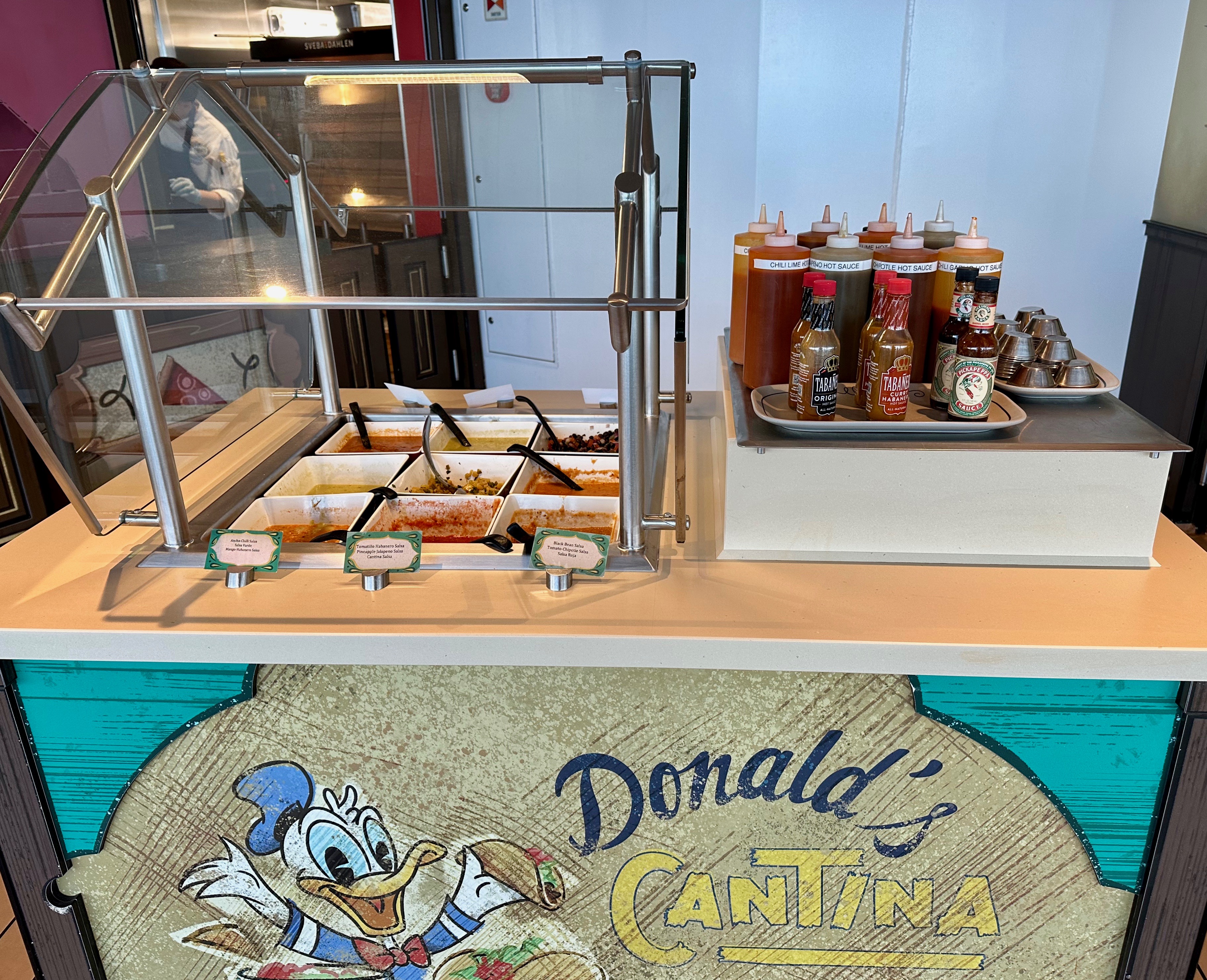
We went for a late lunch given the big breakfast and our late dinner seating. The pool side offerings on the Wish are varied with our favorites being the taco stand and the bar-b-que. I still prefer the boiled king crab legs and shrimp and I ate that again. Between the morning mimosas and the seafood, I had found the best deals on the ship. We kept checking the line at the Aqua Mouse, but other than first thing in the morning-it opens at 8 am-the sign indicating the wait stayed at 20-40 minutes throughout the day. I can just imagine what the wait would be on a sailing with more school-age children.
We stayed out at the pool most of the day, enjoying the water, reading, and listening to music. I know Rocky wanted to soak up as much sun a possible given his Minnesota winter. Our show tonight is The Little Mermaid. I was a little different from their other versions, but adapted well for a cruise ship and was well executed. The evening entertainment continued to impress. Since we had time after the show before our dinner seating, we checked out Nightingale’s, the ship’s champagne bar. They had a pretty good selection of by-the-glass champagne and Natasha does love her bubbles.
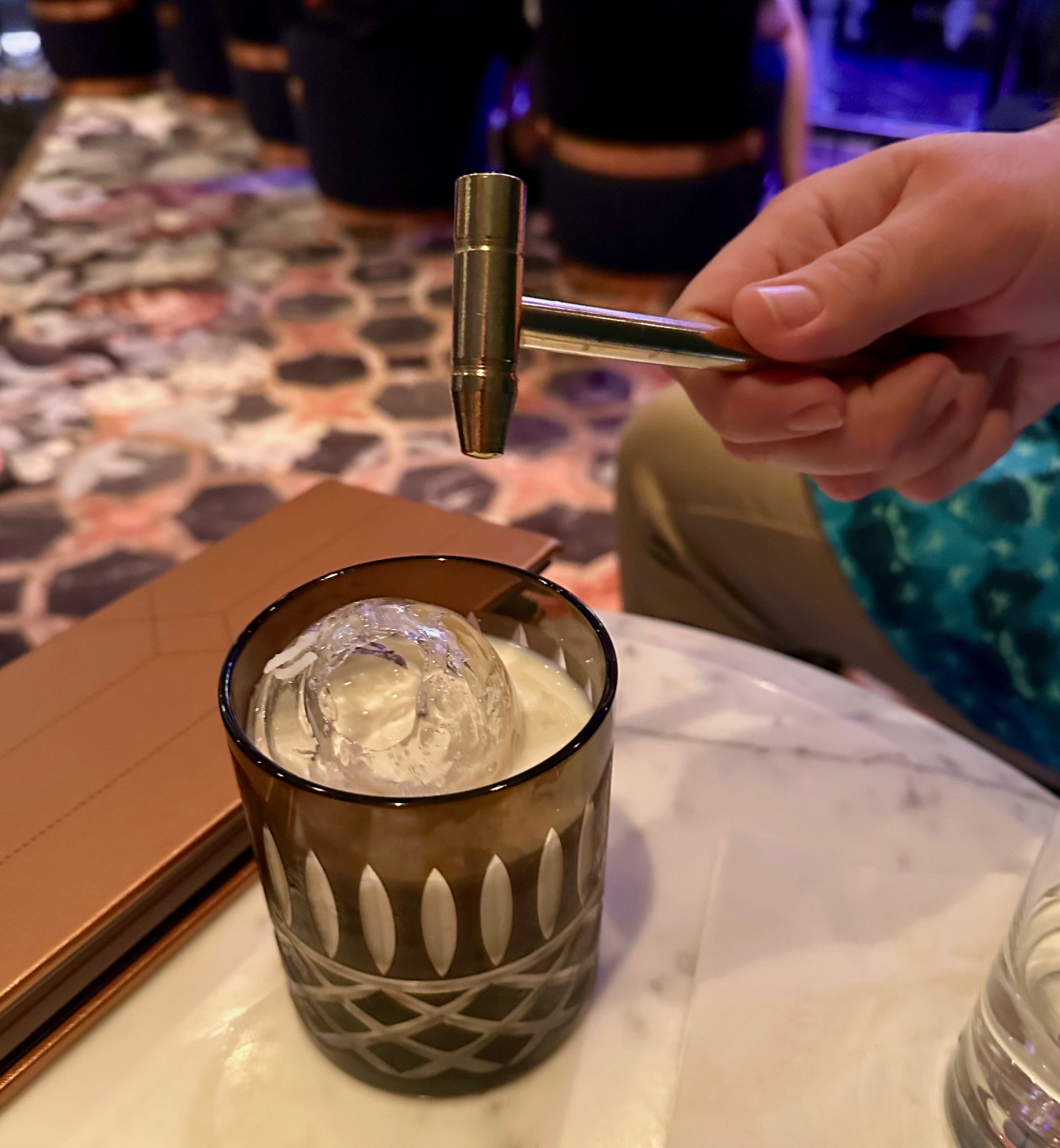
Rocky tried one of the cocktails where they gave you a little hammer to break the ice ball. Gimmicky but fun. The bar’s signature drink comes in a glass shaped like a bird. I doesn’t hold much, but the glass was pretty until you realized you were drinking out of the bird’s tail feathers. The glasses are not meant to be souvenirs, but our server told us that guests had already snuck out with half the stock of the speciality glasses they had when the ship starting sailing.
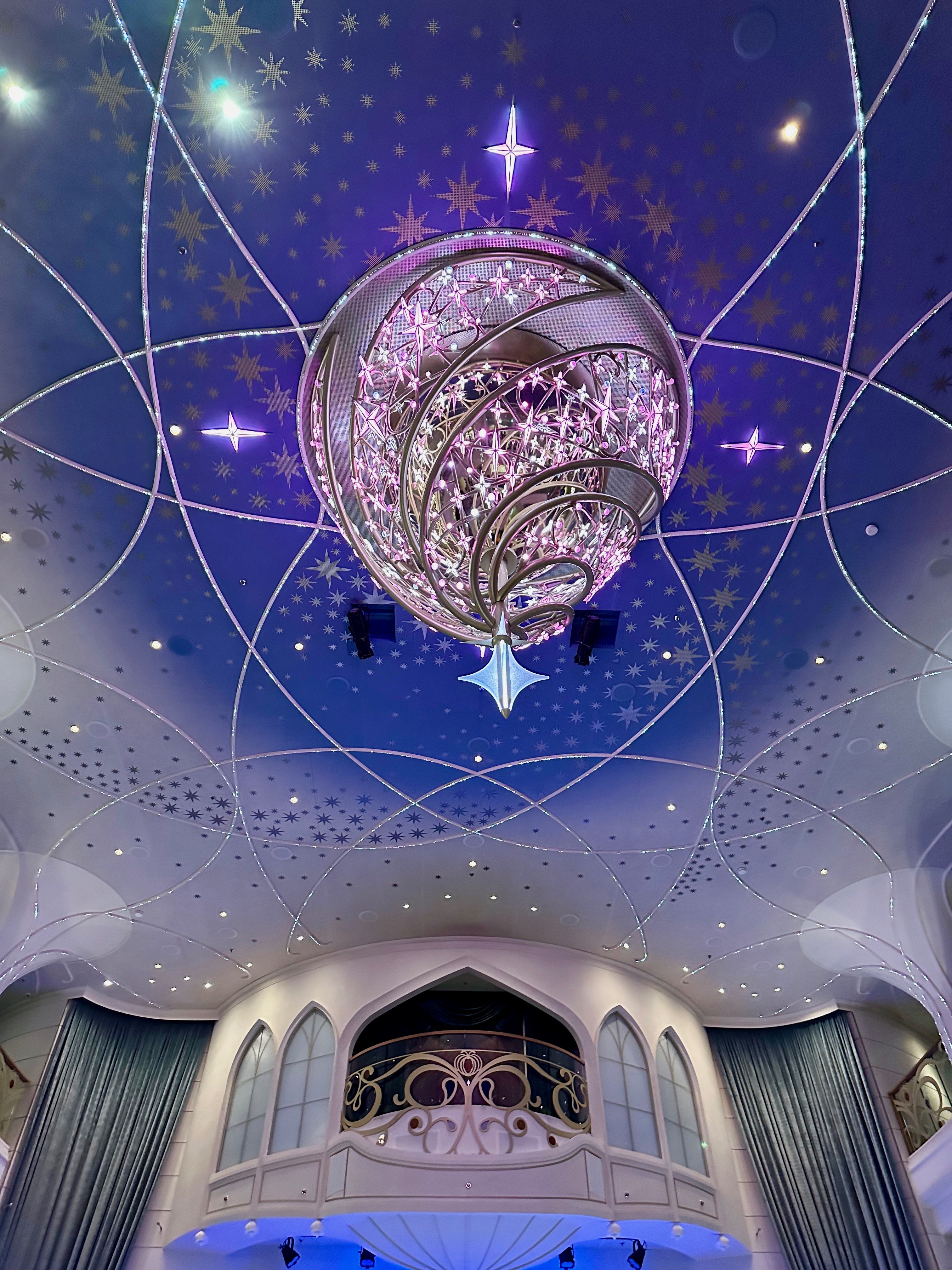
The highlight of Nightingale’s is the beautiful chandelier and the baby grand piano underneith. We enjoyed the Disney music in complicated arrangements performed by Matt who was part of the Victrophonics we saw last night in Luna. The small stage entertainment found outside of Walt Disney Theater was the biggest surprise and my favorite part of cruising aboard The Disney Wish.
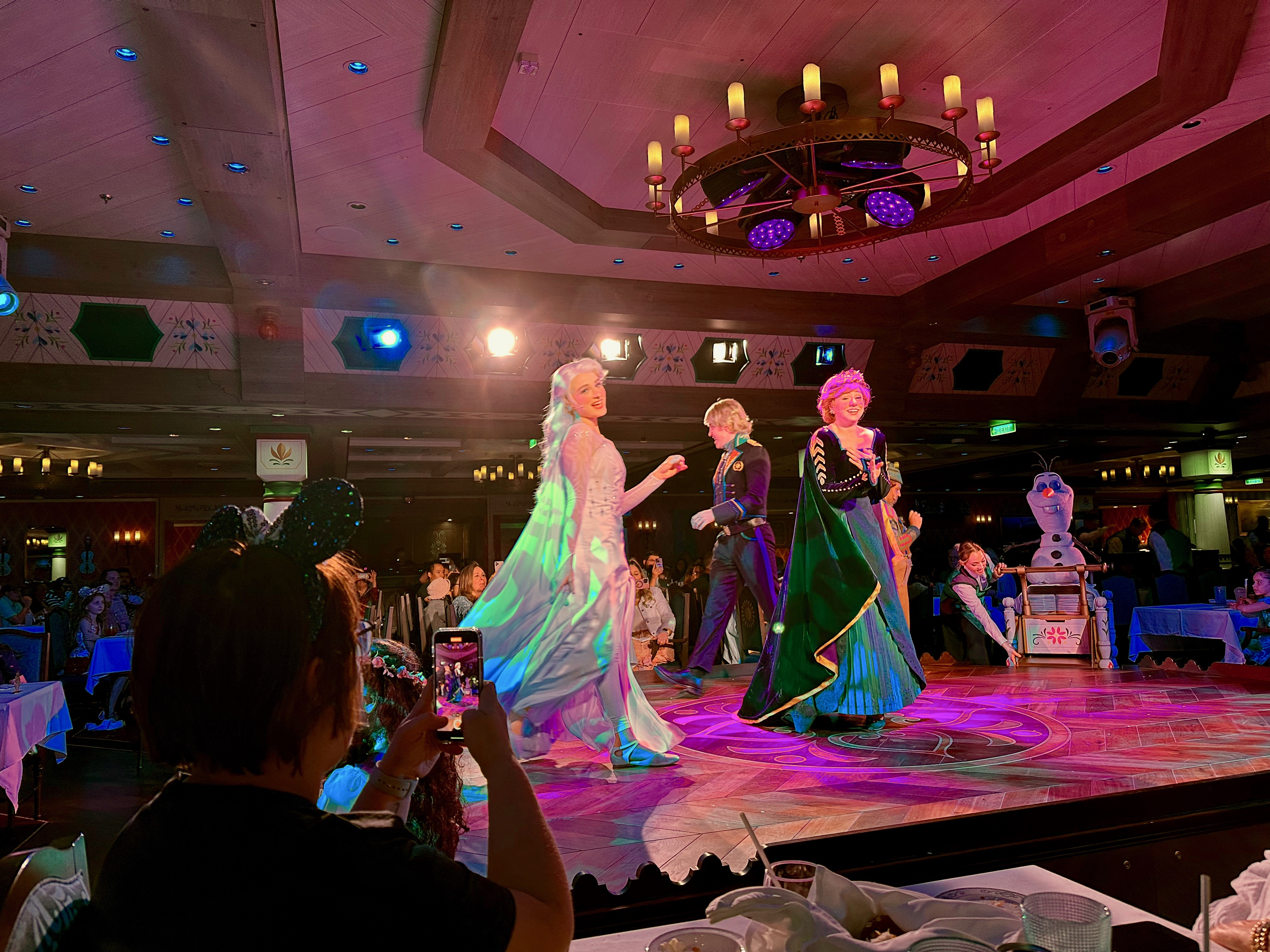
Tonight the dining rotation took us to Arendelle’s, the Frozen-themed dining venue. I had been to a similar venue on one of the other Disney ships and was seated out in the boonies. I was excited to have a stage-side table this time. Periodically, you would get appearances on the stage, by Oaken (who acted as MC), minstrel performers, and later Anna, Elsa, Olaf, and Kristoff. Honestly, the best work was by done by the minstrel singers.
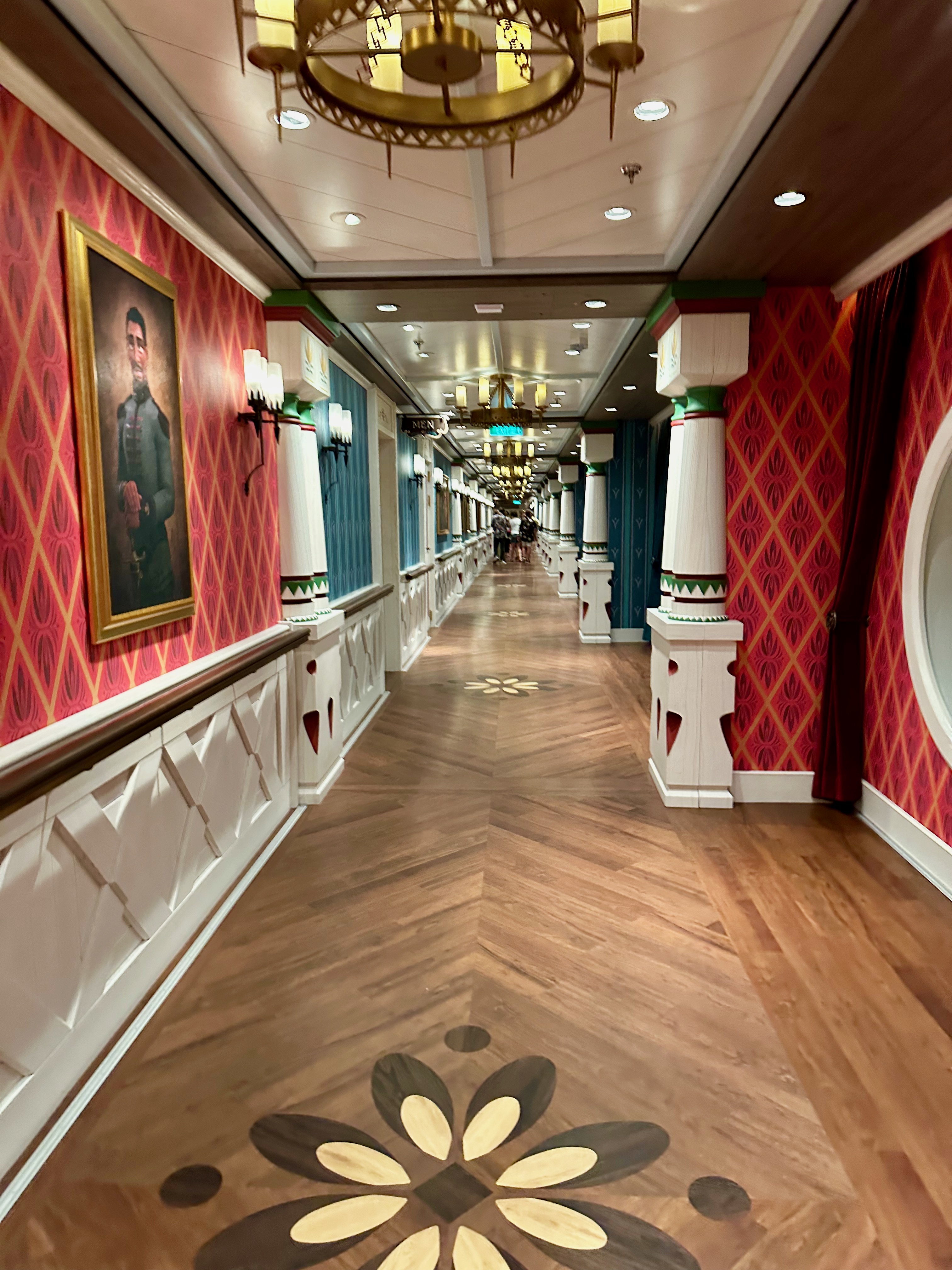
The venue itself is designed for serving, sight lines, and roaming characters. The characters wave and pass by the tales but do not stop. My favorite part of the venue is the hall that takes you back to the dining area, setting the mood and giving the feel of a castle corridor lined with portraits of family and friends. Rocky got into copying one of the painting as Anna did in the original Frozen.
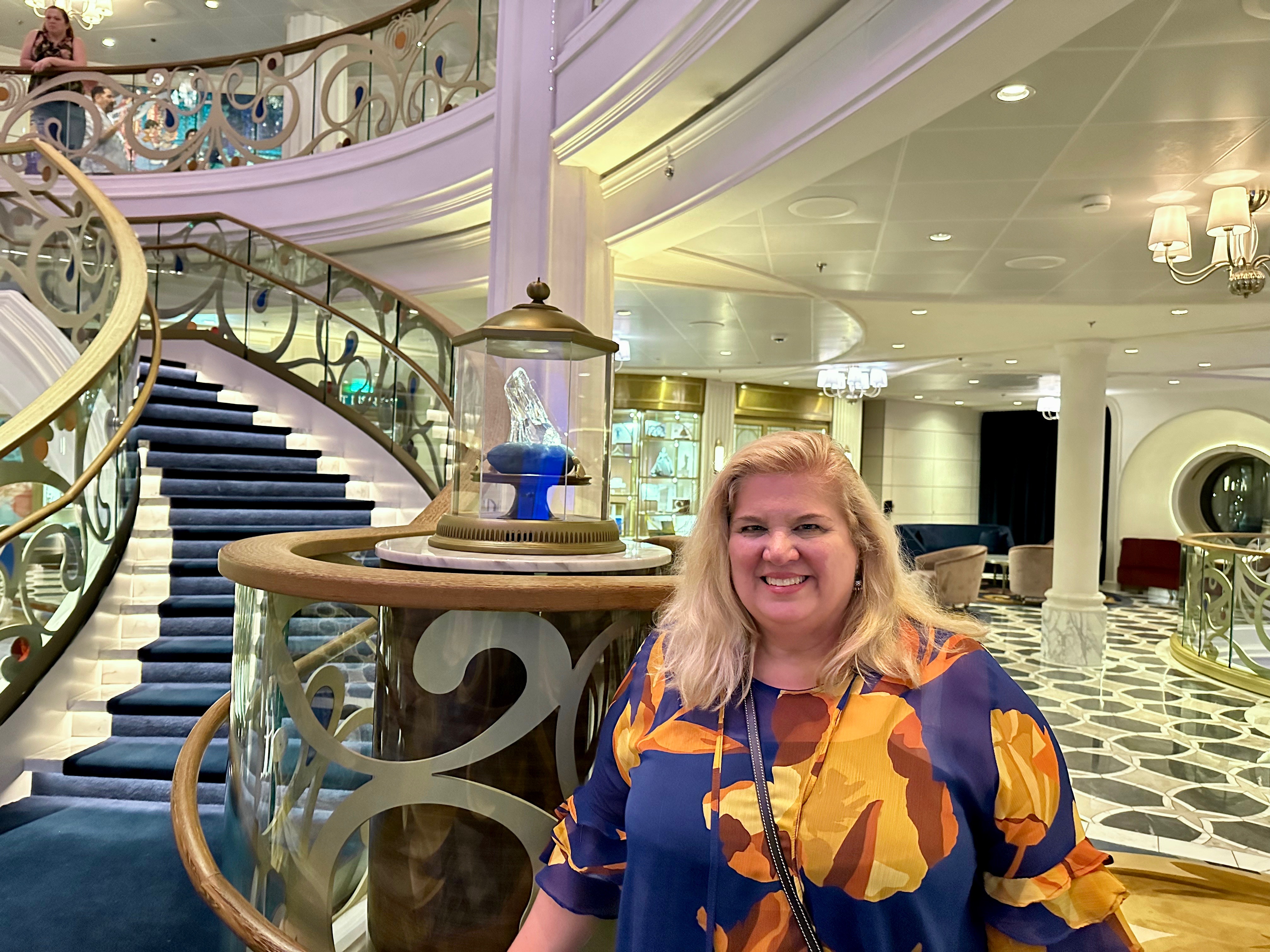
After dinner, we ran into some more characters, did some more bar hopping and caught another one of Matt’s sets-music from a different era. We ended the evening the the Grand Hall getting pictures with the Cinderella statute and her glass slipper.
This past summer, Disney Cruise Lines (DCL) released the first of two boats in its new line of passenger vessels. Natasha has been on all the Disney cruise ships, so to keep that statement true and as a Christmas present to Rocky (selected among several options I gave him) we took a five-day Winter voyage on the Disney Wish. You can only book passage on the Wish for a 3 or 4- night voyage. I suspect they are doing this given high demand. You can book a longer trip on any of their other four DCL ships for less money, but the time frame and the lure of the new ship made The Wish our choice.
People like to complain and I had seen lots of negative comments about the ship. That included a review that ranked it last (5th) among the five Disney ships. That is pretty brutal for a brand-new ship. There are changes to the Wish that make it different from the previous Disney vessels, which I think is the primary reason for the complaints. All that said and maybe because I had read those reviews, The Disney Wish and our voyage on it exceeded our expectations.
My adult son Rocky has been living in Minnesota for a year and a half, hence the appeal of a Caribbean vacation in late January. To avoid carrying all his winter gear, he got a ride to the airport from his uncle (my brother) and slipped inside the terminal wearing only a lightweight jacket, tee, shirt, jeans, and athletic shoes. By the time I saw him in baggage claim in the Orlando airport (MCO), he had ditched the jacket, tee shirt, and jeans and was in shorts and the Grogu (Baby Yoda) shirt I had given him for his birthday and suggested he wear. What he didn’t know, was that I was wearing the same shirt. (He is a good sport and I could only get away with this because families wear matching shirts at Disney Parks all the time.)
For those unfamiliar with MCO, the arrivals, departures, and check-in counters are on level three. Baggage Claim in on Level two and the transfer buses are on level 1 on the B side. We chose to take the Disney transfers to insure we made the ship since we were flying in the day of the ships’s departure. We did take the earliest direct flights available to us from Houston and Minneapolis. Last time out of Cape Canaveral, all the vehicular traffic was held up getting into the port. This time, that was not a problem, but we by-passed the long line for cars, cabs, shuttles, and UBERs waiting to drop off at the cruise terminal. Either time, we had a cheaper, faster, and hassle-free transfer by booking through the cruise line. We also avoided the risk of missing the ship by using the company’s transportation. (At the end of the cruise, we were also one of the first groups off the ship.)
Once at the terminal, they confirmed we had our passports and our boarding passes and then we went through security. If you haven’t been on a cruise in a while, most of the things we used to do at check-in counters at the cruise terminal are now done on line (credit card submission, information forms, health forms, passport uploads, etc.). The room keys were outside our cabin doors. We had a bit of a wait due to a routine coast guard inspection that morning. Check-in was running just over an hour behind. Although running late, the process was smooth. We walked over to the boarding area when the group just before ours was called and when the line got short, we were able to board even before our group was called.
As with other Disney ships, crew members announce your family name as you enter the Grand Hall. After a look around and a greeting from Flynn and Rapunzel, we dropped off our carry-ons in the room, picked up our room keys at the cabin, and headed up to the buffet for a late lunch. Both Rocky and I had got up early-him at 4 am, me at 5 am-and we were both ready for something to eat and drink. At the back of the Marceline Market (deck 11 buffet) I found the fresh boiled seafood and enjoyed king crab legs and shrimp with a variety of dipping sauces. Cruise ship buffets are no longer walk up and serve yourself events. Crew members add food to your plate at your request. The Wish had a wide variety of food stations. You were able to get your own drinks, using a new glass each time. Water and fruit beverages were complimentary, as were soft drinks. Disney is the only cruise line at this price point that includes soft drinks at no additional cost. The venue is named for Marceline MO, Walt Disney’s hometown.
After our lunch, we went roaming around the ship while we waiting for our luggage to be delivered to our room. One of the advantages of the Disney transfers was that we gave them our luggage at the airport-tagged with the ship identification we were sent in the mail-and didn’t have to worry about it again until it was delivered to our cabin onboard. We were particularly interested in finding out where the Star Wars Hyperspace Lounge was; that was a definite on our visit list. We also wanted to find the COVE which is the pool, bar, and hot tub area restricted to adults. If you are looking for information and experiences about traveling on the Wish with children, you won’t find it here. In fact, we were focused on the adult offerings the cruise provided. Since were sailing at a time most schools were in session, most of the children on board were very young.
Every ship has a muster drill and ours was just prior to the time we pulled away from the pier. Fortunately, you sit comfortably in the muster station and don’t have to queue on the outside decks. Our luggage had made it to our room, so after the drill we unpacked and watched the sail away from our balcony. We often get a outside cabin on Disney ships since we are rarely in the room, but we went for the balcony this time as it wasn’t that much more. By looking at the room, you can tell this is a new ship. There are plugs and USB ports everywhere you might want them. This is especially great if you use a CPAP machine like me. We could both plug everything in at the same time if we wanted to. If you are tempted to stay in the room, the wonderful flatscreen gives you access to all the Disney movies and shows you could hope for. Although not unique to the Wish, there are some Disney room features that I particularly like. There is a curtain that separates the sofa sleeping area from the queen bed. Also there are two separate bathroom areas, both with a sink. One has the tub/shower and the other the toilet. The shower was really nice with a glass door that swung both in and out. (The plug wasn’t in the best place as I kept stepping on it during my shower and when turned in the door hit the clothes line, but these details were overshadowed by this better than typical cruise ship bathroom.) One of the other things I like on these Disney ship is the metal door which allows people to add magnetic decorations. Some families go all out on their decorations, even adding a mail pouch so those not staying in their cabin can leave notes.
Dining aboard a Disney ship is a little different, you have assigned seating and you, your table mates, and your servers rotate between the unique and included theme restaurants onboard. In highly recommend the second seating for adult parties. The staff will tell you that they intentionally rush the first seating since it is mostly parties with small children. Second seating is quieter and served at a more relaxed pace. It does mean you go to the stage entertainment early (6 or 6:30), but we found that it gave us more free time to explore the adult areas on the ship. There are speciality (pay) restaurants that are very nice and I have eaten at some aboard Disney ships, but on a short sailing like this, it just isn’t necessary unless you want to completely avoid children. One of the restaurants in the rotation is duplicated on the 4-night sailing, but you don’t know which night that will be until you board so it is harder to get reservations. You are also likely to miss some of the evening entertainment if you are booked into a specialty restaurant. It all depends on your priorities. Some adults might enjoy a night or two at those venues.
The first night was a short (30-minute) welcome aboard show and I was kind of indifferent to it and wanted to check out some of the new adult venues, but Rocky wanted to go so we headed over to the Walt Disney Theater about 15 minutes before show time. The theater was almost packed and there really weren’t great seats left even for a party of two. After testing this for the shows (3 of 4 nights of the cruise), I found that you really need to get there 30 minutes before the show for a good seat and maybe even earlier if you have a large party and all want to sit together. The show was terrific and I am so glad we didn’t miss it. It was the best welcome show I ever saw on a Disney ship, probably the best welcome show I have seen on the almost 40 cruises I have been on.
Afterwards we thought we would try our luck at getting into the Hyperspace Lounge since it was nearby on Deck 3. The reviews had all complained about getting in. When the ship first set sail you had to have a reservation, but that is no longer the case. During busier times, there is a sign out asking you to limit you stay to 45 minutes and they will deliver the check to insure you keep to that time frame. We actually headed right over after the show and got in this small venue. There aren’t a lot of decorations, but the highlight is the window. The idea is you are on a lounge on a cruiser in space and periodically the cruiser goes into hyperdrive and you are transported to outside another planet with a different view outside the window.
The other draw is the clever drinks, especially those where the server forms a bubble on top that grows and eventually breaks into smoke. There are some pricier options, but most of cocktails range from $15-20. We had such a great time, chatting with other patrons, watching the planet window and hyperspace mode, and trying out the cocktails.
After the Lounge, it was time to head over to our 8:15 late seating dinner reservations. Tonight we are dining in World of Marvel. The current show is centered around Ant Man and the Wasp. The movie featuring these characters is due out in a few months. My suspicion is that that the story will change to feature different Marvel characters and story lines after the AntMan movie has been out for a while. We are at a 6-top tables, but there are only four of us assigned to it. We learned when we were boarding that there are about 3500 passengers rather than the 4000 full capacity that the ship often sails with. One of the reasons we chose to travel at this time was knowing that hopefully there would be fewer passengers since most children are in school. Our table companions were a mother and daughter traveling together. The daughter is about 5 years older than Rocky.
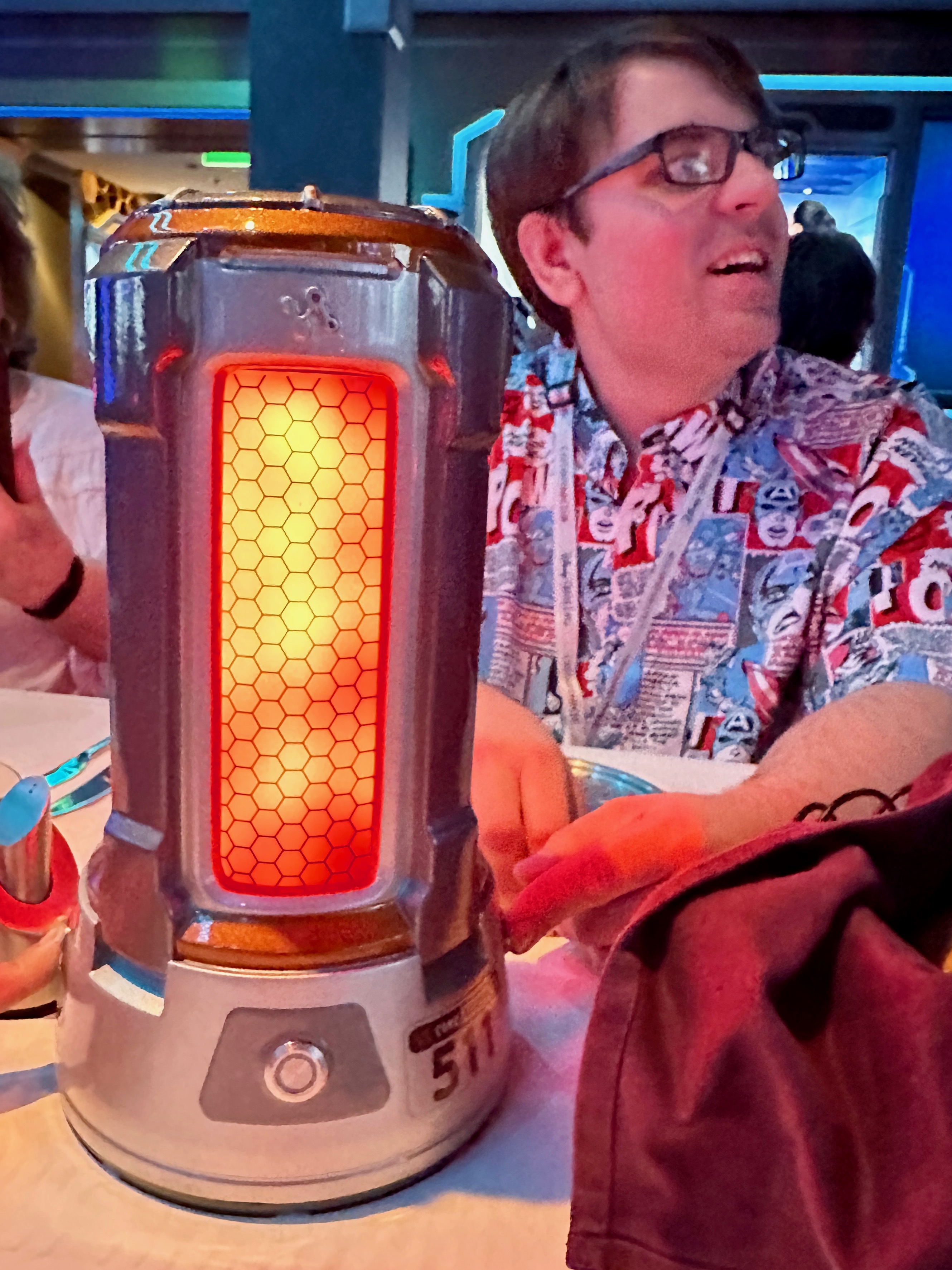
Once everyone was seated, met the servers, and ordered, the screen show began. There is a story and build up to a big finish. Parts of the event are interactive using a device that sits on the table. Both the 30-years-olds at our table really got into it. The story develops in parts, but the screens are also on and showing pictures throughout the dinner. Dinners are multiple courses and you can have has many or as few as you would like. They also take the theme seriously with the tableware featuring the Avengers logo.
Some past guests really found the screens distracting and annoying during diner and the teenager at the table next to us lost interest and left for his cabin as soon as his second course was served, but most of the guests seemed to enjoy it. I could see where it would entertain small children who otherwise get bored sitting through a multi-course dinner. You can’t know Rocky without being initiated into the Marvel Universe so I knew the characters and I found the experience a fun change from normal cruise dining. There are surprise appearances at the end of the show (although the waiters tell you that someone may come). The characters just walk through, no stopping for individual photos or autographs, but it is a nice way to end the experience.
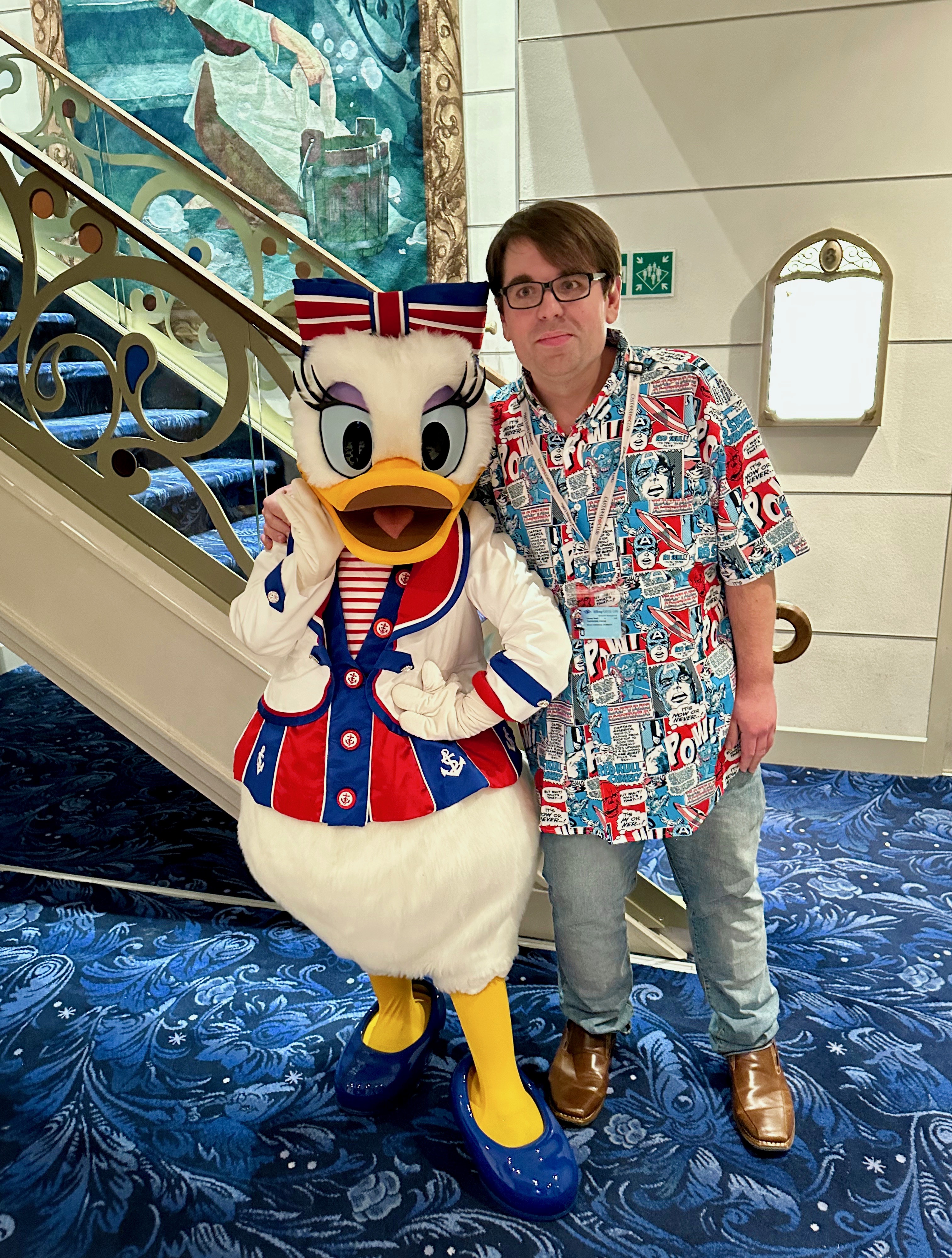
Finding activities aboard the Disney ships is a little different than it has been in the past. After both dinner seatings and both of the main stage (Walt Disney Theater) performances are over, there is lots of activity in the main hall on the multiple decks that open to it. The photographers are finishing up with the optional background photos and lots of characters are milling around. We walked by Daisy Duck and had to get a photo for my mom. It is not so much the character that she loves, but my Dad did a great Donald Duck imitation so she identifies with his sweetheart Daisy. There are no longer any printed schedules on the Disney cruise ships. The Navigator is now available via the cruise line app. You put your phone in airplane mode and log into the Disney wifi (free of charge) to use the app. Other internet access comes with a fee. It took me a while to find things on the app and some of the program descriptions weren’t clear, but we used it to decide where we were headed after dinner.
I had done “silent discos” aboard other cruise ships and at my college reunion parties and I encouraged Rocky to try it out. It wasn’t starting until later so we stopped by the venue to see what was goin on. There were ending one of quip competitions which clearly were very popular given the crowded venue and the number of quiz scheduled throughout each day of the cruise. We decided to walk around a bit and check out the pub and barber shop on board. We returned to Luna Lounge later to catch the musical act that proceeded the silent disco. We were treated to an awesome performance of this group that included the ship’s primary musicians, one of the actors (he was the Genie in Aladdin later in the week), a female singer, and one of the dancers who was easily spotted on stage throughout the week by her height. The music was fabulous, the vocals outstanding, and the tap dancing phenomenal. Look for the “Disney Victrophonics” on your app schedule and don’t miss their performance.
After the Victrophonics performance, we stayed in Luna for the Silent DJ Party. This event is not unique to Disney. Participants are given headphones with multiple tracts of music. The headphones light up in different colors for each tract so you can tell which tract your neighbor is listening to. To the outside observer, you see lots of people dancing and even singing, but you don’t know where the music is coming from. It can be very entertaining even if you are not participating.
We participated and Rocky loved it. We danced the entire time, not sitting down once. One of our table mates was also there. I was proud of myself as a parent for instilling this love of music and dancing in my son. We were literally the last two dancers on the floor, although sweaty and moving slower by the time the event ended. I took another shower when I got back to the cabin. What a great start to our week aboard The Disney Wish.
There is more to come from the Caribbean and aboard The Disney Wish…Natasha.
When we finished our half day touring Machu Picchu I was wore out and thirty. We went directly to the restaurant next to the Belmond Lodge right at the entrance to the Machu Picchu ruins. It was set up for a buffet and fortunately, our group had reservations. It was a clear, hot day but I had been afraid to drink much since the only toilets were outside the ruins entrance gate and there was no reentry. Most members of our group were hungry, but I just wanted to keep thinking water and then a Peruvian soda that was on the buffet. I hardly ate anything at all.
Machu Picchu, Peru
Exhausted, we all got in line for the bus back down the mountain after lunch. The line actually moved pretty quickly; we didn’t have much of a wait at all. The hotel was going to deliver our bags to the train station, so once we arrived back in Aguas Calientes (Machu Picchu Pueblo) we had free time to visit the bars and souvenir stands before the train ride back to Ollantattambo From there we are taking our bus to Cuzco. At this point, I wish we just had the direct train to Cuzco.
Carlos showed us the layout of the city and where the entrance to the train station was although it was too early for us to get in. Neither Boris nor I felt much like shopping, but sitting in a bar near the station, hydrating, and watching the crowds sounded like a good plan to me. We saw more of the sherpas loaded down with gear for the Inca Trail while we passed through the marketplace.
When the luggage arrived, we made our way into the train station to wait. There were lots of passengers waiting for multiple train departures. It is obvious that some people hike up to Machu Picchu, but take the train back down and it was much more crowed than when we arrived yesterday. Wow, that was only yesterday. It seems like so long ago given the amazing experiences we had visiting the Lost City of the Incas.
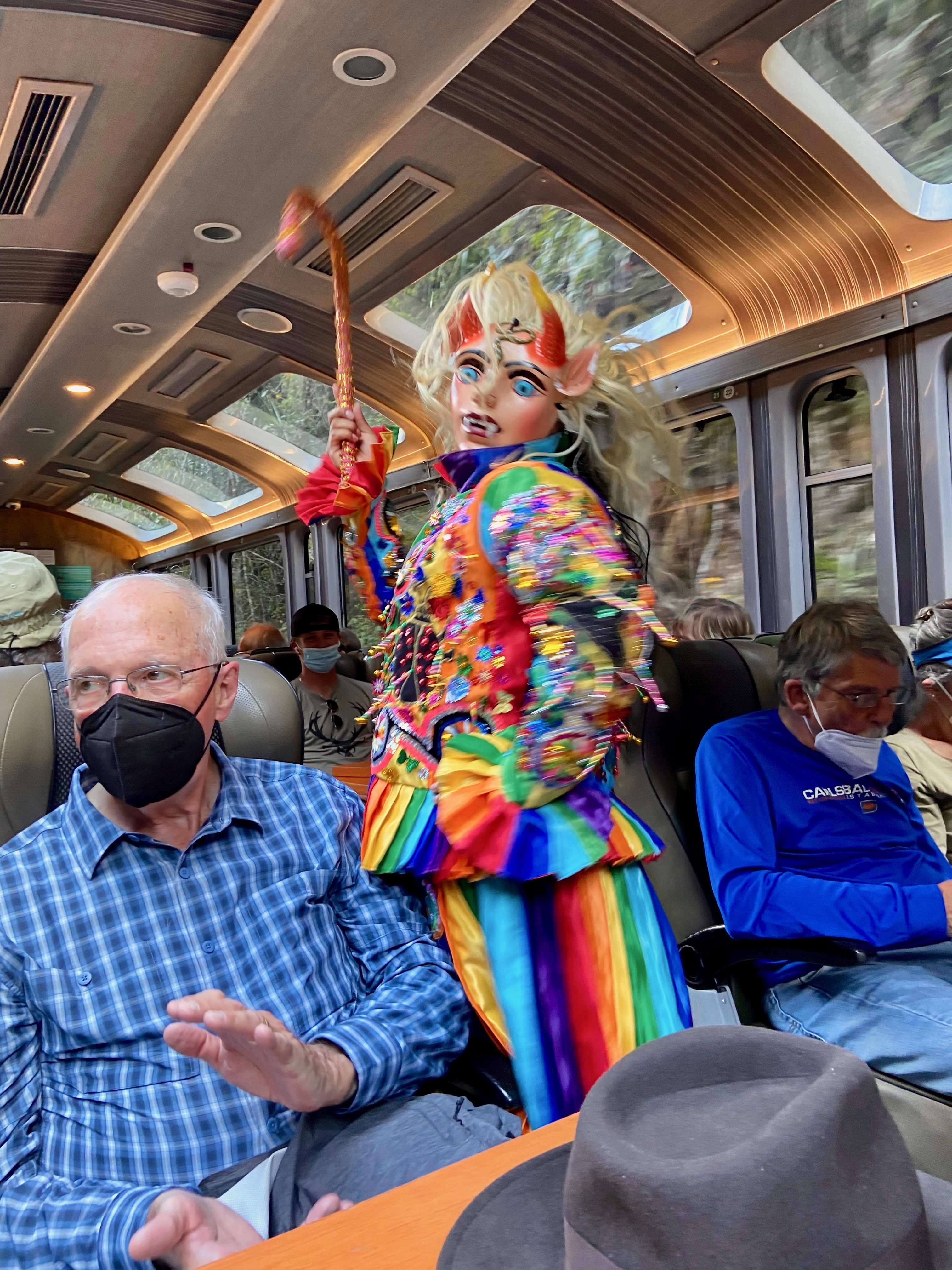
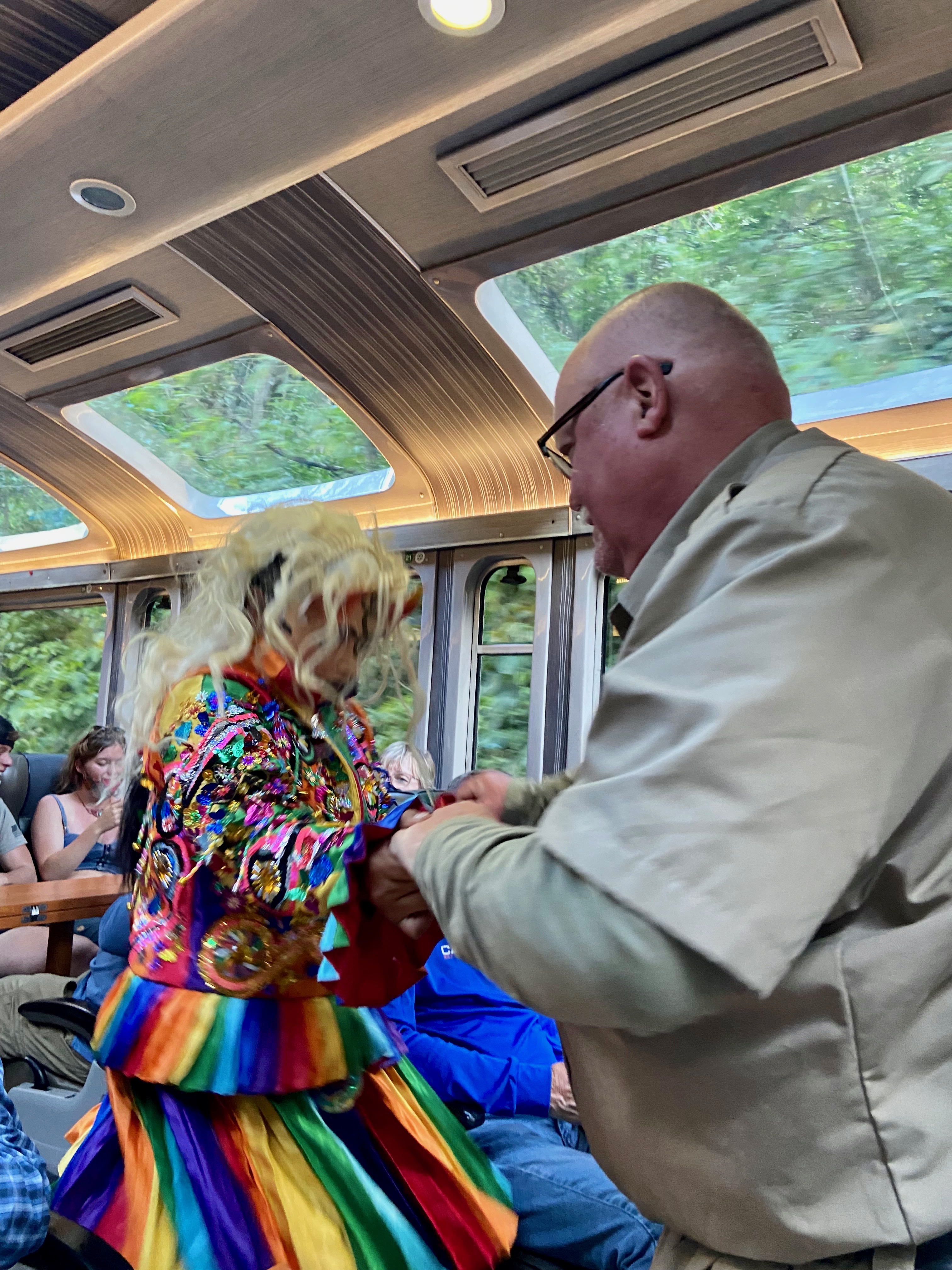
There were more steps and some difficulty handling luggage, so just be prepared if you are leaving from the Pueblo station. Once on board, we found that instead of the relaxing ride and looking out the windows, we were going to be treated to some entertainment. A dancer dressed in costume and mask appeared and danced down the car to piped in music. She was dressed as a demon according to Harvey, our Incan guide. After her own performance, she decided she needed some audience participation.
It came as no surprise that she selected to dance with Joe. However, guess who was her second victim, I mean partner. Thats right. Boris. He danced with her back and forth down the aisles. Hysterical, but he looked like he was enjoying himself. Of course, I got some video.
After the dancing, the staff in our car put on a fashion show. Peru is headed into winter, so none of the items we saw were anything I could wear anytime soon. That didn’t stop me from looking though. Of course after the show they came down the aisles selling the modeled clothing.
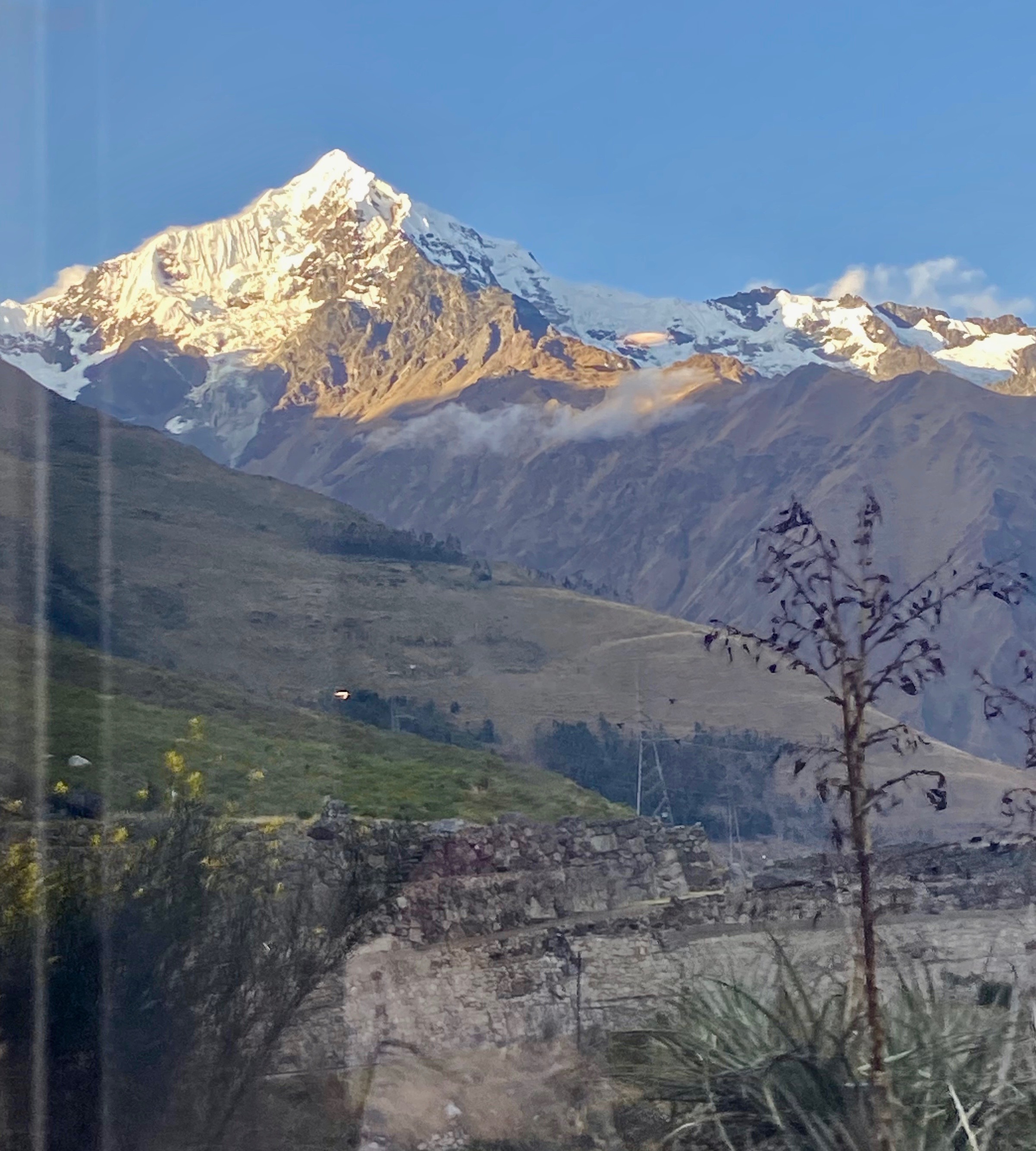
After that we settled into the rest of the ride into Ollantattambo, hoping for a view of the glaciers. I was on the wrong side for the best pictures, but I did catch a glimpse. Given all the entertainment, it felt like a quick trip back. Upon arrival in Ollantattambo, we had to get off the train quickly as it was continuing on to Cuzco. From the station we got back on the bus for our drive into Cuzco.
On the way into Cuzco, Harvey told us about the new airport planned for the city. It has been in the process for about 10 years, but has met with a lot of resistance because it is closer to the Sacred Valley and many of the people are concerned about the disturbance and perhaps damage it will cause to the area. It will be bigger and closer to the attractions in the Sacred Valley and access to Machu Picchu.
Arriving in the city, we hit lots of traffic and it was very slow going. If they are going to put an airport out here they better start with wider roads and more lanes of traffic. Once we got closer to the hotel, we had to switch from our bus to two smaller vans because our bus wouldn’t fit into the narrow lanes of the old city where we are going. Our hotel tonight is something very special-although all the hotels on this trip have been amazing. As the name implies, Monasterio, A Belmond Hotel, is an ancient monastery and one of the most touted hotels in Cuzco.
Upon arrival the doorman greeted us at the front of a large wooden door. Once everyone was on the sidewalk, he opened the door for the big reveal. We were checking in in the monastery’s chapel. What a moment. We quickly got on our way. Our luggage had been delivered to the hotel prior to our arrival and we simply had to point out our bags and receive the heavy metal key to our cell (what the monks called their rooms). Although not large, the room was gorgeous with high ceilings and the bathroom made the most of its tiny space. No two rooms in this hotel are alike.
Carlos recommended several area restaurants for dinner, but Boris was so exhausted he didn’t want to go out. We ordered room service and then crashed after our exciting day at Machu Picchu and our spectacular arrival into Cuzco, the ancient capital of the Incas. The exploration of more Incan sites and this fabulous city is on the agenda for tomorrow.
If you are a regular blog reader you know I have done extensive international travel, much of it before I even started the blog. My bucket list for travel ebbs and flows, but for many years now the number one thing on the list has been a visit to Machu Picchu in the Andes Mountains of Peru.
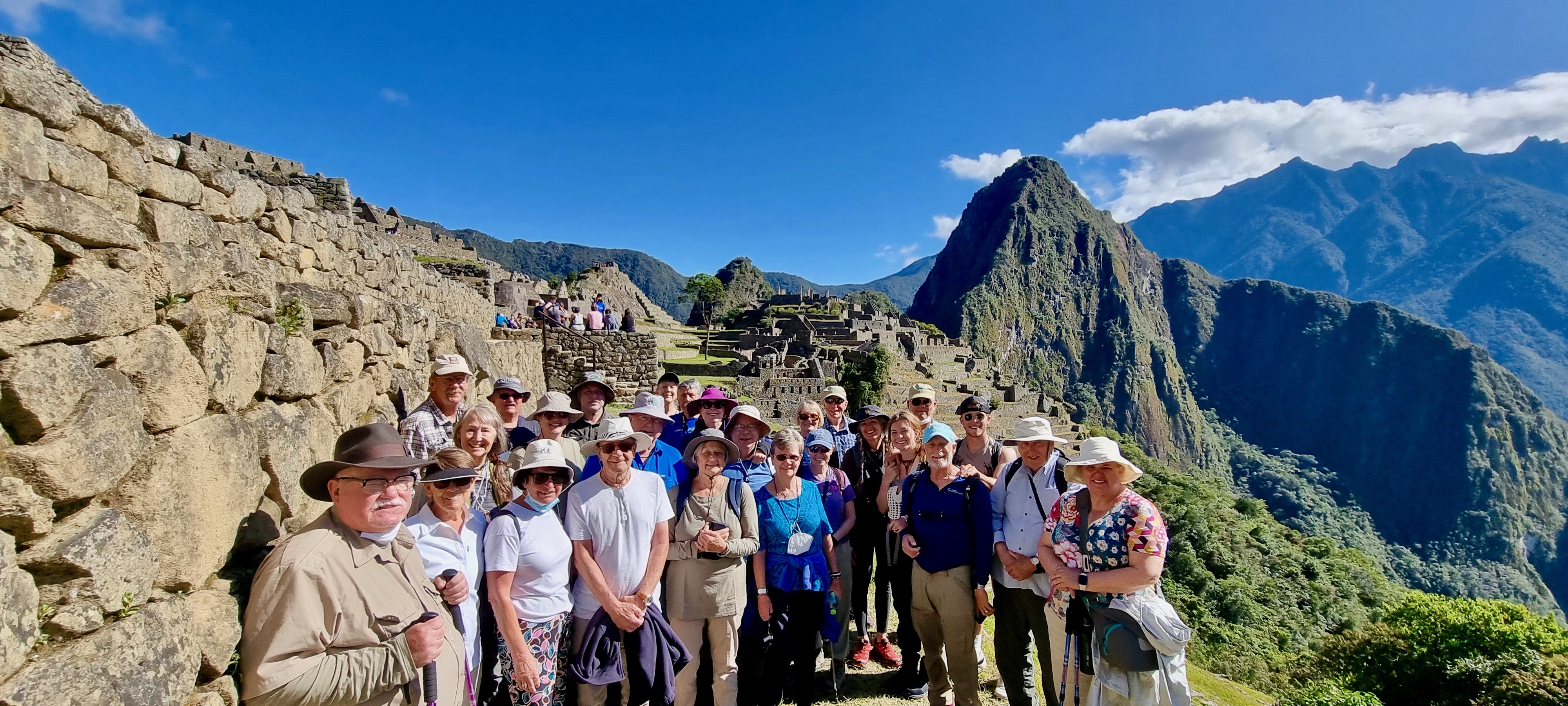
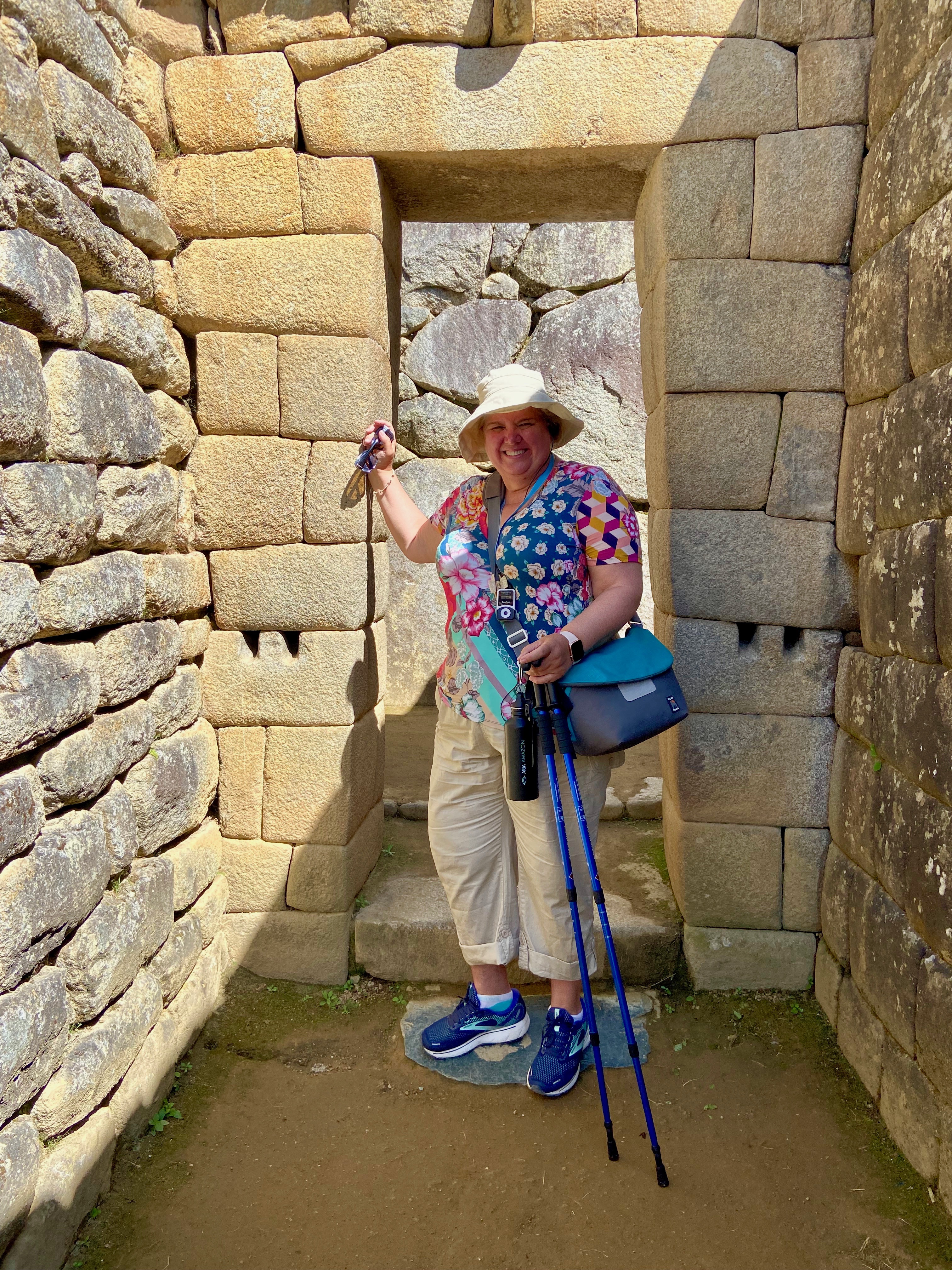
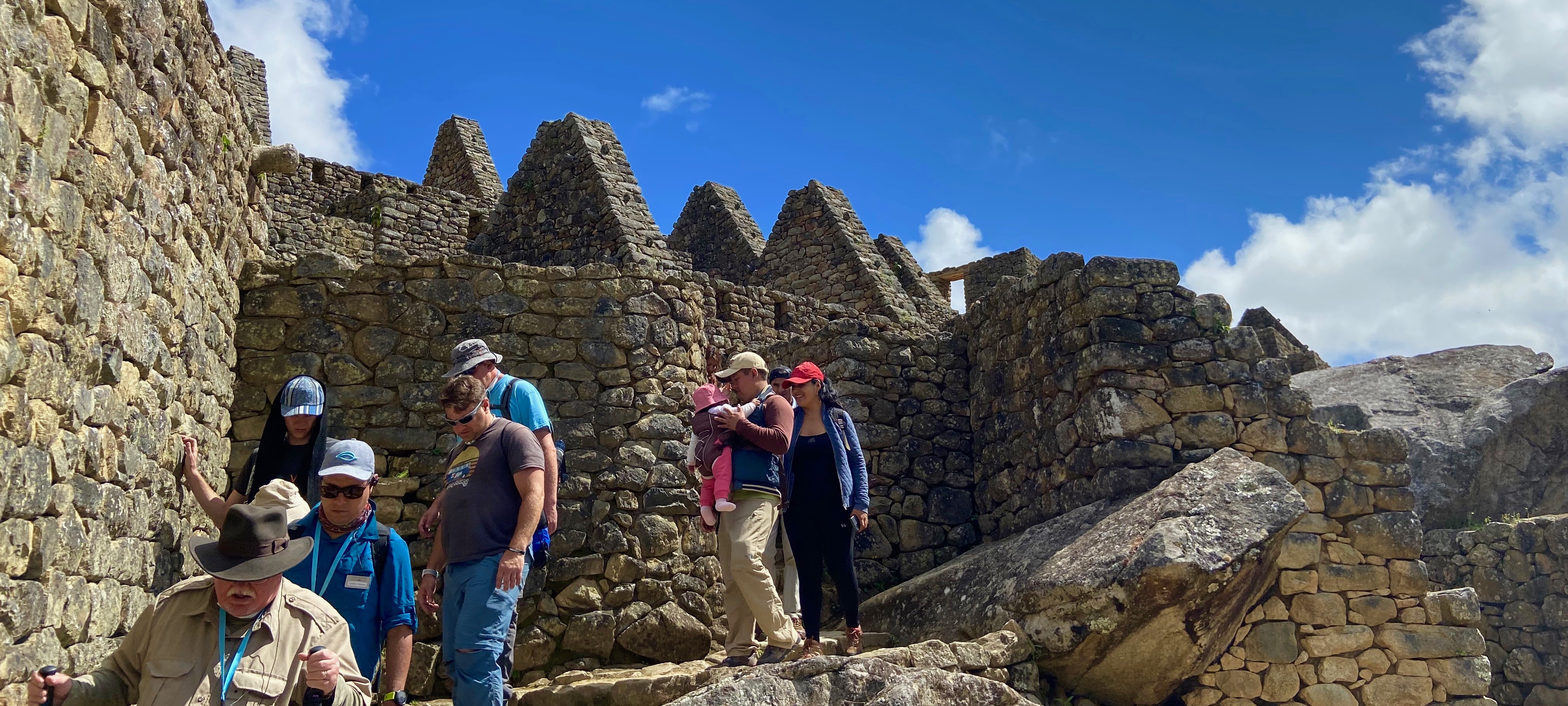
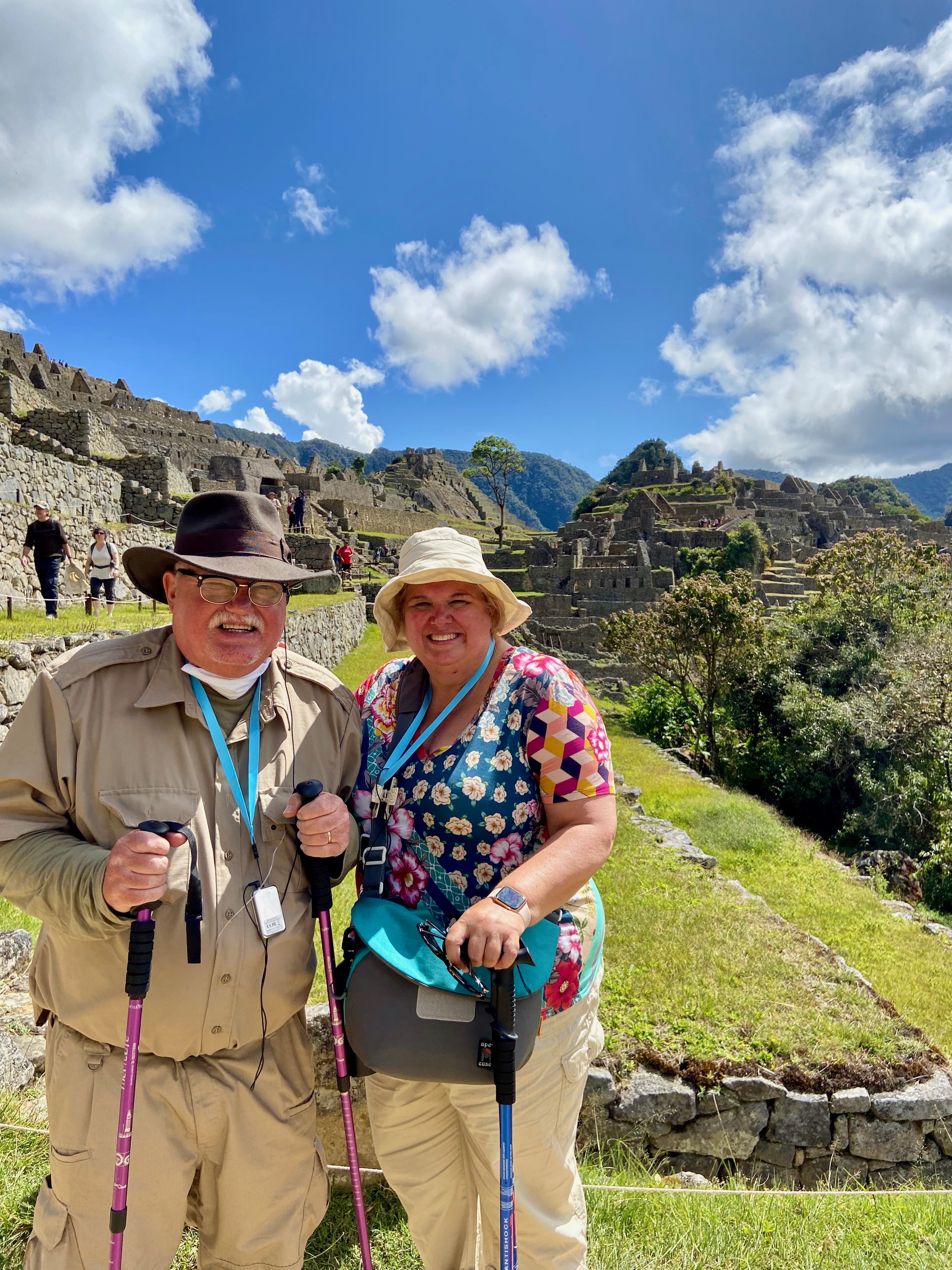
Our Tour Group at Machu Picchu. Boris and I bookend the group. You’ll see he is in full Indiana Jone wear today. Photo by Carlos Alvarez.
We expanded the trip by adding a cruise on the Amazon on the front end by booking a package with Uniworld Boutique River Cruises. I covered that portion of our trip in eight previous posts. After flying to Cuzco at the end of the river cruise, yesterday we started our exploration of the Inca heritage sites traveling through the sacred valley and boarding the train in Ollantattambo.
Leaving Ollantattambo, you can hike the magnificent Inca Trail to Machu Picchu, a four day-three night walking excursion with the assistance of sherpas who carry the heavy loads and set up the tents. On our way into Ollantattambo, we passed a field where all the clean gear had been laid out to dry. We later saw the sherpas in town. Hiking the Inca Trail is the only option if you want to enter Machu Picchu through the Sun Gate.
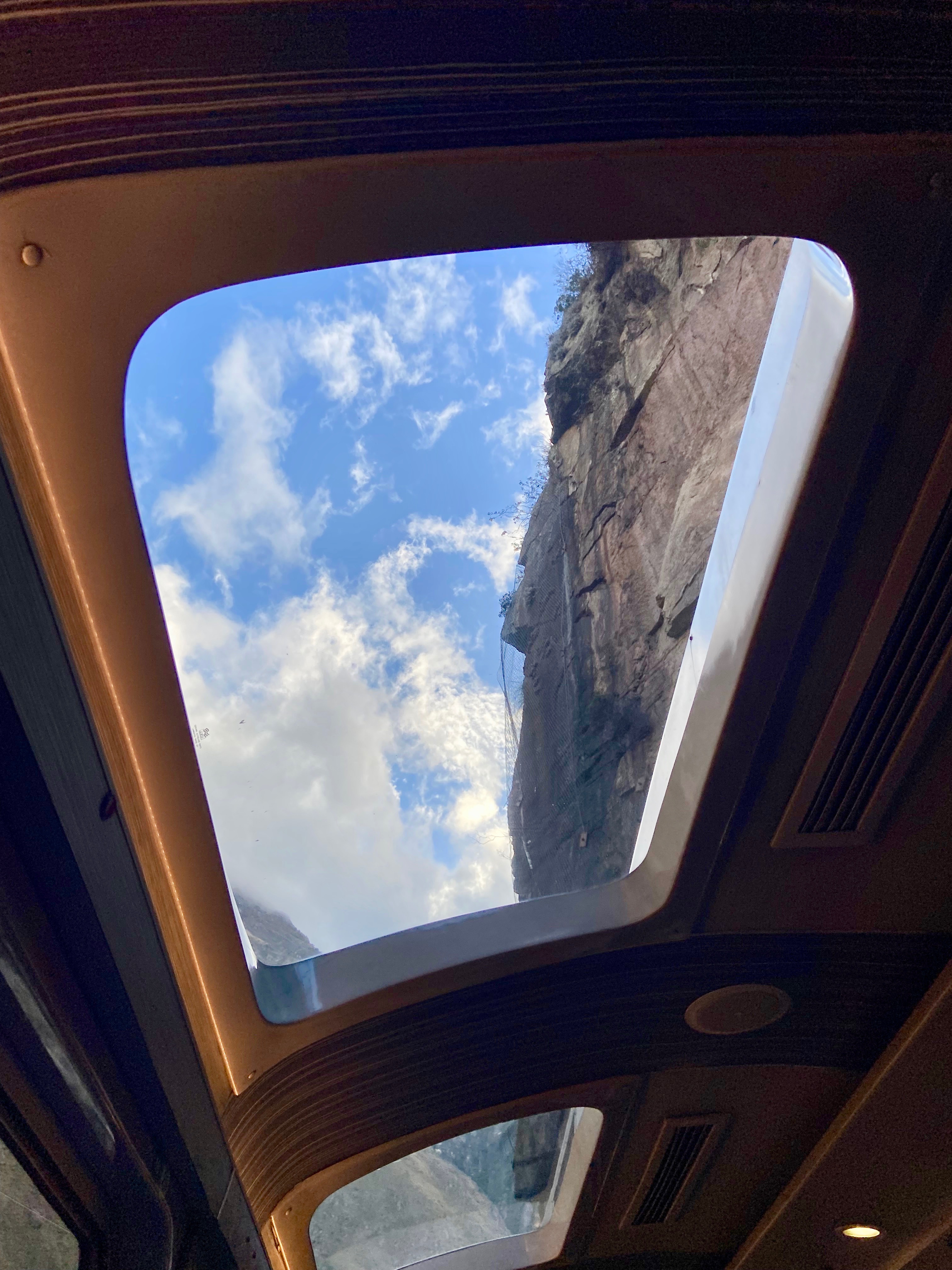
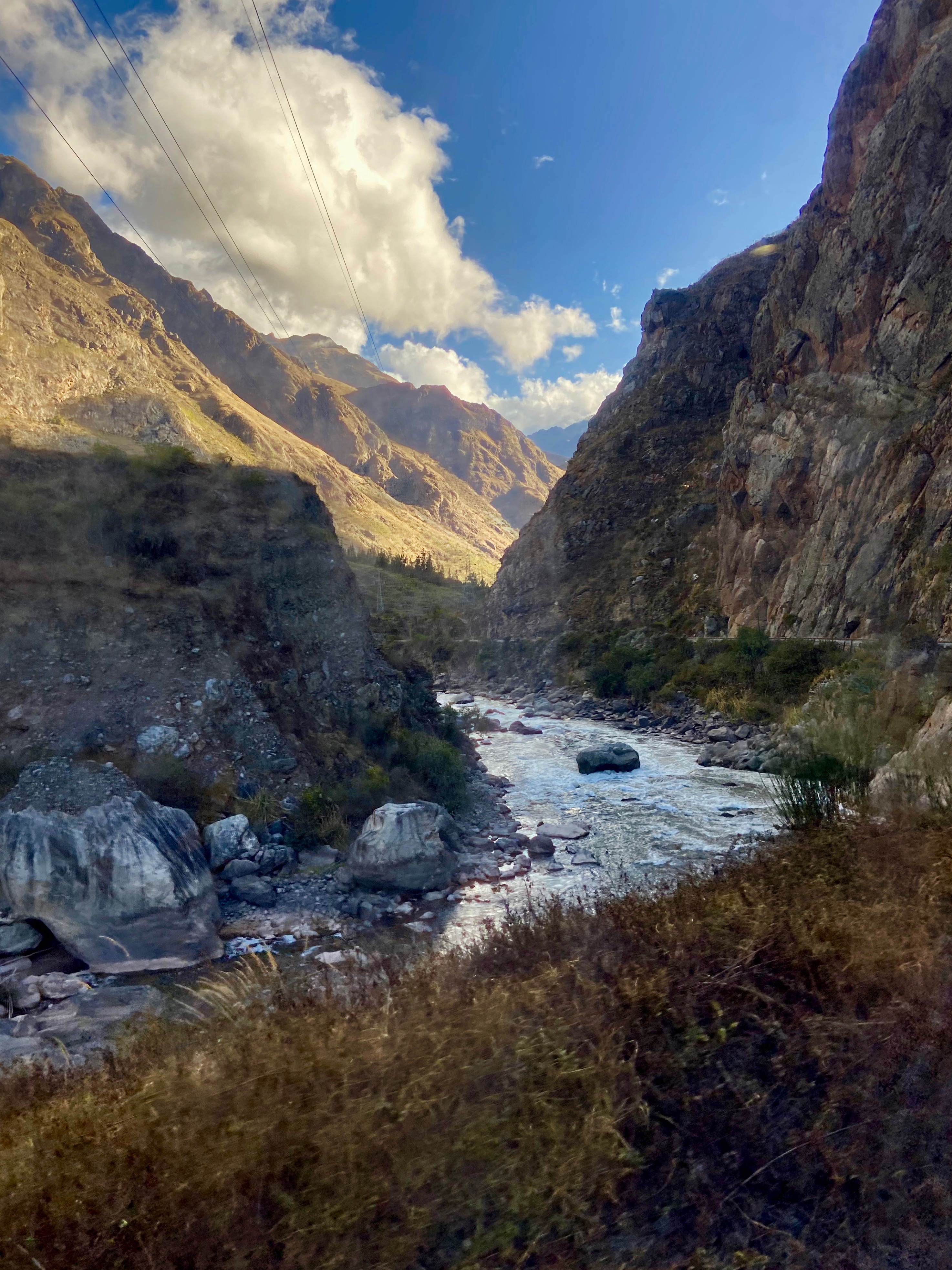
You can not drive to Machu Picchu. If you are not hiking, your other option is to take the train up. The train was definitely the right choice for Natasha. Not only it is a better fit given my physical health after two foot surgeries and a later fall down the stairs, but I didn’t have to give up the spectacular views. The train tracks run right along the Urubamba River and right between the canyon walls. Our vista dome car meant we had large windows, including ones in the roof. I spent the 2 hour and 15 minute trip staring out the windows. We took the 3:55 afternoon train up. The number of tourists that can visit the site on a daily basis is now limited-only 75 are let in each hour. There is an adequate number of trains offering service to the site, but you want to be sure to book your travel well in advance.
If you are not touring other destinations in the Sacred Valley, you can take the three and a half hour train ride from Cuzco. There are various levels of luxury depending on what company you choose. The end of the line for travelers from either Ollantattambo or Cuzco is Aguas Calientes, named for the warm springs. Its official name is Machu Picchu Pueblo. Here there are hotels, restaurants, and other tourist services. We ate at our hotel after our evening arrival, but there are other restaurants in town and plenty of places to buy souvenirs. If you really want to stretch your budget, there is a Belmond Sanctuary Lodge at the entrance to the ruins. We stayed at the SUMAQ Machu Picchu Hotel which has a lovely view of the mountains. It is one of two luxury hotels in Aguas Calientes.
In the morning, we took the 30-minute bus ride from the hotel up to the entrance to the ruins. Aguas Calientes sits at 6700 ft. Machu Picchu sits at almost 8000 ft. We originally thought we were going to have to go to the community meeting point where guests line up for buses that begin running at 5:30 am. However, given the size of our group-we almost fill a bus-they are bringing a bus to us at the hotel. The alternative to the bus ride is a 90-minute to two-hour strenuous walk up to the citdel.
Machu Picchu. Photo by Phil LichtenbergerLlamas roam through the upper levels of the ruins at Machu Picchu where they met other members of our group. Photo by Phil Lichtenberger
There were no written records mentioning Machu Picchu until Europeans visited the site in the 19th Century because unlike the Mayans, the Incas did not have a written language. As we toured, various locations were referred to by specific names like the Temple of the Sun, the Sacred Rock, and the Temple of the Condor. These names are the inventions of the explorers who came later and are based on the tombs and other physical evidence found.
“Most recent archaeologists believe that Machu Picchu was constructed as an estate for the Inca emperor Pachacuti (1438–1472). Often referred to as the “Lost City of the Incas”, it is the most familiar icon of Inca civilization. The Incas built the estate around 1450 but abandoned it a century later, at the time of the Spanish conquest. According to the new AMS radiocarbon dating, it was occupied from c. 1420–1532. Historical research published in 2022 claims that the site was probably called Huayna Picchu by the Inca, as it exists on the smaller peak of the same name.” Wikipedia
After it was abandoned by the Incas, few beyond those in the immediate area even knew of its existence. The jungle completely overtook the landscape, effectively hiding the ruins. It was Yale lecturer Hiram Bingham who began writing extensively about Machu Picchu after he was led there in 1911 by locals Melchor Arteaga and Pablito Alvarez. In 1912, he led an expedition to begin clearing the site. If this story sounds vaguely familiar, it is the basis of the opening scenes of the Indiana Jones movie with Harrison Ford in the lead role, a character based roughly on Hiram Bingham.
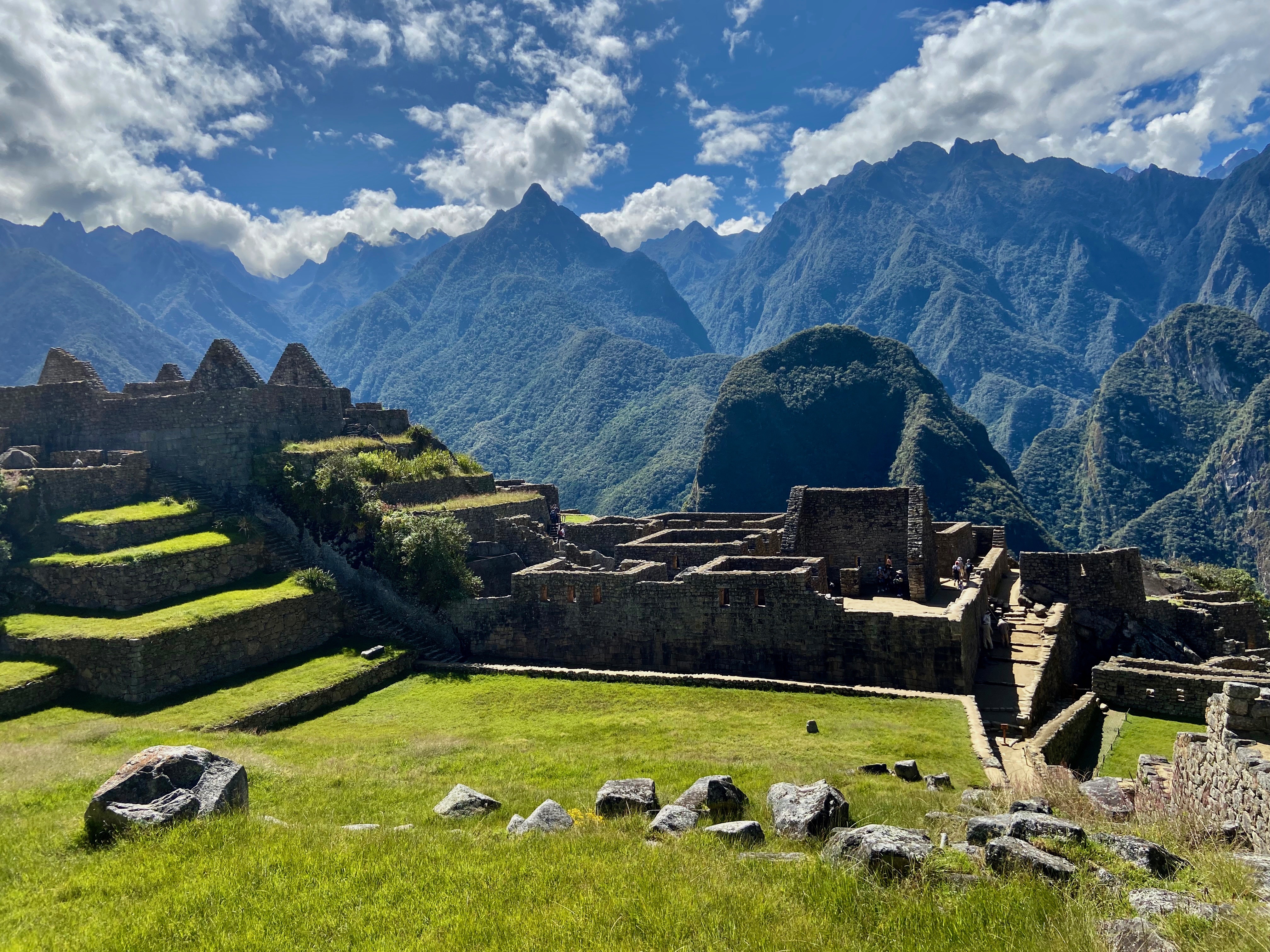
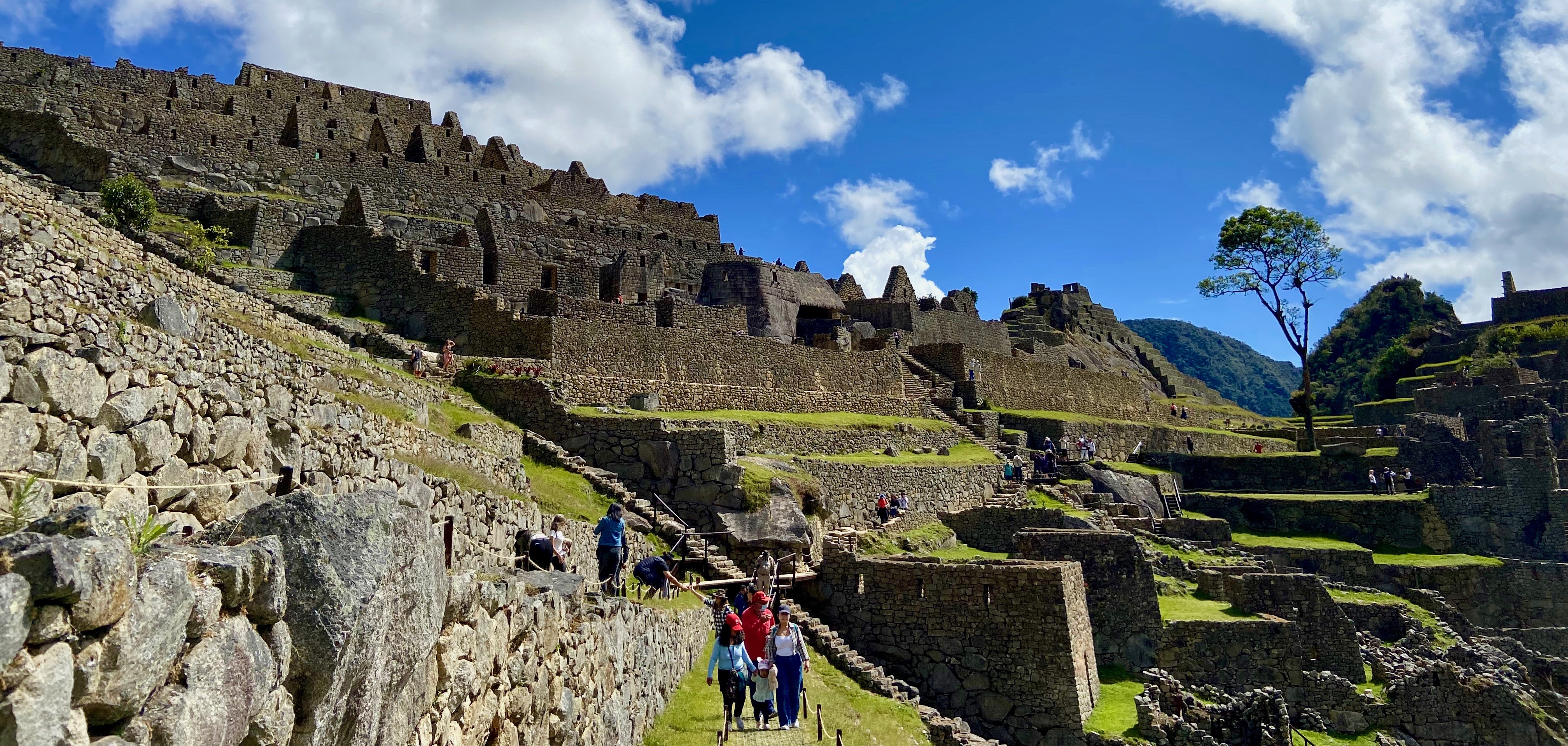
While we toured the lower route and got to into the temples and other structures, other members of our touring party took the upper route and got these iconic views of Machu Picchu. Photo by Phil Lichtenberger.
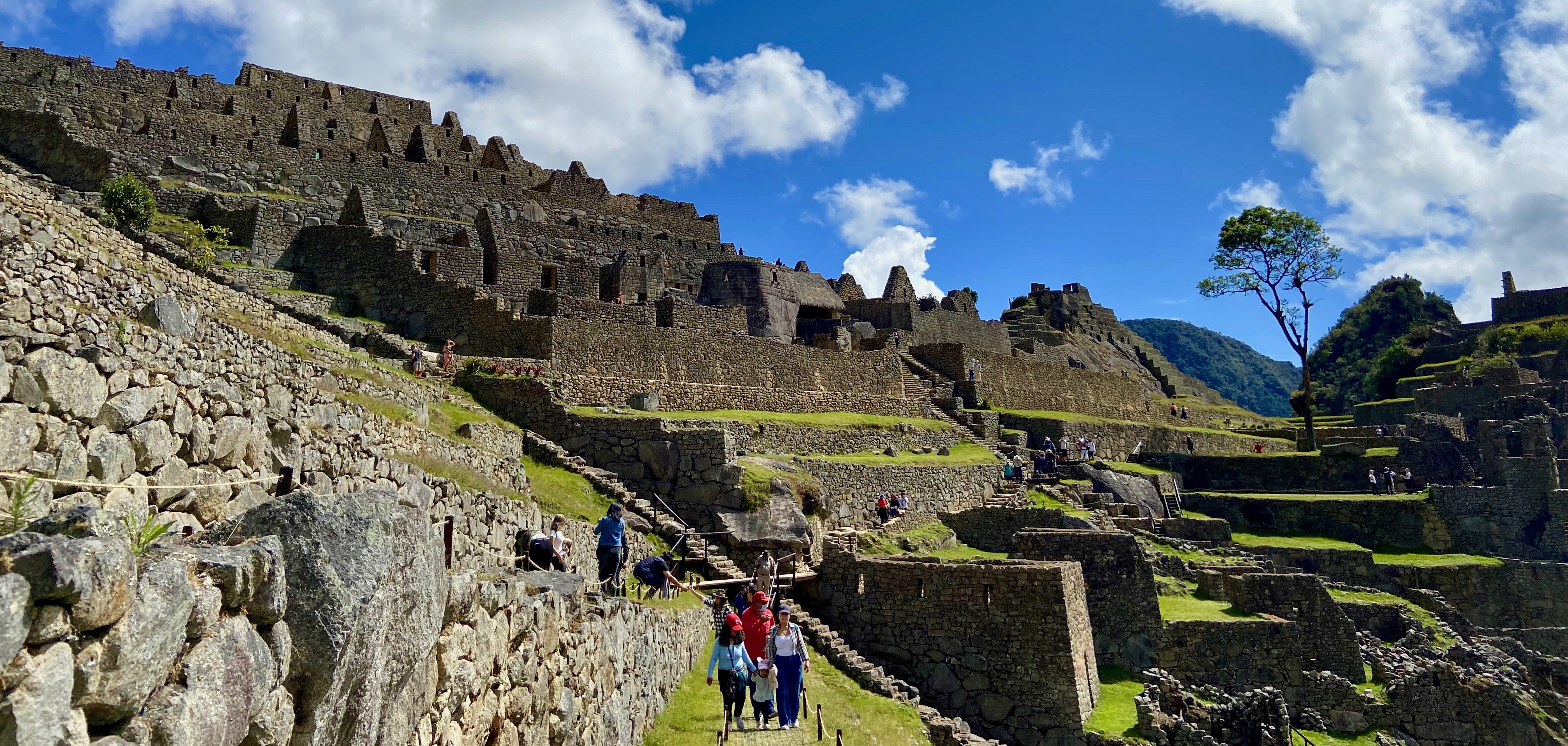
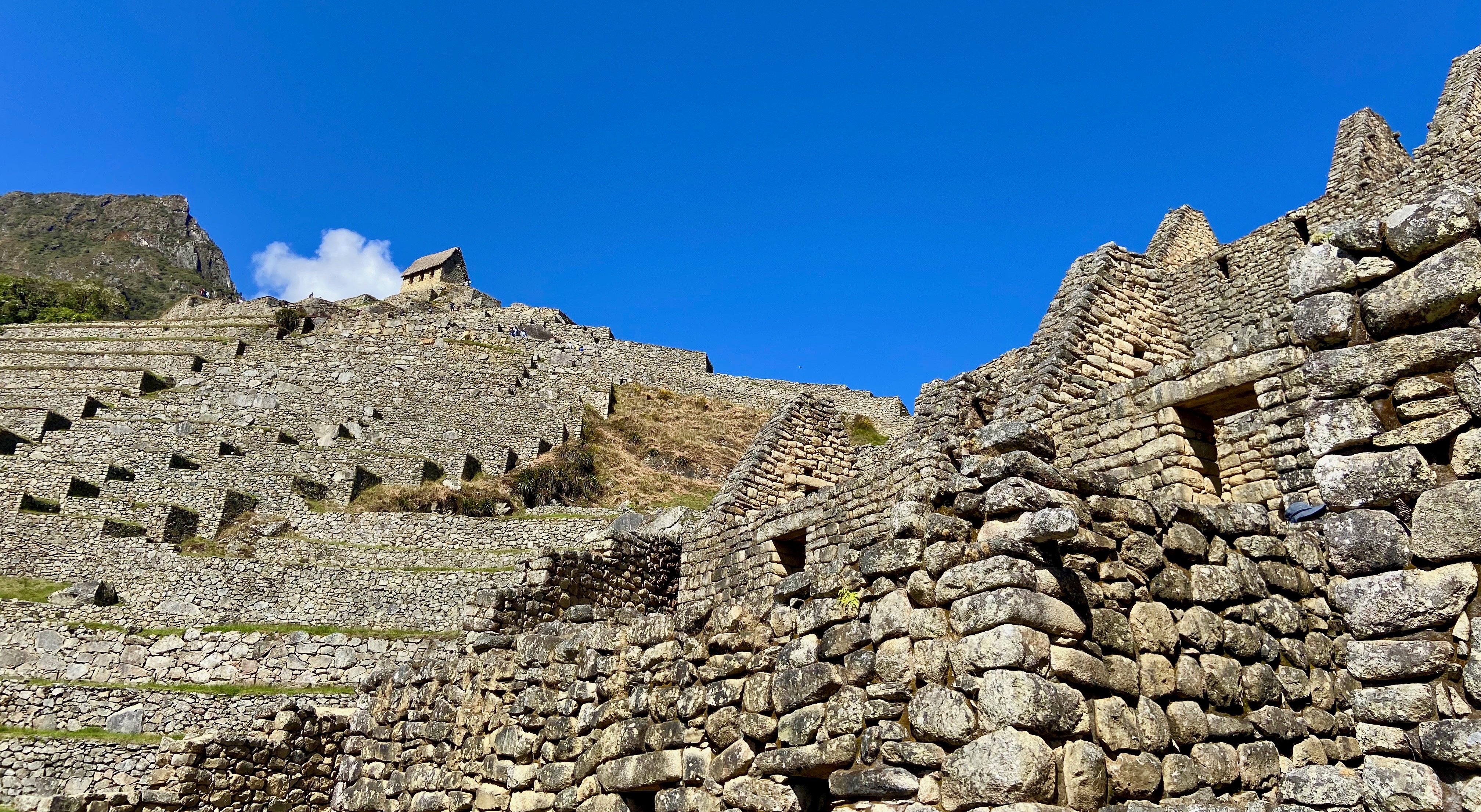
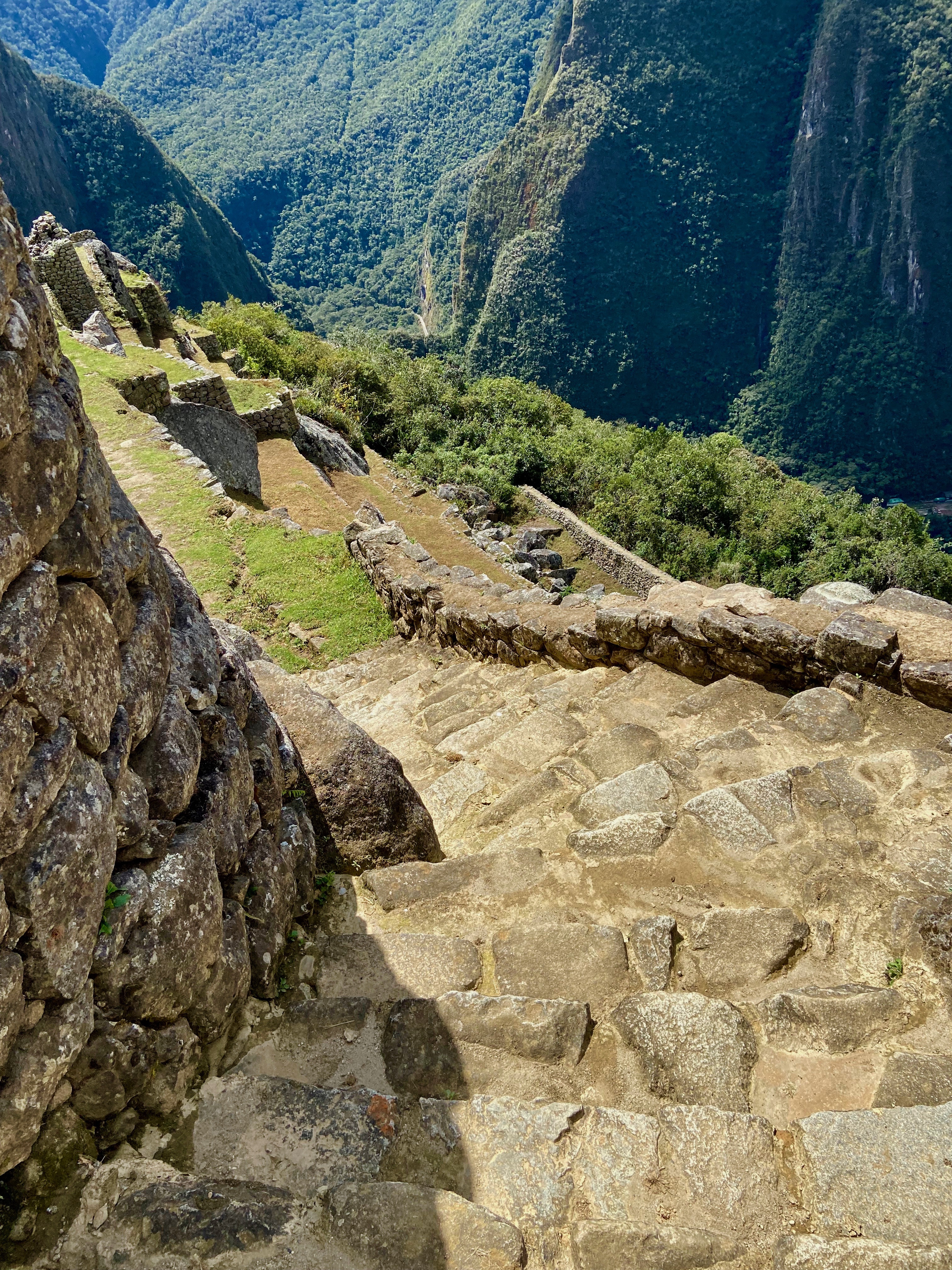
In 1983, Machu Picchu was declared a World Heritage Site by UNESCO. Today it is one of world’s favorite tourist destinations and after a closure for COVID has reopened to visitors. The only restrooms are outside the ruins. There is a small fee to use them. You can not reenter the citadel, so although water was recommended throughout our visit, I was afraid to drink much in case I needed to go to the toilet and then couldn’t come back in.You must tour Machu Picchu with a guide. Due to the size limitation for tour groups, our group was split into three. There are four routes: long upper route; short upper route; long lower route; short upper route. For ease, we are taking the long lower route which is also the one recommended for first time visitors. The iconic views we see in familiar photographs of Machu Picchu are taken from the upper route. The lower route offers you the opportunity to enter many of the structures.
We walked along side the amazing terracing we have come to associate with the Inca sites. Our first stop was the Temple of the Sun, (Temple du Soleil or “Torreon”) and the the Royal Tomb (Tombeau Royal) “Only priests and other high ranking Incas were likely [sic] only permitted access into the Temple of the Sun, one of the most sacred temples in all of Machu Picchu. Adapted to the natural environment, the unique semi-circular construction of the temple is built over an enormous granite rock and there’s a tower with a trapezoidal window. In this sacred temple, it’s believed that Incas worshipped their Sun God, Inti [sic]and may have served as a royal tomb.” machupicchu.org.
“A trapezoid window of the Temple of the Sun was positioned along its curved wall to capture sunlight during the winter solstice on June 21st…There is a natural cave under the Temple of the Sun, Originally, it was believed that this cave may have contained the remains of the Inca Pachacutec, but more recent studies indicate that the space was likely used to do ceremonies in honor of Mother Earth (Pachamama).” machupicchu.org
The next stop was what might have been the royal residence (Maison de l’Inca). You are able to tour this series of structures with amazing views, sources of water, and wonderful acoustics. The Incas truly were early masters of architecture.
After viewing the residences, we went on to see the Sacred Rock, Wank’a in Quechua. The Rock resembles the mountains behind it. The spot was a shine and a place of rituals and offerings to the earth. The spot also afforded us our best view of the high point of Huayna Picchu, the mountain seen in all the iconic pictures of Machu Picchu and arguably the best spot to get a photograph of the citadel ruins. The ruins sit on a lower point of the mountain. You can climb to the top of Huayna Picchu, but you must make reservations very early. Only 650 people are allowed to climb Huayna Picchu each day.
After circling behind the Sacred Rock, we went to visit some of the lower structures and the Temple of the Condor. “The Temple of the Condor in Machu Picchu is a breathtaking example of Inca stonemasonry. A natural rock formation began to take shape millions of years ago and the Inca skillfully shaped the rock into the outspread wings of a condor in flight. On the floor of the temple is a rock carved in the shape of the condor’s head and neck feathers, completing the figure of a three-dimensional bird. Historians speculate that the head of the condor was used as a sacrificial altar. Under the temple is a small cave that contained a mummy.” Peru.com
Temple of the Condor, Machu Picchu. Photo by Leslie and Carmen Sharp
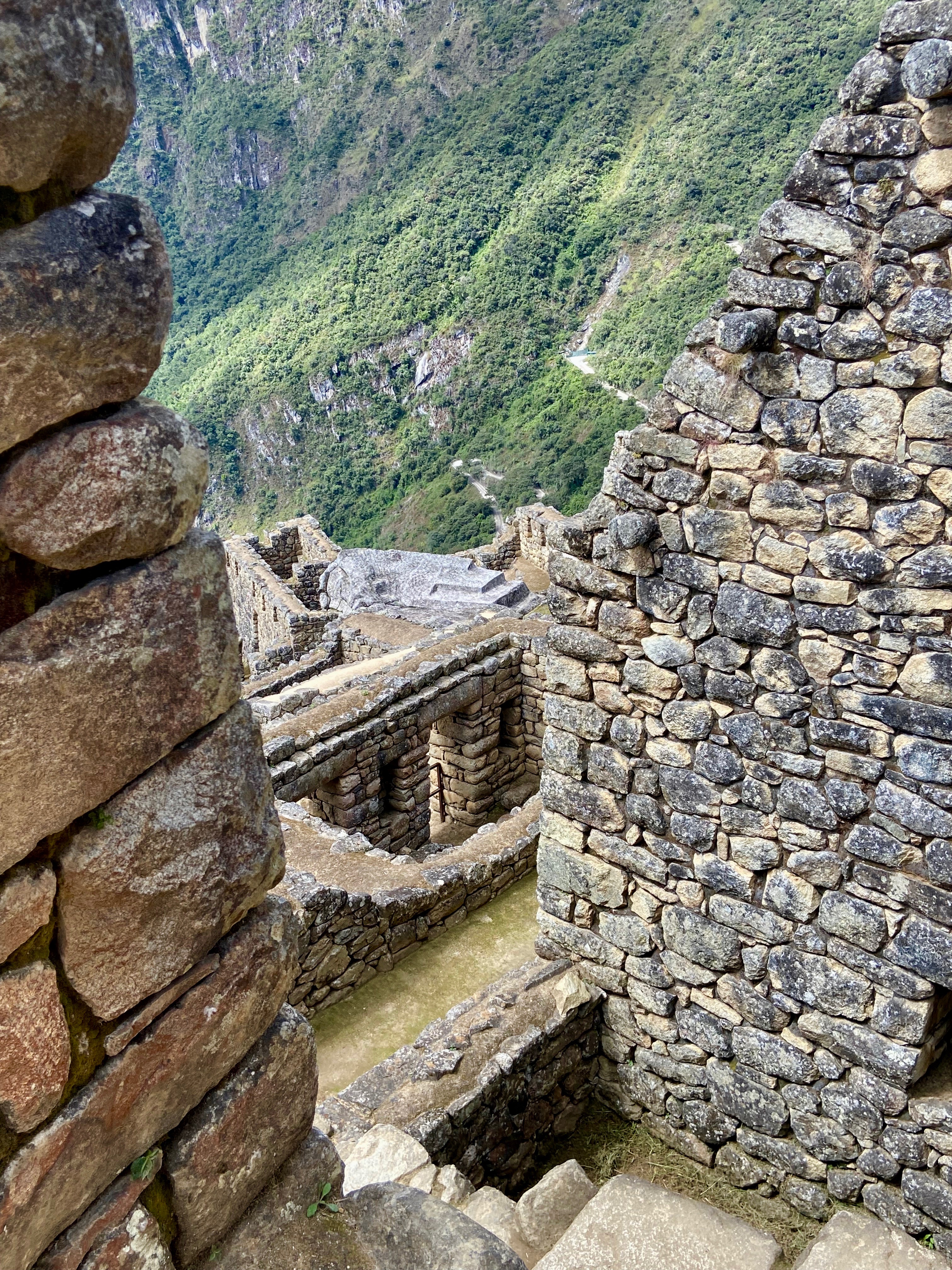
The lower structures offered us terrific views of the hilltops, canyons, and valleys below. We could also look across and see the sun gate where hikers on the Inca Trail enter the historic site.
The site was totally deserving of its number one designation on my bucket list. I would encourage everyone to visit this true wonder of the world. –Natasha
Looking a little worse for the wear, Boris and Natasha complete their visit to Machu Picchu. Photo by Carlos Alvarez.
We woke up in our gorgeous hotel in the Sacred Valley in the Andes Mountains of Peru ready to start the next phase of our Peruvian adventure, discovering the sites of the ancient Inca culture. Late this afternoon we will take the train to Machu Picchu which we will visit tomorrow. After breakfast we headed out for Moray.
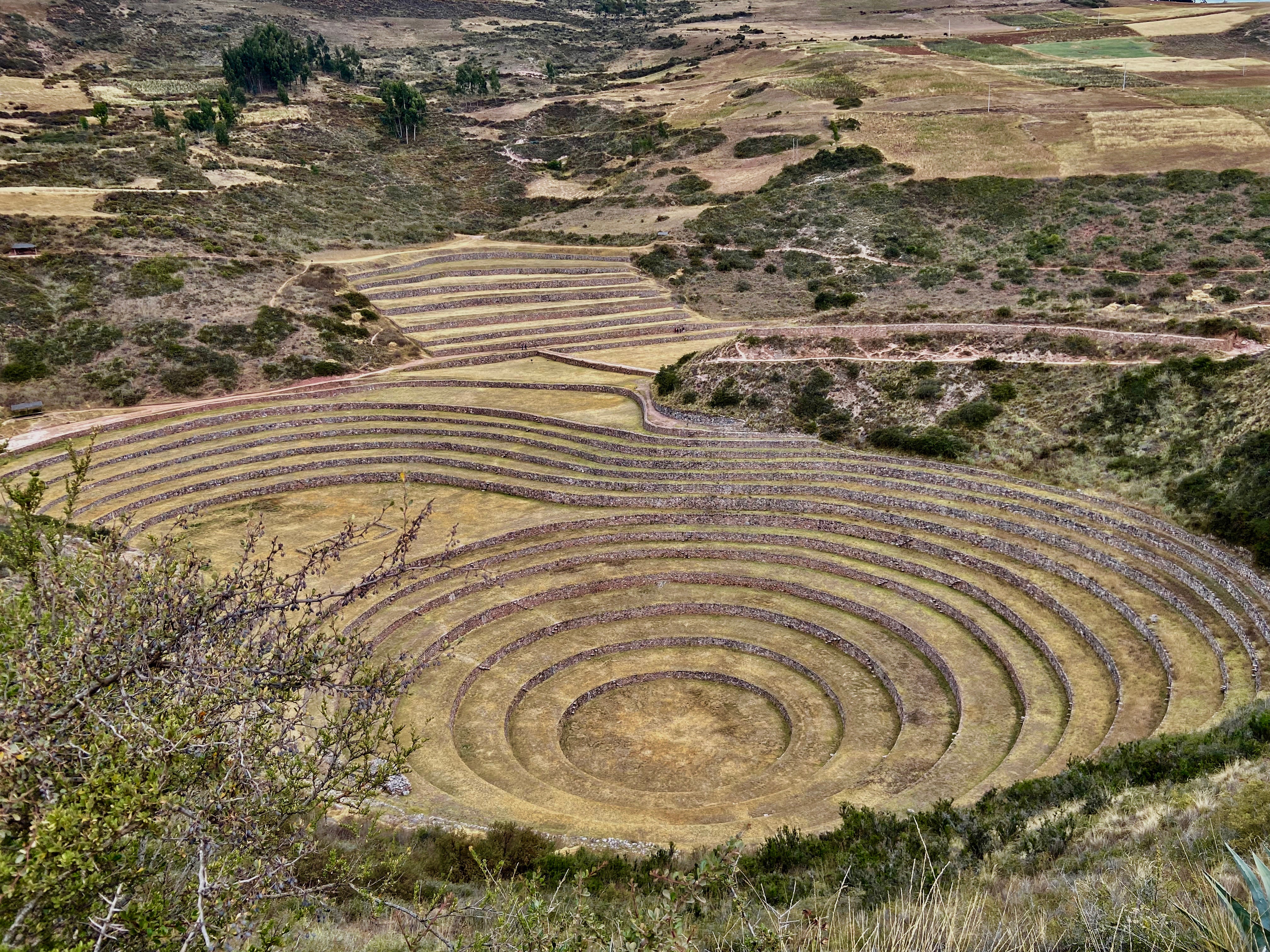
At 11,500 feet and sitting just west of the village of Maras, is the Inca ruin Moray. The site contains a series of terraced circular depressions. The largest depression is 98 feet deep. Significantly, the temperature difference between the top of the highest terrance to the bottom of the lowest can be as much as 27 degrees F. The Incas were ancient masters of design. Their ruins are architectural marvels and their understanding of orientation, the wind, and the sun was excellent.
The purpose of the Inca depressions at Moray is not certain. The Incas had no written language so there are no ancient texts to consult. It has been suggested that the terraces at Moray were designed for agricultural purposes, an amphitheater for ceremonies and celebrations, a quarry that was retrofitted after mining was complete, or were even the site of an extraterrestrial landing. The most widely accepted theory was that the area was experimental terraced farming with various microclimates at the differing levels given the temperature differences and the sun hitting specific sections at varying times of the day. The Incas developed a series of channels that fed water to the terraces from high in the mountains. It has been suggested that they used the knowledge gained from the experimental production to develop farming techniques for the varying landscape of their empire.
Excavation of the site “suggests that the bottom six terraces may have been built by a culture predating the Incas. Presumably, the Wari culture who thrived from the 6th – 10th century.” Peruforless.com. What we see today was created by the Incas between the 12th and 14 centuries. The farmers who live is this area have always known about the ruins, but it wasn’t until the 1930s that the terracing at Moray came to the attention of western cultures. Since the 1970’s the areas has served as a tourist attraction.
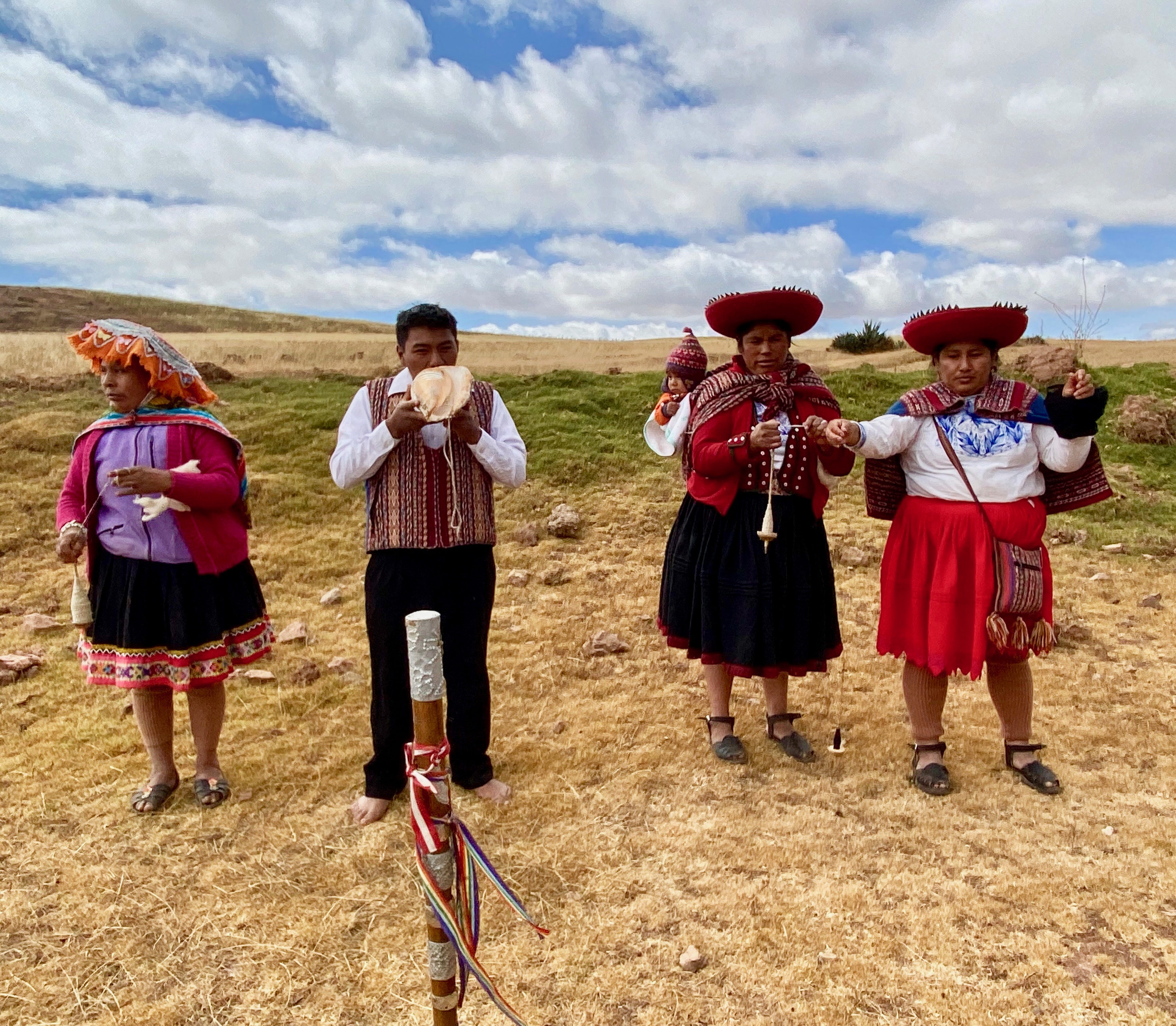
We will see more ruins today, but our next stop was a little different. We are visiting local weavers for a demonstration and the opportunity to purchase the artisan crafts. This is llama and alpaca country and their fur is what serves as the base for the local textiles. We were greeted by the mayor-his ceremonial stick present during the demonstration-and the women who make these beautiful products. They were dressed in traditional costumes. The difference in headwear showed us that one of the women was from a different community.
Carlos started with an introduction and a translation, but then one of the woman surprised us by speaking beautiful accented English. Even joking with us in English. During the demonstration we saw how they clean the fur, derive color from the natural products, and weave the cloth. They used different looms to create the various items, some very colorful and some in the natural color of the alpaca fur.
They showed us how many of the products served multiple functions from table linens to personal garments. One of the most interesting was an almost square piece of cloth that was used to carry a baby or small child. The little boy who was “volunteered” for the demonstration on how to fold the cloth was adorable, especially when he got a break and was given a cookie. We were never sure which of the women was the mother. They all held him at some point during the demonstration. I also admired the beautiful pom poms the women wore in their braids which traditionally would have indicated what community they were from. When the two braids are loose the woman is unmarried. She wears the two braids bound together after she marries.
We are traveling around the Sacred Valley of the Incas in the Andes Mountains just north of Cuzco, the ancient capital of the Incas. The area is also known as the Urubamba Valley, coming from the name of the Urubamba River that flows through it. Today this is agricultural land, villages, and ruins from the Inca civilization. Our guide Harvey will tell you that the Spanish Conquistadores did not conquer the Incas, although they did steal their treasures and abuse and enslave their people. Harvey is of Incan decent. You can see it in his size (smaller stature) and his features. It is his belief that the Incas are alive and well today and in many ways tricked their Spanish invaders into thinking they had adopted their religion and culture. He promised us more examples when we tour Cuzco.
“The Cusco region attracts around 1.8 million visitors annually, many of whom are on their way to visit Machu Picchu. The iconic royal retreat is the best-known tangible remnant of the Inca Empire, which arose out of the Andean Plateau near Cusco and grew to encompass most of the Andean highlands. The Sacred Valley of the Incas envelops a fertile agricultural and cultural landscape, punctuated by small villages of Quechua-speaking communities and dotted with the surviving remains of great Inca family estates.” World Monument Fund.
We drove through the Sacred Valley, crossing back and forth over the river. We saw the “cabins” on the mountainside that you can stay in; you have to repel in. Fascinating, but not in my wheelhouse. Our next stop is the village of Ollantaytambo where we will visit a traditional house, tour the famous ruins, and later today board the train to Machu Picchu. In the mid 15th Century, Ollantaytambo was part of the personal estate of the Inca emperor Pachacuti. Here the emperor built lodging for the Inca nobility and terraces and irrigation systems for support. Later when the Spanish would raid the region, Ollantaytambo served as the temporary capital of the native resistance against the Spanish Conquistadors.
The Sacred Valley village of Ollantaytambo is “set on the Urubamba River amid snow-capped mountains. It’s known for the Ollantaytambo ruins, a massive Inca fortress with large stone terraces on a hillside. Major sites within the complex include the huge Sun Temple and the Princess Baths fountain. The village’s old town is an Inca-era grid of cobblestoned streets and adobe buildings.” Google
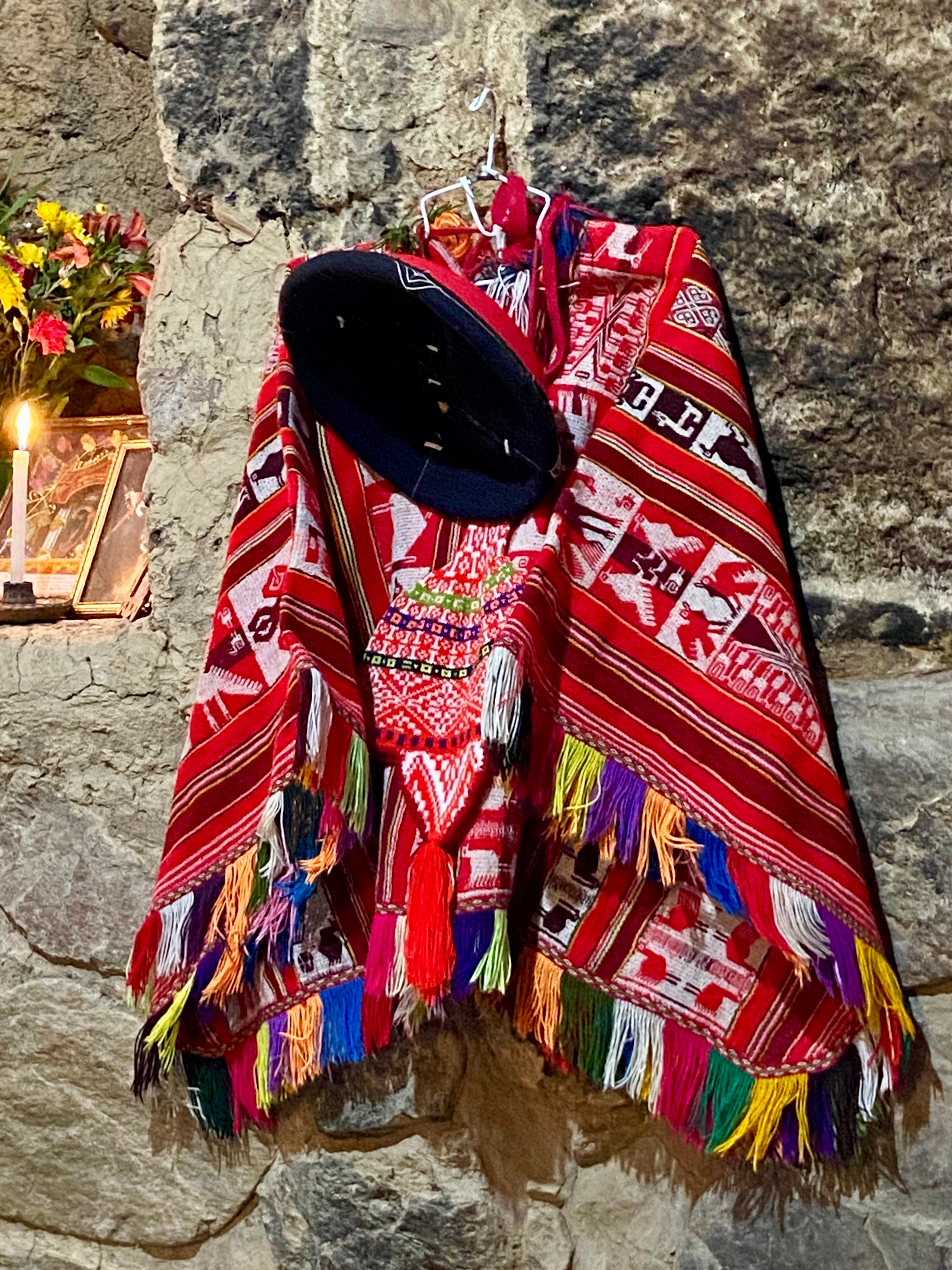
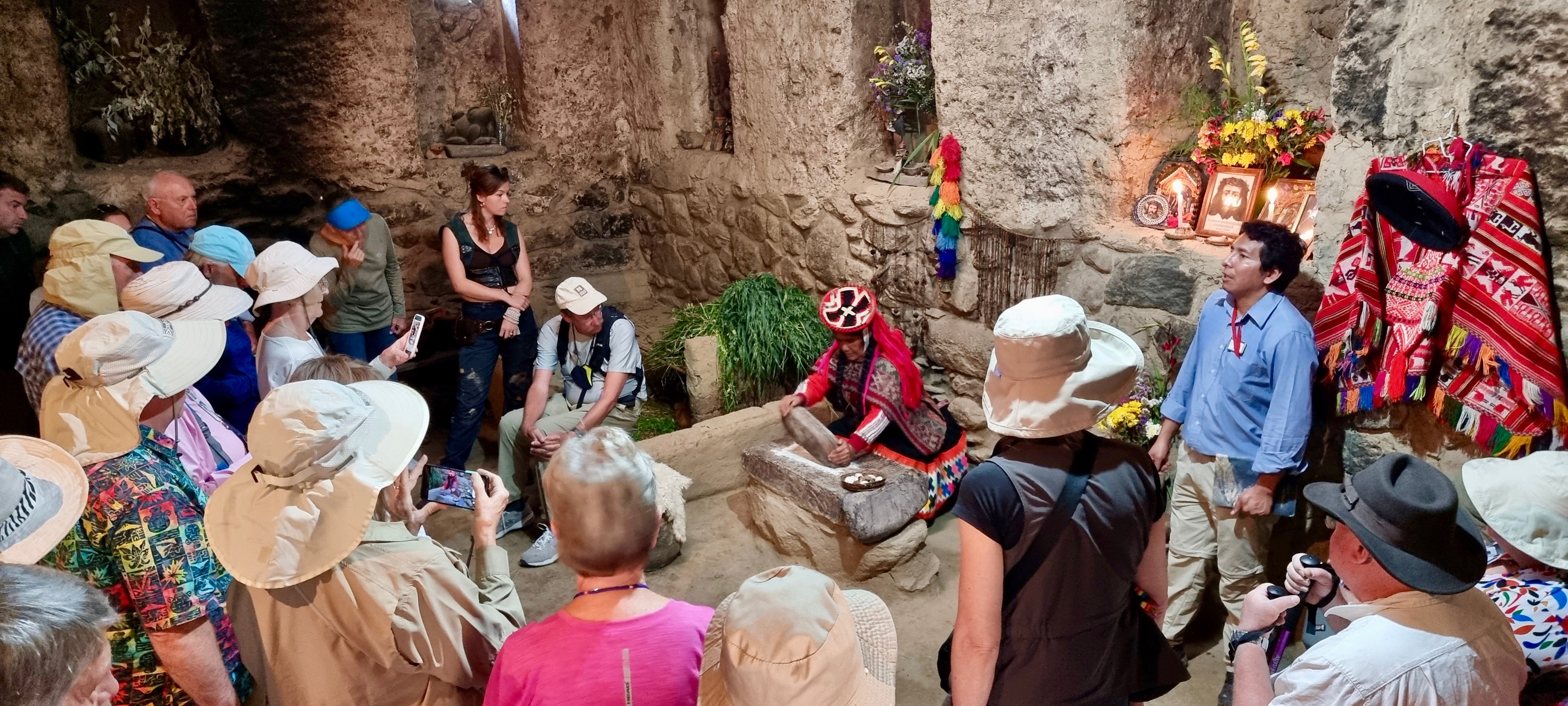
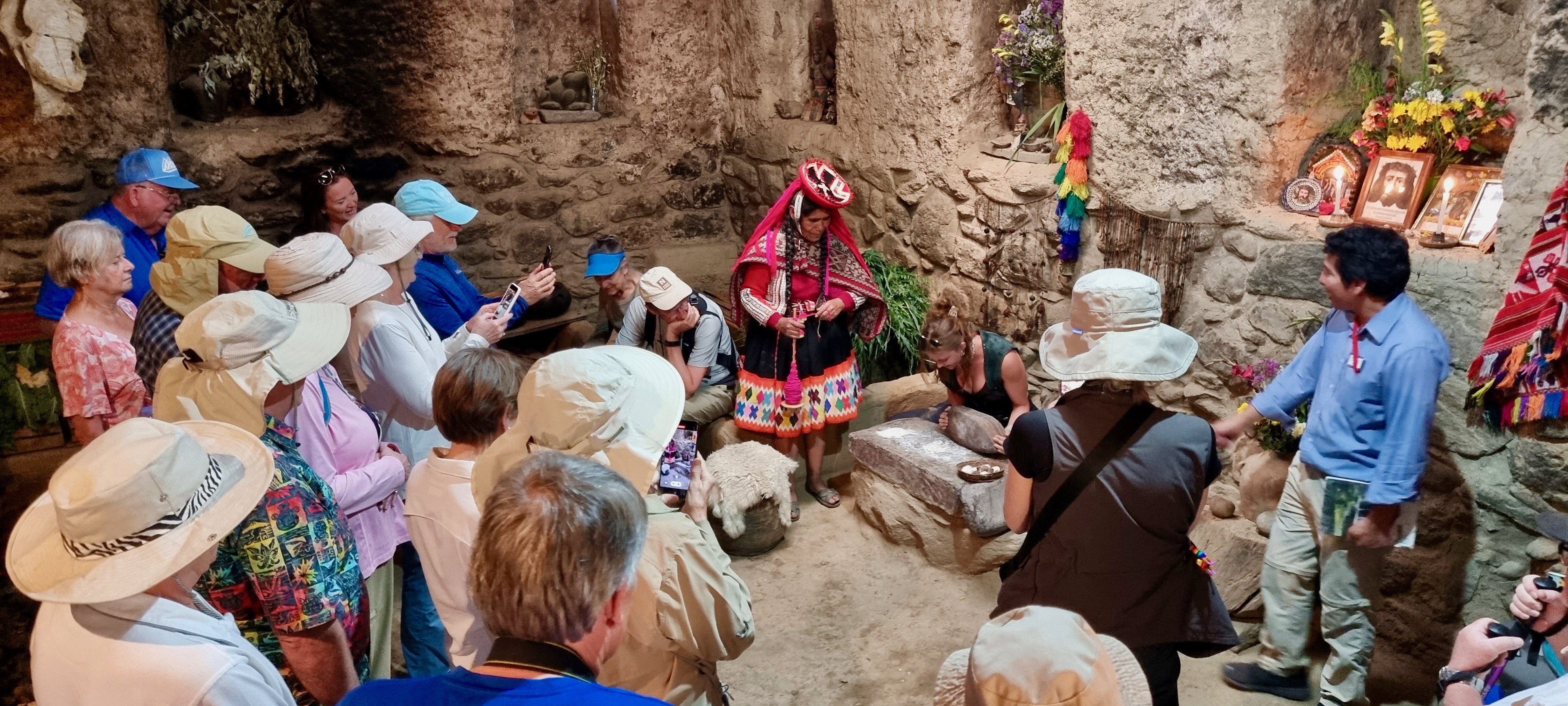
Our first stop in the village was a traditional home where we were welcomed by the owner. We entered through a courtyard and went down steps into a large room. There was a hayloft, but otherwise the home was a single room with sections dedicated to specific functions. Alpaca skins lined the benches of the table as cushions, small altars were set up around the room, native clothing was hung as a display, and colorful textiles were folded on the end of the bed.
Harvey gave us an introduction to the various sections of the room and introduced the owner who gave us a demonstration on how grain was hand-milled. Grace was given a chance to try it and confirmed it was hard work. On of the corners of the room was a short walled sections that served as a pen for guinea pigs. They are not kept as pets. Guinea pig is considered a delicacy in Peru. One guinea pig serves as a meal for two persons.
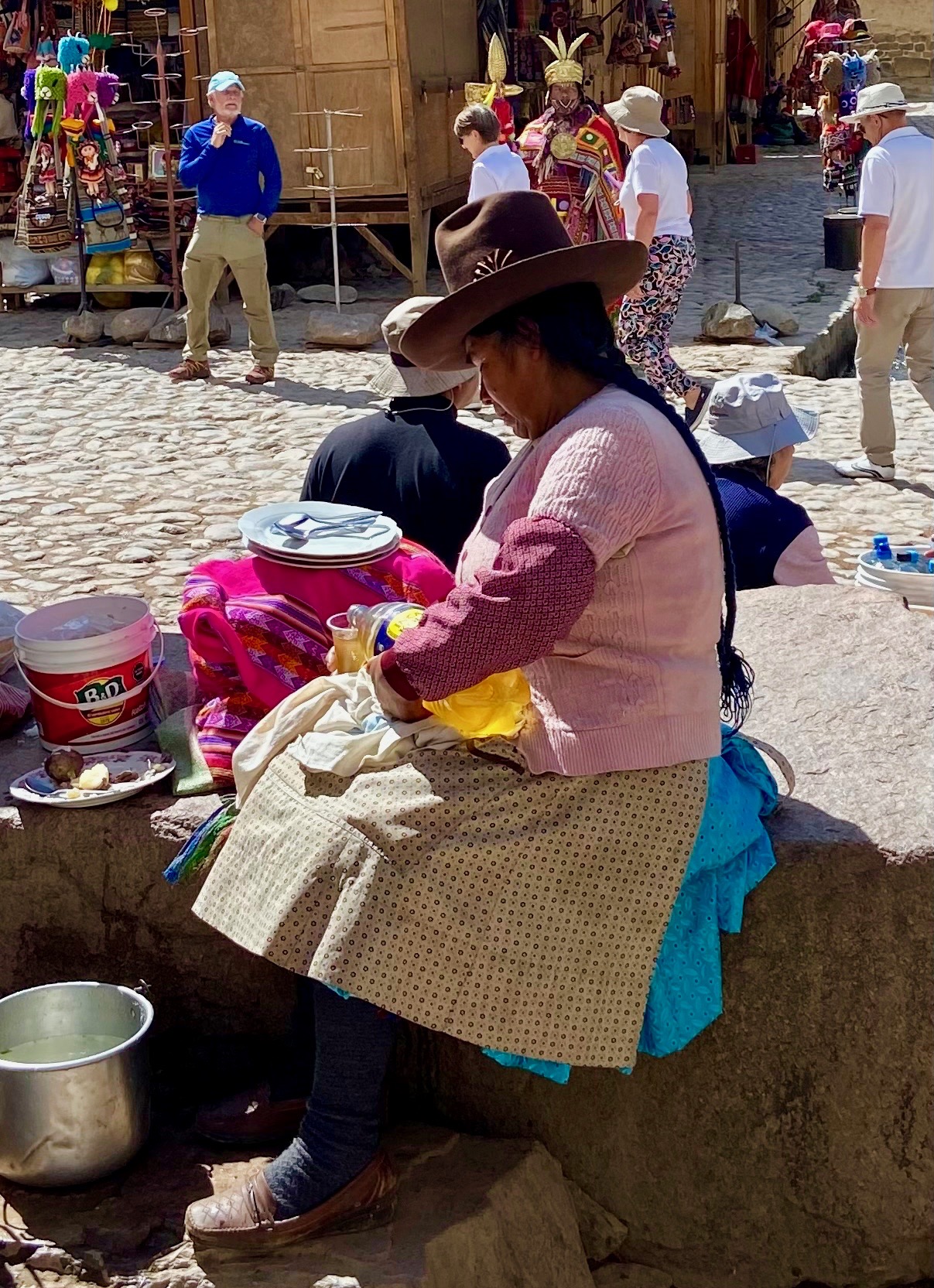
After the home tour, we headed over to the ruins. There was a market place set up right next to the ruins entrance. Ollantaytambo has a thriving tourist industry. People come here to glimpse a traditional way of life, the colorful native dress, the beauty of the Andes, the spectacular ruins of the Inca Empire, and as a jumping off point for the train up to Machu Picchu and the Inca Trail. Just like in other tourist destinations, there is someone dressed up for a photo op. For a small fee, you can have have your picture taken with an Inca Emperor, although this one is wearing a face mask due to COVID restrictions. The hot items to buy here are anything with coca leaves or walking sticks. Boris brought some walking sticks from home, but I picked up a pair for $20 that I will use tomorrow at Machu Picchu.
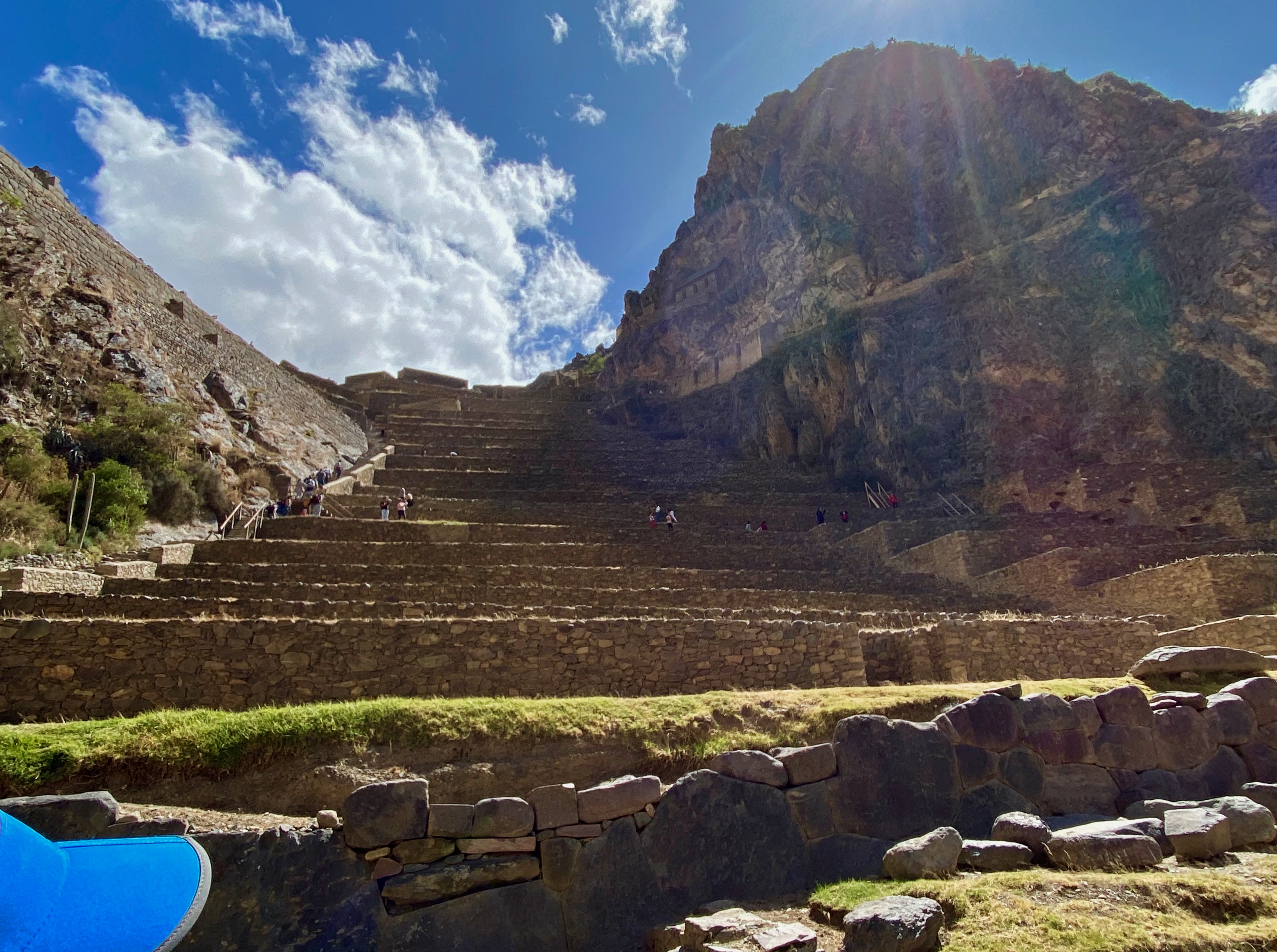
After entering the archaeological site, Harvey gave us an orientation as we looked up at the temple steps. It was very windy and dry (a far cry from the still, humid rainforests of last week on the Amazon), and we had to look away to keep the grit out of our eyes. On “a steep hill…the Incas built a ceremonial center. The part of the hill facing the town is occupied by the terraces of Pumatallis, framed on both flanks by rock outcrops. Due to impressive character of these terraces, the Temple Hill is commonly known as the Fortress, but this is a misnomer, as the main functions of this site were religious.” Wikipedia
With very limited time and a desire to save my strength for tomorrow’s visit to Machu Picchu, I decided not to make the 30 minute hike up and down the temple steps. A few members of our group made the trek and the rest of us took pictures and then headed over to the fountain bath of the princess.
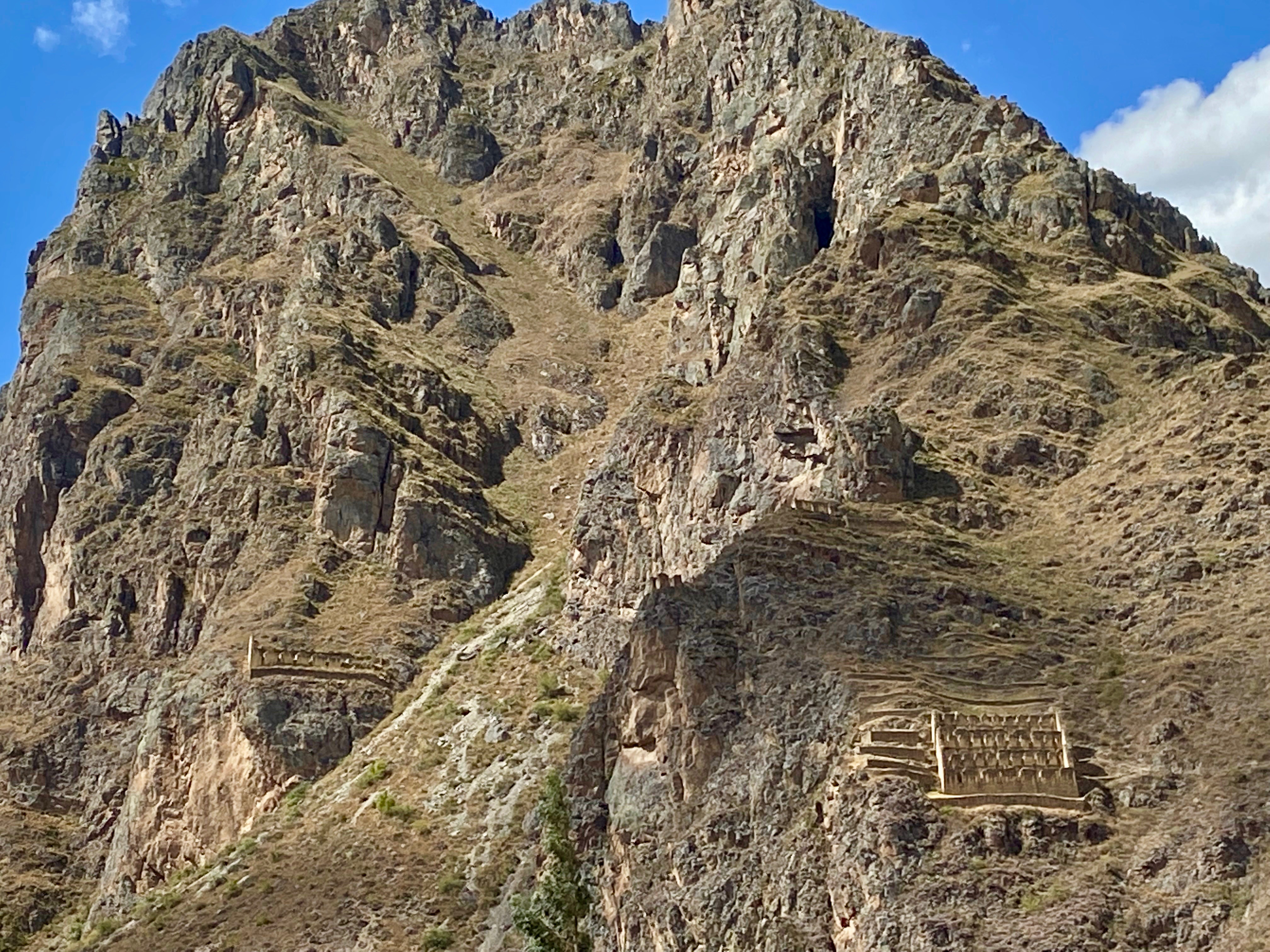
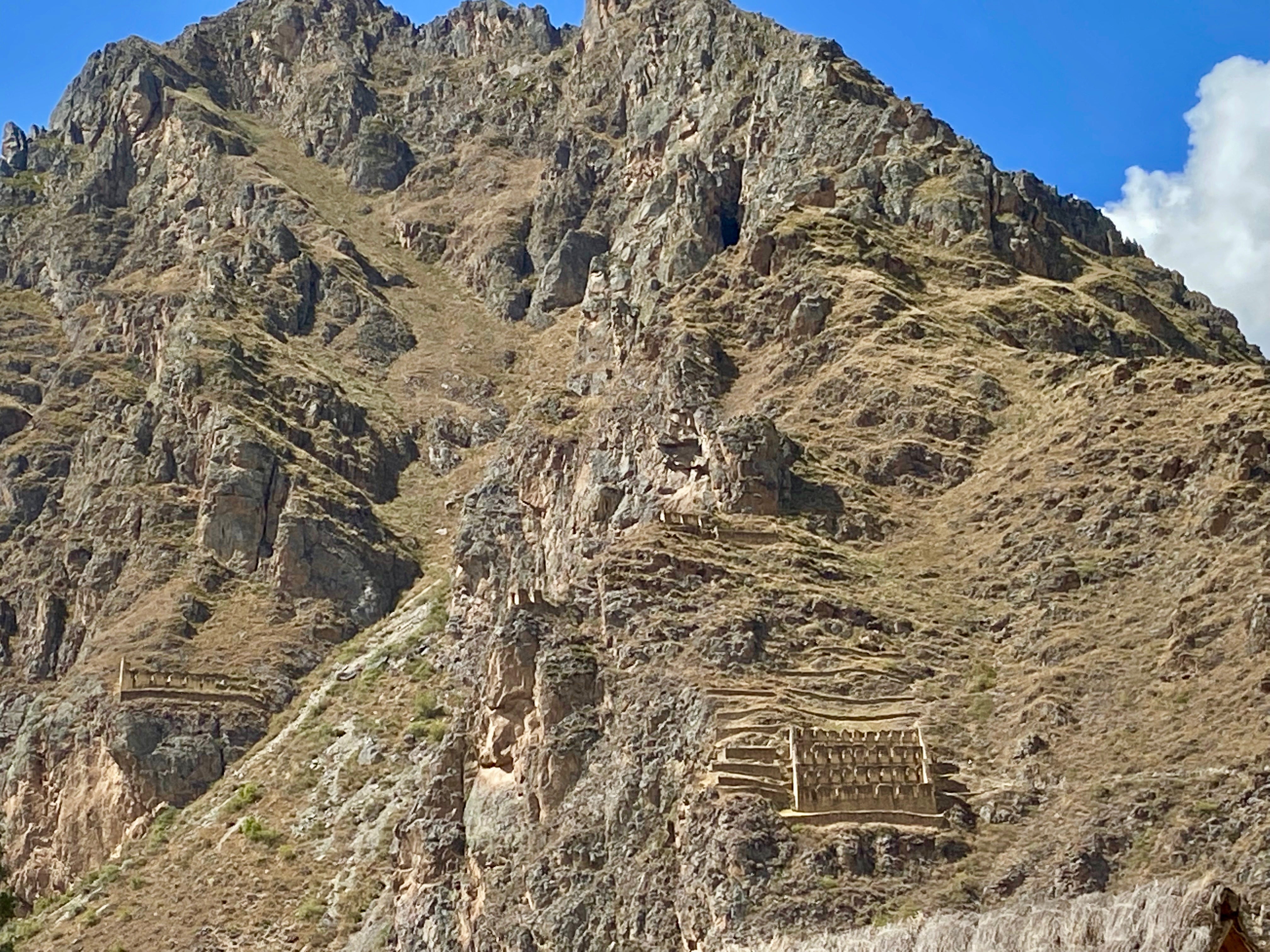
Walking toward the fountain, we could look up and across and see the wonderful storehouses with their unique ventilation system set in the hillsides of Ollantaytambo. Because the storehouses were located high in the neighboring hills where there is more wind and lower temperatures, the contents could more easily be defended against decay. While Harvey was describing the bath of the princess at the base of the ruins, the fastest trekker, Joe, arrived to celebrate his victory. Ah to be 20! It is his, and his twin Grace’s, birthday today. Just when we thought it couldn’t get better, Per arrived to celebrate his half climb. Got to give him his due as well.
We had to hurry out to the bus and a few people got caught up in the shopping, but it was time to finally head to lunch. That’s right, everything that I just described was from the first half of our day. Rather than try to find a place to accommodate our large group for a “midday” meal, we are going for a picnic lunch. I had envisioned box lunches at a park, but Carlos reminded me that this is Uniworld.
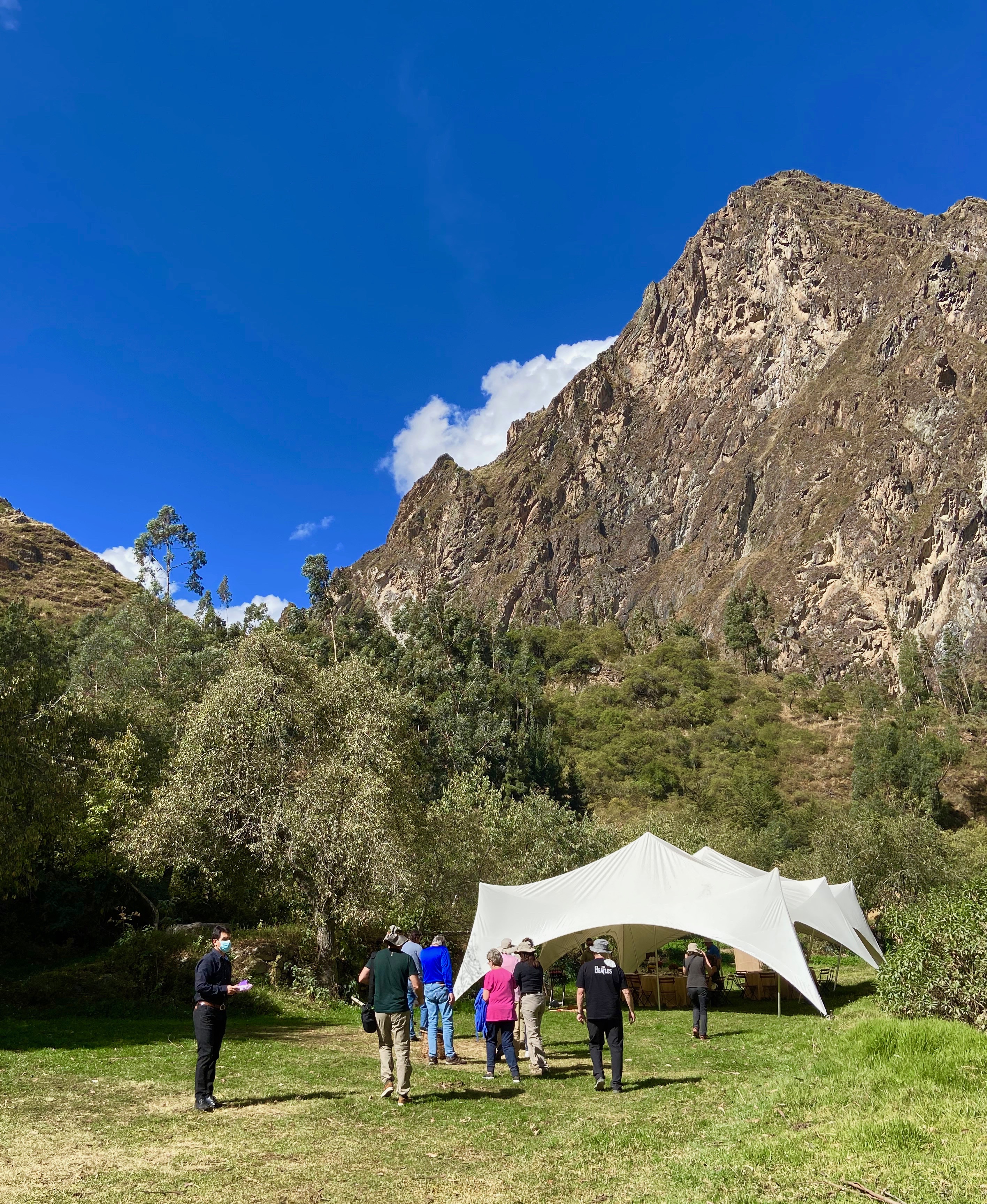
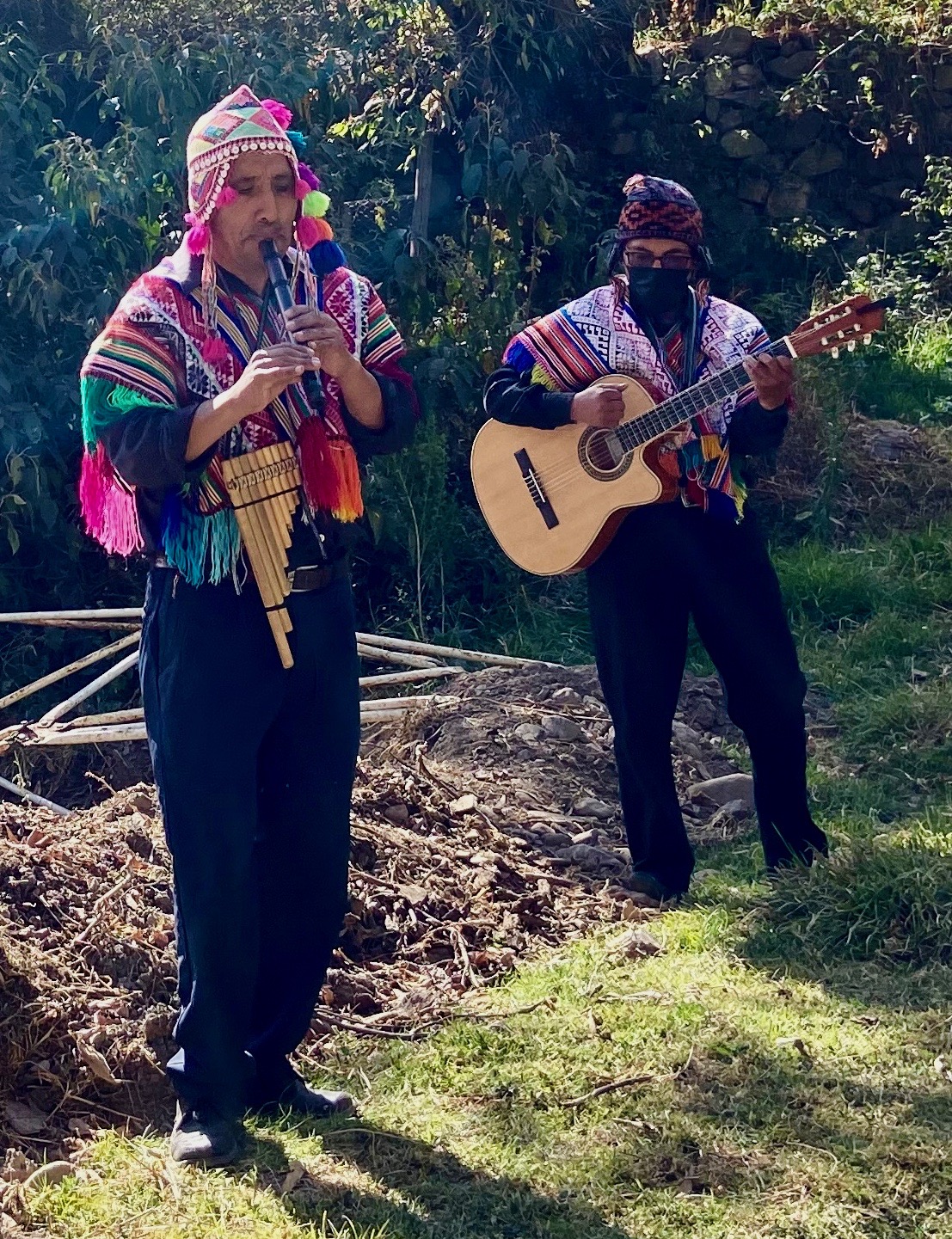
We went to a open field near town where gorgeous tents had been set up for a lunch with multiple courses with perhaps the best steak I have ever had and I’m from Texas. We were entertained by musicians on traditional Peruvian instruments including the pan flute. Then we were each given a pan flute as a souvenir and had a lesson in playing it. I was terrible. The video of the group attempt is hysterical.
Today we transition from the river cruise portion of our trip to our journey of discovery related to the ancient Incas. We will disembark the Amazon Aria today, fly first to Lima, and then on to Cuzco to do a little altitude adjustment.
Our Amazon Aria Naturalists. From left to right, Ricardo, Julio, Billy, and Roland.
There was breakfast and then our luggage had to be outside our rooms by 9:15 am. That still gave us time to relax until 10:30 am when we would disembark the Aria and head to shore on our last skiff ride. We cruised back and forth a bit on the Aria since we obviously arrived in Iquitos early. I will be terribly sad to leave our naturalists behind. All four are different and yet I feel like I made a connection with each of them. From the beginning with Roland…the hand holding with Ricardo (he kept me steady)…the animal encounters with Billy…to the laughter with Julio. They are amazing individuals.
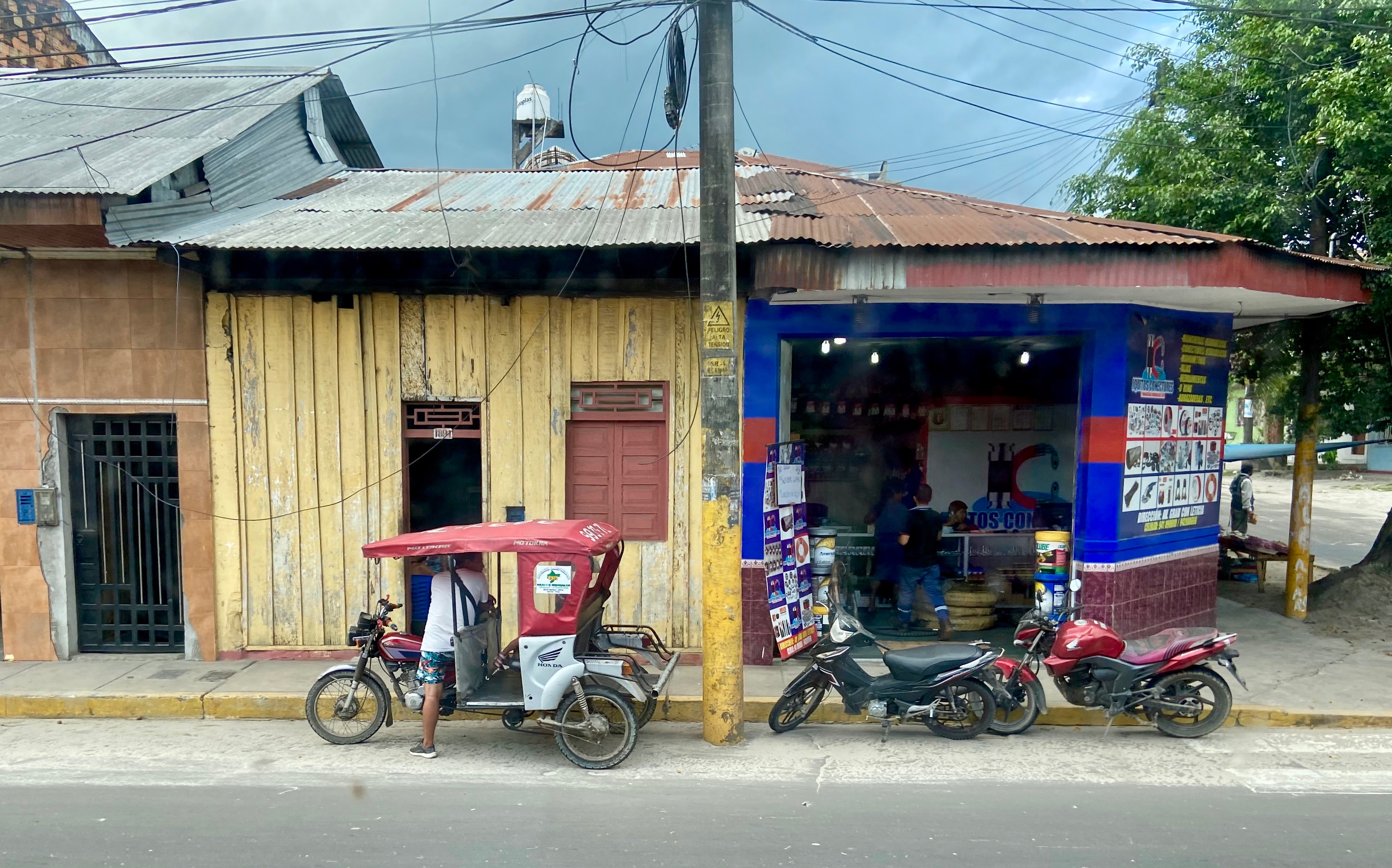
We saw a lot of the tuk tuks (local taxi powered by a motorcycle) around the city. There were also lots of motorcycles. Honda has a motorcycle production facility near Iquitos. The cost of purchasing the cycles for the locals has come down dramatically. Many families purchased them during the pandemic as a means of making additional money by providing transportation or delivery. Tourism is a key component of the Iquitos economy. When I asked Billy if the people suffered due to the lack of tourism during the pandemic, he said it was not as bad as it was in other areas as the people of the Amazon are self-sustaining. They grow or catch their own food as a normal way of life.
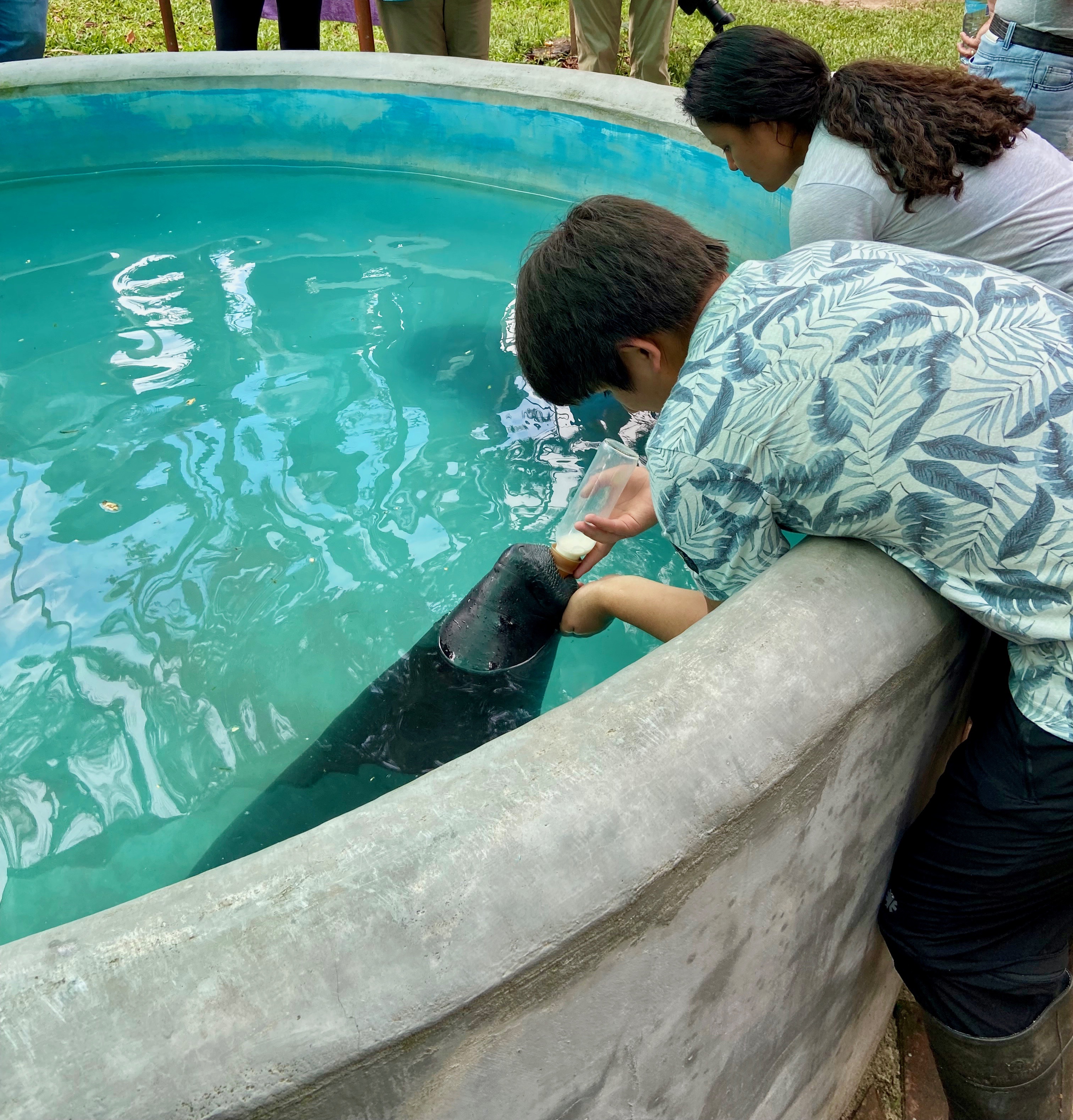
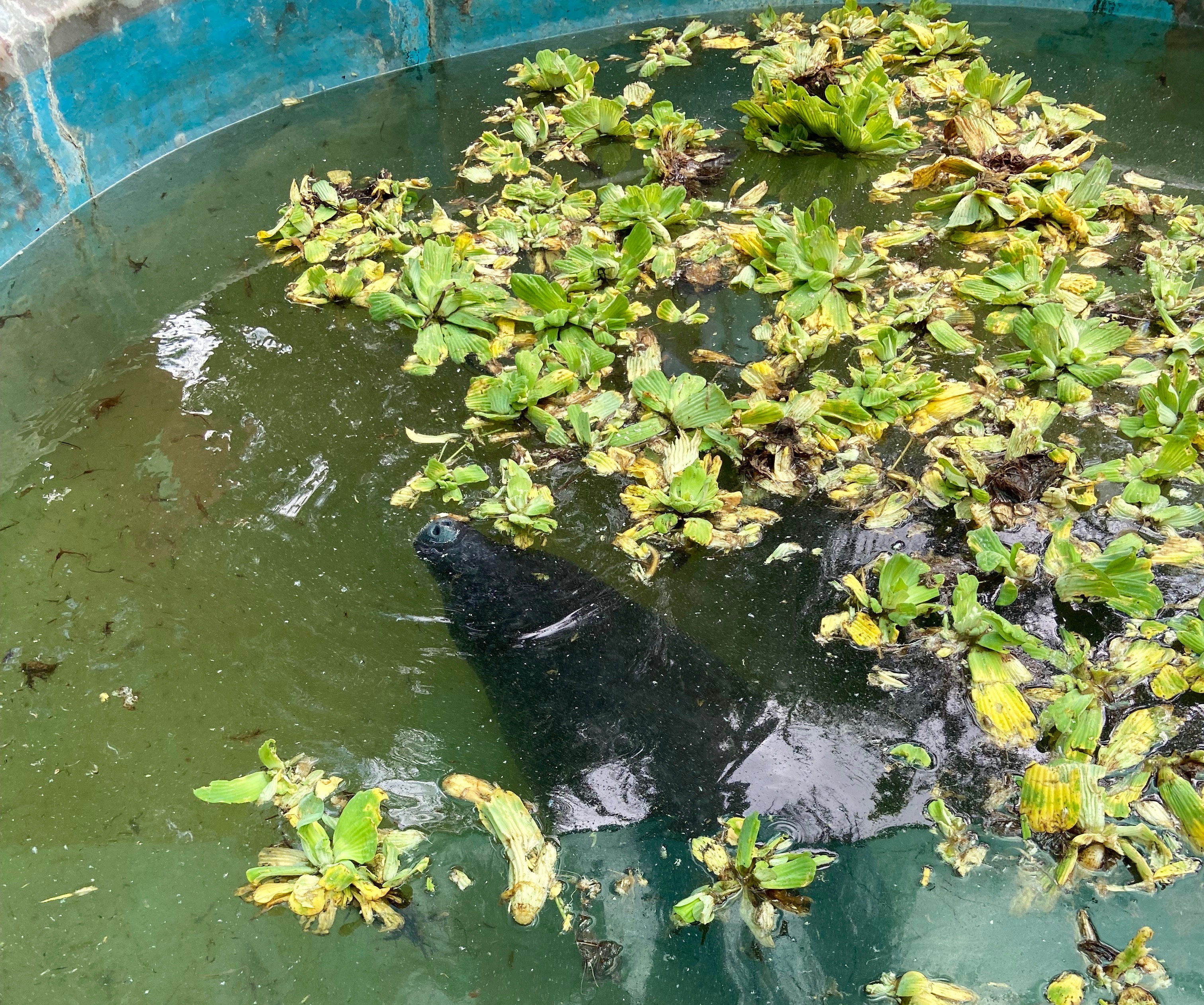
Once ashore, we boarded a bus for the ride through town to the manatee rescue center. Manatees are endangered and this is one of the places trying to make a difference in the population. There are several different tanks, from the clear one with the juveniles to the older ones where you see the water beginning to look a lot more like the muddy waters of the Amazon. The really small ones were more lethargic. The largest one of the three really liked to swim around and the guide told us that even he was rather listless when he first came to the center. What a difference three months makes!
The manatees’ habitat is shrinking and they sometimes are injured by the motors on the canoes that once were only propelled by human strength applied to a wooden paddle. The greatest threat to the manatees is that they have always been a source of food for the Amazonian people. With the shrinking rainforest and fewer animals, the gentle manatee has become the easier prey and their population is decreasing. The baby manatees the Amazon Rescue Center rehabilitates are often orphans left to fend for themselves or sold on the black market.
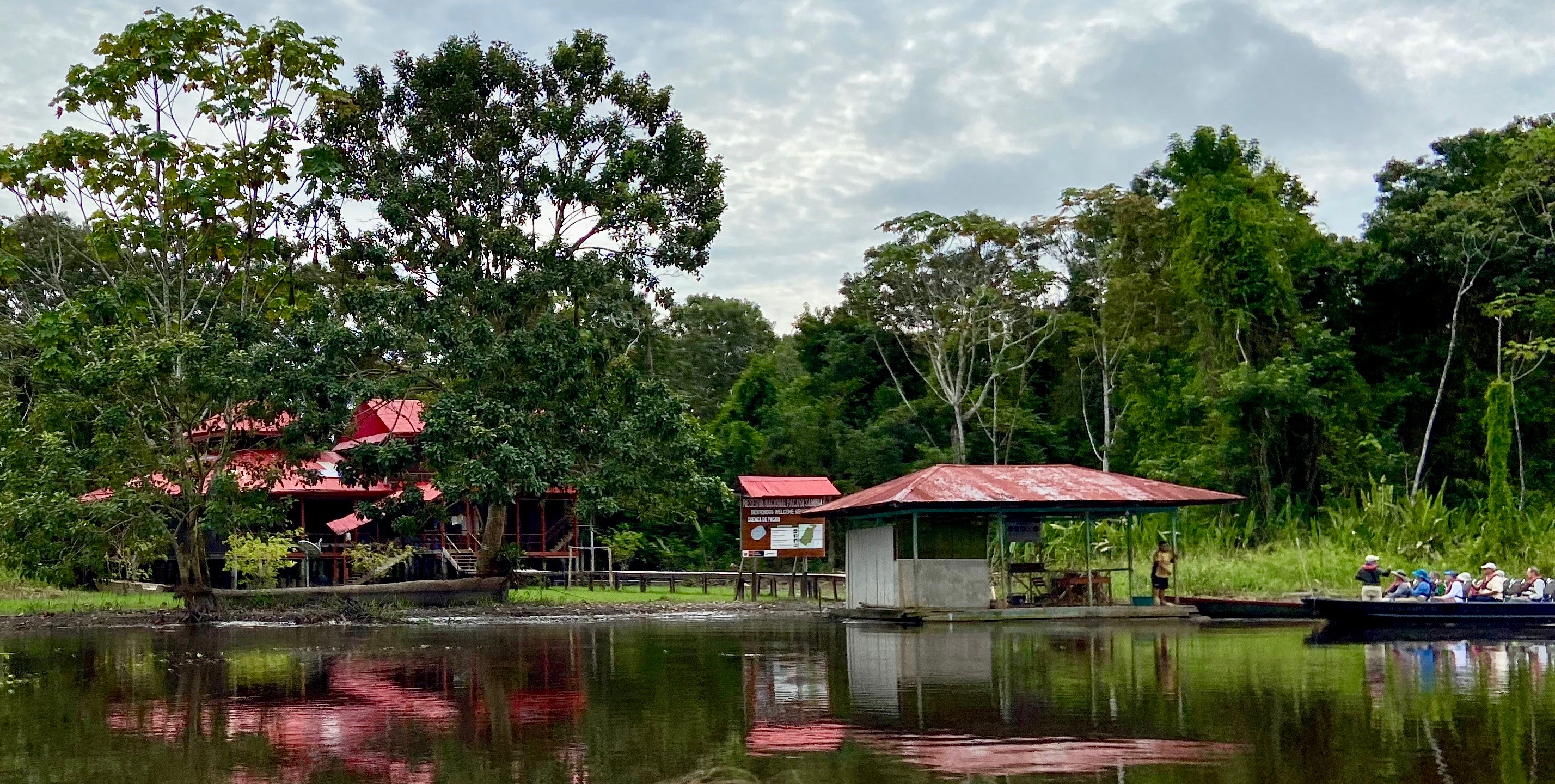
The goal of the center is to reintroduce the manatees into the wild. The last phase of the rehabilitation is a large pond where the manatees have no human interaction for one year before they are released into the Pacaya-Samiria Reserve that we have been touring. The protection they are afforded at the reserve gives them their best chance at survival. The rescue center is located on the road between Iquitos and Nauta.
Beyond rehabilitation, the center’s secondary goal is education and a large part of the tour was visiting the grounds where educational presentations and play areas geared to children are located. The hope is to convince the next generation that manatees are not a food source. Manatees are not the only rescued animals at the center. We saw lots of monkeys, macaws, turtles, and even a sloth. One of the saddest creatures was an anteater whose leg had been intentionally broken so he couldn’t get away and could be kept as a pet. He did have an interesting set-up. His home looked like a doghouse and he ate and drank from pet bowls.
The highlight of are visit was watching the staff feed the baby manatees. They could really take down a bottle of formula. It was a hot, humid day. I wish I had the opportunity to change before we got on the plane because my clothes were soaked by the end of our rescue center visit. I missed the cool breezes we enjoyed while riding along the Amazon in the skiffs.
After the rescue center, visit we re-boarded the bus for our trip to the airport. We said goodbye to our naturalists at the airport as they handed us our sack lunches and drinks. It was bittersweet. As a travel note, in Peru you can take drinks through security on domestic flights. Boris and I are struggling to keep the weigh of our bags down to 50 pounds (23 kg) each, the limit for domestic flights within Peru. I think they may have let us slide a bit at check in. After getting through security, we didn’t have too long a wait before we boarded the plane.
Before COVID-19, there were direct flights from Iquitos to Cuzco; unfortunately that route is no longer being offered. We will miss the nice dinner planned for the hotel in the Sacred Valley tonight. In Lima, we had to walk out of the baggage claim and then go back into the airport and through security before boarding our flight from Lima to Cuzco. Fortunately, the baggage didn’t have to be reclaimed; it was sent straight through. Carlos recommended we grab some food at the airport, but there really wasn’t much time.
For whatever reason the preassigned seats seemed to always have me being last off the plane. This route, Carlos got me a seat in the front and I was able to move up and sit next to him for the flight to Cuzco. While he ate his dinner, I enjoyed snacks I had brought from the Aria. When we arrived I walked with him to baggage claim immediately feeling the effects of the higher altitude. Cuzco, the ancient capital of the Incas, sits at the highest altitude we will experience during the trip.
In baggage claim, we were met by our local guide Harvey who told us about the city as we made our way out of town. We did make a momentary stop for Carlos to collect some fresh bread and cheese he had ordered for our journey. By the time we arrive at the hotel, the restaurant and bar will be closed. It was after 11 pm when we finally made it to the Sacred Valley. Of course, when the itinerary had been designed, the plan was that we would make it there much earlier; we were waylaid by the altered flight schedules and the loss of the direct flight.
It was a long day of travel and I miss the Aria, but our hotel in the Sacred Valley was gorgeous. I will enjoy the beautiful bed before we begin early in the morning on our touring of the ancient Inca sites. On to the next phase of our adventure…
Today is the day. I have seen them. Saw their red bellies and their sharp teeth. I have even tested fate by swimming in their river. Today, Natasha is going to catch a piranha.
But fishing is for later in the morning…It is the final day of our Amazon River cruise and the naturalists are once again offering an early morning excursion. Not to miss the opportunity, I’m in. Boris slept in once again. There was only one skiff headed out with Billy for our early departure. We traveled down interesting channels off the river. It was kind of like the Venice of the Amazon (without the bridges, and the buildings, ok maybe not like Venice) and we were in rush hour traffic on the water. There were so many boats out and about. Farmers were headed to their newly emerged plots of land and children were headed to school
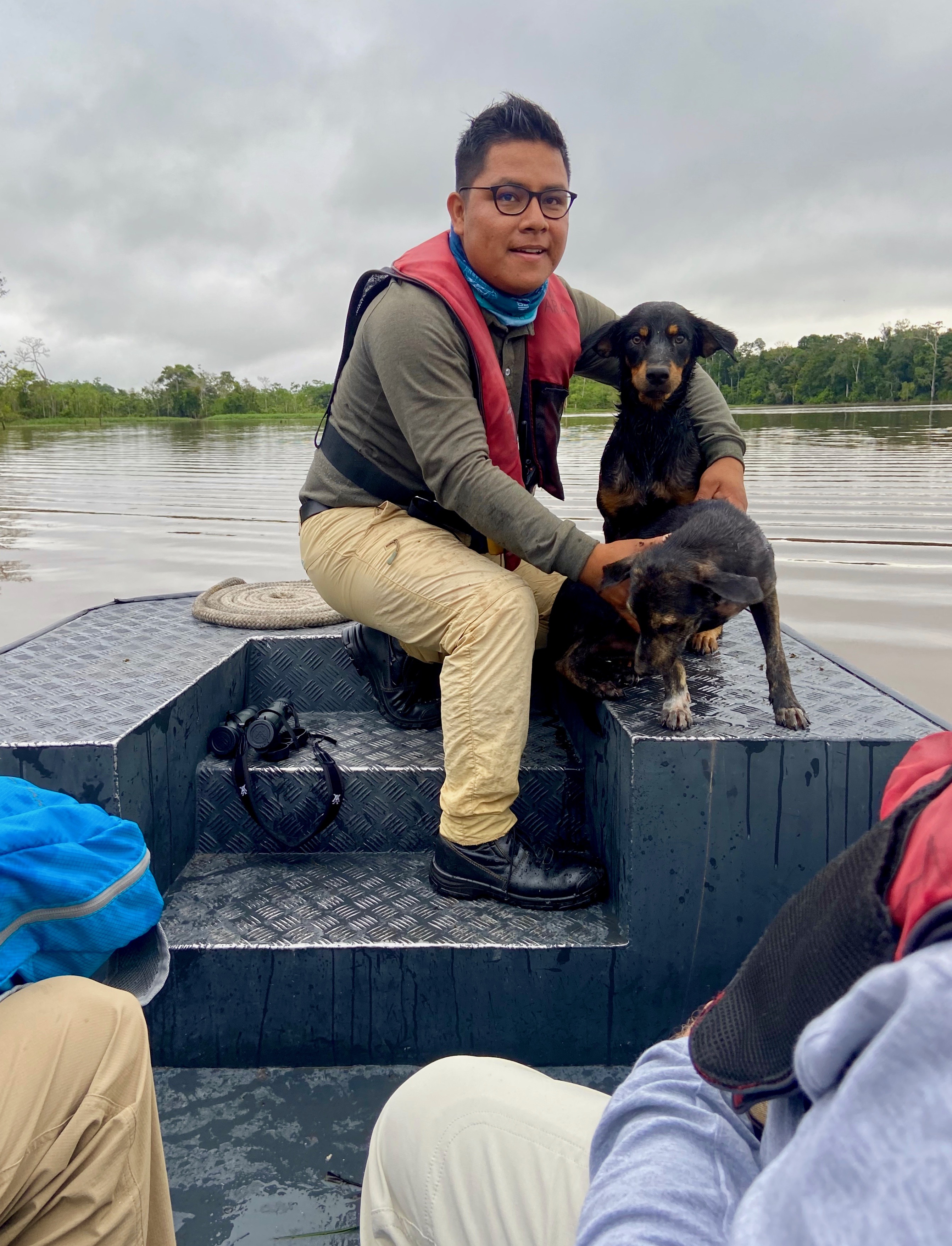
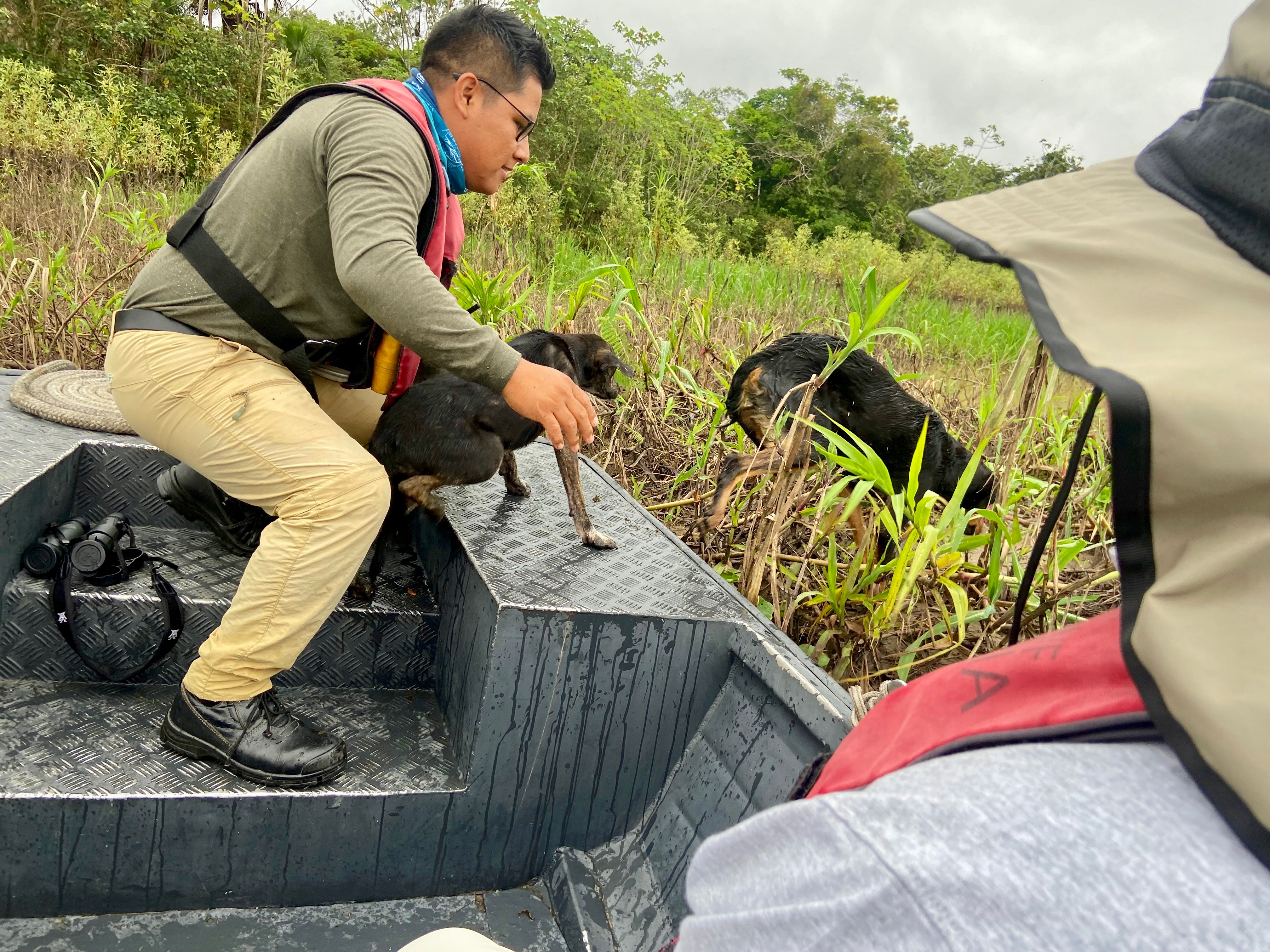
We have gotten better about spotting and identifying the various bird and animal calls. We spent some time listening and then trying to find the animals we heard. We also saw a couple of dogs along the way. Two of our guests, Phil and Kathy, are service dog trainers. The dogs would show up periodically as we traveled down the channel. They appeared to be really struggling in the mud and were most likely separated from their owner. When they swam to us it was obvious they were being more than friendly; they needed help.
Because he is naturally just a great guy, we had already almost completed our touring, and the fact that everyone on the boat was focused on the dogs, Billy pulled the two dogs aboard our skiff and held them at the front. They were shaking but also happy to be aboard. Billy knew of a nearby village and we asked people along the way and were able to confirm that the dogs’ owner lived in the village. At the edge of the village, Billy released the dogs and they headed home, but not before they took a look back at us. Billy is our hero. Boris is going to be sorry he missed this. We are both missing our Westie Peabody.
We look the journey back to the Aria, spotting a few more animals along the way including a mantis that looked like Pickett, the bowtruckle (animal character) out of the current Harry Potter Fantastic Beasts series. There were plenty of farmers already out at work on their plots of land even though the hour was still early.
For our regular morning excursion after breakfast we are going piranha fishing and will have our second chance to do some swimming in the river. The fact that we are doing these at activities in roughly the same area did not escape me. For the piranha fishing, we are snuggling up to the shore line. We are baiting the lines with steak.
Per and Leslie show off their catch. Photo by Ricardo
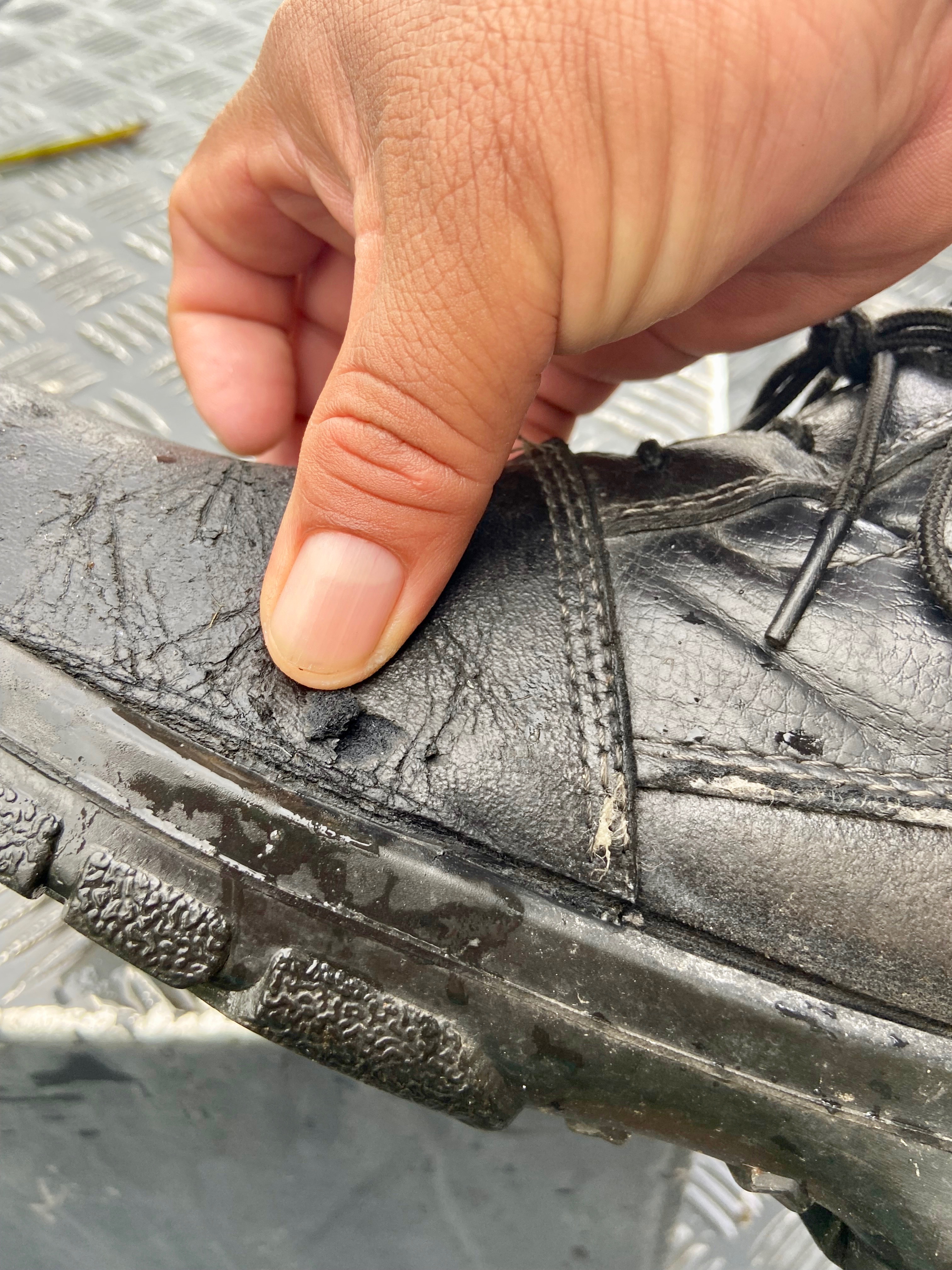
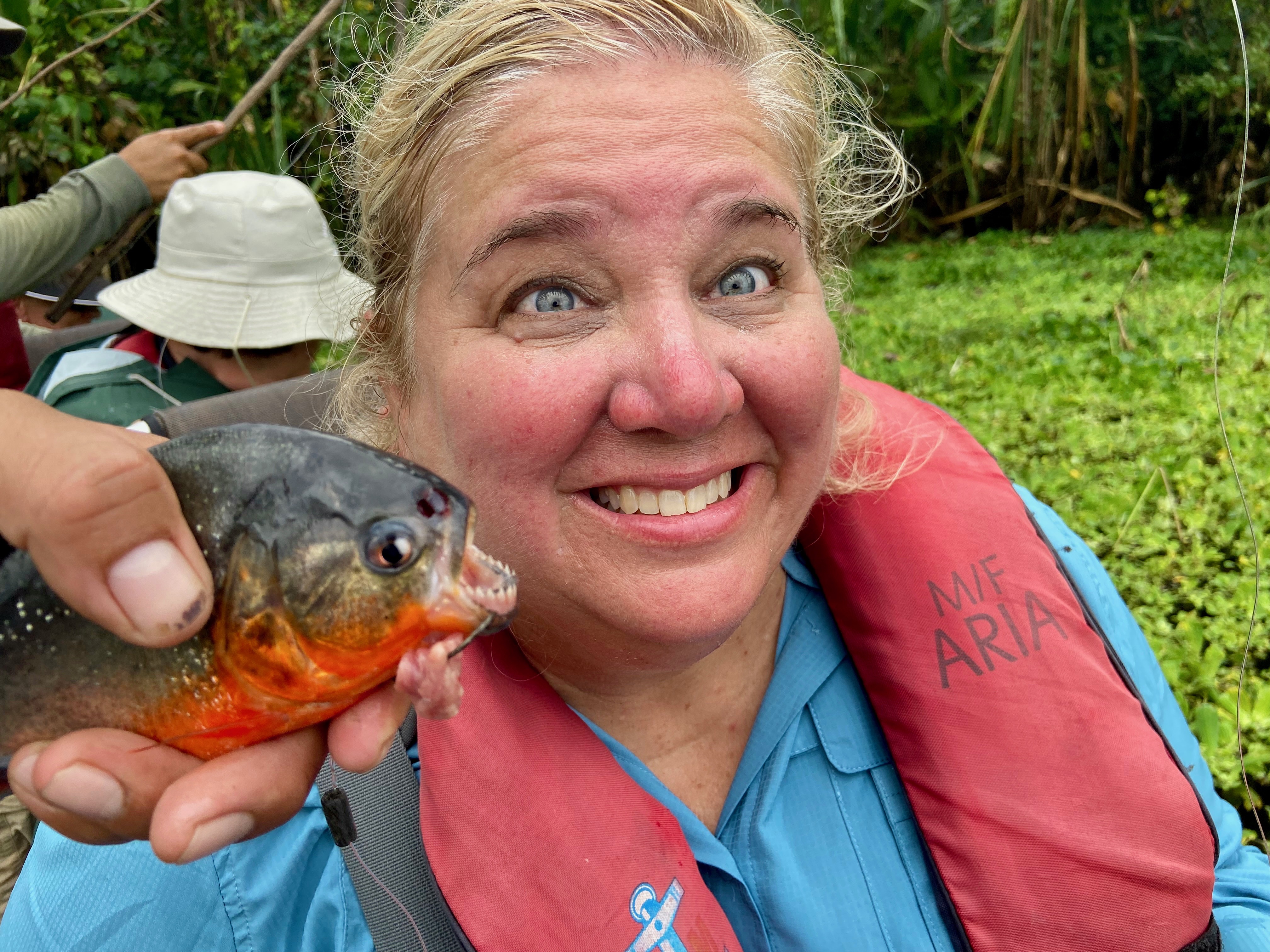
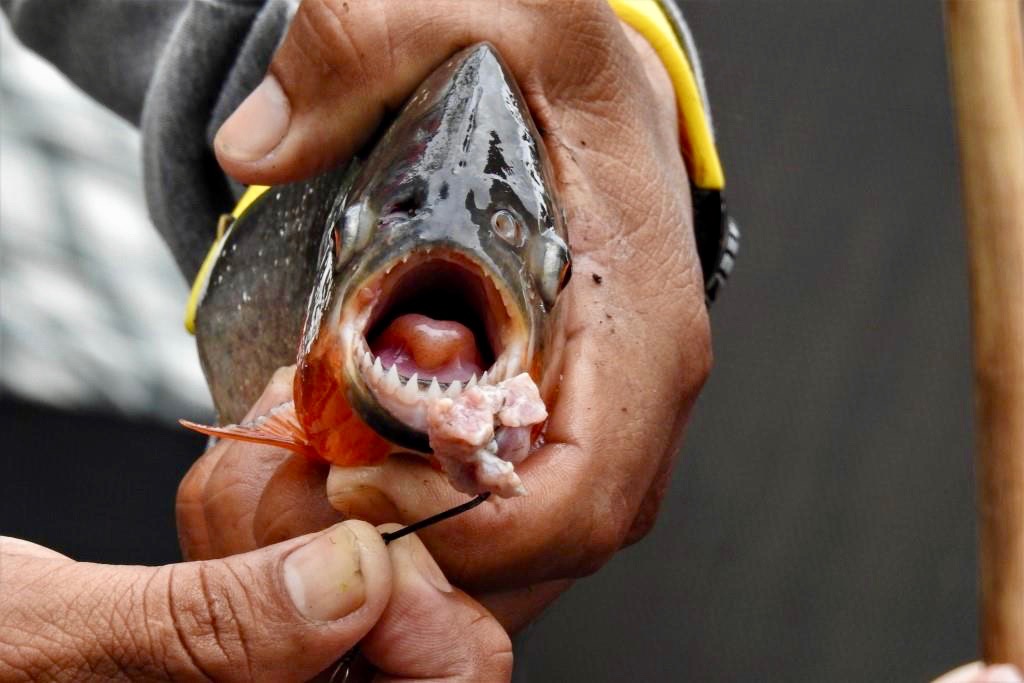
I admit that I was a little apathetic about the fishing. Boris was really into it, but I was happy just to watch. The women on our boat were killing it. Rita and Karen caught 7 and 8 respectively. It probably didn’t help my attitude that Rita was right behind me and would swing her line and fish right in front of me each time. Many times the piranha landed at my feet. They are nasty little things that chewed right through Julio’s shoes so I admit to a few screams when one of those suckers landed on me. Ricardo got some pretty funny video.
Grace dressed to match her catch. Photo by Ricardo.Photo by Jean Janssen. That nasty piranha chewed right through Julio’s shoe.
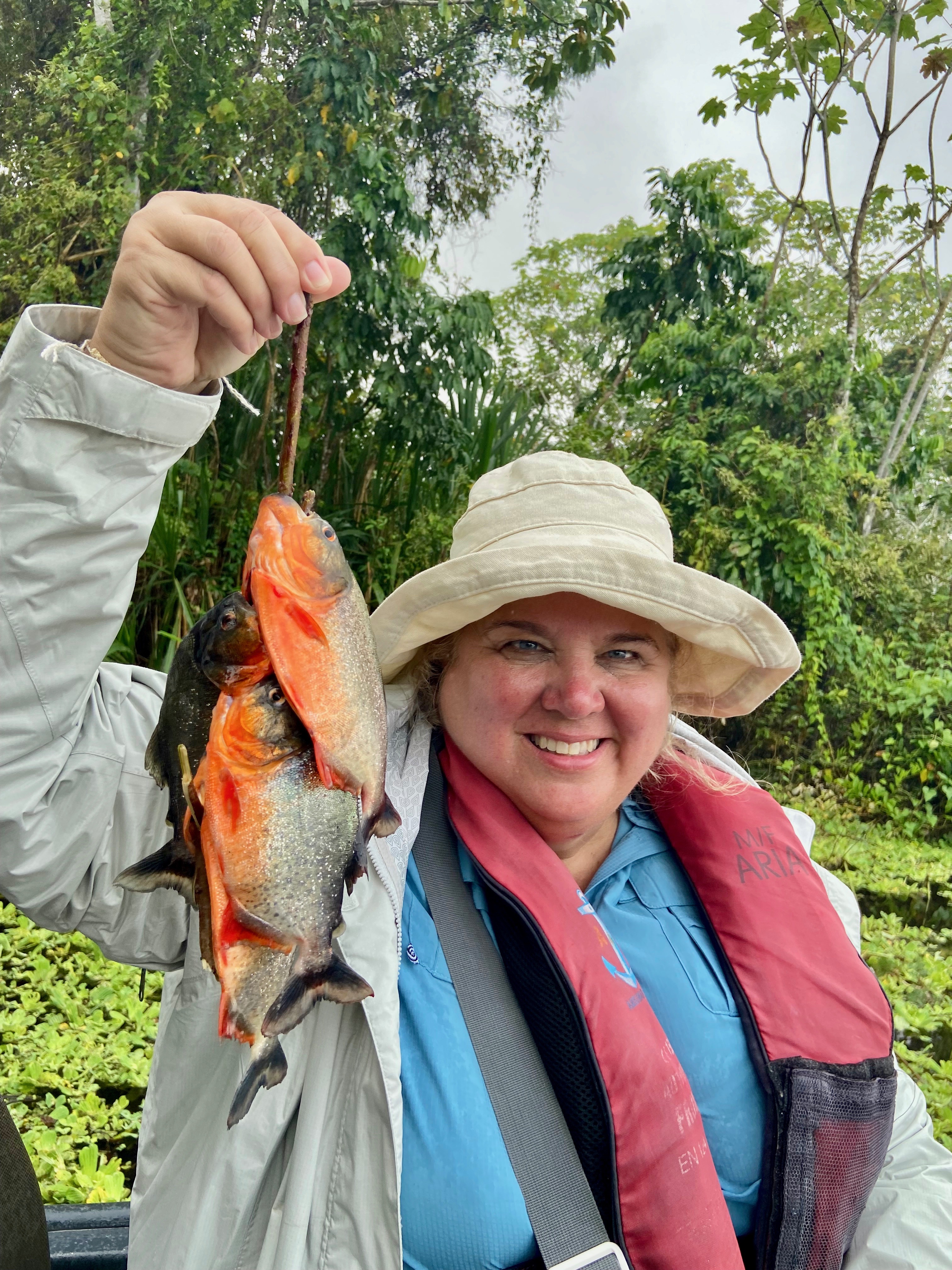
Finally, Julio came up to me and announced that we weren’t leaving until I caught a piranha. I had by this point caught a few; I just hadn’t landed any. So I gave in, baited the line, and Julio told me when to pull. I ended up catching one of the larger ones. Well then I was hooked and caught a few more. Boris did really well; he is the real fisherman in the family.
Natasha and friendBoris and his haul of Piranhas. Photo by Ricardo.Amazon Piranha. Photo by Ricardo.Amazon Piranha. Photo by Ricardo.
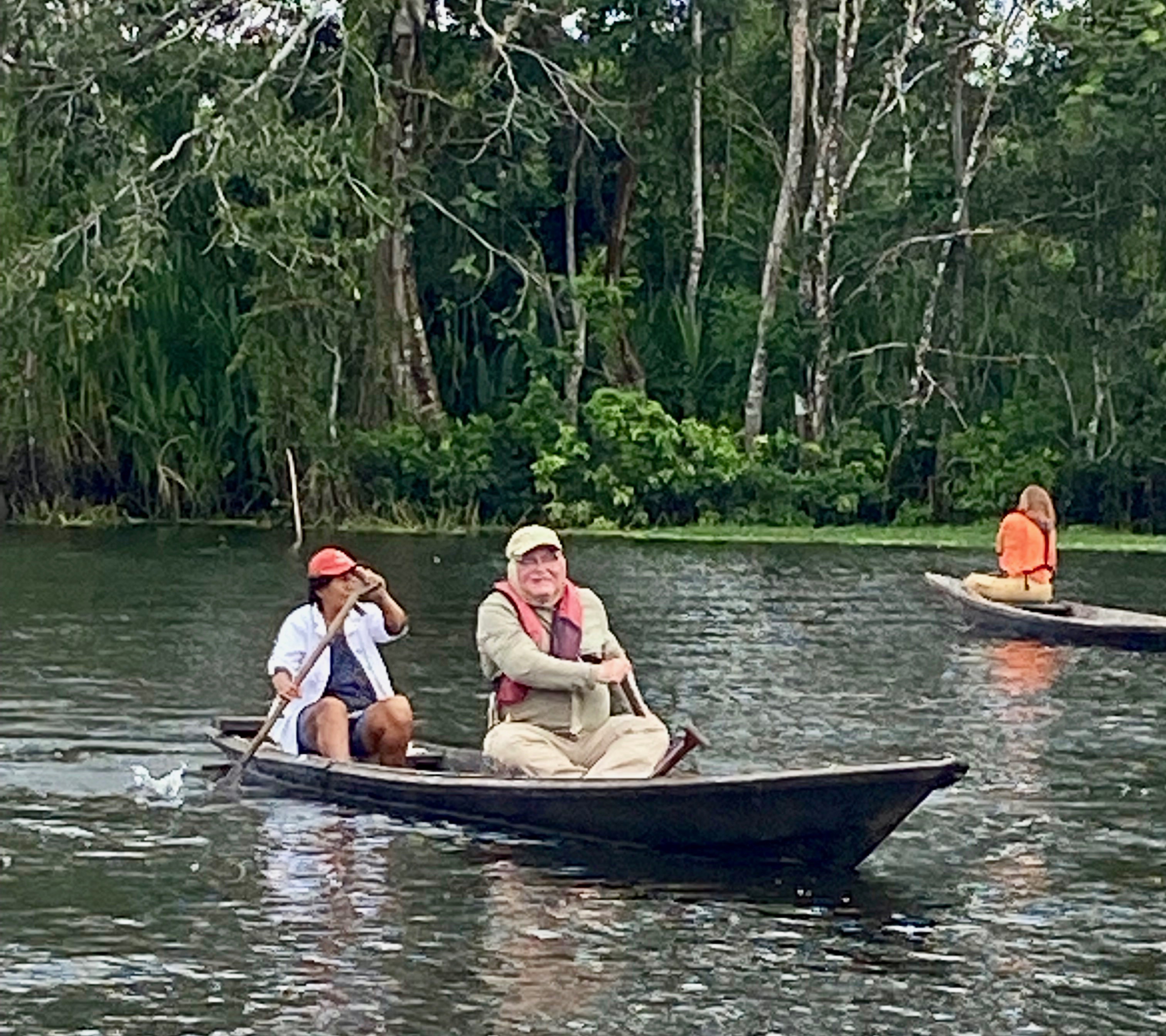
By the time our fishing was almost complete, we had gathered quite an audience of the native people. As it turned out, they were there to provide rides in their canoes for anyone who wanted to participate. The ship had also supplied kayaks for anyone who wanted to paddle on their own. Boris went for a canoe ride and I stayed behind to get pictures of him.
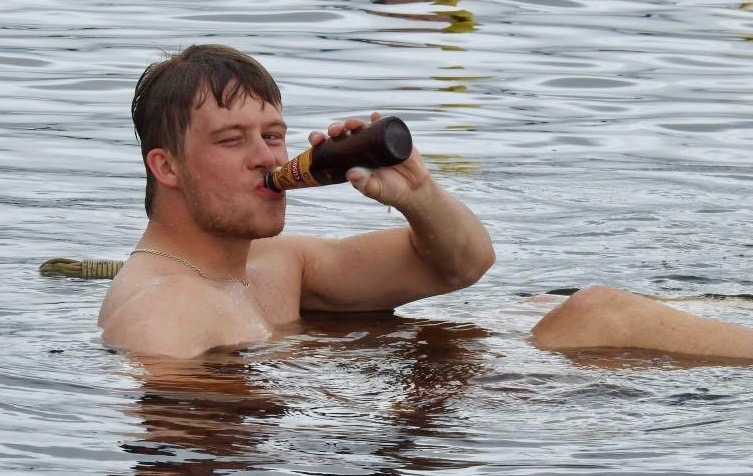
After the paddle, we had our final chance to swim in the Amazon. Of course I jumped in. Once again it was cool and refreshing. Several of the guests decided to take their beverages in with them. At the end of our morning excursions, we headed back to the ship for lunch and a break. We have a village visit this afternoon.
Ready for a guest for her canoe on the Amazon. Photo by RicardoJoe enjoying the Amazon River. Photo by Ricardo.
One of the things I admire about particular travel groups is the ability to blend the cultural experience with the active one. It is even more impressive when they offer a philanthropic opportunity to bond with the native peoples. My dive masters, Ann and Eric Keibler, with Oceanic Ventures in Houston make that a part of all their international dive trips. Today we are visiting a local village and taking them health and school supplies. Good for Uniworld and Amazon Adventures.
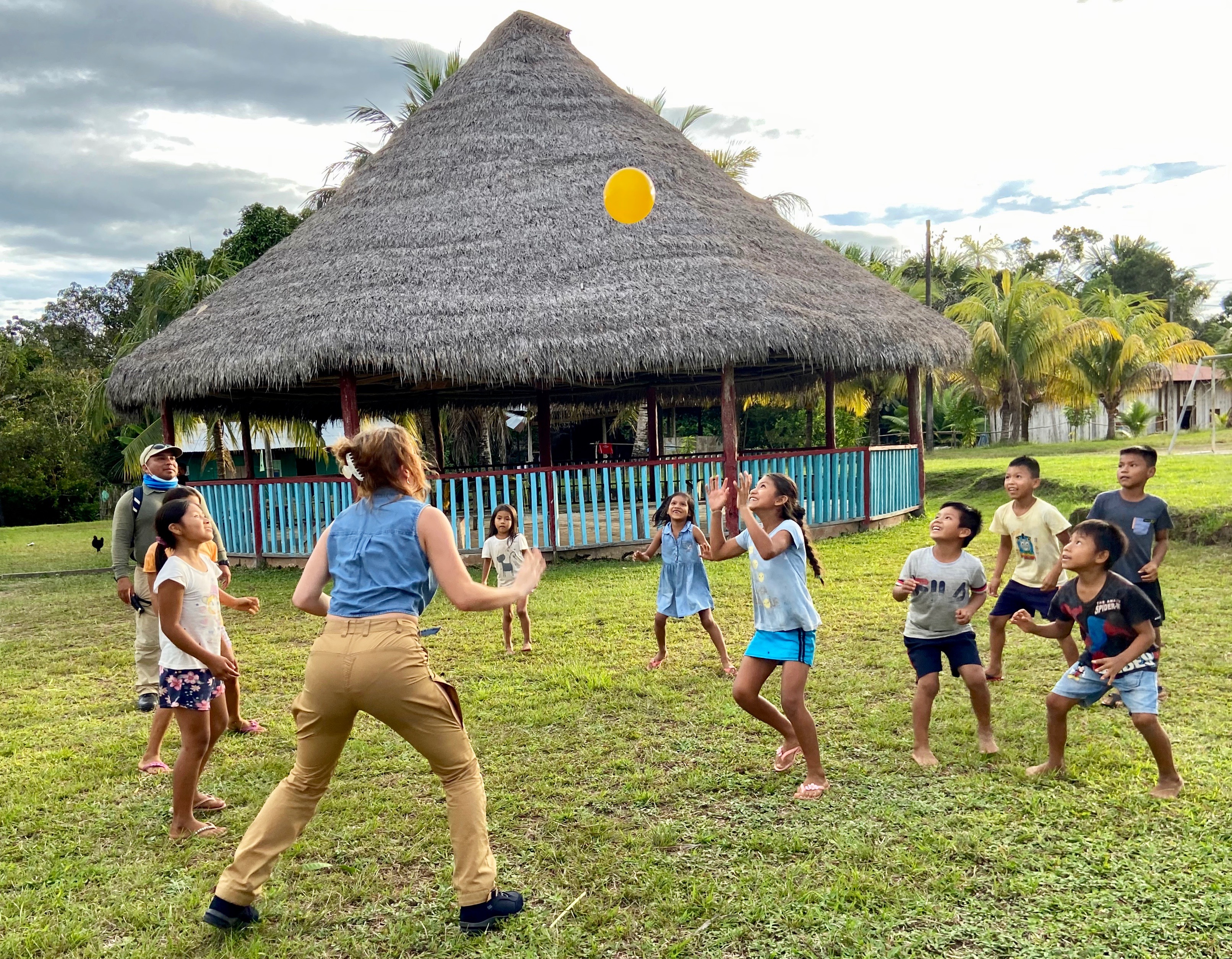
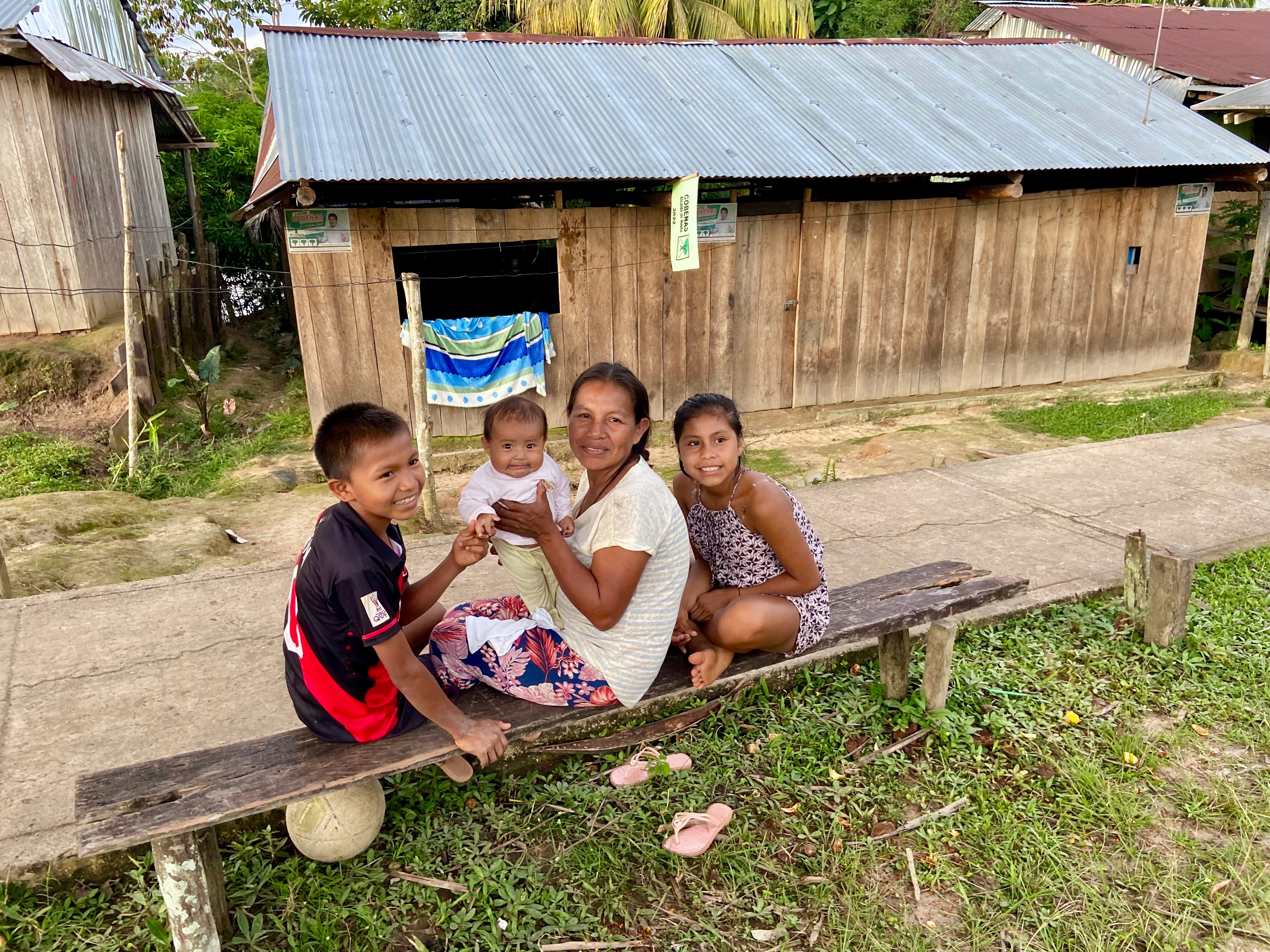
Julio led us in introductions and games and even with a language barrier, we felt a connection with the families. We met the village midwife, a rarity and a lucky addition for this village. She had delivered multiple generations of children in the village and couldn’t even remember a total number. We had the opportunity to present each of the children with a gift bag and Boris and Joe even interacted with some of the local animals. It was a wonderful afternoon.
Tonight was our final dinner aboard the Aria. We saw a wonderful video presentation of all the pictures and movies that Ricardo had recorded during our week on board. I have shared many of those with you. Harvey our head waiter did an amazing dance routine; none of knew he had it in him although there were hints when he led the conga line at last night’s dance party. Tomorrow is a transition day for us. We will leave the Aria then fly first to Lima and then on to Cuzco. No worries! The trip is far from over. Now we turn our attention to the ancient Inca sites that Peru is famous for. Stay tuned; there is so much more to come…
Sunset view from the Amazon Aria. Photo by Ricardo.Natasha and her piranhas.
Cruising on the skiffs in the Amazon. Photo by Ricardo.
This morning as we took our morning ride along the Amazon, I shot a lot of videos. We saw so many of the beautiful white birds in flight. The color contrast of the white birds against the green foliage and black water was striking. Sometimes we were slow as we enjoyed the images of the shoreline reflected in the glass-like water, and other times if felt like our skiffs were racing along the river.
Our tour director Carlos (not to be confused with our bartender Carlos) was riding in our skiff today. We stopped a local fisherman to see what he had caught this morning and Carlos bought a rather remarkable fish that he intended to take to the chef. Then it was back to our primary mission of finding the lily pads. They are disappearing in the Amazon
Like the other life along the Amazon, the lily pads play an important role. “The Amazon Rainforest is most famed for its exceptional biodiversity, with over half of the world’s estimated ten million animal, plant and insect species calling it home. The rainforest is also the largest pair of lungs on the planet and provides approximately 20% of the world’s oxygen.” Rainforest cruises.com
The lily pad can grow to up to 8-10 feet in diameter, depending on the variety, and can be incredibly strong (holding up to 65 lbs.). They have a lip around the edge creating a bowl like effect to protect things from falling off the edge. Perhaps even more interesting that the surface of the lily pad, is the underside where the defensive mechanisms protect it from fish that want to eat it. There are also stalks that extend deep into the water.
We are going to be out quite a while this morning, so we made a stop at an outpost with a western style toilet not usually found in the rainforest. It didn’t actually flush; you poured water into from the barrel next to it. Unfortunately to reach the toilet, you had to cross a narrow plank and go out across a bridge.
While we were at the stop, the workers told our naturalists about an anaconda that was tangled in fishing line behind the structure. Julio and Billy went to check it out. The snake had deep gashes in it, cut by the fishing line. Our heroes got it free from the line and released it back into the water while we watched. Both said that the injury was not too bad and that the anaconda would recover.
Making a turn onto another tributary, we spotted our chef. Our boats were then tied together for lunch on the river. We started with the chef making fresh ceviche with the fish that Carlos had bought that morning. It was followed by drinks and lunch wrapped in a palm leaf.
We had a full afternoon on the river. We found more monkeys at play to enjoy, rode down the river as beautiful birds flew overhead, saw lizards and new interesting foliage, and just enjoyed the serenity of the Amazon Rainforest.
Photo by RicardoPhoto by RicardoPhoto by Ricardo
We got back to the ship late afternoon and took a break before our evening celebration. We only have one full day left to explore the river. We had asked the cruise director earlier in the week when there was going to be dancing and tonight she delivered. After our evening lecture, we all went out back on the third deck to the hot tub lounge area where there was a food and beverage setup.
Our cabin stewards performed on traditional instruments including the pan flutes I associate with Peru. Ricardo joined along on the box drum. The rest of our crew danced behind the buffet table. They used to hire experienced staff and then try to train them for entertainment. It is now done the other way around. In this case they hired fabulous musicians and taught them how to be cabin stewards. It showed; they were fabulous entertainers.
Wendy swayed to the music, but I got a lot of the girls up and we made the most of the evening. We had a great dance party before going down to dinner. I sweated the entire time through dinner. Totally worth it.
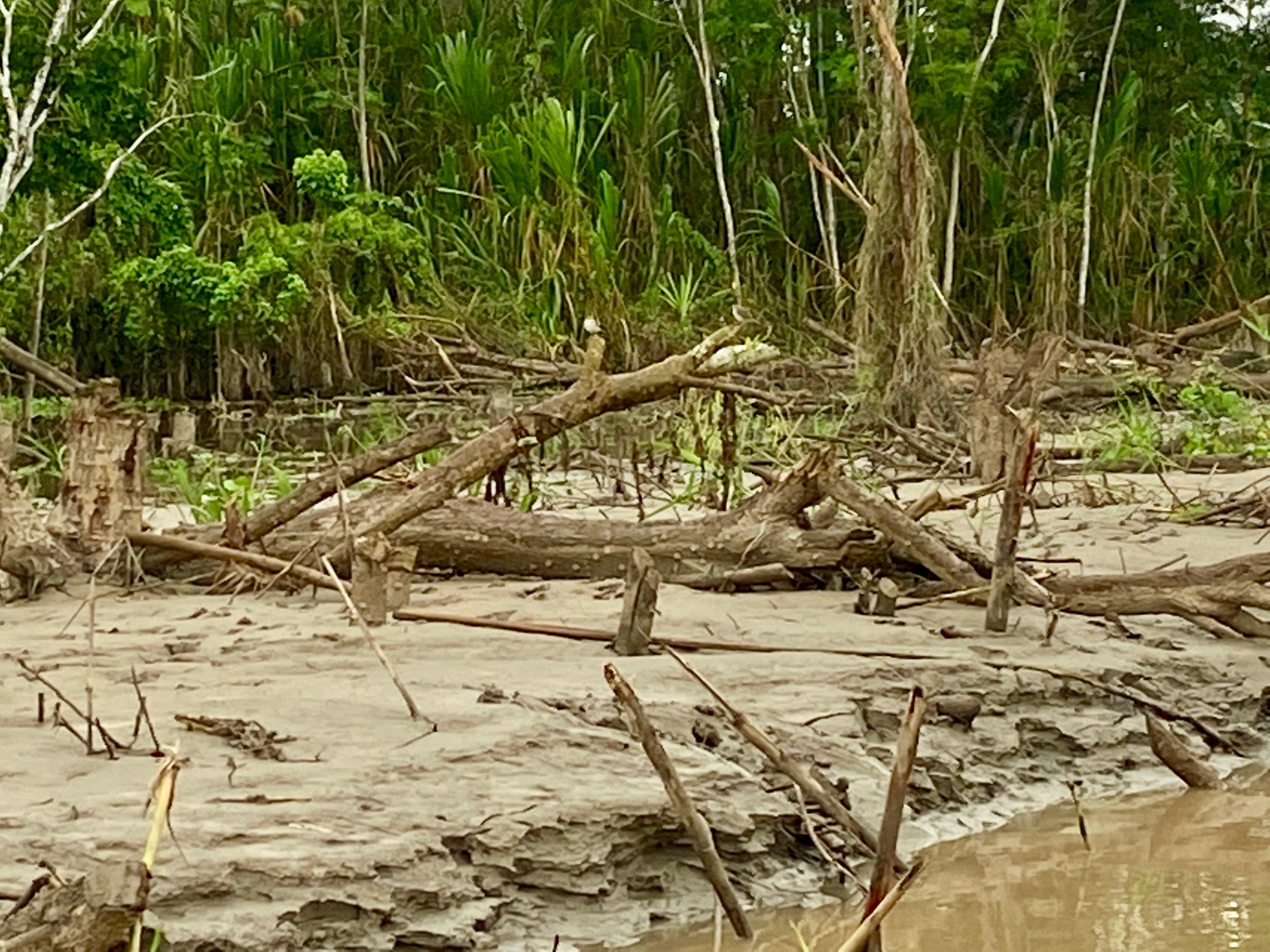
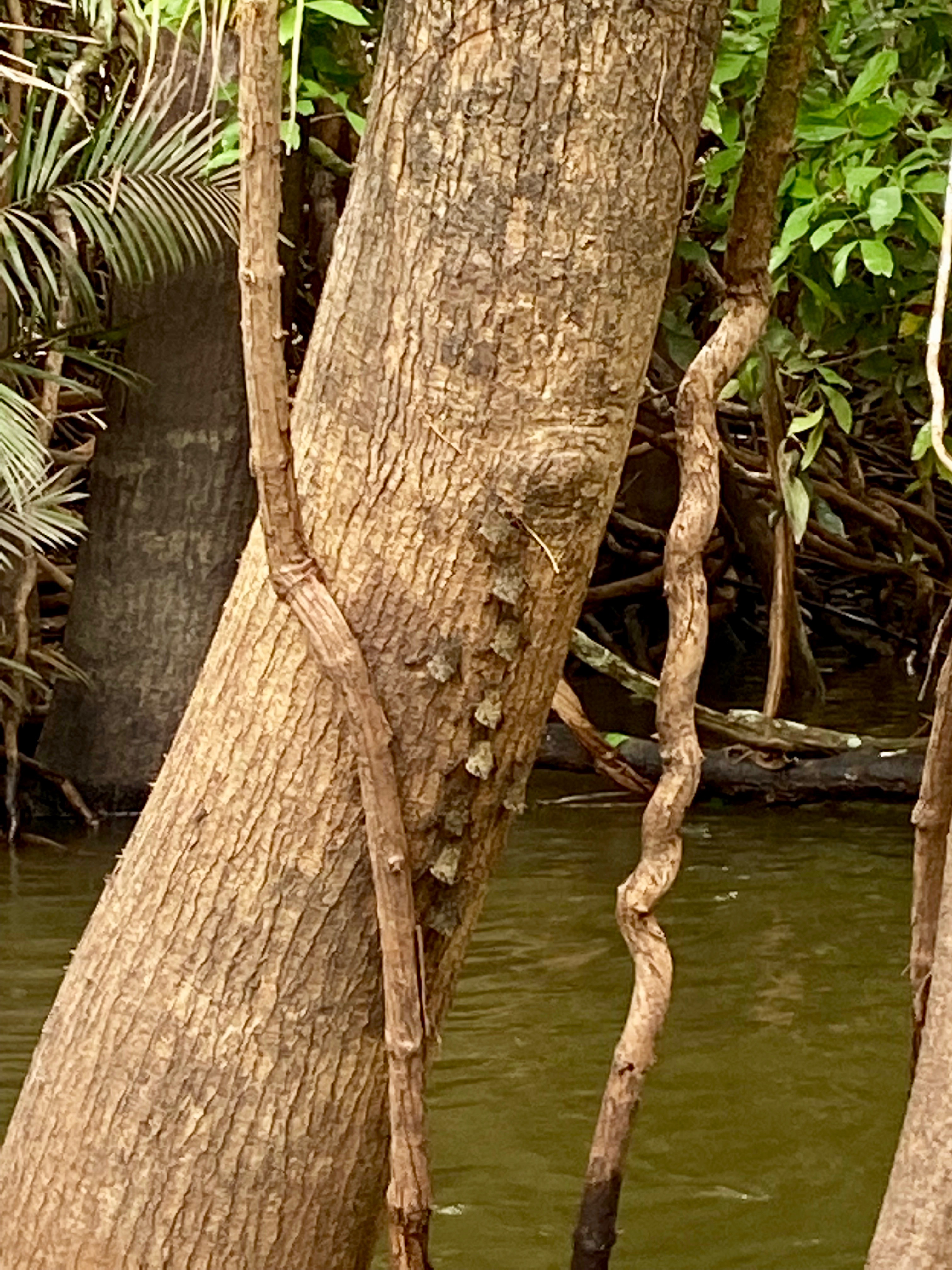
Another amazing day on the Amazon, today I really noticed the water line on the trees, realizing the water level is dropping fast. One of the first things we saw was a line of long nose bats on a tree trunk. Ricardo told us it was a harem with one male bat and many females. Apparently this guy is doing really well; it was a larger group than usual.
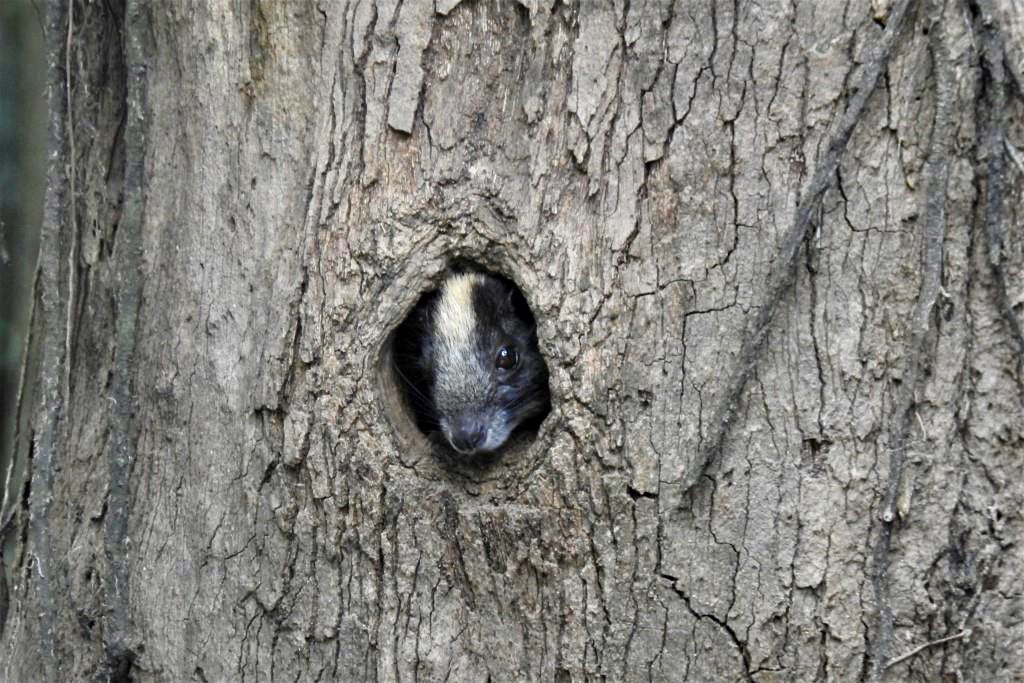
Most days we enjoy the play of the plentiful squirrel monkey. Today, we also saw the saddleback monkey and the black tamarin monkey, a small monkey with a white face. The hollowed out spaces in the trees were hiding places for some wonderful animals. On our first evening out, we saw three owl monkeys hiding in a tree. One of our big finds today was a kinkachu with its dog-like canine teeth. Like the owl monkey, it is nocturnal.
Hollowed out tree trunks are great places to find animals along the Amazon. Photo by Ricardo.Black tamarin along the Amazon. Photo by Ricardo.Amazon Squirrel Monkey. Photo by Ricardo.It wouldn’t be a day in the Amazon without a sloth sighting. Photo by Ricardo.
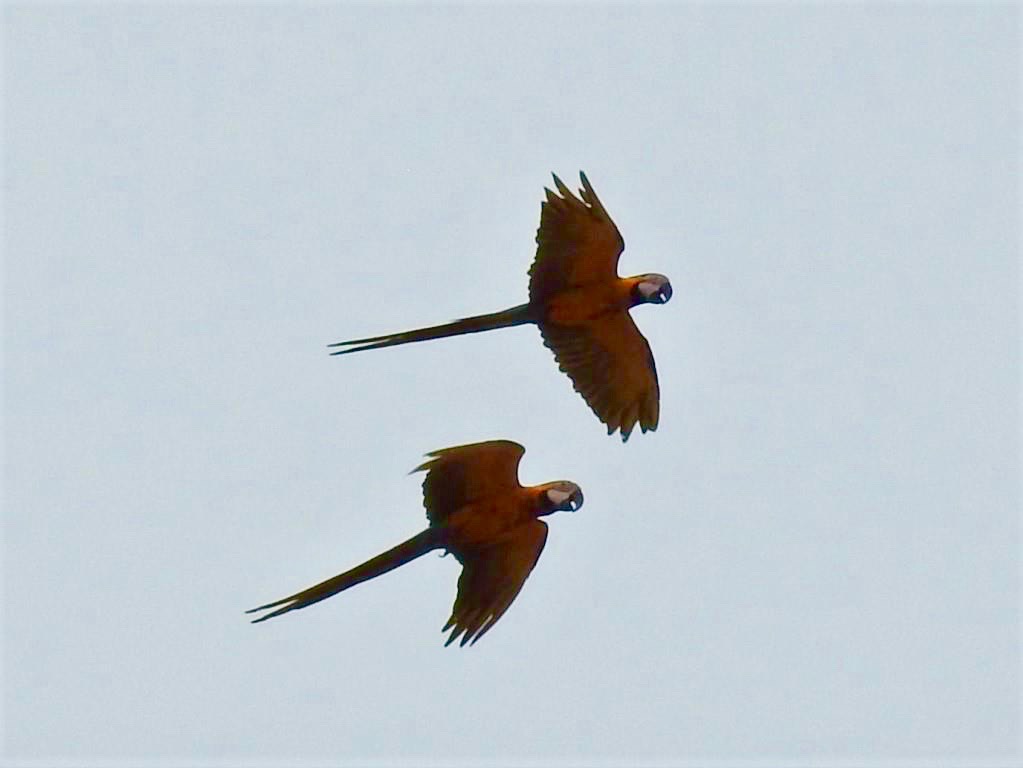
While we have been fortunate to see sloths everyday, it was unusual birds, some we hadn’t yet seen, that dominated the day. We saw two pairs of blue and yellow macaws and a pair of scarlet macaws in flight. Although we see them in aviaries at home, seeing them fly over the river in their natural habitat is a sight to behold.
A pair of scarlet macaws in flight. Photo by Ricardo.Along the Amazon. Photo by Ricardo.Along the Amazon. Photo by Ricardo.Along the Amazon. Photo by Ricardo.
We saw some marvelous hawks, including the black hawk, in the trees today. We are also beginning to see sand bars appear in the river as the water level retreats. On one sandbar we saw the small birds that migrate from continent to continent in large flocks.
Along the Amazon. Photo by Ricardo.The black hawk along the Amazon. Photo by Ricardo.Along the newly appeared sandbar in the Amazon. Photo by Ricardo.
These sandbars appear as the water levels drop. Families will go out and claim areas, marking their “fields” with flags, tee shirts, etc. The spaces are used for planting rice and other crops that thrive in these wet areas. The season is short, about five months, and the people have to harvest before the rainy season begins. On one such area, we saw a beautiful pair on the storks.
We saw water taxis out on the Amazon transporting people from one community to another. Many areas are only accessible by water. Speaking of hitching a ride, Boris raised the bar today. After a series of cricket ride alongs, today it was a striking blue butterfly that landed on his hat and made the morning journey with us.
Back on board the Aria for lunch, it was demonstration day once again. Carlos was back making a new series of drinks and got Leslie and Joe to help with the shaking. Harvey gave us a napkin folding demonstration and crafted a lily pad that he added a frog handicraft to; it took it back to my room as a decoration. Finally, our chef made a wonderful ceviche which we all got samples of to start off our lunch. Afterwards, we also enjoyed a food coma and an afternoon break.
Late afternoon, we headed out down one of the tributaries that line the Amazon River. Some of these tributaries are black water rather than the muddy brown water of the Amazon. It is a rather sudden change when they merger. The black water originates at a swamp, rather than coming from the mountains. “As vegetation decays, tannins leach into the water, making a transparent, acidic water that is darkly stained.” In contrast to the black water created by the tannins, when water runs down the mountains it collects silt that gives the rest of the Amazon its muddy brown color. The black water has a strikingly different PH balance. Pink dolphin mothers come to the black water just after giving birth while the baby is still attached by the umbilical cord. The water kills the umbilical cord causing it to fall off; the water then seals the hole. If you place a piece of red meat on a string in the black water it will be white when you pull it up; the water cooks it.
The black water if really quite beautiful. It is mirror-like and reflects the surrounding foliage on the surface of the water. When we swam in the black water, it looked like we were swimming in tea. Most of the planet’s blackwater rivers are in the Amazon Basin, but we also have some in the Southern United States.
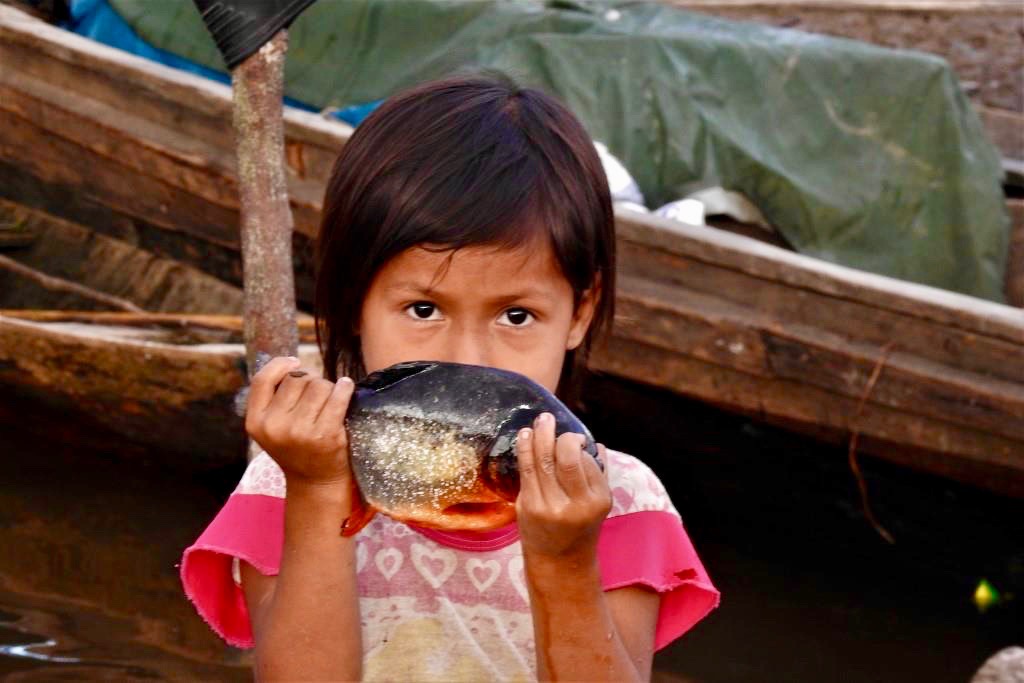
A child of the Amazon proudly displays her catch, an armored catfish. Photo by Ricardo.A child of the Amazon proudly displays his catch, a red-bellied piranha. Photo by Ricardo.A young Amazonian girl and her piranha. Photo by Ricardo.
After a twenty minute ride down the tributary, we pulled into a creek and came across children out in canoes; they rowed their small narrow boats with a wooden paddle.. They were eager to show us what they had caught. Some had the iron armored catfish; other piranhas.
A young boy brought his armored catfish right up to the boat. The fish was aptly named. Although they are found in my home state of Texas, I had never seen anything like it. In the US State of Florida, the invasive armored catfish is considered a problem for the endangered manatees. While these catfish only eat algae, they cling to the back of the manatee to eat the algae that collects there. For the manatee, it is like being attacked by a swarm of mosquitos.
Julio brought the armored catfish inside our skiff and we got a look at the underside of the fish as well. It was spotted like a giraffe, an interesting contrast. Some of the other young fishermen had caught piranhas. They had bright red bellies. Julio gave us a close up look at the teeth on one of them.
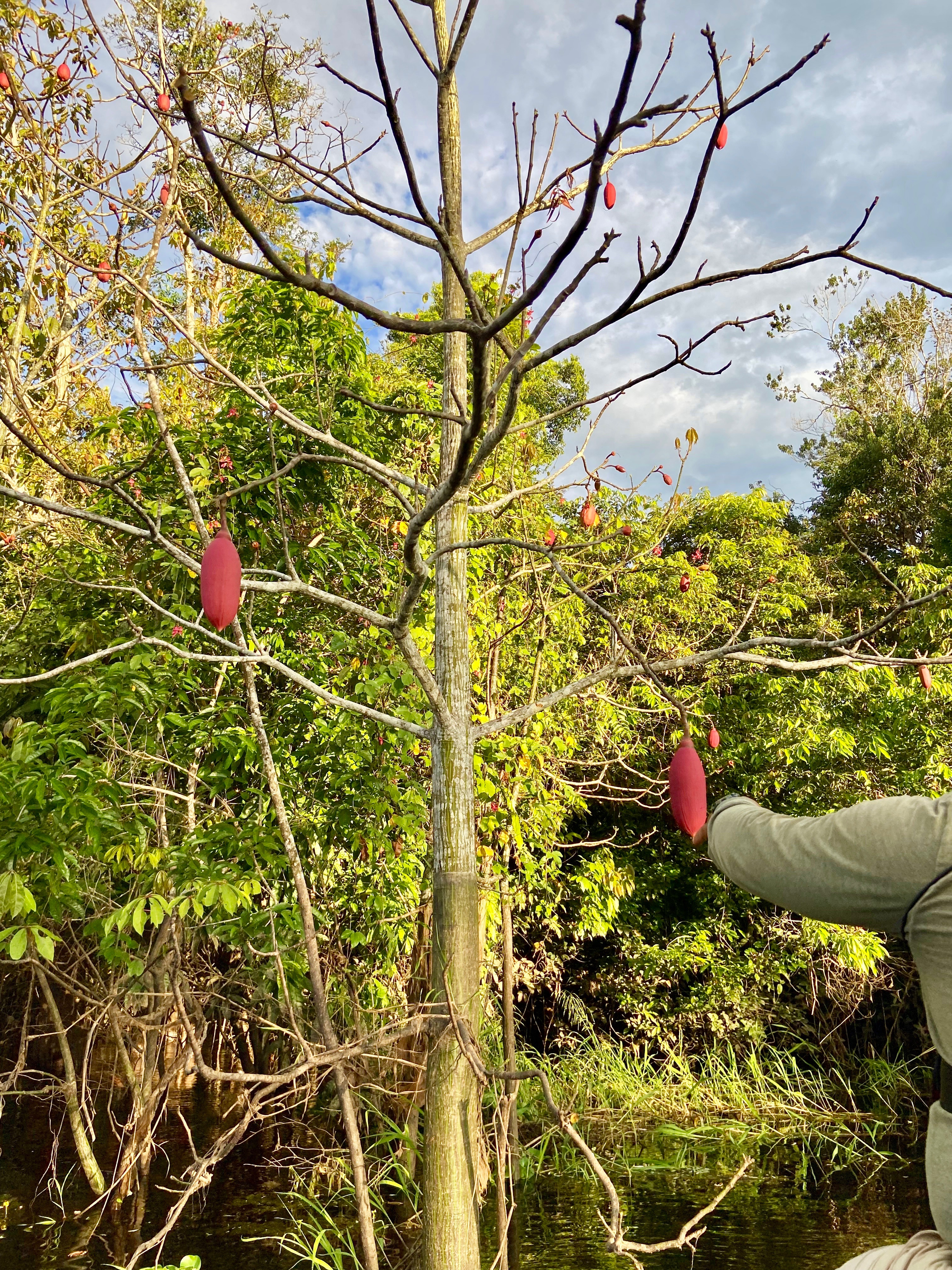
I love being out on the river at this time. The day is cooling and the breeze as we glide along is refreshing. One of the things we spot is the beautiful red fruit with the silk cotton inside. We have seen some with holes where the parakeets have eaten the seeds and made a home. We have also seen sloths lounging in these trees, presumably eating the fruit when they are hungry. The fruit on the trees we came across was not quite ripe. Julio opened one for us.
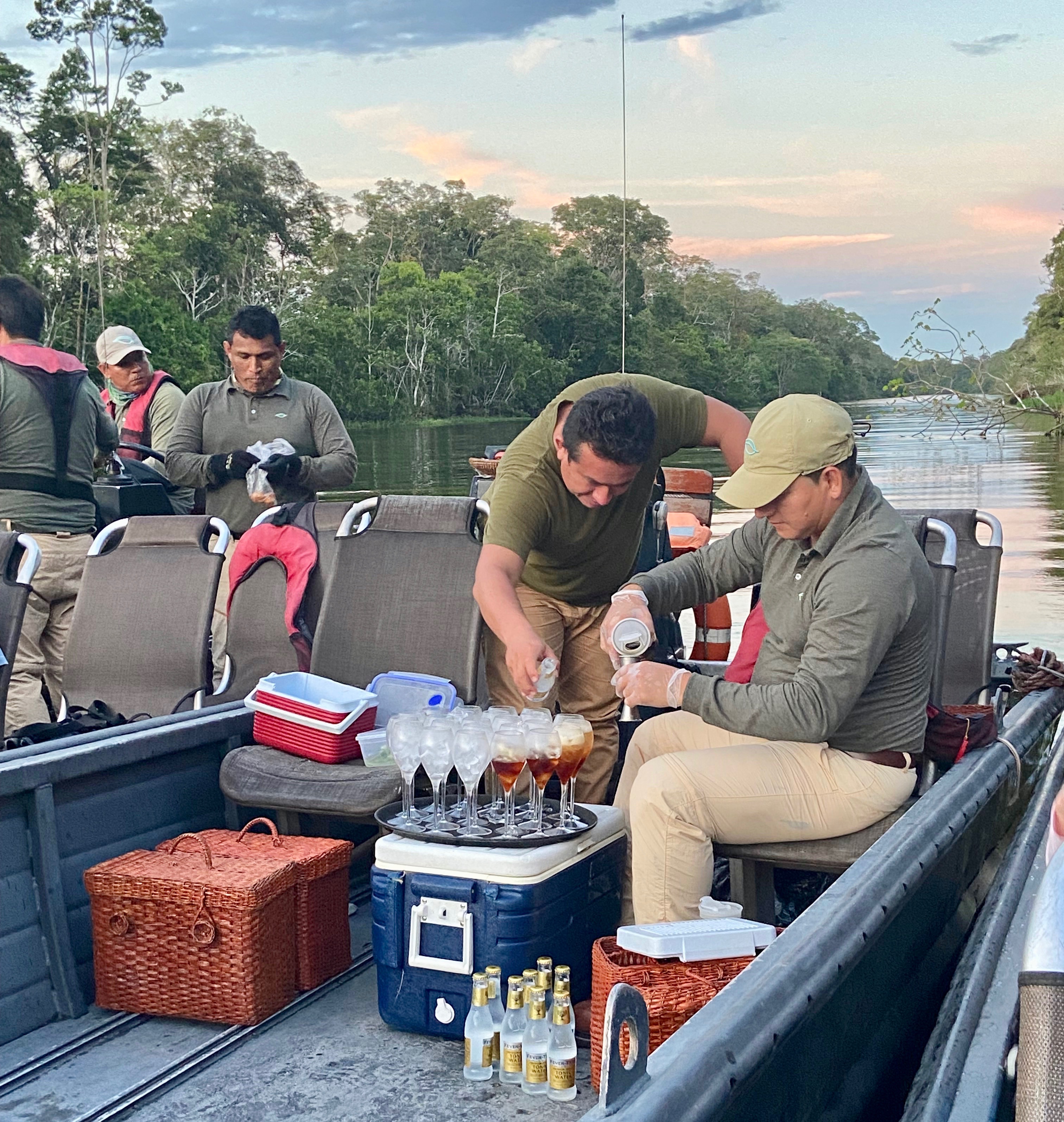
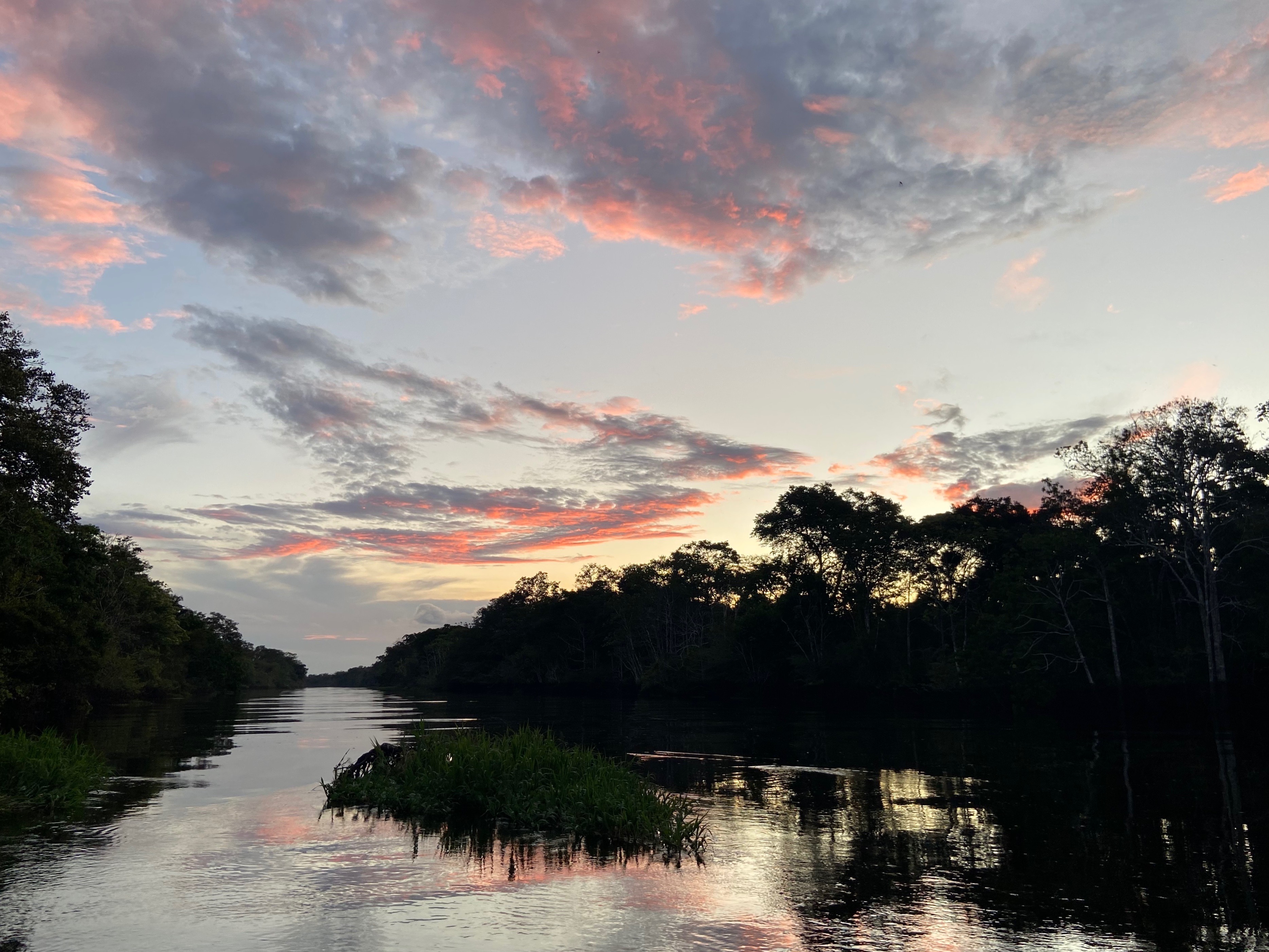
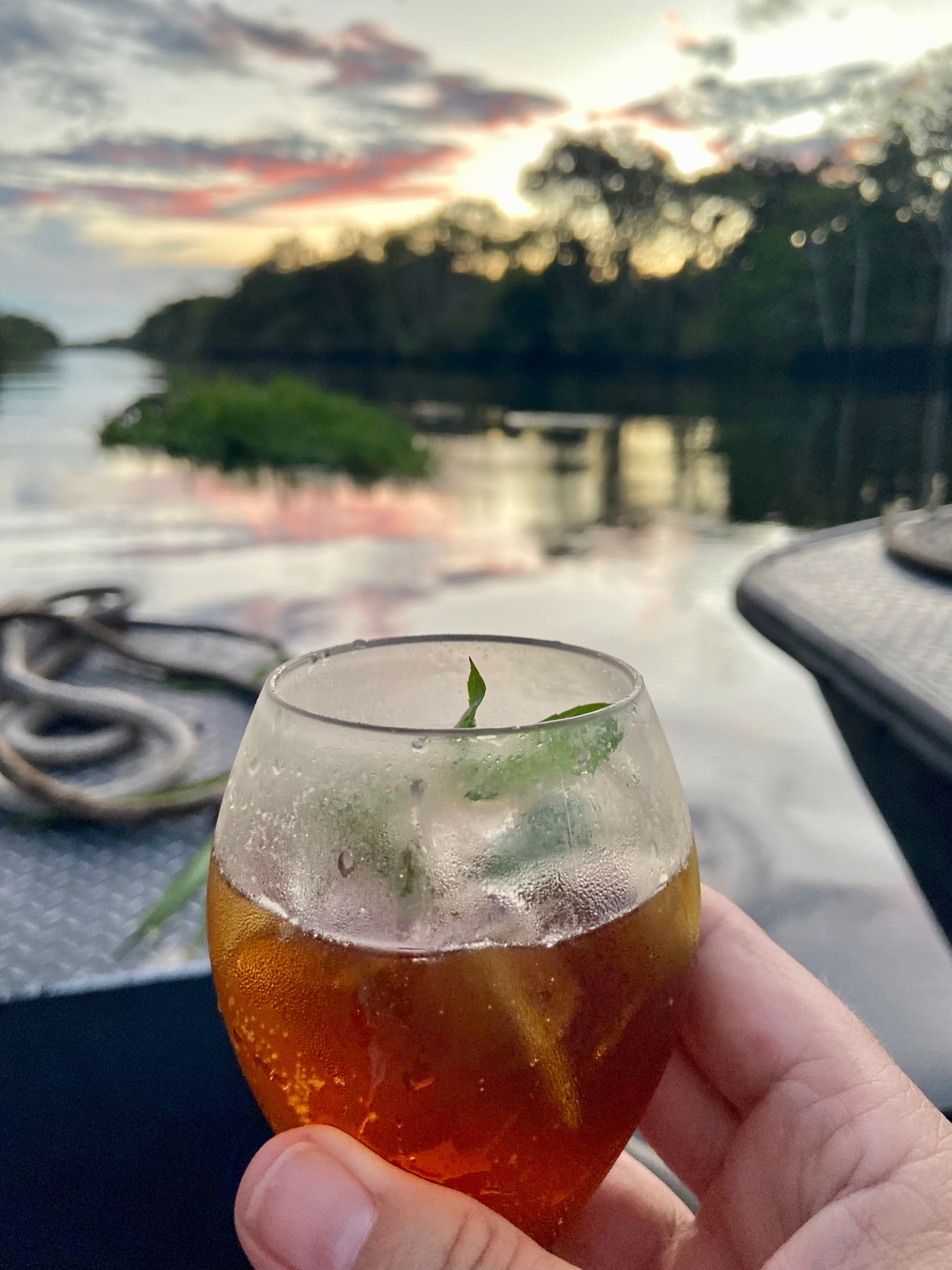
We will be out on the river after dark tonight, so Carlos met us along our route for a sunset treat. Evening cocktails were enjoyed on the river as we got to watch the colors change in the sky with the sun’s setting. It was gorgeous. The on-river cocktail hour was a surprise.
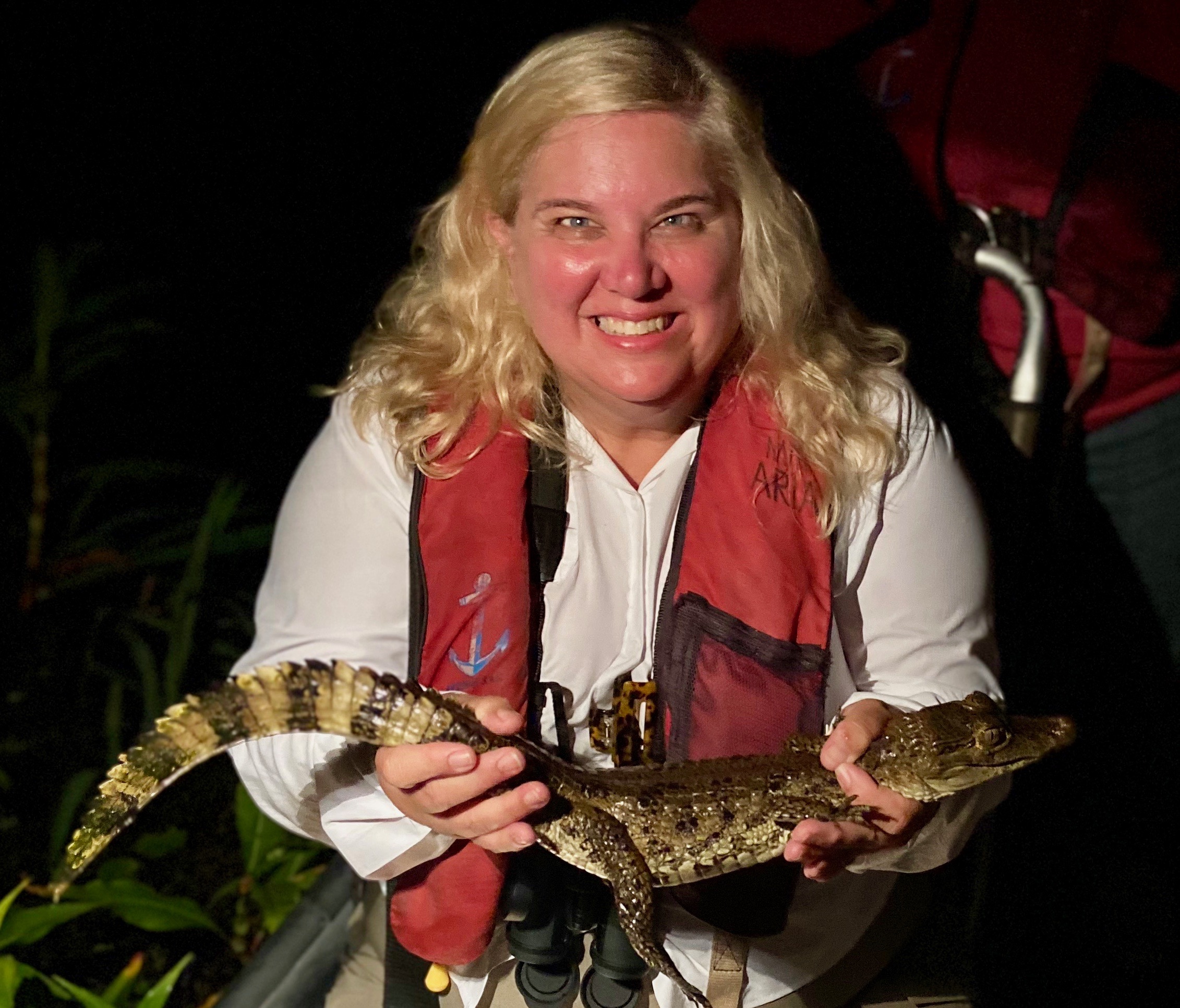
We are hunting for caimans tonight; that is why we are out after dark. Since the guides use a spot light, all kinds of creatures are attracted to the light. As we moved through the water, we wore masks and clear glasses to protect ourselves. The easiest way to spot the caimans is to look for their red eyes. Billy and Julio are the best spotters and we are lucky to be in Julio’s boat tonight. We found caimans in two patches of reeds.
One of our caiman catches. Photo by RicardoCaiman of the Amazon. Photo by RicardoA closer look at one of our caiman. Photo by Ricardo
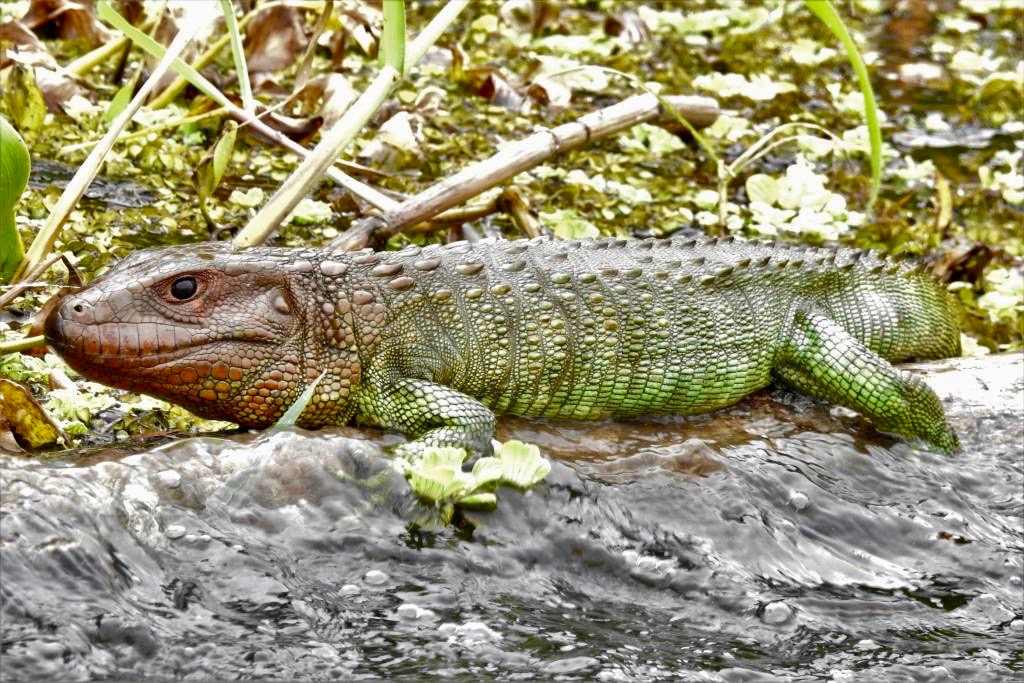
Caimans are “species of Central and South American reptiles that are related to alligators and are usually placed with them in the family Alligatoridae.” Brittanica. The name is sometimes spelled cayman, like the Caribbean island. We found one small and one medium caiman. I got to hold them both; Boris chose not to. Everything we caught was returned to the water.
Natasha and her caiman. Photo by Ricardo.
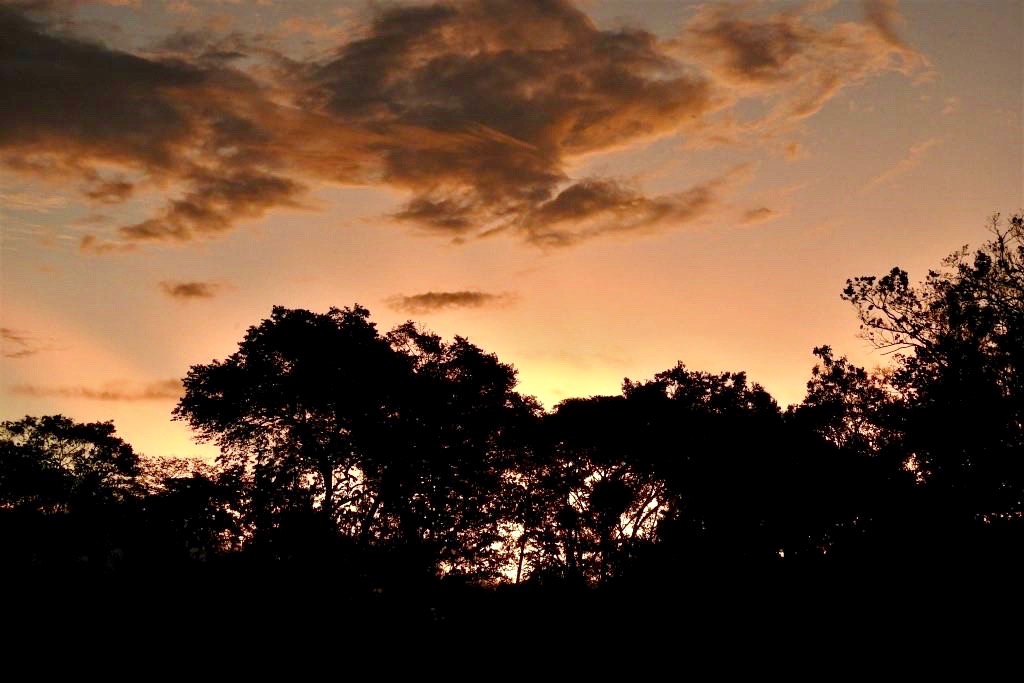
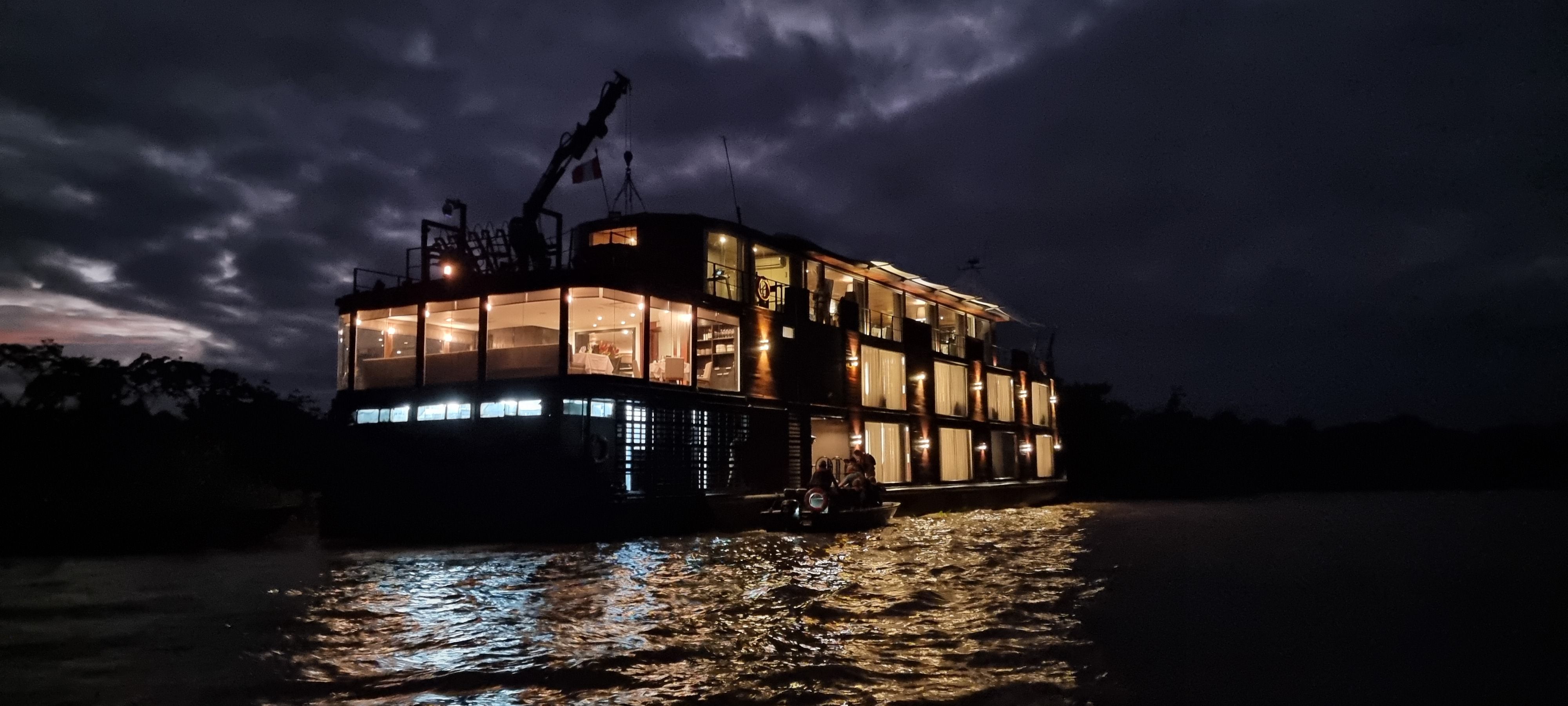
After our successful caiman hunt, we headed back to the Aria along the completely dark tributary and than the main river. Our guides moved the spot light along the shore looking for more caimans. Occasionally, they pointed out a large log in the middle of the river to our drivers. For almost the entire journey, the drivers navigated completely on memory not by sight. It was truly impressive.
Sunset on the Amazon. Photo by Ricardo.Sunset on the Amazon. Photo by Ricardo.Returning to the Aria. Photo by Ricardo.
Swimming in the Amazon River. The brave members of our party who jumped in. Photo by Ricardo
More than anything else I heard from friends when I announced I was going to Peru, and in particular cruising along the Amazon, was don’t get in the water. No hands, no feet, and certainly no one had even contemplated that we might swim in the Amazon. Defying the odds, that is exactly what I did. Our naturalists knew where to take us and once I understood the difference between the black and muddy water, I figured they knew where it was safe to jump in. But I am getting ahead of myself…
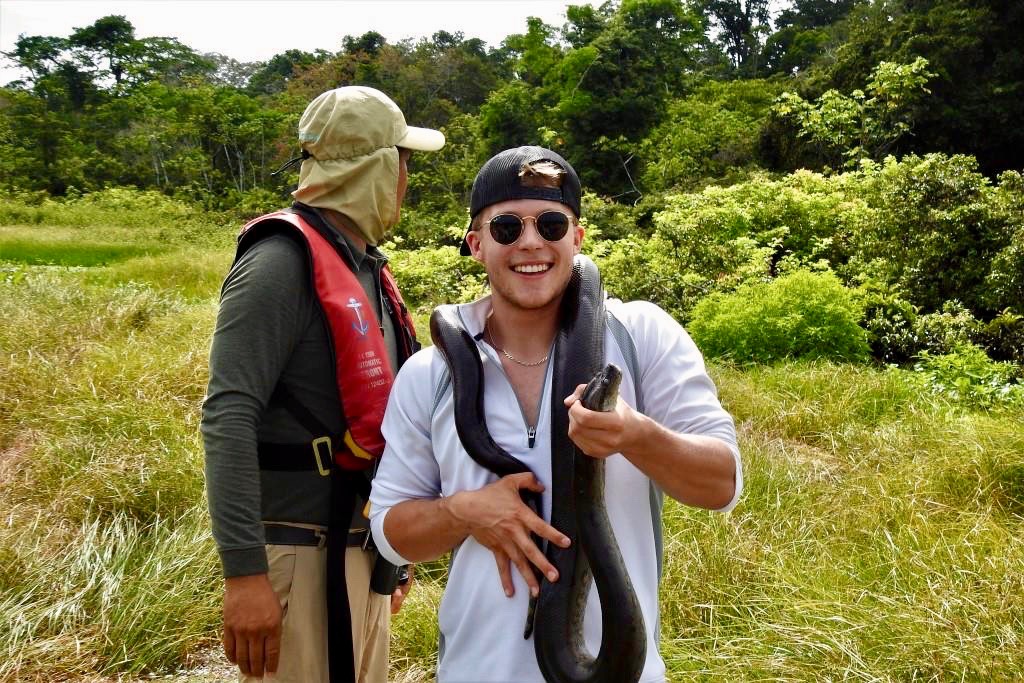
We are all a little worried about Joe who decided to “kiss” the anaconda yesterday. He is out for the count, recovering from an allergic reaction. Photo by Ricardo.
We had a little bit of a scare yesterday after the anaconda photo session. One of the young guests, not only held, but kissed the anaconda. He was not at dinner last night and not at breakfast today. He had a strong allergic reaction. There is no way to know if it is the result of “the kiss”, but it is a coincidence if it is not.
Billy was hunting in the tall grasses again today, but this time we were looking at tarantulas and spiders. We were also reminded how different the life is for many of the animals who live in the rainforest. Their life is in the trees or on the plants since their world has a water bottom. Something you would expect to see on the ground in other parts of the world, is found here attached to a tree or a plant. The ant and anteater nests are a prime example.
With his telephoto lens, Ricardo was able to get some great pictures of the sloths. This adult is high in the trees
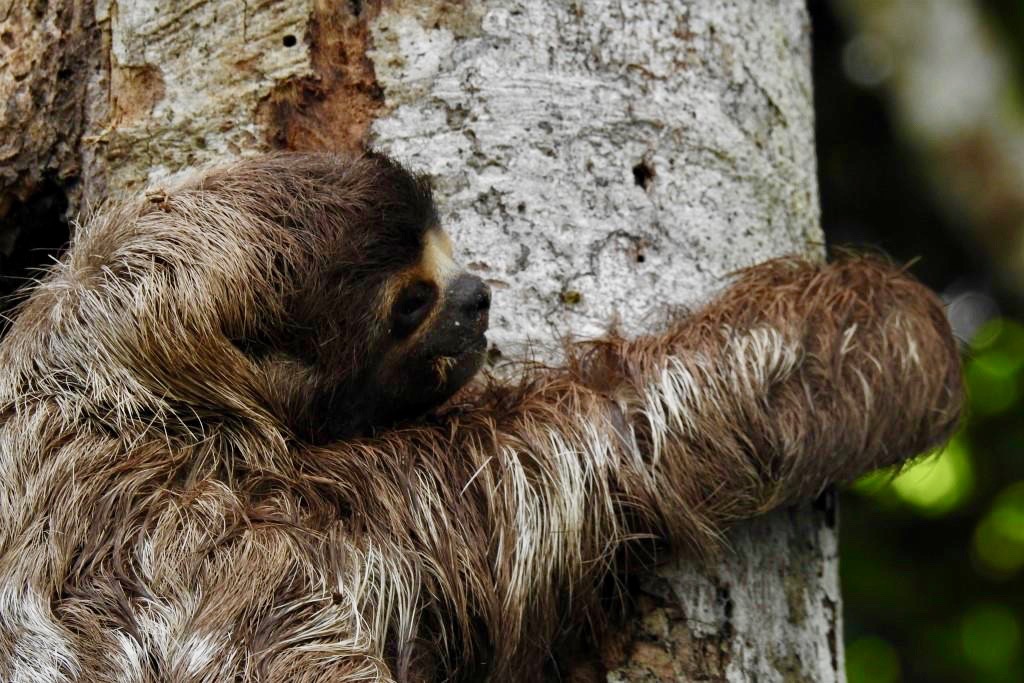
This was the morning of the sloths. While we had seen some each day, they were usually high in the trees. In other words, some distance away. Today, we got to see a juvenile of about 7 months old, up close. She was out on her own clinging to a tree. We were able to pull the boat right up next to her. But the coolest thing…she moved. It is everything you have heard. The movement is painstaking slow. I got a great video, but unfortunately this platform won’t support video. Just know that when I sent it to the animal expert in the family-Rocky-he was impressed. The movement is something you rarely get to witness up close, especially in the wild.
Up close and personal with the Juvenile sloth. Photo by Ricardo.A closeup of the juvenile sloth. Photo by Ricardo.
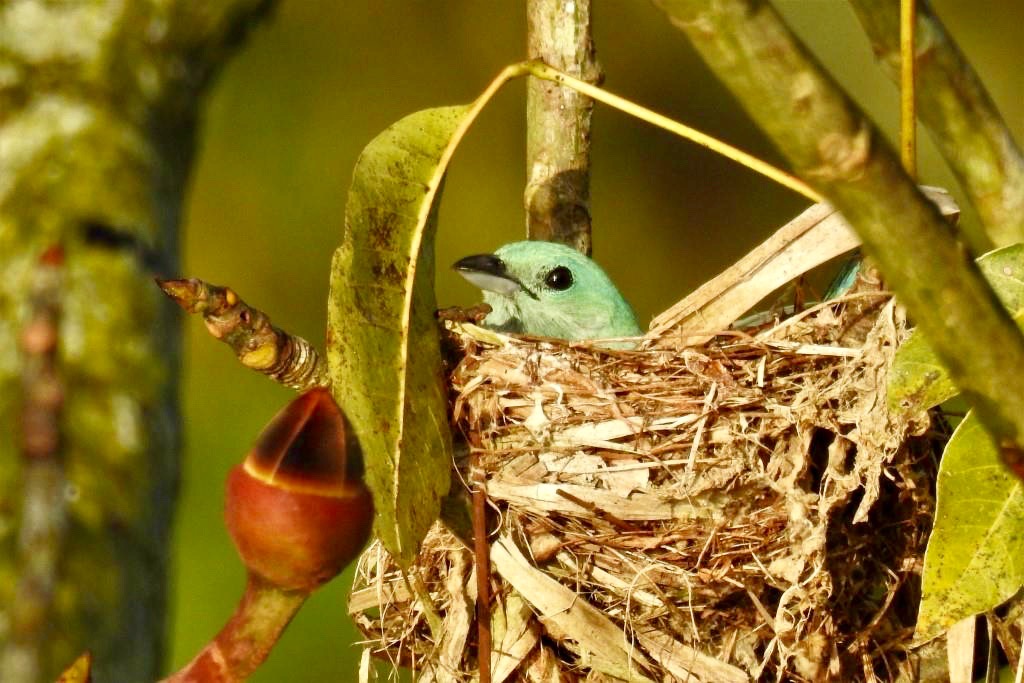
Of course, we also saw some amazing birds that we hadn’t yet seen. It was just hard to top our girl the sloth and that up close and personal experience. The Amazon Aria provides their guests with a wildlife check list and I have started to mark off the different animals we have seen. By far the wide variety of bird species exceeds all others. More than the variety, these are birds we would never see at home and they are so beautiful and colorful. Even the nests are fascinating, particularly the weaver nests that hang from the trees.
Along the Amazon River. Photo by Ricardo.Along the Amazon. Photo by Ricardo.
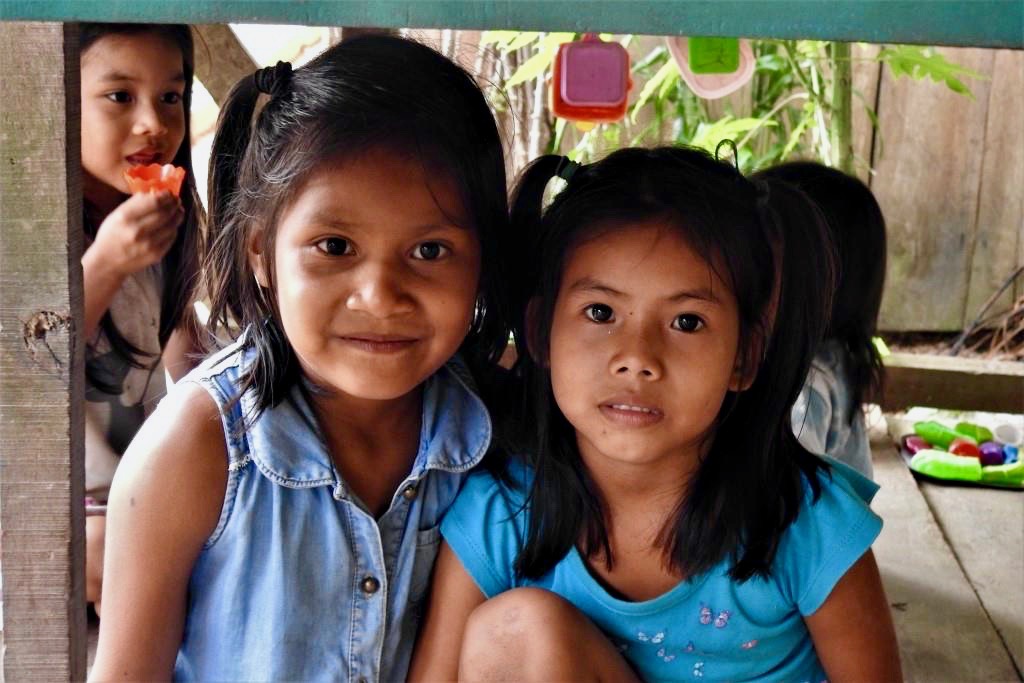
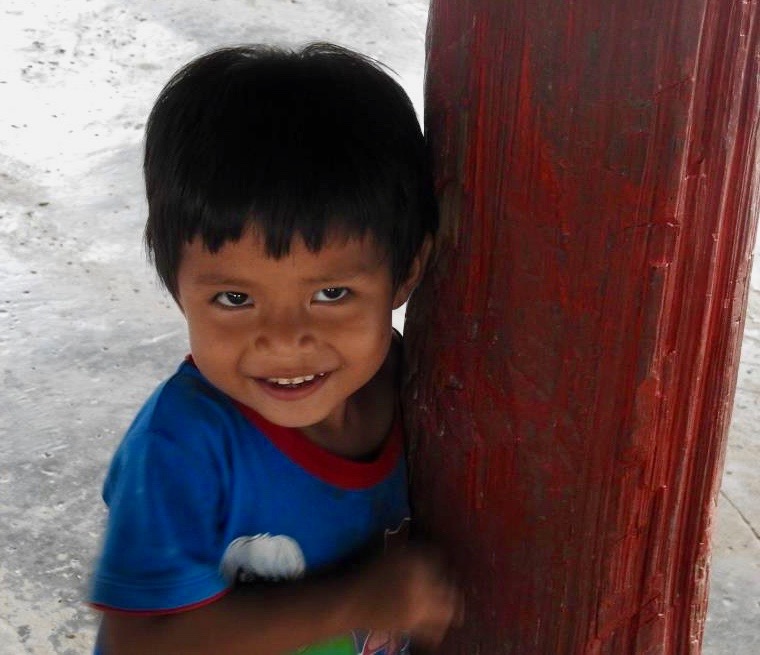
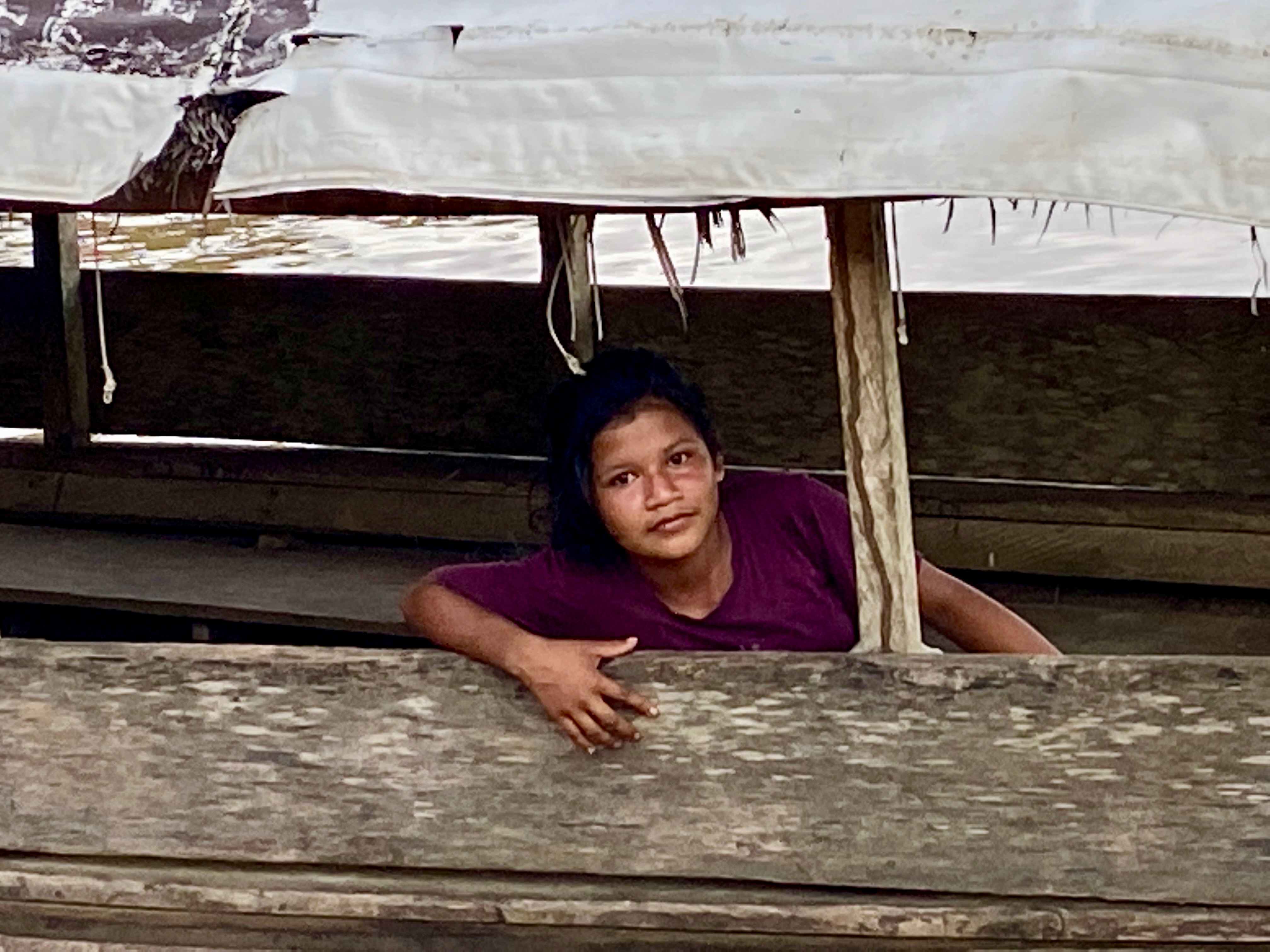
After a full morning it was back to the Aria for our break. This afternoon we are going into a village to see the weaving techniques. There will be a crafts market for us. More than anything else, it is the beautiful smiles on the faces of these remarkable children that stay with you long after your visit.
The beautiful children of the Amazon. Photo by Ricardo.A beautiful child of the Amazon. Photo by Ricardo.
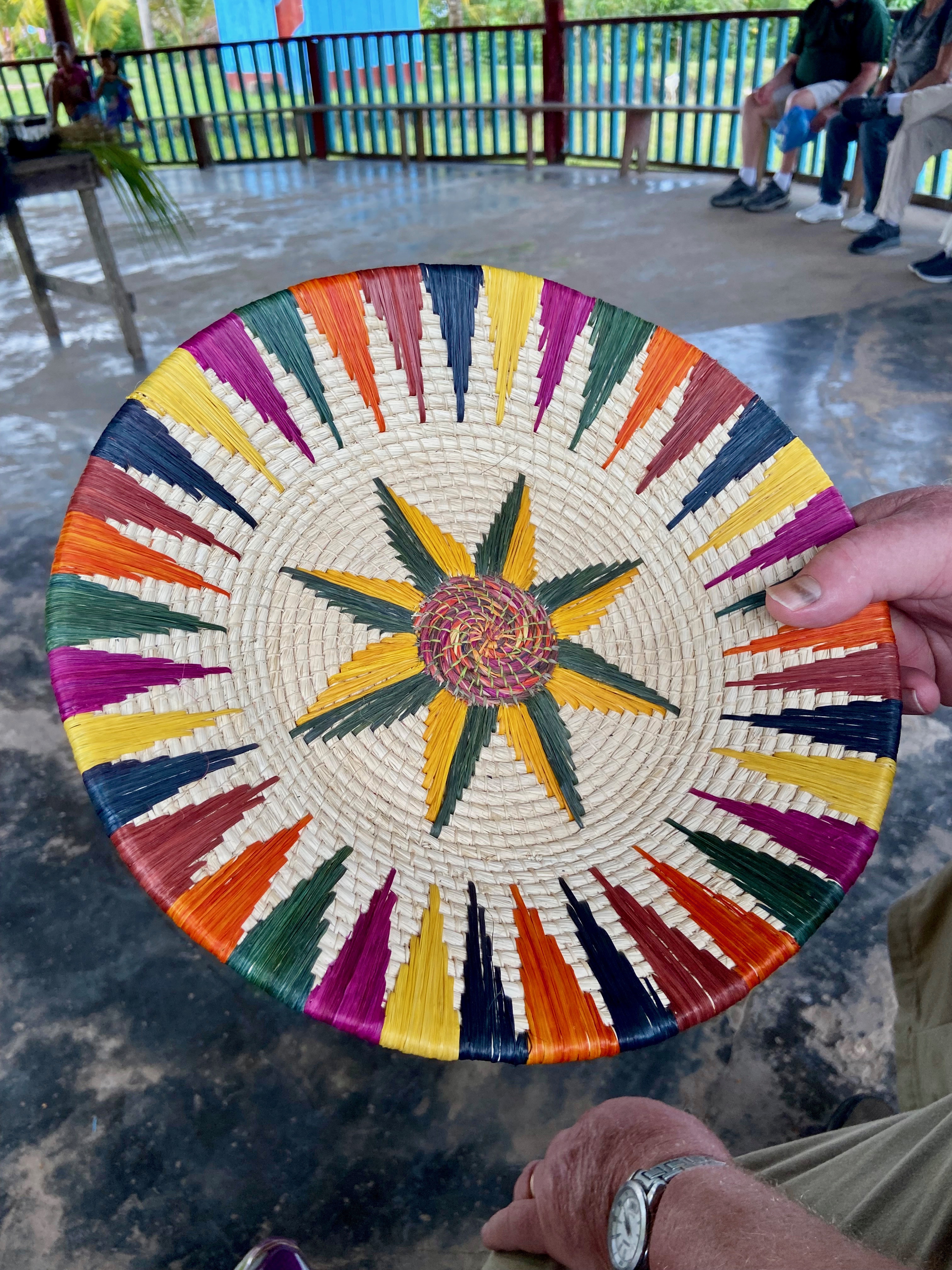
Wisely, we were asked to wear masks to protect the villagers. We saw a demonstration on how they use natural products to produce the various dyes used to color the straw that is then woven into wonderful products like baskets, napkin rings, and animal figures. There was also some wood carvings. I picked up the wonderful basket made by the young mom who did our demonstration and a figure of the wonderful Amazon Kingfisher that flies just above the surface of the water.
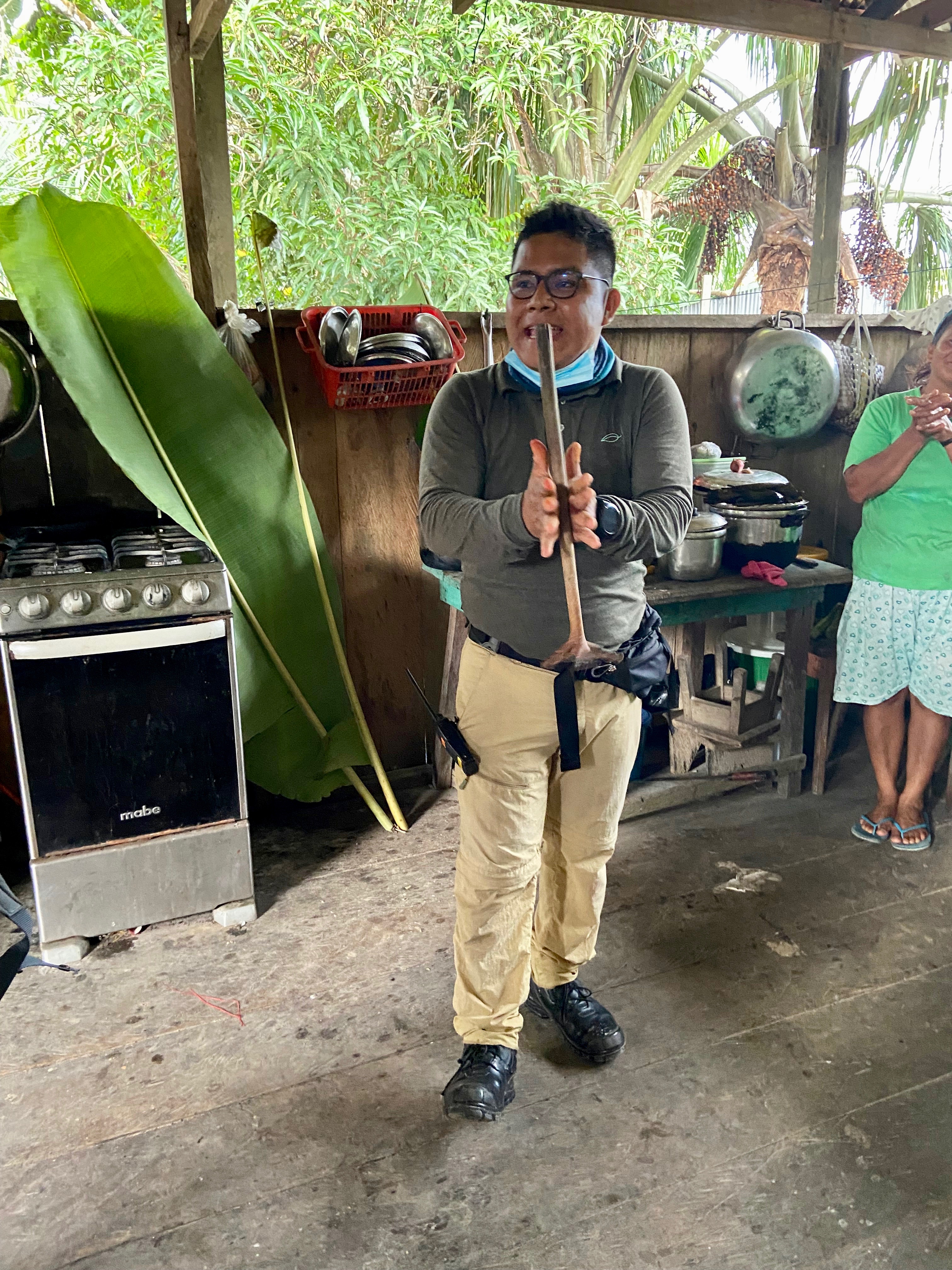
We were also invited into a family kitchen, covered, but open-aired, and were shown how food is prepared in this environment. There is an outlet ready for when electricity finally makes it to the village. Part of the infrastructure is there but not the power. Billy showed us the Amazon’s version of a blender. Only hand power needed.
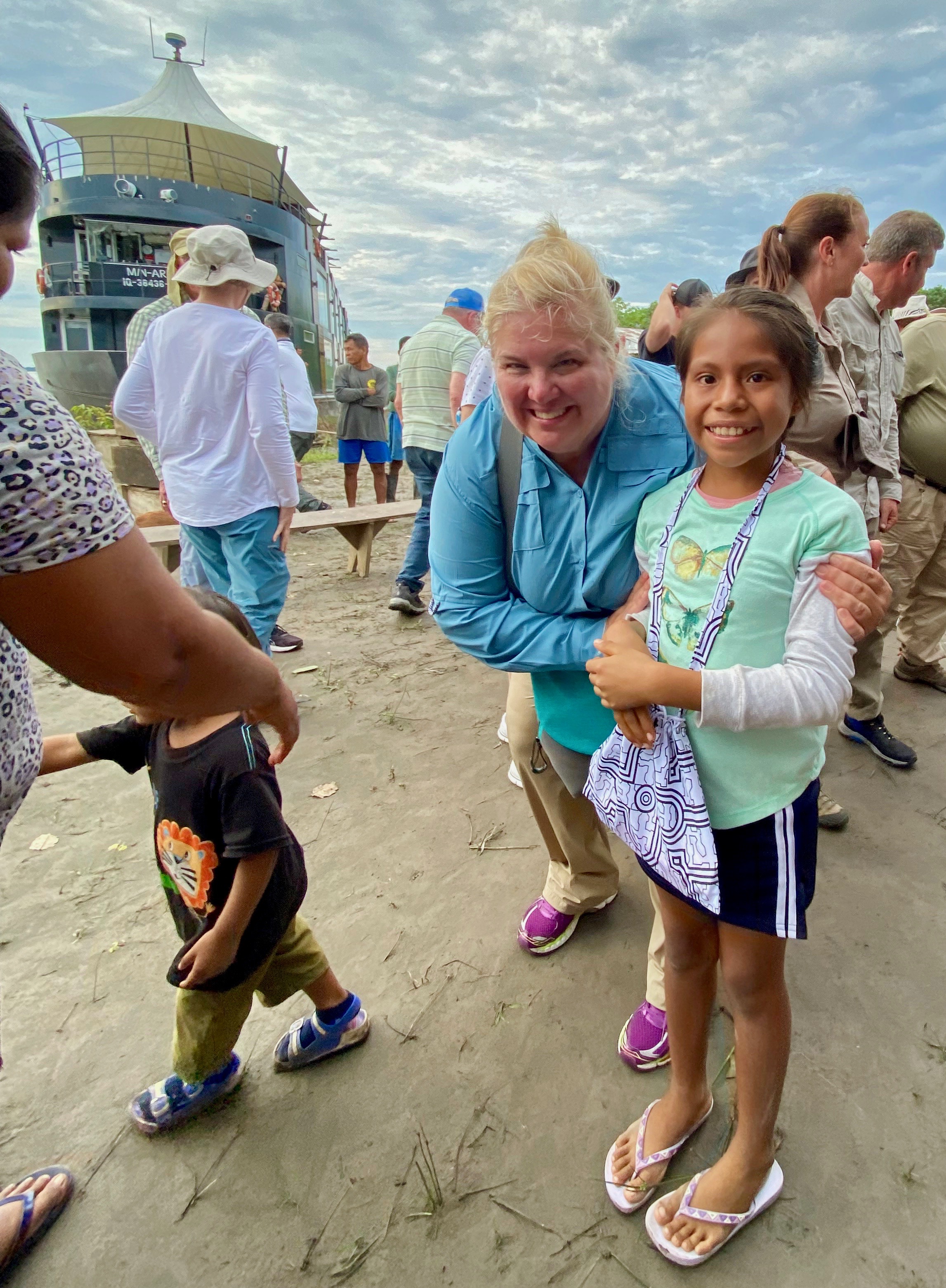
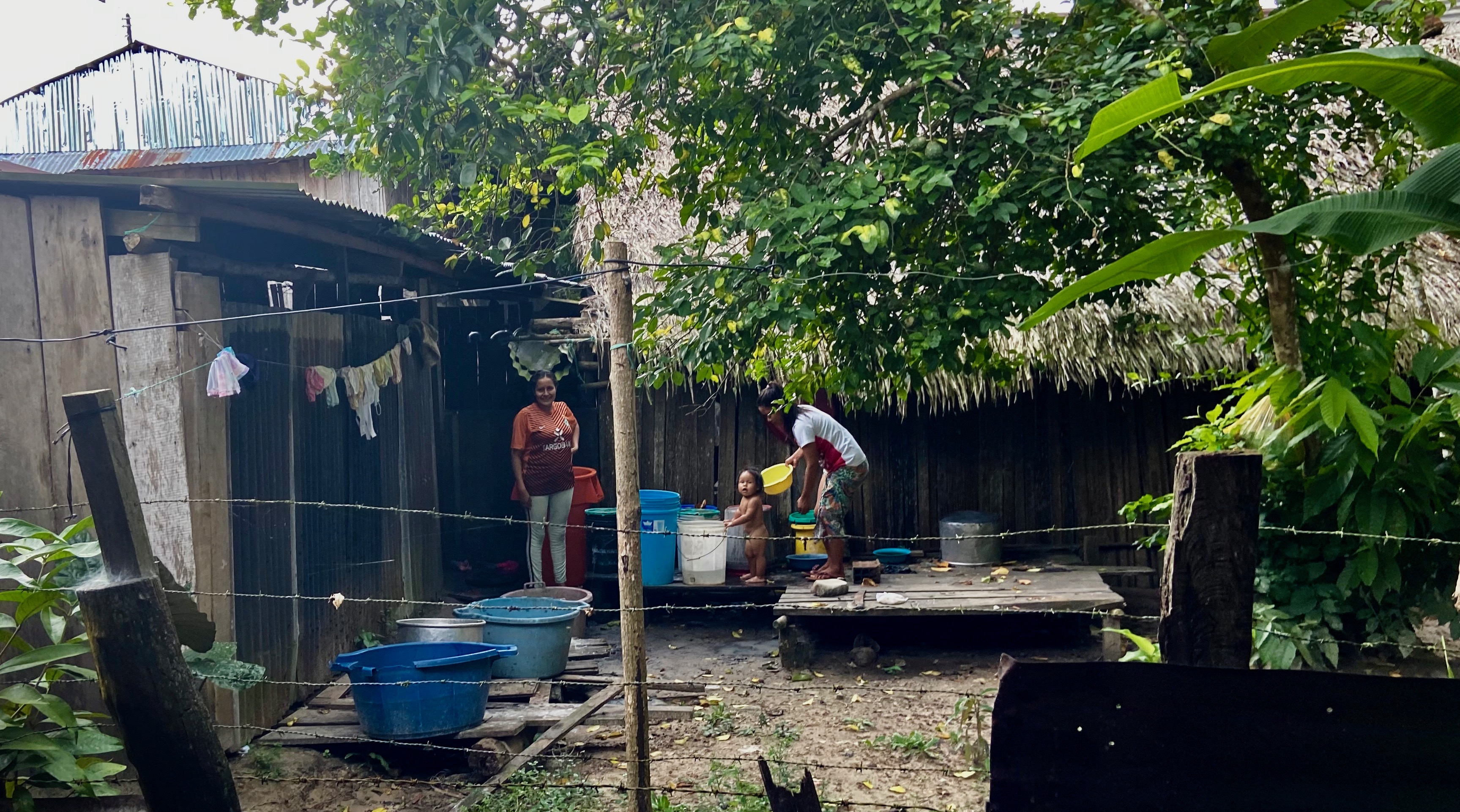
From inside the kitchen, I looked over at the patio next door and saw moms bathing their children in large plastic bins. I got a smile and a wave from the women. Everyone was very friendly. Carmen, one of our Brits joined in a pickup soccer/football game and Grace played volleyball with the children in the large open field. Football (soccer to Americans) is very popular all over South America. Most of the villages have large open areas for play.
I am happy to report that the first person I saw when I returned to the ship was Joe. He is feeling much better and anticipates rejoining our activities tomorrow.