

Today we are at our final Icelandic port, Akureyri. We have moved from the Northwest region and the Westfjords to the Northeast section of Iceland. With 20,000 residents, Akureyri is the second largest city in Iceland (but keep in mind that 80% of the country’s population lives in Reykjavik and the surrounding region). Akureyri, which sits at the base of the Eyjafjorour Fjord, is often referred to as the Capital of the North. It is one of the country’s most important ports and fishing centers.
https://guidetoiceland.is/best-of-iceland/top-things-to-do-in-akureyri
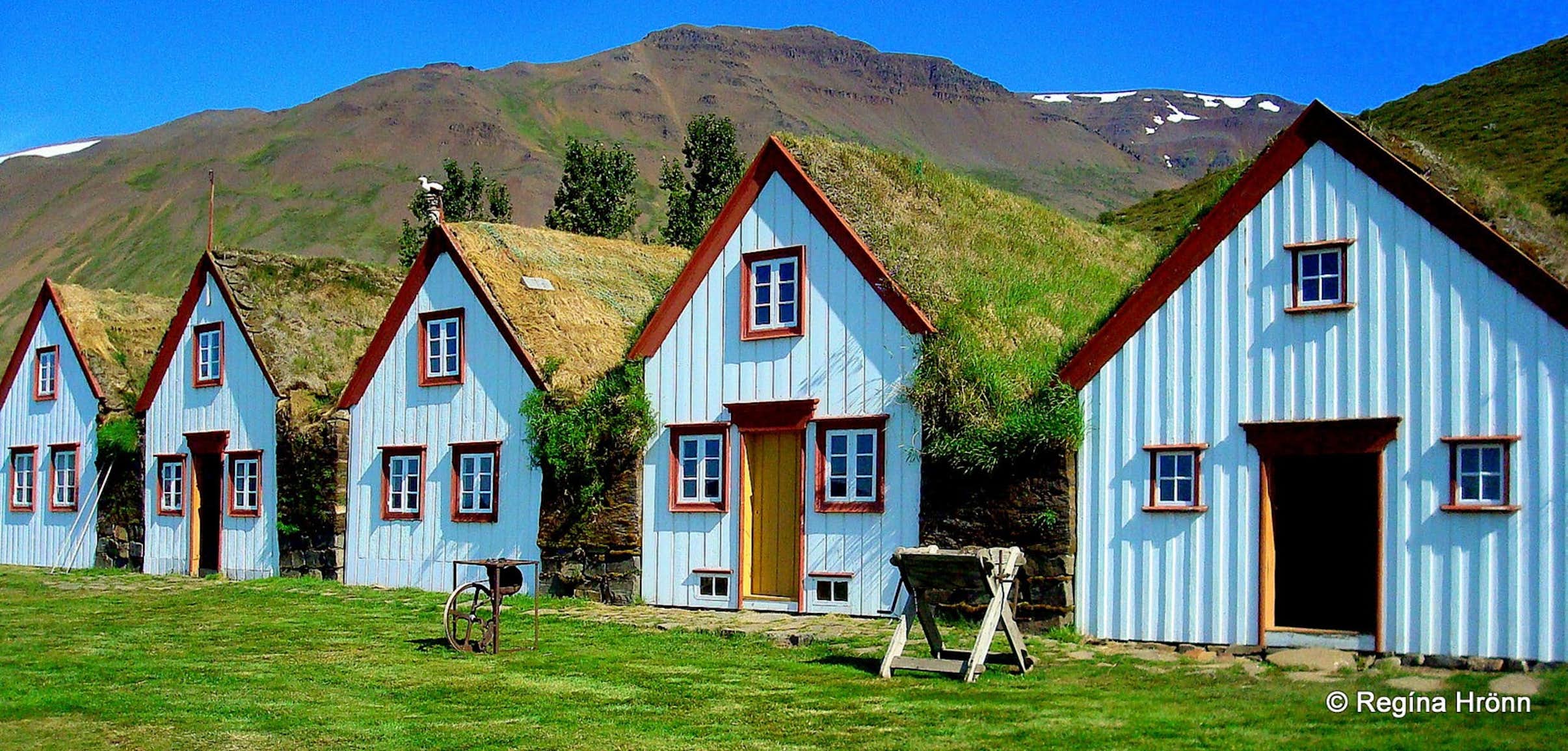
Visiting the city itself, be sure to see the government-maintained Lufas Turf Houses, that show how Icelandic citizens used to live. Other city highlights include the Akureyrarkirkja, a Lutheran church with stained glass windows depicting scenes from Icelandic history; the Akureyri Art Museum with its collection of contemporary art from Iceland; and the Arctic Botanical Gardens with specimens from across Iceland.

https://guidetoiceland.is/best-of-iceland/top-things-to-do-in-akureyri
Going just a little farther afield, you can trek through the Kjarnaskognr Forest; go horseback riding; hike Mount Sulur; visit the Dettifoss Waterfall (the largest waterfall in Iceland and the most powerful in Europe); go whale watching; or visit the Asbyrgi Canyon. I would have loved to go to Grimsey Island, the only part of Iceland that is actually above the Arctic Circle (the rest of the country sits just below it), and home to very few people, but lots of seabirds. Grimsey is a nesting place for puffins.

There are lots of nature-based excursions being offered, but honestly I didn’t seriously consider all of them because this was my opportunity to visit a Icelandic mineral bath, a cultural favorite. Having missed my chance at the Blue Lagoon by not flying into Reykjavik early, I was set on going to the Myvatn Nature Baths today. I got more than I hoped for with today’s excursion, also visiting several of the other major attractions near the capital of the north.


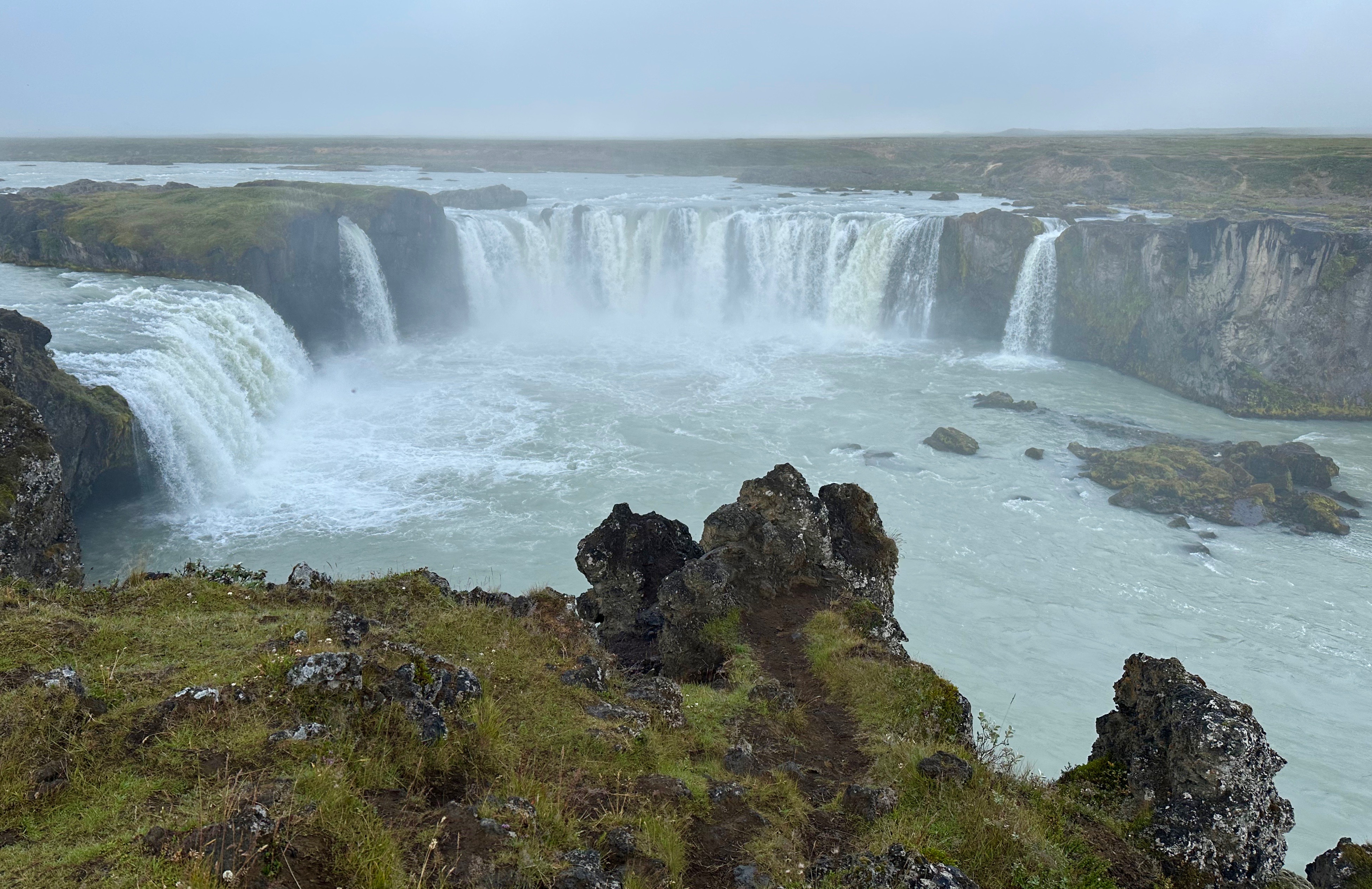
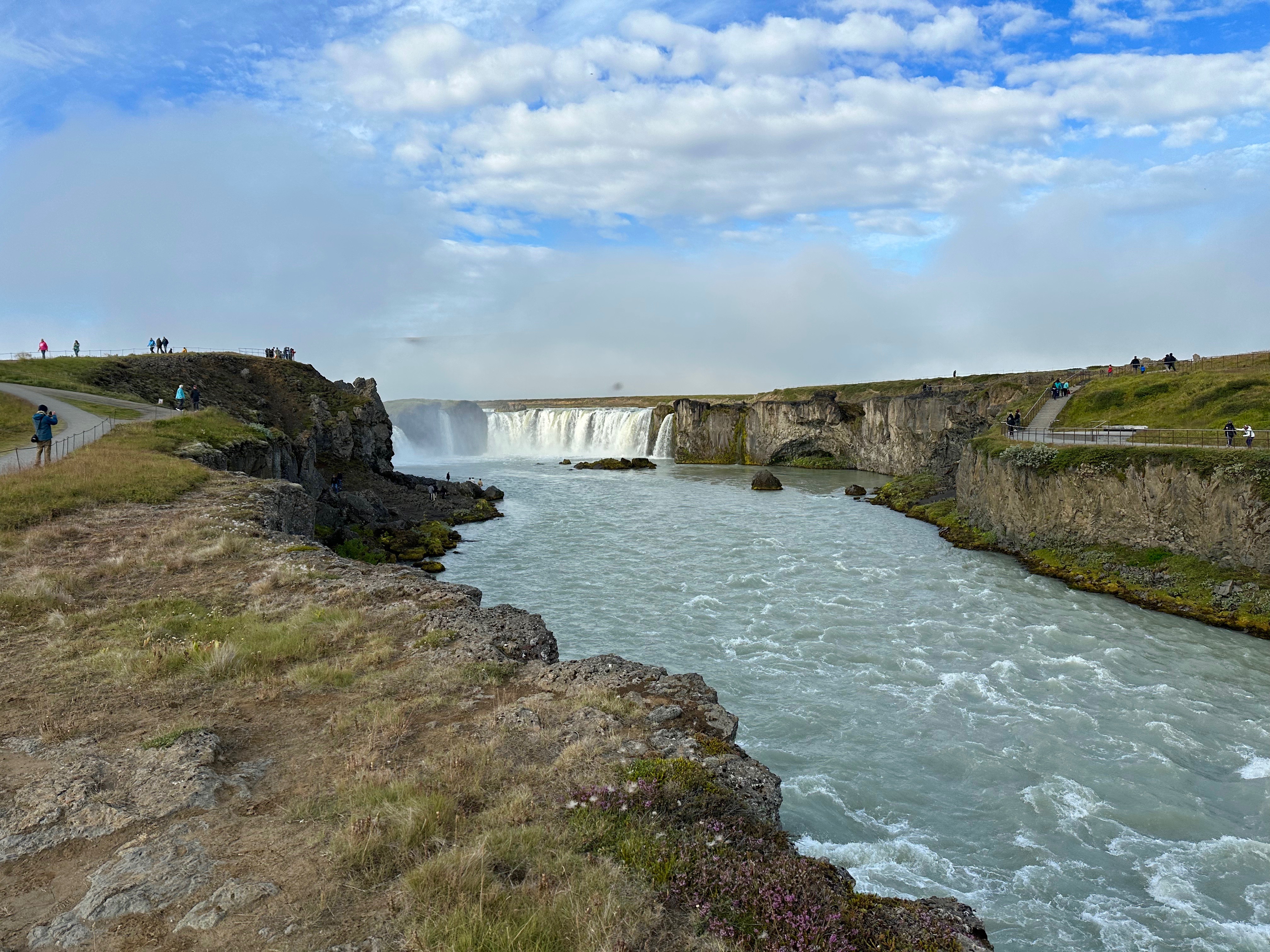
We had an early start to our day and had to meet for our tour at 7:30 am. We got off a little early under sunny skies and as we drove, we could see the fog rolling in as we were heading to our first stop. Regardless of the weather, this stop was a treasure. It wasn’t just a waterfall, it was the famous Godafoss Waterfall. Legend has it that around 1000 AD a local chieftain threw his statutes of pagan gods into these falls when he decided Icelanders should adopt Christianity. Hence the name, Waterfall of the Gods.


The falls are fed by a glacial river and the surrounding riverbank is formed by 8,000 year-old lava. The soil here is very thin, mostly dwarf shrubs, lichen, and moss. The falls are spectacular and the surrounding lava landscape is amazing. There are viewing platforms (and car parks) on both sides of the falls. There were even steps down to explore the river. We received countless warnings to avoid the lava rock, but that didn’t stop everyone.


There is a very popular cafe and souvenir shop near the parking lots for the falls. I admit I did pick up a few Icelandic souvenirs here. They obviously have visitors from all over the world, some with different cultural habits. A sign in the toilets, complete with explanatory drawings, reminded visitors to put tissue paper waste in the toilet and also that it is not appropriate to stand on the toilet seat. Apparently some visitors used to squatties prompted the need for the signs.

On our way to the next stop at the mineral baths, we drove around the Skutustadahreppur region and Lake Myvatn. Mývatn is a volcanic lake, and the area surrounding it is spectacular. There are wonderful hiking opportunities with the mud baths, geothermal pools, bird-watching (particularly for ducks), mountains, craters, and an active volcano. “Mývatn is, in fact, so beautiful that it was used as a site in the Game of Thrones franchise. Filmed in mid-winter, it was used to represent the lands North of the Wall, namely Mance Raider’s Wildling camp.” —Guide to Iceland.is
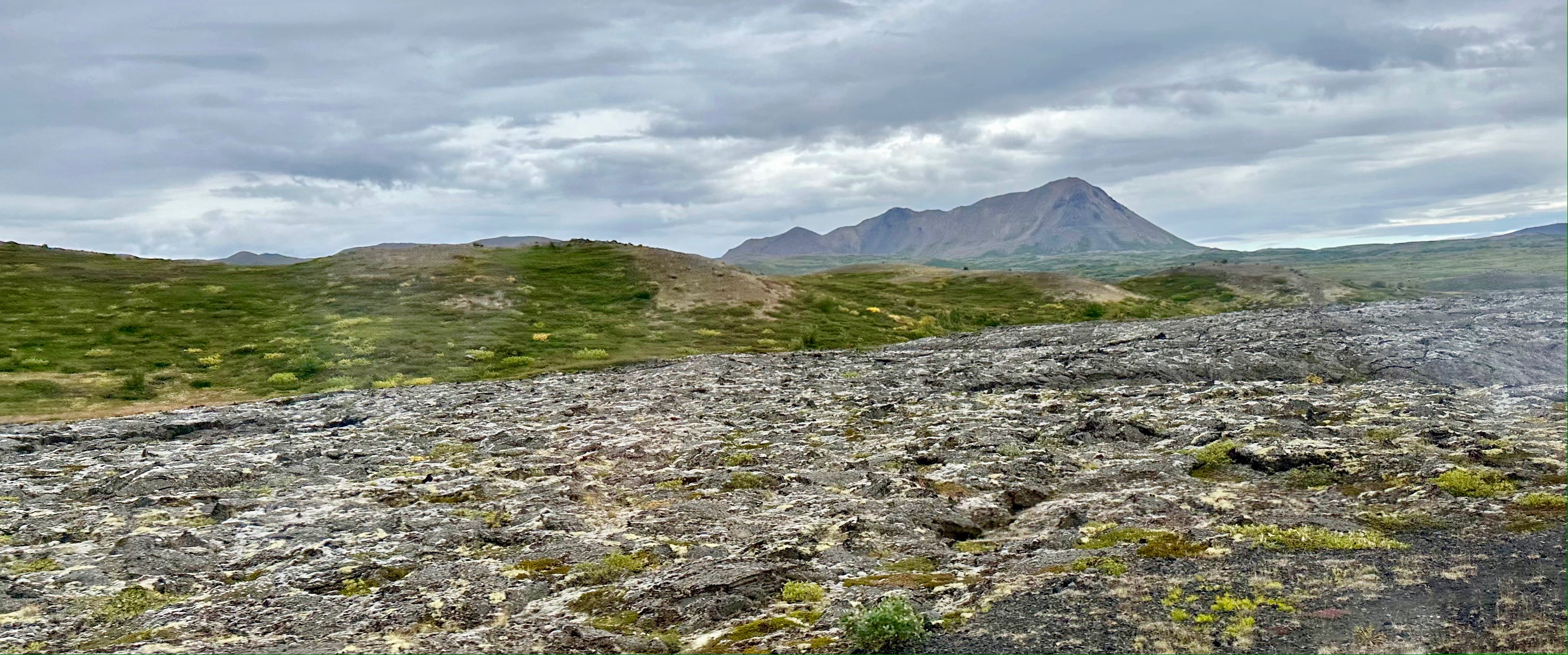

The Lava fields were incredible. We saw one that ended abruptly just before reaching a church. The Krafla Viti volcano has erupted 29 times since the 9th century. The name translates to “hell”. The most recent violent eruptions were between 1975 and 1984 when there were nine magna eruptions. Although there were no casualties, farmland was rendered useless for years.

In addition to the volcano there are these amazing craters that cause you to wonder if an asteroid hit this region at some point. There are also multiple pseudocraters. “These rootless craters form when piping hot thin-flowing molten lava flows over a wetland or boggy areas. The hot lava boils the water of the wetlands and the steam pressure causes explosions, creating clusters of pseudocraters.” —Guide to Iceland.is. The only places on the earth where pseudocraters are found are Iceland, Hawaii, and the Azore Islands. There is also one on the planet of Mars.

Next it was time for the mineral baths. We arrived at the popular Myvatn Nature Bath and got our orientation. First we had to “fight our way” through the gnats. These pesky bugs are actually the origin of the lake’s name. They do bite but they really don’t hurt; they are more annoying. I saw people with netted face masks and a special spray was recommended. You really do not need it. I got a few bites that lasted a few days but nothing painful. There were no gnats once we got inside the building and the mineral baths.
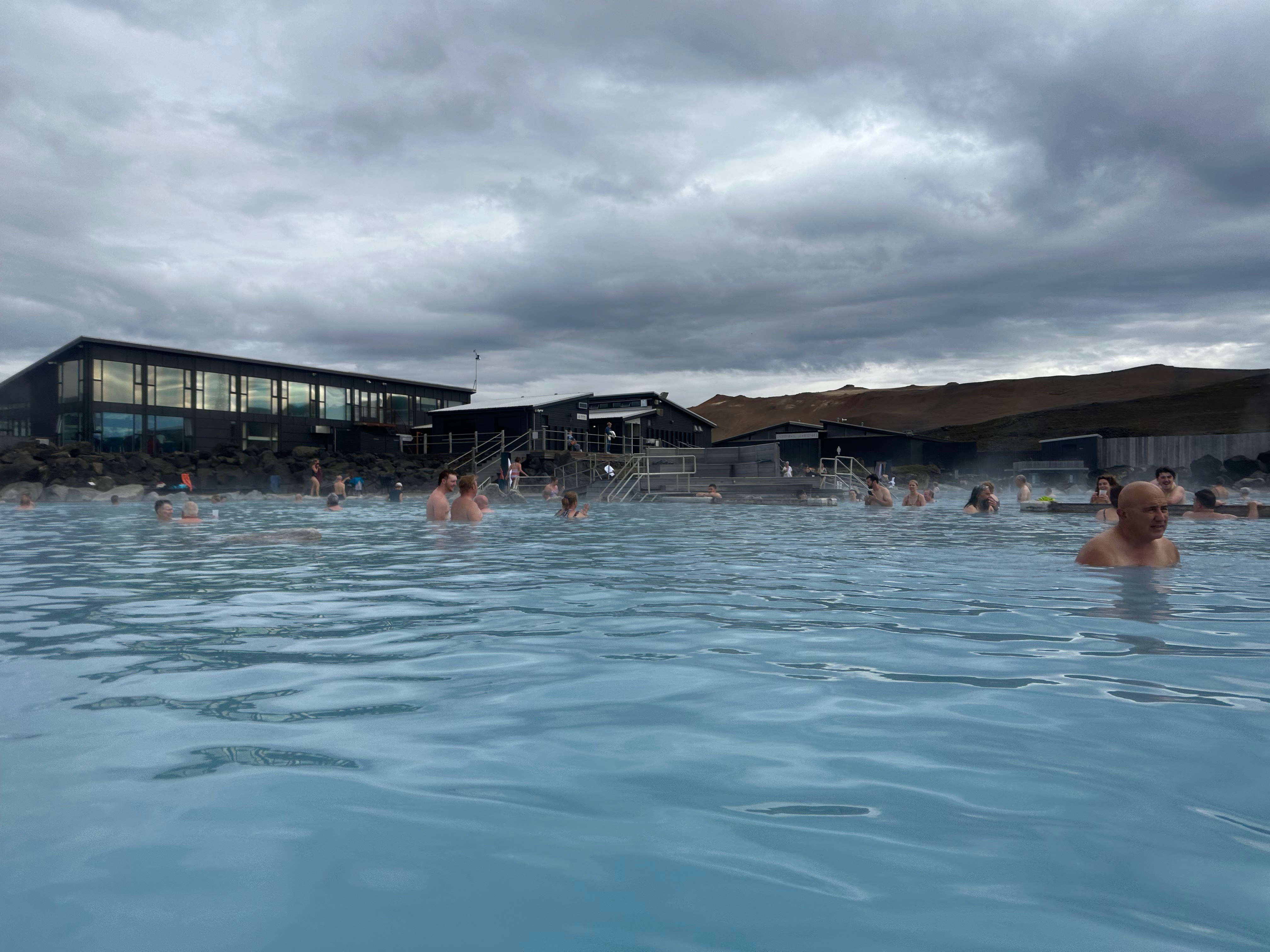
We were taken to a locker room (women and men are seperated) and given a coin that allowed us to get in and out of our locker as many times as we wanted. You are required to shower (with nice warm water I would add) without clothing-including swimsuits-under Iceland’s health regulations. We were told there would be a monitor, but I didn’t see one. Some of the younger women ignored that rule. It is a large community shower, but after the fact I noticed that there were two private ones. I put extra conditioner in my hair because the minerals will dry out your hair, but I never actually submerged my head. My swimsuit sustained no damage due to the minerals, but you do need to take off any metal jewelry.

There were easy ramps in and out of the water. The warm water felt fantastic. The minerals are said to be good for your skin and my skin sure felt wonderful when I got out. Be sure to move around the pool and determine your level of desired heat. The water is different temperatures in different parts of the pool. There are a few places to sit outside the water and relax and there is also an indoor cafe. We didn’t have that much time there so I stayed in until it was time to shower off again and get dressed.

Boris wasn’t sure about going to the baths, but he ended up really enjoying it. We met a nice Italian couple who were surprised Boris spoke the language and we visited with them for a while while enjoying the mineral baths. They were not on a cruise. I had gotten Boris and I clear underwater holders for our phones so our cell phones could be taken in the water. They were less than US$10 each on Amazon. You can see from the photo, Boris forgot to bring his from the locker room, but I used mine and it worked great; my phone worked perfectly both during and after we were in the milky mineral water. I recommend these inexpensive cases so you are able to take a few pictures while in the baths.


If we had been on our own I might have made a day of it, getting in and out of the baths and enjoying lunch there. All too soon it was time to head back. We passed a power plant where they use the steam from underground to generate energy. The Krafla Power Station was built in 1977. Clean energy from these geothermal power plants powers most of the homes and towns in northern Iceland. That is one way to benefit from an active volcano.


From the waterfalls, to the lava fields, to the craters and pseudocraters, to the mineral baths, to the volcano, to the clean energy lesson, it was quite a day spent in the land of fires and ice.


On to Greenland.
–Natasha

 travelbynatasha